
⏱ 10 Reading Time
- 01Step 1: Check the Platform’s Terms of Service Before You Generate
- 02Step 2: Confirm Your Subscription Tier Includes Commercial Rights
- 03Step 3: Verify Whether the Platform Offers IP Indemnification
- 04Step 4: Avoid Prompts That Reference Real People, Brands, or Copyrighted Characters
- 05Step 5: Add Human Creative Modifications to Strengthen Your Copyright Claim
- 06Step 6: Document Your Prompt-to-Output Workflow
- 07Step 7: Check Marketplace-Specific AI Disclosure Rules
- 08Step 8: Register Copyright Only for the Human-Authored Elements
- 09Platform Commercial Licensing Comparison
- 10What Are the Most Common Commercial Licensing Mistakes?
- 11Frequently Asked Questions
- 12Related Reading
Reviewed by the Knowara AI Tools team. This guide cross-checks the current Terms of Service for Midjourney, OpenAI (DALL-E/ChatGPT), Adobe Firefly, and Stable Diffusion, plus U.S. Copyright Office registration guidance, as of August 2026.
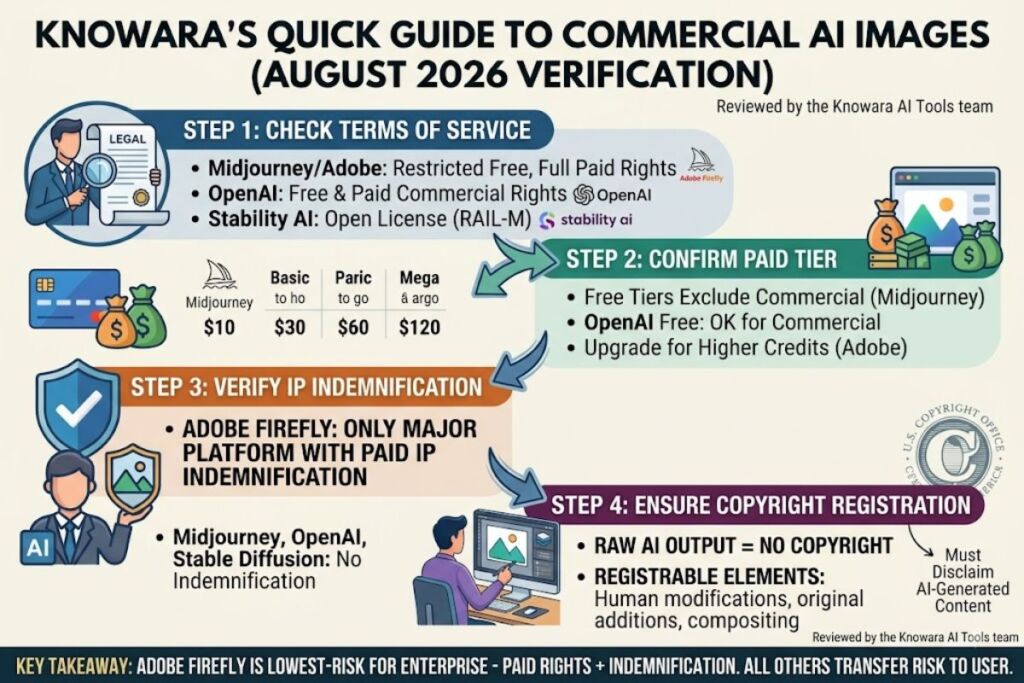
Commercial use of AI-generated images requires three checks: your subscription tier grants commercial rights, the platform’s IP indemnification status, and whether your specific output qualifies for copyright registration under U.S. Copyright Office human-authorship rules.
Step 1: Check the Platform’s Terms of Service Before You Generate
Every AI image platform sets commercial rights inside its Terms of Service, not inside the app interface, and those terms differ by subscription tier. Reading the ToS before generating avoids building a campaign around images you cannot legally sell.
Midjourney’s Terms of Service assign full commercial rights to paid subscribers and restrict free-trial users to a non-commercial CC BY-NC 4.0 license. OpenAI’s Terms of Use state: “As between you and OpenAI, and to the extent permitted by applicable law, you own all Input and Output,” which covers images generated through DALL-E and ChatGPT. Adobe’s Generative AI User Guidelines grant commercial use on paid Creative Cloud and Firefly plans, with indemnification limited to non-beta features. Stability AI licenses Stable Diffusion 1.5 and SDXL under CreativeML Open RAIL-M, which permits commercial use with no revenue cap.
Example: A freelance designer generating a client logo concept in Midjourney checks the pricing page first, not the Discord bot, because commercial rights live in the Terms of Service linked from that page — not in any in-app disclaimer.
Step 2: Confirm Your Subscription Tier Includes Commercial Rights
Free tiers on Midjourney and Stable Diffusion API access restrict or exclude commercial use, while OpenAI extends commercial rights to both free and paid ChatGPT accounts. Tier confirmation prevents a takedown or contract dispute after delivery.
Midjourney’s four paid tiers — Basic ($10/month), Standard ($30/month), Pro ($60/month), and Mega ($120/month) — all carry full commercial rights. Midjourney’s free trial does not. Companies with more than $1,000,000 in gross annual revenue must run Midjourney Pro or Mega plans to retain commercial rights at the corporate level. OpenAI’s ChatGPT Plus ($20/month), Team, and Enterprise plans all include commercial rights, and OpenAI’s terms extend that same output ownership to free-tier ChatGPT users, subject to OpenAI’s right to use free-tier inputs and outputs for model training. Adobe Firefly’s free tier caps monthly generative credits and restricts practical commercial use; Creative Cloud and Firefly Premium subscribers receive full commercial rights.
Example: An e-commerce brand generating 200 product mockups per month on Adobe Firefly’s free tier hits the monthly generative credit ceiling mid-project — upgrading to a paid Creative Cloud plan removes that ceiling and adds indemnification coverage the free tier lacks.
Step 3: Verify Whether the Platform Offers IP Indemnification
Adobe Firefly is the only major AI image platform offering IP indemnification on paid plans, meaning Adobe defends the subscriber if a third party sues over output infringement. Midjourney, OpenAI, and Stability AI carry no equivalent indemnification clause.
Adobe trains Firefly exclusively on licensed Adobe Stock content, public domain material, and openly licensed content, which lets Adobe extend indemnification to paying Creative Cloud, Firefly Premium, and Firefly for Enterprise subscribers. That indemnification covers copyright infringement claims on Firefly output outside beta features; it does not cover trademark claims, right-of-publicity claims, or output generated through third-party API wrappers built on Firefly. Midjourney and OpenAI provide no indemnification — the user bears the full legal risk of an infringement claim on any output.
Example: A marketing agency producing a national ad campaign selects Adobe Firefly over Midjourney specifically because Firefly’s indemnification transfers legal exposure to Adobe if a rights holder later claims an output infringes their copyrighted work; the same campaign built in Midjourney would leave that exposure entirely with the agency.
Step 4: Avoid Prompts That Reference Real People, Brands, or Copyrighted Characters
Prompting any platform to reproduce a named celebrity, a trademarked logo, or a copyrighted character voids commercial protection regardless of subscription tier. This restriction applies uniformly across Midjourney, OpenAI, Adobe Firefly, and Stable Diffusion.
OpenAI’s usage policies prohibit generating content that closely resembles copyrighted characters or trademarked brand elements, such as Disney characters or the Nike logo. Adobe’s Generative AI User Guidelines prohibit prompts intended to produce content that infringes IP, defames real people, or imitates a living artist’s distinctive style — violating these guidelines forfeits Firefly’s indemnification. Midjourney’s content policy applies best-effort filtering to block outputs that closely replicate training-data source material but does not indemnify the user if a filter fails to catch an infringing output.
Example: A prompt reading “superhero character in the style of Marvel Comics” risks generating a trademark-adjacent output on any platform — replacing the brand reference with a described visual style (“high-contrast comic-book linework, primary color palette”) produces a commercially safer result on all four platforms tested.
Step 5: Add Human Creative Modifications to Strengthen Your Copyright Claim
A raw, unedited AI output generally cannot be registered with the U.S. Copyright Office because it lacks the human authorship the Copyright Act requires. Editing the output in a tool like Photoshop or Illustrator, and documenting each creative decision, builds the record needed to register the human-authored elements.
The U.S. Copyright Office’s Part 2 report on Copyright and Artificial Intelligence (January 2025) concludes that human contributions to AI-generated outputs can constitute authorship, evaluated case by case. The Zarya of the Dawn decision (February 2023) refused registration for fully AI-generated illustrations while allowing copyright on the human-authored text and the human-directed arrangement of images. Thaler v. Perlmutter, decided by the D.C. Circuit in March 2025, upheld the Copyright Office’s refusal to register a work with no human author. A detailed prompt alone, without downstream editing, does not establish authorship under current Office guidance.
Example: A print-on-demand seller generates a base illustration in Midjourney, then composites it in Photoshop with original hand-drawn linework, custom typography, and a color grade the seller applied manually — the composited file, not the raw Midjourney output, becomes the registrable work.
Step 6: Document Your Prompt-to-Output Workflow
Saving prompt iterations, rejected outputs, and each editing decision creates the evidentiary record a copyright registration or an infringement defense requires. This step matters because the Copyright Office evaluates human authorship claims case by case, not by a fixed formula.
A defensible documentation file includes the original prompt text, every refinement made to that prompt, screenshots of outputs rejected before the final selection, and a list of the specific edits applied outside the AI tool. Copyright registration applications for AI-assisted works must identify and disclaim the AI-generated portions per the Copyright Office’s March 2023 registration guidance — an application that fails to disclaim AI-generated material risks cancellation, as occurred in the Théâtre D’Opéra Spatial registration dispute.
Example: A game studio generating 40 concept-art variations in Stable Diffusion before selecting one keeps a folder logging the seed values, prompt edits, and the 6 manual repaint passes applied in Krita — that folder becomes the studio’s evidence file if a registration examiner or opposing counsel later challenges authorship.
Step 7: Check Marketplace-Specific AI Disclosure Rules
Print-on-demand and stock-photo marketplaces set their own AI-content rules independent of the AI platform’s licensing terms, and those marketplace rules vary by platform. Selling a commercially licensed AI image still requires compliance with the marketplace’s separate disclosure policy.
Etsy permits AI-generated listings when the seller discloses AI use in the listing description. Amazon Merch on Demand rejects designs that read as obviously AI-generated without substantial human modification. Redbubble requires sellers to confirm AI-generation status at upload. Adobe Stock accepts AI-generated submissions in a dedicated AI content category. Getty Images does not accept AI-generated content for licensing as of this guide’s verification date.
Example: A seller uploading the same Midjourney-based t-shirt design to Etsy and Amazon Merch on Demand discloses AI use on the Etsy listing per Etsy policy, then adds a hand-illustrated border and adjusted typography to the Amazon Merch version to clear that platform’s human-modification threshold.
Step 8: Register Copyright Only for the Human-Authored Elements
A copyright application covering an AI-assisted image must disclaim the AI-generated portions and claim protection only for the human-authored elements — the selection, arrangement, and original additions. Filing without this disclaimer risks the same cancellation outcome as the Théâtre D’Opéra Spatial case.
The application’s authorship statement should specify which elements the applicant created manually — such as composition choices, added illustration, typography, or color grading — and exclude the AI-generated base image from the claim. This produces a narrower but enforceable copyright covering the applicant’s original contribution, consistent with the Copyright Office’s January 2025 Part 2 guidance.
Platform Commercial Licensing Comparison
| Platform | Commercial Rights (Paid Tier) | Free Tier Commercial Use | IP Indemnification | Revenue Threshold Trigger |
|---|---|---|---|---|
| Midjourney | Yes — Basic ($10/mo) through Mega ($120/mo) | No | No | $1,000,000/year → requires Pro or Mega |
| OpenAI (DALL-E/ChatGPT) | Yes — Plus ($20/mo), Team, Enterprise | Yes, with training-data caveat | No | None disclosed |
| Adobe Firefly | Yes — Creative Cloud, Firefly Premium | Limited (credit-capped) | Yes, non-beta features only | None disclosed |
| Stable Diffusion (SD 1.5/SDXL) | Yes — CreativeML Open RAIL-M, self-hosted | N/A (open license) | No | None (SD 1.5/SDXL) |
| Stable Diffusion 3/3.5 | Yes — Stability AI Community License | N/A | No | $1,000,000/year → requires Enterprise license |
Licensing terms verified as of August 2026. AI platform Terms of Service change without notice — confirm current terms on each platform’s official pricing and legal pages before a commercial launch.
What Are the Most Common Commercial Licensing Mistakes?
The most common mistake is treating output ownership and copyright registrability as the same thing — a platform can grant full commercial-use rights while the U.S. Copyright Office still refuses to register the unedited output. Three other recurring mistakes follow the same pattern of confusing platform permission with legal protection.
Sellers frequently assume a paid subscription alone protects against infringement claims, when only Adobe Firefly’s paid plans carry indemnification. Agencies frequently deliver client work generated on a personal free-tier account, which under Midjourney’s terms excludes commercial rights entirely regardless of what the client believes was licensed. Teams frequently skip disclaiming AI-generated content on copyright applications, which the Théâtre D’Opéra Spatial case shows leads directly to registration cancellation.
Frequently Asked Questions
Can I sell an AI-generated image without editing it?
Selling is permitted under most paid platform licenses, but the raw output generally cannot be registered for copyright under current U.S. Copyright Office guidance, leaving the file legally unprotected from copying by others.
Does a paid Midjourney subscription protect me from a copyright lawsuit?
No. Midjourney grants commercial usage rights but offers no IP indemnification, so the subscriber carries full legal exposure if an output is later found to infringe a third party’s copyright.
Which AI image platform is safest for enterprise brand campaigns?
Adobe Firefly, based on its licensed-only training data and paid-tier IP indemnification, which no other major AI image platform currently offers.
Do I need to disclose AI use when selling on Etsy or Amazon?
Etsy requires AI-use disclosure in the listing description. Amazon Merch on Demand rejects designs that read as unmodified AI output without added human creative work.
Related Reading
For broader tool selection guidance, see Knowara’s pillar guide, Best AI Coding Tools in 2026, and the following related guides in the AI Image Tools cluster: Midjourney vs Adobe Firefly (Commercial Use Compared), Best Free AI Image Generators for Commercial Projects, and Adobe Firefly Pricing Breakdown (2026).
The single decision-relevant fact: Adobe Firefly is the only major AI image generator that combines paid-tier commercial rights with IP indemnification, making it the lowest-legal-risk option for brand and enterprise commercial work, while Midjourney, OpenAI, and Stable Diffusion require the user to absorb infringement risk directly.