
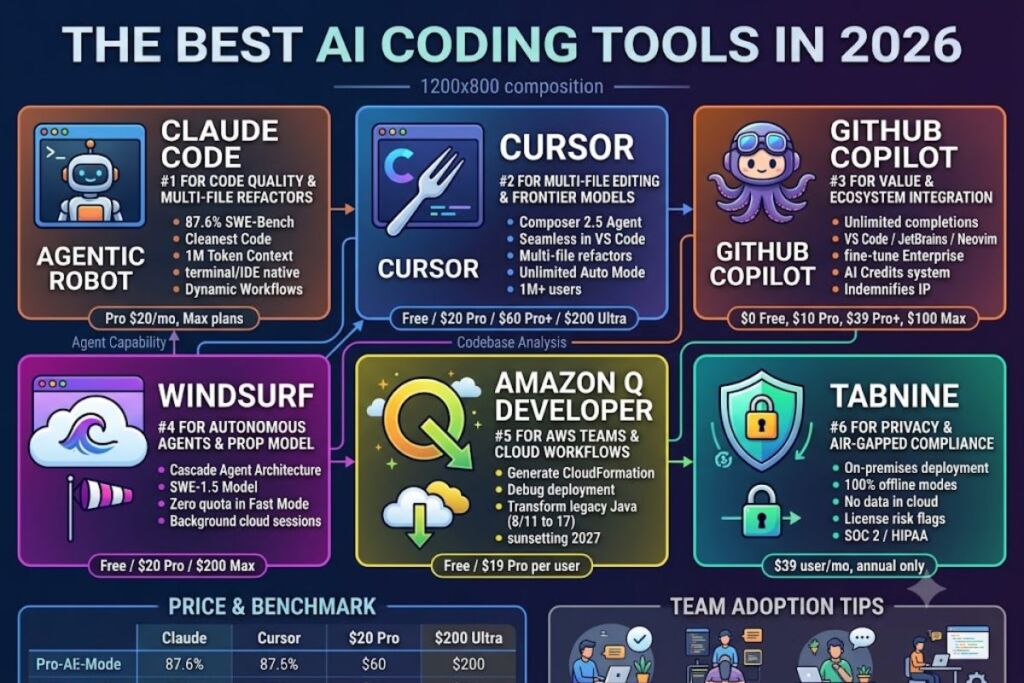
Claude Code, Cursor, and GitHub Copilot rank as the top 3 AI coding tools in 2026 based on hands-on testing across benchmark performance, pricing transparency, and multi-file editing capability. Windsurf, Amazon Q Developer, and Tabnine complete the top 6 for specialized use cases.
- 011. Why Is Claude Code One of the Best AI Coding Tools in 2026?
- 022. Why Is Cursor One of the Best AI Coding Tools for Multi-File Editing?
- 033. Why Is GitHub Copilot One of the Best AI Coding Tools for Value?
- 044. Why Is Windsurf One of the Best AI Coding Tools for Autonomous Agents?
- 055. Why Is Amazon Q Developer One of the Best AI Coding Tools for AWS Teams?
- 066. Why Is Tabnine One of the Best AI Coding Tools for Privacy and Compliance?
- 07How Do the Best AI Coding Tools Compare on Price and Benchmark Score?
- 08Who Should Use Which AI Coding Tool?
- 09Frequently Asked Questions
1. Why Is Claude Code One of the Best AI Coding Tools in 2026?
Claude Code ranks #1 because it posts the highest verified SWE-bench score among agentic coding tools and produces the cleanest code in blind developer reviews. Anthropic’s terminal-native coding agent runs on Claude Opus 4.8 and integrates directly into the command line, VS Code, and JetBrains IDEs.
- Scores 87.6% on SWE-bench Verified on the Opus 4.7 release, the highest published result among agentic coding tools that report the benchmark, according to Anthropic’s model card.
- Wins blind code-quality reviews 67% of the time against OpenAI’s Codex, per a 500-developer Reddit survey cited by independent benchmarking site CatDoes.
- Runs a 1-million-token context window on Sonnet and Opus models through the API, enabling full-repository analysis without manual chunking.
- Executes Dynamic Workflows — hundreds of parallel subagents that split a single coding task across isolated contexts, reducing overlooked edge cases by roughly 4x compared to single-agent execution.
- Prices at $20/month for Pro, $100/month for Max 5x, and $200/month for Max 20x, based on Anthropic’s official pricing page. Claude Code requires a paid plan; there is no free tier.
- Indexes and edits across your entire codebase through its agent loop (Plan → Execute → Verify), rather than generating isolated snippets.
Claude Code fits developers who prioritize code quality on multi-file refactors over raw execution speed. Solo developers billing hourly typically recover the $20 Pro subscription cost within the first week of use, based on standard freelance billing rates of $75–$150/hour.
2. Why Is Cursor One of the Best AI Coding Tools for Multi-File Editing?
Cursor ranks #2 for its Composer agent, which handles multi-file refactors and codebase-aware edits inside a VS Code fork that over 1 million paying developers now use daily. Anysphere, the company behind Cursor, incorporated in 2022 and crossed $2 billion in annualized revenue by February 2026.
- Offers 6 pricing tiers: Hobby (free), Pro ($20/month), Pro+ ($60/month), Ultra ($200/month), Business ($40/user/month), and Enterprise (custom), according to Cursor’s official pricing page.
- Runs Composer 2.5, Cursor’s first-party model released in 2026, which delivers frontier-level coding performance at a fraction of the token cost of Claude Opus or GPT-5.
- Includes unlimited Auto mode on every paid plan — Cursor selects a cost-efficient model automatically and does not draw from the monthly credit pool.
- Supports every major frontier model in one interface, including Claude, GPT, Gemini, and DeepSeek, so developers switch models per task without leaving the editor.
- Bills usage through a credit system since June 2025: Pro includes a $20/month credit pool, consumed at API token rates when a developer manually selects a premium model.
- Serves engineering teams at Stripe, OpenAI, Figma, and Adobe, according to Cursor’s customer case studies.
Cursor suits development teams that need deep codebase context and are willing to pay double GitHub Copilot’s price for Composer’s multi-file editing depth. Read the full breakdown in our <strong>Cursor AI Review</strong>.
3. Why Is GitHub Copilot One of the Best AI Coding Tools for Value?
GitHub Copilot ranks #3 as the budget and ecosystem-integration leader, pricing Individual access at $10/month while remaining the most widely adopted AI coding tool on the market. Copilot is built directly into GitHub, VS Code, Visual Studio, JetBrains IDEs, and Neovim.
- Prices at $0 (Free), $10/month (Pro), $39/month (Pro+), and $100/month (Max) for individual developers, with Business at $19/user/month and Enterprise at $39/user/month, per GitHub’s official plans page.
- Switched to GitHub AI Credits billing on June 1, 2026, replacing Premium Request Units. One credit equals $0.01, and credits meter token consumption on chat, agent mode, and code review.
- Keeps code completions and Next Edit Suggestions unlimited on every plan, including Free, regardless of the credit system change.
- Fine-tunes on private codebases at the Enterprise tier, improving suggestion relevance for proprietary APIs and internal libraries — a capability Business and Individual plans lack.
- Indemnifies IP on Business and Enterprise plans, covering legal risk from AI-generated suggestions that Cursor does not offer at any price tier.
- Reaches millions of individual users and tens of thousands of business customers, making it the most widely deployed AI developer tool by seat count, according to GitHub’s own product page.
GitHub Copilot fits professional developers who want production-quality autocomplete and chat without paying for Composer-level multi-file agents. Compare it directly in <strong>Cursor vs GitHub Copilot: Which AI Coding Tool Wins in 2026?</strong>
4. Why Is Windsurf One of the Best AI Coding Tools for Autonomous Agents?
Windsurf ranks #4 for its Cascade agent architecture, which reads the entire codebase and executes multi-step tasks through Windsurf’s proprietary SWE-1.5 model at zero additional token cost. Cognition AI, the company behind the autonomous coding agent Devin, acquired Windsurf in 2025.
- Restructured pricing on March 19, 2026, replacing monthly credit pools with daily and weekly usage quotas across Free, Pro ($20/month), Max ($200/month), Teams ($40/user/month), and Enterprise tiers.
- Runs SWE-1.5 at zero quota cost, Windsurf’s in-house Fast Agent model, while third-party frontier models like Claude Sonnet 4.6 and GPT-5.4 consume quota proportional to token usage.
- Keeps Tab autocomplete unlimited on every plan, including Free, mirroring Cursor’s approach to inline completions.
- Certifies FedRAMP High, HIPAA, and SOC 2 Type II on Enterprise deployments, a compliance depth Cursor currently lacks.
- Deploys background cloud sessions, letting Cascade continue multi-step development tasks without an open editor window.
- Matches Cursor Pro’s $20/month price point exactly as of March 2026, ending Windsurf’s prior position as the budget agentic-IDE option.
Windsurf fits developers who want an in-house model that reduces dependency on expensive third-party API tokens during long agentic sessions.
5. Why Is Amazon Q Developer One of the Best AI Coding Tools for AWS Teams?
Amazon Q Developer ranks #5 for its native AWS integration, generating CloudFormation templates and debugging deployment issues that no general-purpose competitor matches. AWS built Q Developer as the successor to CodeWhisperer, folding chat, agentic coding, and code transformation into a single AWS Console-integrated tool.
- Offers a genuinely usable Free tier: unlimited code completions, unlimited chat, and 50 agentic requests per month, more generous than GitHub Copilot’s free tier, according to AWS’s official pricing page.
- Prices Pro at $19/user/month, matching GitHub Copilot Business exactly and undercutting Cursor Business by more than half.
- Transforms legacy Java applications automatically, upgrading Java 8/11/17 codebases to newer versions — a code-modernization capability unique to Q Developer among this list.
- Indemnifies IP at the Pro tier, matching Copilot Business’s legal protection.
- Is being sunset by AWS: new signups for Q Developer IDE plugins and paid subscriptions closed on May 15, 2026, with end-of-support set for April 30, 2027, as AWS transitions customers to its successor tool, Kiro.
Amazon Q Developer suits teams already committed to AWS infrastructure who need deployment-aware suggestions today, but new adopters should evaluate Kiro directly given the confirmed sunset timeline.
6. Why Is Tabnine One of the Best AI Coding Tools for Privacy and Compliance?
Tabnine ranks #6 as the only tool on this list offering fully air-gapped, on-premises deployment, making it the default choice for regulated industries that cannot send code to a third-party cloud API. Tabnine launched in 2018, predating GitHub Copilot, and has since repositioned entirely around enterprise privacy.
- Retired its free and individual plans in 2025, moving to an enterprise-only model priced at $39/user/month for Code Assistant and $59/user/month for the Agentic Platform, both billed annually.
- Deploys in 4 modes: SaaS, VPC, on-premises, and fully air-gapped, letting regulated organizations keep code entirely off external networks.
- Flags license risk in real time, checking AI-generated completions against public GitHub repositories and warning when output resembles GPL-licensed code.
- Certifies SOC 2 Type II, ISO/IEC 27001, GDPR, and HIPAA-eligible configurations, the most complete compliance stack among the tools in this ranking.
- Trains a Protected model exclusively on permissively licensed code (MIT, Apache 2.0, BSD) for organizations that need zero copyleft-contamination risk.
- Costs more than every competitor on this list at the entry tier, and requires GPU infrastructure for self-hosted deployment, adding $1,000–$3,000/month in cloud compute for a 20-to-50-developer team.
Tabnine fits finance, healthcare, defense, and government engineering teams where code sovereignty outweighs raw model capability. For broader financial constraints, our <strong>Best Free AI Coding Tools in 2026</strong> guide covers zero-cost options this ranking excludes.
How Do the Best AI Coding Tools Compare on Price and Benchmark Score?
| Tool | Entry Price | Top Individual Tier | SWE-bench / Key Benchmark | Best For |
|---|---|---|---|---|
| Claude Code | $20/mo (Pro) | $200/mo (Max 20x) | 87.6% SWE-bench Verified | Multi-file code quality |
| Cursor | Free (Hobby) | $200/mo (Ultra) | Not publicly reported | Composer multi-file agent |
| GitHub Copilot | Free | $100/mo (Max) | Not publicly reported | Price-to-value, GitHub-native |
| Windsurf | Free | $200/mo (Max) | SWE-1.5 (proprietary, unbenchmarked externally) | Autonomous Cascade agent |
| Amazon Q Developer | Free | $19/user/mo (Pro) | Not publicly reported | AWS-native workflows |
| Tabnine | $39/user/mo | $59/user/mo (Agentic) | Not publicly reported | Air-gapped enterprise deployment |
Who Should Use Which AI Coding Tool?
Solo indie developers shipping side projects on a budget get the strongest completions-per-dollar from GitHub Copilot Pro at $10/month, with Cursor Hobby as a zero-cost multi-file testing ground.
Full-time professional developers running agentic sessions all day justify Claude Code Max ($100–$200/month) or Cursor Pro+ ($60/month) through direct time savings on complex refactors.
Enterprise teams on AWS already paying for AWS infrastructure extract the most value from Amazon Q Developer Pro at $19/user/month, provided they plan a migration path to Kiro before the April 2027 support cutoff.
Regulated industries — finance, healthcare, defense, government — require Tabnine’s air-gapped deployment regardless of the $39/user/month premium over every other tool on this list.
Teams standardizing on a single agentic IDE choose between Cursor and Windsurf based on model philosophy: Cursor for maximum frontier-model flexibility, Windsurf for a proprietary model (SWE-1.5) that reduces third-party token spend.
Frequently Asked Questions
What is the best AI coding tool overall in 2026?
Claude Code ranks #1 in this comparison based on its 87.6% SWE-bench Verified score and its 67% win rate in blind code-quality reviews against OpenAI’s Codex, tested across multi-file refactoring tasks.
Is GitHub Copilot still worth it compared to Cursor in 2026?
GitHub Copilot remains worth it for developers who want unlimited completions and GitHub-native chat at $10/month. Cursor costs double at $20/month but adds Composer’s multi-file agent editing, which Copilot’s Chat does not match.
Which AI coding tool has the best free tier?
Amazon Q Developer’s free tier includes unlimited code completions, unlimited chat, and 50 agentic requests per month — more generous than GitHub Copilot Free or Cursor Hobby, though AWS has confirmed a sunset timeline for the product.
Do any of these tools work fully offline or air-gapped?
Tabnine is the only tool in this ranking that supports fully air-gapped, on-premises deployment, at $39–$59 per user per month with annual billing required.
Claude Code, Cursor, and GitHub Copilot cover 95% of use cases in this ranking; Windsurf, Amazon Q Developer, and Tabnine exist for the autonomous-agent, AWS-native, and air-gapped-compliance edge cases specifically.
Pingback: LookX AI Review 2026: Pricing, Features & Alternatives
Pingback: How to Use Leonardo.ai Realtime Canvas (2026)
Pingback: Spacely AI Review 2026: Pricing, Features & Alternatives
Pingback: Planner 5D Review 2026: Features, Pricing, Verdict
Pingback: Kaedim Review 2026: AI 3D Game Asset Generator Tested