
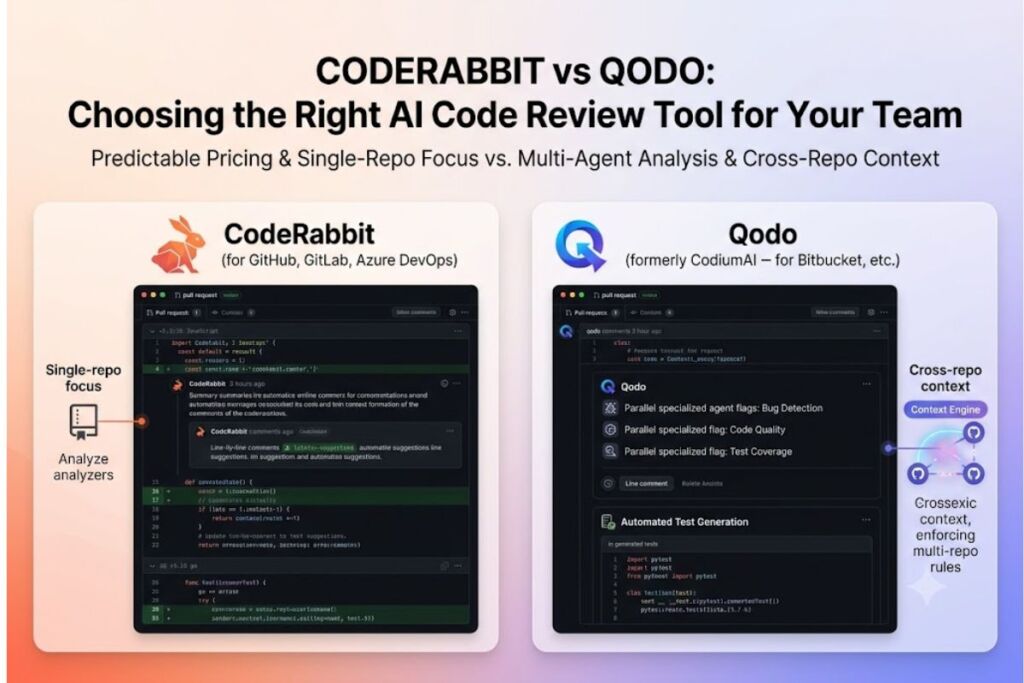
CodeRabbit wins on price, noise control, and platform breadth. Qodo wins on bug-detection depth and automated test generation. CodeRabbit’s Pro plan costs $24/user/month and posts an independently measured 44-46% bug catch rate with low false positives. Qodo’s Pro Teams plan runs on credit-based billing after a 14-day trial and claims a 60.1% F1 score using its own multi-agent benchmark. The right pick depends on whether your team optimizes for signal-to-noise ratio or maximum recall.
- 01What Are CodeRabbit and Qodo?
- 02What Are CodeRabbit’s Key Features?
- 03What Are Qodo’s Key Features?
- 04How Much Does CodeRabbit Cost?
- 05How Much Does Qodo Cost?
- 06What Are the Pros and Cons of CodeRabbit vs Qodo?
- 07How Does CodeRabbit Compare to Qodo?
- 08Who Should Use CodeRabbit vs Qodo?
- 09What Are the Best Alternatives to CodeRabbit and Qodo?
- 10Frequently Asked Questions
What Are CodeRabbit and Qodo?
CodeRabbit and Qodo are both AI-powered code review platforms that scan pull requests and post inline comments before merge, but they analyze code differently. CodeRabbit reviews the diff in front of it. Qodo cross-references the pull request against a wider codebase context, including shared modules and API contracts, through its Context Engine.
CodeRabbit, Inc. launched CodeRabbit in 2023 from Walnut Creek, California. Harjot Gill, Guritfaq Singh, and Vishu Kaur founded the company, which has raised $88 million across three funding rounds, including a Series B round in September 2025. CodeRabbit integrates with GitHub, GitLab, and Azure DevOps, and it does not support Bitbucket. The platform runs on Claude, GPT, and NVIDIA Nemotron models and combines AI analysis with 40+ bundled linters and static analysis tools, including ESLint, Ruff, golangci-lint, Clippy, RuboCop, TruffleHog, and Trivy.
Qodo, formerly known as CodiumAI, operates out of Tel Aviv, Israel, and was founded in 2022. Qodo shipped a multi-agent review architecture called Qodo 2.0 in February 2026, replacing its single-pass AI review with parallel specialized agents for bug detection, code quality, security, and test coverage. Qodo integrates with GitHub, GitLab, Bitbucket Cloud, and Azure DevOps. The company builds three connected products: Qodo Merge for PR reviews, Qodo Gen for in-IDE code and test generation inside VS Code and JetBrains, and Qodo Cover for automated regression testing.
| Attribute | CodeRabbit | Qodo |
|---|---|---|
| Founding company | CodeRabbit, Inc. | Qodo (formerly CodiumAI) |
| Headquarters | Walnut Creek, California | Tel Aviv, Israel |
| Release year | 2023 | 2022 (Qodo 2.0: February 2026) |
| Entry-level paid plan | $24/user/month (Pro, annual billing) | Credit-based, billed after 14-day trial |
| Platforms | GitHub, GitLab, Azure DevOps | GitHub, GitLab, Bitbucket Cloud, Azure DevOps |
| Key feature | Automated PR summaries with sequence diagrams and 40+ bundled linters | Multi-agent review with automated test generation |
| Independent detection rate | 44-46% (Macroscope, techsy.io benchmarks) | 60.1% F1 (Qodo’s own benchmark, different methodology) |
Source: CodeRabbit official pricing page (coderabbit.ai/pricing), Qodo official pricing page (qodo.ai/pricing), Tracxn company profile, Macroscope Code Review Benchmark.
What Are CodeRabbit’s Key Features?
CodeRabbit’s core feature set centers on automated PR summarization, line-by-line inline comments, and one-click autofix, all delivered through a semantic index of the full codebase. The platform is built for teams that want zero-configuration setup and low review noise.
- Generate a plain-English PR walkthrough with sequence diagrams the moment a pull request opens.
- Index the entire codebase semantically to detect cross-file bugs, not just changes visible in the current diff.
- Run 40+ bundled linters and SAST tools automatically based on the detected tech stack, including secret detection via TruffleHog and IaC scanning via Trivy.
- Chat with the reviewer directly in PR comments to request unit tests, JSDoc generation, or an explanation of a flagged issue.
- Apply one-click Autofix, currently in early access as of April 2026, which spawns a coding agent to commit the fix to the branch.
- Connect up to 5 MCP servers on the Pro plan and 15 on Pro Plus for extended tool access during review.
- Plan upstream work through the Issue Planner, which integrates directly with Jira and Linear before a pull request even opens.
- Score 49.2% precision in the 2026 Martian independent AI code review benchmark, ranking first among tested tools on that metric.
What Are Qodo’s Key Features?
Qodo’s differentiator is a multi-agent review architecture combined with automated test generation, so the platform doesn’t just flag a missing test, it writes one. Four specialized agents run in parallel on every pull request instead of a single generalist AI pass.
- Deploy four parallel review agents — bug detection, code quality, security analysis, and test coverage — on every PR through the Qodo 2.0 architecture shipped in February 2026.
- Generate unit tests automatically when the review agent finds an untested code path, rather than only posting a comment about the gap.
- Enforce cross-repository rules through the Living Rules System, blocking a merge when a PR violates an API contract or duplicates logic from a shared module.
- Reference shared modules and service contracts across repositories through the multi-repo Context Engine, not just files inside the current diff.
- Support BYOK (bring your own key) on Enterprise, connecting Anthropic Claude, OpenAI, Azure OpenAI, or self-hosted models.
- Retain zero code during analysis — Qodo states code is analyzed and discarded, not stored or used for model training.
- Hold SOC 2 Type II certification through independent audit for security-regulated engineering teams.
- Achieve a 60.1% F1 score and 56.7% recall rate in Qodo’s own comparative benchmark across eight AI code review tools, the highest published result in that specific test.
How Much Does CodeRabbit Cost?
CodeRabbit runs three tiers: Free at $0/month, Pro at $24/user/month billed annually ($30 monthly), and Pro Plus at $48/user/month billed annually, plus custom Enterprise pricing. Billing is per-seat and charges only developers who open pull requests, per CodeRabbit’s official pricing page.
The Free plan includes unlimited public and private repositories, PR summarization, and reviews inside the IDE and CLI, along with a 14-day trial of Pro Plus features. Pro adds unlimited reviews, linters and SAST tool support, Jira and Linear integrations, agentic chat, product analytics dashboards, customizable reports, docstring generation, 5 MCP connections, and 1 linked repository analysis. Pro Plus adds 20 custom pre-merge checks, 15 MCP connections, 10 linked repository analyses, the Issue Planner, and finishing-touch automations like unit test generation (UTG), code simplification, and merge conflict resolution. Enterprise adds custom RBAC, SSO, audit logging, API access, self-hosting, multi-org support, SLA guarantees, and EU SaaS deployment, with pricing set through direct sales contact. A separate usage-based add-on charges for unrestricted CLI and agentic-loop reviews beyond the seat-based plans.
How Much Does Qodo Cost?
Qodo does not offer a permanent free tier as of mid-2026 — every workspace starts with a 14-day free trial with unlimited usage, then moves to credit-based billing under Pro Teams or Enterprise. This is a structural difference from CodeRabbit’s per-seat model, per Qodo’s official pricing documentation.
Credits meter review activity: a smaller PR draws fewer credits, a larger or more complex review draws more, and the workspace dashboard tracks real-time balance and burn rate. Pro Teams is the standard self-serve plan and supports up to 30 users sharing one credit pool, with monthly billing, no annual self-serve option, and a configurable overage spending cap billed at the same per-credit rate as the base plan — no penalty pricing. Qodo’s own site lists a credit rate near $0.012 per credit for the Pro Team plan. Enterprise adds SSO/SAML, BYOK, single-tenant or on-premises deployment, priority support, and a dedicated customer success manager, with custom pricing. Third-party trackers report the prior Teams tier at roughly $30/user/month before the shift to credit-based billing, so teams evaluating Qodo today should confirm current credit pack pricing directly on qodo.ai/pricing before budgeting.
What Are the Pros and Cons of CodeRabbit vs Qodo?
CodeRabbit’s advantage is low noise and predictable per-seat pricing; its limitation is a lower bug catch rate on independent benchmarks. Qodo’s advantage is deeper cross-repo context and built-in test generation; its limitation is usage-based pricing that complicates budgeting and the loss of a permanent free tier.
CodeRabbit pros:
- Scores 2 false positives in a comparative benchmark against Greptile’s 11, per independent testing cited by WeavAI.
- Costs $24/user/month on Pro, undercutting Qodo’s historical $30/user/month Teams price point.
- Bundles 40+ deterministic linters alongside AI review, catching issues a pure-LLM tool misses.
- Supports Azure DevOps in addition to GitHub and GitLab.
- Reviewed more than 10 million pull requests as of mid-2026, per CodeRabbit’s own product data.
CodeRabbit cons:
- Detects roughly 44-46% of bugs in independent benchmarks from Macroscope and techsy.io, trailing Qodo’s self-reported 60.1% F1 score.
- Publishes all AI comments directly to the PR with no human-approval step before posting.
- Does not support Bitbucket.
- Stays bounded to the current repository rather than enforcing cross-repo contracts.
Qodo pros:
- Achieves the highest F1 score (60.1%) among eight tools in its own published benchmark.
- Generates unit tests automatically for untested code paths instead of only commenting on the gap.
- Enforces API contracts and shared-module rules across repositories through the Living Rules System.
- Holds SOC 2 Type II certification and offers BYOK model routing on Enterprise.
- Supports Bitbucket Cloud, which CodeRabbit does not.
Qodo cons:
- Removed its permanent free tier; new workspaces get a 14-day trial only.
- Uses credit-based billing that can produce unpredictable monthly costs, especially since premium model requests consume more credits per review.
- Benchmark claim of 60.1% F1 uses Qodo’s own dataset and methodology, not an independently replicated third-party test.
- Has no self-serve annual billing discount, unlike CodeRabbit’s 20% annual savings.
How Does CodeRabbit Compare to Qodo?
CodeRabbit fits teams that want fast, low-noise, single-repo PR review at a predictable per-seat price; Qodo fits teams that need cross-repo enforcement, test generation, and are willing to manage credit-based billing. The two tools solve different layers of the same problem.
| Factor | CodeRabbit | Qodo |
|---|---|---|
| Pricing model | Per-seat, $24-$48/user/month | Credit-based, billed after 14-day trial |
| Bug detection (independent) | 44-46% | Not independently tested; 60.1% F1 self-reported |
| False positive rate | Low (2 in comparative test) | Not independently published |
| Test generation | Comment-only, describes what to test | Generates the unit test automatically |
| Cross-repo enforcement | No — bounded to current repository | Yes — Living Rules System blocks merges on rule violations |
| Free tier | Yes, unlimited repos, $0/month | No permanent free tier as of mid-2026 |
| Bitbucket support | No | Yes (Bitbucket Cloud) |
| Human approval before posting | No — comments post automatically | Governed through Living Rules configuration |
Teams that already run a full comparison across the AI code review category can cross-reference this data against the broader Best AI Coding Tools in 2026 roundup for how both tools rank against Greptile, Cursor BugBot, and GitHub Copilot Code Review.
Who Should Use CodeRabbit vs Qodo?
Solo developers, GitHub-first startups, and teams prioritizing low review noise fit CodeRabbit; mid-size to enterprise engineering orgs enforcing cross-repo standards fit Qodo. Team size, platform, and risk tolerance for missed bugs decide the split.
- Solo indie developers and small GitHub teams: CodeRabbit’s Free plan covers unlimited public and private repos at $0/month with no seat limit friction.
- Startups on a fixed per-seat budget: CodeRabbit Pro at $24/user/month (annual) delivers predictable costs without credit-tracking overhead.
- Enterprise teams enforcing API contracts across services: Qodo’s Living Rules System and multi-repo Context Engine catch contract violations CodeRabbit’s single-repo scope misses.
- Teams that want tests written, not just requested: Qodo’s automated test generation fits QA-constrained teams directly.
- Regulated industries needing SOC 2 Type II and BYOK model control: Qodo Enterprise addresses both requirements natively.
- Teams on Bitbucket Cloud: Qodo supports Bitbucket; CodeRabbit does not.
- Azure DevOps shops that also want bundled linters: CodeRabbit covers both requirements in one tool.
What Are the Best Alternatives to CodeRabbit and Qodo?
Greptile, Cursor BugBot, and GitHub Copilot Code Review are the three most-cited alternatives when CodeRabbit or Qodo don’t fit a team’s constraints. Each trades bug-detection depth, cost, or platform breadth differently.
- Greptile indexes the full codebase for deep cross-file context and reports the highest published catch rate in some benchmarks, priced at $30/developer/month with higher reported false-positive rates than CodeRabbit. Read the full Greptile AI Code Review Tool review.
- Cursor BugBot works best for teams already paying for the Cursor IDE, at $40/seat/month, with a highly selective commenting style that minimizes low-value flags.
- GitHub Copilot Code Review bundles review into the broader Copilot subscription starting at $19/user/month on Business, making it the cheapest option for teams that already pay for Copilot but capping review volume through a shared premium-request pool.
Frequently Asked Questions
Is CodeRabbit cheaper than Qodo?
Yes. CodeRabbit’s Pro plan costs $24/user/month on annual billing, a fixed per-seat rate. Qodo runs on credit-based billing after a 14-day trial, so its effective monthly cost varies with review volume and model tier used.
Does CodeRabbit or Qodo catch more bugs?
Independent benchmarks from Macroscope and techsy.io measure CodeRabbit’s detection rate at 44-46%. Qodo reports a 60.1% F1 score using its own benchmark and methodology, which has not been independently replicated on the same dataset as CodeRabbit’s scores.
Which tool supports Bitbucket?
Qodo supports Bitbucket Cloud. CodeRabbit does not support Bitbucket in any form as of mid-2026.
Can CodeRabbit or Qodo write unit tests automatically?
Qodo generates unit tests automatically when its review agent finds an untested code path. CodeRabbit’s UTG (unit test generation) feature is limited to the Pro Plus and Enterprise tiers and posts as a finishing-touch automation rather than the default Pro-tier behavior.
Does Qodo still have a free plan?
No. As of mid-2026, Qodo replaced its permanent free Developer tier with a universal 14-day free trial, after which every workspace moves to credit-based Pro Teams or Enterprise billing.