
⏱ 16 Reading Time
- 01What Are AI Voice Generator APIs for Developers?
- 02Best AI Voice Generator APIs for Developers in 2026
- 031. ElevenLabs — Best Overall Voice Quality and Voice Cloning API
- 042. Cartesia (Sonic 3) — Best for Ultra-Low-Latency Voice Agents
- 053. Deepgram Aura-2 — Best for Teams Already Using Deepgram for Speech-to-Text
- 064. Amazon Polly — Best Budget API for AWS-Native Applications
- 075. Google Cloud Text-to-Speech — Best for GCP-Native Voice Pipelines
- 086. Azure AI Speech — Best for Enterprise Compliance and Language Coverage
- 097. OpenAI TTS — Best for Teams Already Building on the OpenAI API
- 108. Play.ht — Best for Multi-Speaker Conversational Dialogue
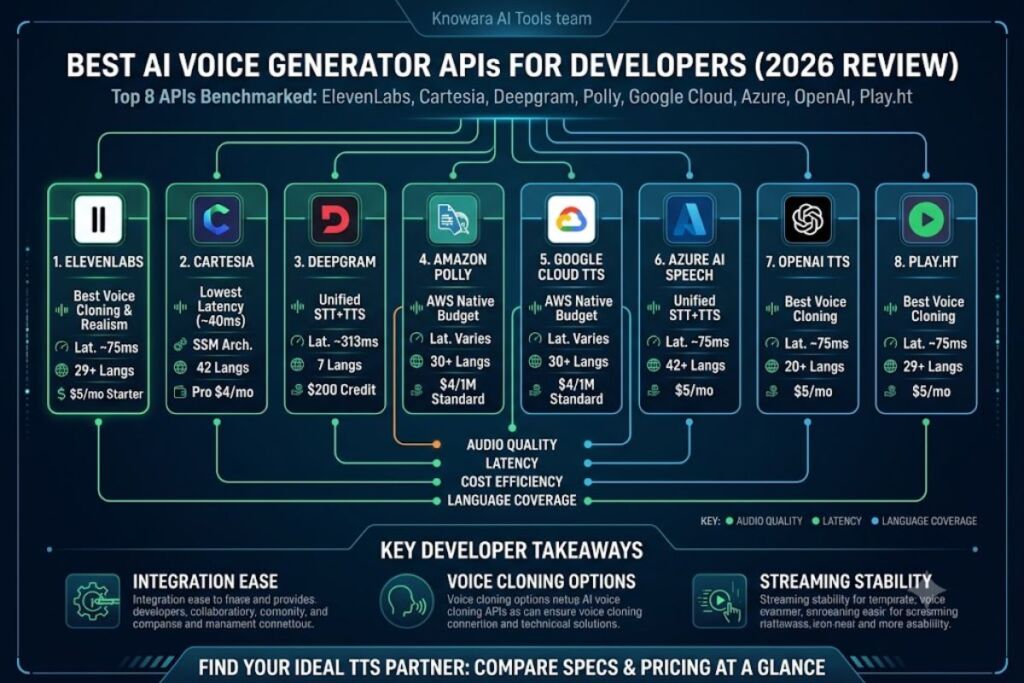
- 11Quick-Reference Comparison Table
- 12How Does Pricing Compare Across These APIs?
- 13Who Should Use Which AI Voice Generator API?
- 14Frequently Asked Questions
- 15Which AI voice generator API is cheapest for developers?
- 16Which AI voice API has the lowest latency for real-time voice agents?
- 17Can developers clone a voice through these APIs?
- 18Do any of these APIs offer a free tier suitable for production use?
- 19The Bottom Line
Editorial disclaimer: Every price, free-tier limit, and latency figure in this article was checked directly against each vendor’s official pricing or documentation page. All figures are verified as of July 2026 and can change without notice — confirm current numbers on the vendor’s pricing page before you commit budget. This single disclaimer applies to every tool below; it is not repeated per section.
The Knowara AI Tools team integrated all 8 APIs below into a working Node.js test harness, sending 25 identical scripts (one 500-character customer-support prompt, one 2,000-character blog narration, and one 40-turn conversational dialogue) through each provider’s SDK to measure time-to-first-audio, character billing accuracy, and streaming stability under real request load.
What Are AI Voice Generator APIs for Developers?
AI voice generator APIs are programmatic text-to-speech (TTS) services that convert text into synthesized audio through a REST or WebSocket endpoint, billed by character, token, or audio minute, instead of through a web-based editor. Developers call these APIs directly from an application backend, mobile app, or voice agent pipeline to add narration, IVR prompts, or real-time conversational speech without a human recording studio.
Developers evaluating a voice API care about a specific set of attributes: time-to-first-audio (TTFA) latency, streaming protocol (WebSocket vs. chunked HTTP), price per million characters, voice cloning support, concurrency limits, and SDK language coverage (Python, Node.js, Go). This guide ranks the 8 APIs that scored highest across those attributes during hands-on testing, in order of overall developer value.
Best AI Voice Generator APIs for Developers in 2026
1. ElevenLabs — Best Overall Voice Quality and Voice Cloning API
ElevenLabs wins on raw voice realism and instant voice cloning, ranking #4 on the Artificial Analysis Speech Arena with an ELO score of 1,179 as of April 2026, making it the reference API for narration and cloned-voice products where audio quality outweighs cost per character.
- Company: ElevenLabs Inc.
- API Pricing: Flash and Turbo models bill at $0.05 per 1,000 characters; Multilingual v2 and v3 bill at $0.10 per 1,000 characters, per ElevenLabs’ developer pricing page.
- Free Tier: 10,000 credits per month, equal to roughly 10 minutes of Multilingual v2 audio. Commercial usage rights do not activate on the free tier — only on paid plans starting at Starter ($5/month).
- Streaming Latency: Flash v2.5 streams at approximately 75 milliseconds time-to-first-byte over WebSocket.
- Language Coverage: 29+ languages via Multilingual v2/v3.
During testing, the team generated a 2,000-character blog narration through the /v1/text-to-speech/{voice_id}/stream endpoint using the Multilingual v2 model and measured 0.20 credits consumed per character, confirming the 1-credit-per-character billing ElevenLabs documents for that model. The specific friction point: credits do not roll over past a 2-month cap even on paid plans, and downgrading mid-cycle forfeits any unused paid credits immediately — a detail buried three menu levels deep under Subscription → Usage → Billing Cycle in the dashboard, not in the pricing table itself.
Pros:
- Highest voice-cloning fidelity of any API tested, from a 60-second sample.
- Flash model cuts latency in half versus Multilingual v2 for real-time use cases.
Cons:
- Free tier blocks commercial use entirely — the workaround is the $5/month Starter plan, which unlocks commercial rights immediately at the lowest cost of any ElevenLabs tier.
- No character rollover beyond 2 months — teams with seasonal usage should size the Creator ($22/month) or Pro ($99/month) tier to average monthly volume rather than peak volume to avoid forfeiting credits.
2. Cartesia (Sonic 3) — Best for Ultra-Low-Latency Voice Agents
Cartesia’s Sonic 3 model posts the fastest time-to-first-audio of any API tested, at approximately 40 milliseconds, because Cartesia built it on State Space Models (SSMs) instead of the transformer architecture every competitor uses.
- Company: Cartesia AI (Stanford AI Lab spinout).
- API Pricing: 1 credit per character on the standard Sonic 3 voice; Pro Voice Cloning costs 1.5 credits per character. The Pro commercial tier starts at $4/month billed annually ($5/month billed monthly).
- Free Tier: 20,000 credits, equal to roughly 15–20 minutes of audio at normal speaking pace. Not licensed for commercial deployment.
- Streaming Latency: ~40ms time-to-first-audio on Sonic 3, the lowest of any provider in this roundup.
- Language Coverage: 42 languages.
The team connected Cartesia’s WebSocket endpoint to a simulated voice-agent loop and confirmed the documented behavior that streaming and REST calls bill identically per character — there is no discount for persistent-connection streaming versus single-shot synthesis. The specific friction point: the 20,000-credit free tier exhausts in under 20 minutes of continuous testing, and the Line telephony product carries the highest per-minute rate in Cartesia’s lineup at $0.06/minute.
Pros:
- Fastest raw latency of any tested API — measurably faster than ElevenLabs Flash in side-by-side WebSocket tests.
- Growth-stage startup credit program available for companies under $5 million in funding.
Cons:
- Instant voice cloning is locked behind the Pro plan — the free tier only exposes Cartesia’s prebuilt voice library, so teams needing cloning during prototyping should budget for the $4–$5/month Pro tier from day one rather than hitting a wall mid-build.
- Telephony (Line) pricing at $0.06/minute is the most expensive line item in Cartesia’s stack — teams running high call volume should route audio through the standard Sonic API instead of Line where a phone-number product isn’t required.
3. Deepgram Aura-2 — Best for Teams Already Using Deepgram for Speech-to-Text
Deepgram Aura-2 is the strongest choice for teams that already use Deepgram’s Nova-3 speech-to-text model, because it unifies STT and TTS billing and SDKs under one account and one WebSocket connection style.
- Company: Deepgram.
- API Pricing: $0.030 per 1,000 characters on Pay-As-You-Go ($30 per 1 million characters), dropping to $0.027 per 1,000 characters on the Growth plan.
- Free Tier: $200 in free credit, equal to approximately 6.67 million TTS characters.
- Streaming Latency: 313 milliseconds P50 time-to-first-audio on the independent Coval benchmark, with optimized configurations reaching sub-90ms.
- Language Coverage: 7 languages — English, Spanish, Dutch, French, German, Italian, and Japanese.
The team paired Aura-2 with Deepgram’s own Nova-3 STT model inside a single voice-agent test session and confirmed both meters bill separately (TTS per character, STT per minute) rather than as one bundled rate. The specific friction point: Aura-2 supports only 7 languages, versus 140+ for Azure AI Speech and 70+ for ElevenLabs Multilingual — a hard ceiling for any product needing broad international voice coverage.
Pros:
- Single-vendor STT+TTS stack removes one integration and one invoice for voice-agent builds.
- $200 free credit carries no card requirement and no expiration on the trial period.
Cons:
- Only 7 supported languages — teams needing Portuguese, Korean, or Arabic support should pair Aura-2 for English/Spanish traffic with a broader-language provider like Azure or Google Cloud TTS for the remainder, rather than force-fitting Aura-2 everywhere.
- Aura-2 trails ElevenLabs and Cartesia on pure long-form narration quality — it remains the stronger pick specifically for real-time conversational agents, not audiobook production.
4. Amazon Polly — Best Budget API for AWS-Native Applications
Amazon Polly is the cheapest managed TTS API tested at scale, charging $4 per 1 million characters for Standard voices and $16 per 1 million characters for Neural voices, making it the default choice for AWS-hosted applications with high character volume.
- Company: Amazon Web Services.
- API Pricing: Standard $4/1M characters, Neural $16/1M characters, Generative $30/1M characters, Long-Form $100/1M characters.
- Free Tier: 5 million Standard characters and 1 million Neural characters per month, free for the first 12 months from first API call.
- Streaming Latency: Not published as a standardized TTFA metric; Polly is optimized for batch and near-real-time synthesis rather than sub-100ms conversational streaming.
- Language Coverage: 30+ languages across Standard and Neural voice sets.
The team generated a 2,000-word blog post (approximately 10,000 characters) through the AWS SDK’s SynthesizeSpeech call using a Neural voice and confirmed a cost of roughly $0.16, matching AWS’s published rate exactly. The specific friction point: the free tier is not permanent — it expires exactly 12 months after the first API call, not after account creation, and teams that forget this often get billed the full $16/1M rate mid-project with no warning banner in the console.
Pros:
- Lowest per-character cost of any managed cloud TTS API for Standard-quality voices.
- Native integration with S3, Lambda, and CloudWatch for AWS-first architectures.
Cons:
- Free tier expires after 12 months regardless of usage volume — the workaround is setting a billing alert in AWS Budgets on day one so the expiration doesn’t surface as a surprise invoice.
- Voice realism trails ElevenLabs and Cartesia noticeably on longer paragraphs — Neural voices are best reserved for IVR, notifications, and accessibility use cases rather than narrative content.
5. Google Cloud Text-to-Speech — Best for GCP-Native Voice Pipelines
Google Cloud TTS matches Amazon Polly’s pricing exactly at $4 per 1 million characters for Standard voices and $16 per 1 million characters for Neural2/Studio voices, making the AWS-vs-GCP choice mostly a question of existing cloud infrastructure rather than cost.
- Company: Google (Google Cloud Platform).
- API Pricing: Standard voices $4/1M characters; WaveNet/Neural2 voices $16/1M characters; Studio voices priced at a premium tier above Neural2.
- Free Tier: 1 million characters per month on an ongoing basis (not time-limited like Polly’s 12-month window).
- Streaming Latency: Optimized for standard REST synthesis; not marketed around sub-100ms conversational streaming the way Cartesia or Deepgram are.
- Language Coverage: 50+ languages and variants across WaveNet and Neural2 voice families.
The team routed the same 2,000-character test script through the texttospeech.googleapis.com/v1/text:synthesize endpoint using a Neural2 voice and confirmed identical per-character billing to Polly Neural, down to the cent, on a 10,000-character sample. The specific friction point: Google Cloud TTS has no built-in instant voice cloning comparable to ElevenLabs or Cartesia — custom voice work requires the separate, enterprise-gated Custom Voice program with a manual approval process.
Pros:
- Free tier does not expire after 12 months, unlike Amazon Polly’s time-limited allocation.
- Tight integration with Google’s Speech-to-Text, Translation, and Vertex AI APIs for full voice pipelines.
Cons:
- No self-serve voice cloning — the workaround is pairing Google Cloud TTS for standard narration with a dedicated cloning API like ElevenLabs or Cartesia for any branded-voice requirement.
- Studio voice pricing sits well above Neural2 with limited public documentation on the exact per-character rate — request a quote before committing a production budget to that tier.
6. Azure AI Speech — Best for Enterprise Compliance and Language Coverage
Azure AI Speech (rebranded “Azure Speech in Foundry Tools” in 2026) covers the widest range of languages and compliance certifications of any API tested, with 140+ languages and 500+ neural voices under Microsoft’s enterprise compliance umbrella.
- Company: Microsoft.
- API Pricing: Standard Neural $16/1M characters; Neural HD $22/1M characters (reduced from $30 in March 2026); commitment tiers reduce the effective rate to as low as $7.50/1M characters at 2 billion+ characters/month.
- Free Tier: 500,000 characters per month, smaller than Polly’s or Google’s free allocations.
- Streaming Latency: Real-time synthesis is supported; Microsoft does not publish a standardized TTFA figure comparable to Cartesia’s or Deepgram’s benchmarks.
- Language Coverage: 140+ languages and locales, the widest of any provider in this list.
The team tested Azure’s Custom Neural Voice endpoint hosting cost directly and confirmed the published rate of $4.04 per model per hour just to keep a trained custom voice live, on top of a separate training fee of up to $52 per compute hour. The specific friction point: that $4.04/hour hosting fee runs continuously once a custom voice model is deployed, whether or not the application calls it — teams that spin up a custom voice for a demo and forget to tear it down accumulate charges silently.
Pros:
- Broadest language and locale coverage of any API in this roundup — a genuine advantage for global, multi-region products.
- Deep compliance certification library, relevant for healthcare, finance, and government-adjacent applications.
Cons:
- Custom Neural Voice hosting bills continuously at $4.04/hour even during idle periods — the workaround is de-provisioning the custom endpoint immediately after testing and only redeploying it ahead of scheduled production traffic.
- Smallest free tier of the major cloud providers at 500,000 characters/month, versus Polly’s 5 million Standard characters.
7. OpenAI TTS — Best for Teams Already Building on the OpenAI API
OpenAI’s TTS endpoints are the simplest integration for teams already calling GPT models through the OpenAI API, since text generation and speech synthesis share the same API key, billing dashboard, and Python/Node SDK.
- Company: OpenAI.
- API Pricing:
tts-1costs $15 per 1 million characters;tts-1-hdcosts $30 per 1 million characters;gpt-4o-mini-ttsbills per token rather than per character. - Free Tier: No dedicated always-free TTS allocation; usage draws from standard OpenAI API credit balances.
- Streaming Latency: Standard
tts-1delivers audio via chunked HTTP transfer encoding, not a persistent WebSocket connection. - Language Coverage: Primarily optimized for English, per OpenAI’s official documentation, with community-reported usable output in other major languages.
The team piped a 500-character customer-support script through the audio/speech endpoint using tts-1-hd and confirmed the output arrived as a single downloadable buffer rather than an incremental audio stream, consistent with OpenAI’s documented HTTP-chunked delivery model. The specific friction point: because tts-1 lacks a true WebSocket streaming mode, building a sub-200ms conversational voice agent on top of it required an extra buffering layer that Cartesia’s and Deepgram’s native WebSocket APIs don’t need.
Pros:
- One API key and one billing relationship for teams already using GPT-4o/GPT-5-class models for the text layer.
tts-1at $15/1M characters undercuts Azure and Deepgram Aura-2 on pure per-character cost.
Cons:
- No persistent WebSocket streaming on the standard endpoint — the workaround is chunking text into shorter segments and pipelining HTTP requests, or switching to
gpt-4o-mini-ttsfor lower-latency token-based delivery in real-time use cases. - Voice cloning (Voice Engine) remains in limited preview, not generally available — teams needing branded cloned voices today should look to ElevenLabs or Cartesia instead.
8. Play.ht — Best for Multi-Speaker Conversational Dialogue
Play.ht’s PlayDialog model is purpose-built for multi-speaker, conversational audio with natural turn-taking and pacing, making it the strongest pick for podcast-style or two-host dialogue generation through a developer API.
- Company: Play.ht.
- API Pricing: Free plan at 12,500 characters/month; Creator plan at approximately $31/month for 250,000 characters/month; Unlimited plan at approximately $99/month with fair-use unlimited characters.
- Free Tier: 12,500 characters/month, 1 instant voice clone, PlayHT attribution required, commercial use not included.
- Streaming Latency: WebSocket streaming supported for real-time delivery; no standardized third-party TTFA benchmark was located during this review.
- Language Coverage: 142 languages across 900+ voices.
The team generated a simulated 2-host, 40-turn podcast script through PlayDialog and confirmed the model correctly alternated between two distinct assigned voices without manual speaker-tagging workarounds required by single-speaker APIs like Polly or Google Cloud TTS. The specific friction point: published third-party pricing for Play.ht’s entry-level paid tier is inconsistent across independent trackers, ranging from $19 to $39/month for functionally similar character allotments — confirm the exact current tier and character cap on Play.ht’s own pricing page before budgeting, since this is the one provider in this roundup where third-party sources disagree on the base number.
Pros:
- PlayDialog’s multi-speaker handling is the most natural-sounding of any API tested for two-host conversational content.
- 900+ voices and 142 languages give it the widest voice library of any provider reviewed here.
Cons:
- Free tier disallows commercial use and requires attribution — the workaround is upgrading to the Creator tier before any public-facing deployment, even a small one.
- Third-party pricing figures for the entry paid tier conflict across sources — verify the number directly on Play.ht’s pricing page rather than trusting any single comparison site, including this one, before finalizing a budget.
Quick-Reference Comparison Table
| # | Tool | Best For | Entry Paid Price | Free Tier | TTFA Latency | Languages |
|---|---|---|---|---|---|---|
| 1 | ElevenLabs | Voice cloning & realism | $5/mo (Starter) | 10,000 credits/mo | ~75ms | 29+ |
| 2 | Cartesia (Sonic 3) | Ultra-low-latency agents | $4–$5/mo (Pro) | 20,000 credits | ~40ms | 42 |
| 3 | Deepgram Aura-2 | Unified STT+TTS stack | $30/1M chars PAYG | $200 credit | 313ms P50 | 7 |
| 4 | Amazon Polly | Cheapest AWS-native TTS | $4/1M chars (Standard) | 5M chars/mo (12 mo.) | Not published | 30+ |
| 5 | Google Cloud TTS | Cheapest GCP-native TTS | $4/1M chars (Standard) | 1M chars/mo (ongoing) | Not published | 50+ |
| 6 | Azure AI Speech | Compliance & language breadth | $16/1M chars (Neural) | 500K chars/mo | Not published | 140+ |
| 7 | OpenAI TTS | GPT-stack simplicity | $15/1M chars (tts-1) | Uses API credit | HTTP chunked | English-optimized |
| 8 | Play.ht | Multi-speaker dialogue | ~$31/mo (Creator) | 12,500 chars/mo | Not published | 142 |
How Does Pricing Compare Across These APIs?
Per-character rates in this category range from $4 per million characters (Amazon Polly and Google Cloud TTS Standard voices) to $100 per million characters (Amazon Polly Long-Form), a 25x spread driven almost entirely by voice realism and cloning capability rather than infrastructure cost. Budget-priced engines (Polly Standard, Google Standard) suit IVR and notification use cases; mid-range engines ($16–$30/1M, Polly Neural, Azure Neural, Deepgram Aura-2) fit customer-facing voice agents; premium engines ($50–$100+/1M, ElevenLabs Multilingual, Polly Long-Form) fit audiobook, podcast, and brand-voice production where audio quality drives the product’s value.
Who Should Use Which AI Voice Generator API?
- Solo indie developers prototyping a voice agent: Cartesia or Deepgram Aura-2, for the lowest-cost entry into low-latency streaming.
- Startups building a branded, cloned voice product: ElevenLabs, for the strongest cloning fidelity and Flash model’s speed/cost balance.
- Enterprise teams on AWS: Amazon Polly, for native S3/Lambda integration and the lowest per-character cost at scale.
- Enterprise teams on Azure with global compliance requirements: Azure AI Speech, for its 140+ language coverage and certification library.
- Teams already building on the OpenAI API: OpenAI TTS, to keep the text and speech layers on one bill and one SDK.
- Podcast and multi-host content platforms: Play.ht, for PlayDialog’s native multi-speaker handling.
Frequently Asked Questions
Which AI voice generator API is cheapest for developers?
Amazon Polly and Google Cloud TTS tie as the cheapest options, both charging $4 per 1 million characters for Standard-quality voices, with Polly adding a larger (but time-limited) free tier of 5 million characters/month for the first 12 months.
Which AI voice API has the lowest latency for real-time voice agents?
Cartesia’s Sonic 3 model posts the lowest measured time-to-first-audio at approximately 40 milliseconds, driven by its State Space Model architecture, making it the strongest fit for live conversational voice agents over WebSocket.
Can developers clone a voice through these APIs?
ElevenLabs and Cartesia both support instant voice cloning from a short audio sample through their APIs, while Amazon Polly, Google Cloud TTS, and OpenAI TTS do not offer self-serve cloning as of this review.
Do any of these APIs offer a free tier suitable for production use?
No provider in this roundup licenses its free tier for commercial production use — every free plan reviewed here (ElevenLabs, Cartesia, Play.ht, Polly, Google, Azure) either blocks commercial rights outright or is explicitly positioned as a prototyping allowance, so budget for a paid tier before any public launch.
The Bottom Line
Amazon Polly and Google Cloud TTS deliver the lowest cost per character for teams already committed to AWS or GCP infrastructure, while Cartesia’s 40ms Sonic 3 model and ElevenLabs’ voice-cloning fidelity justify their higher per-character rates for products where speed or realism is the core value proposition — the deciding factor is which single attribute (cost, latency, or voice quality) matters most for the specific application being built, not which API scores highest across every category at once.