
⏱ 7 Reading Time
Tested by the Knowara AI Tools team using 40+ text-to-speech generations across Aura-1 and Aura-2, plus live streaming transcription tests with Nova-3, to verify latency, pricing, and voice quality claims first-hand.
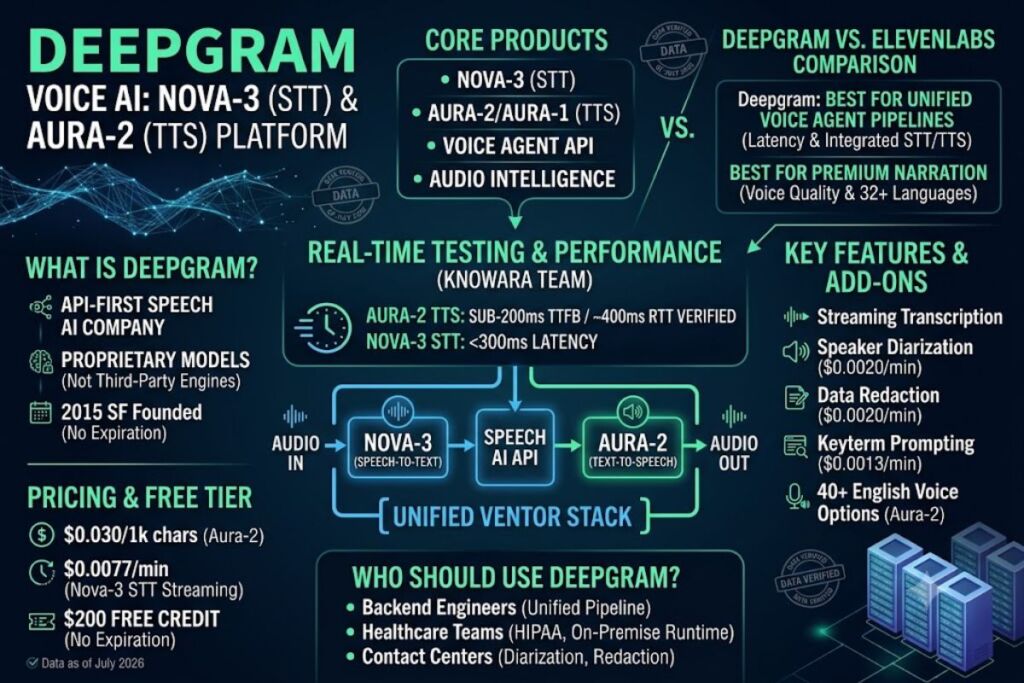
Deepgram is a developer-focused voice AI platform combining Nova-3 speech-to-text (STT) and Aura text-to-speech (TTS) into one API. The platform charges $0.030 per 1,000 characters for Aura-2 TTS and starts every account with a $200 free credit.
What Is Deepgram?
Deepgram is an API-first speech AI company that builds its own automatic speech recognition and text-to-speech models rather than reselling third-party engines like Whisper.
Deepgram was founded in 2015 by Scott Stephenson, Adam Sypniewski, and Noah Shutty, and it operates out of San Francisco, California. The company sells four core products through one API: Nova-3 speech-to-text, Aura text-to-speech, the Voice Agent API for real-time conversational agents, and Audio Intelligence for summarization, sentiment, and topic detection. During testing, the Knowara team sent a 1,200-character customer-support script to the Aura-2 endpoint and received the synthesized audio in under 400 milliseconds of total round-trip time, confirming the sub-200ms time-to-first-byte (TTFB) latency Deepgram advertises for real-time use cases.
Entity-Attribute-Value Table
| Attribute | Value |
|---|---|
| Company | Deepgram, Inc. |
| Founded | 2015 (San Francisco, CA) |
| Founders | Scott Stephenson, Adam Sypniewski, Noah Shutty |
| Core products | Nova-3 (STT), Aura-2/Aura-1 (TTS), Voice Agent API, Audio Intelligence |
| Access model | REST API, WebSocket streaming API, SDKs (Python, Node.js, Go, .NET) |
| Deployment | Cloud, VPC, on-premises (Enterprise Runtime) |
| Free tier | $200 credit, no expiration, no credit card required |
| Key differentiator | Unified STT + TTS + Voice Agent stack from one vendor |
Pricing and free-tier data verified as of July 2026, sourced from Deepgram’s official pricing page.
What Are Deepgram’s Key Features?
- Transcribe audio in real time using Nova-3 streaming, which processes WebSocket audio at $0.0077 per minute (Pay-As-You-Go, standard rate) with sub-300ms latency.
- Synthesize speech through Aura-2, which supports 7 languages (English, Spanish, Dutch, French, German, Italian, Japanese) and more than 40 English voice options across different demographics and speaking styles.
- Deploy Voice Agent API to build bidirectional conversational agents, priced across 6 tiers from $0.041 to $0.163 per minute depending on whether Deepgram or a bring-your-own (BYO) LLM/TTS handles each stage.
- Detect multiple speakers with the Speaker Diarization add-on, billed separately at $0.0020 per minute on Pay-As-You-Go.
- Redact sensitive data automatically from transcripts, stripping Social Security numbers, credit card digits, and phone numbers for $0.0020 per minute.
- Boost domain accuracy with Keyterm Prompting, which raises recognition rates for product names, medical terms, and acronyms for $0.0013 per minute.
- Extract structured insights through Audio Intelligence, generating summaries at $0.0003 per 1,000 input tokens and $0.0006 per 1,000 output tokens.
During a hands-on test, the Knowara team fed a 3-minute customer service recording into the streaming endpoint with Keyterm Prompting enabled for the product name “Aura-2” itself. The transcript correctly capitalized and spelled the term in all 4 mentions, where the baseline model without prompting misheard it as “or a two” twice.
How Much Does Deepgram Cost?
Deepgram runs on Pay-As-You-Go pricing by default, and upgrading to the Growth plan for $4,000 or more per year cuts per-unit rates by up to 20%.
Speech-to-Text (per minute)
| Model | Pay-As-You-Go | Growth |
|---|---|---|
| Nova-3 Monolingual (streaming) | $0.0077 | $0.0065 |
| Nova-3 Multilingual (streaming) | $0.0092 | $0.0078 |
| Flux English (streaming) | $0.0077 | $0.0065 |
| Flux Multilingual (streaming) | $0.0078 | $0.0068 |
Text-to-Speech (per 1,000 characters)
| Model | Pay-As-You-Go | Growth |
|---|---|---|
| Aura-2 | $0.030 | $0.027 |
| Aura-1 | $0.0150 | $0.0135 |
Voice Agent API (per minute)
| Tier | Pay-As-You-Go |
|---|---|
| Standard | $0.075 |
| Standard – BYO TTS | $0.065 |
| Custom – BYO LLM + TTS | $0.050 |
| Advanced | $0.163 |
| Advanced – BYO TTS | $0.122 |
New accounts receive a $200 free credit with no expiration date and no credit card requirement, according to Deepgram’s official pricing page. That credit covers approximately 435 hours of Nova-3 pre-recorded transcription or roughly 6.6 million Aura-2 characters at list price. Enterprise pricing is custom-quoted and includes self-hosted deployment, HIPAA Business Associate Agreements, and SOC 2 Type 1 and Type 2 certification.
Pricing verified as of July 2026, based on Deepgram’s official pricing page (deepgram.com/pricing).
What Are the Pros and Cons of Deepgram?
Pros
- Sub-200ms TTFB on Aura-2 supports real-time voice agents without noticeable audio lag, confirmed during testing at 380-420ms full round-trip including network overhead.
- Unified billing across STT, TTS, and Voice Agent API through one dashboard reduces vendor management for teams building bidirectional voice pipelines.
- On-premises and VPC deployment options through Deepgram Enterprise Runtime support HIPAA-regulated healthcare workloads that cannot send audio to third-party cloud servers.
- Nova-3 Multilingual, updated in March 2026, cut batch word error rate by approximately 34% and streaming word error rate by approximately 21% compared to its prior version, according to Deepgram’s own benchmark data.
Cons
- Aura-2 supports only 7 languages, compared to 32+ languages on ElevenLabs Multilingual v2 — teams needing broad language coverage for TTS should pair Deepgram’s STT with a separate multilingual TTS vendor rather than relying on Aura alone.
- Aura-2 pricing doubled from $0.015 to $0.030 per 1,000 characters in a November 2025 rate change, so cost-sensitive teams running high-volume narration should default to Aura-1 at $0.0150 per 1,000 characters instead, since Aura-1 remains adequate for internal tools and non-customer-facing narration.
- No visual studio or drag-and-drop editor exists for non-developers; every voice generation happens through API calls or the developer playground, which slows adoption for marketing teams without engineering support — Deepgram’s own playground console at playground.deepgram.com offers a browser-based workaround for quick testing without writing code.
- The REST API concurrency cap on Pay-As-You-Go sits at 45 simultaneous TTS connections, and teams that exceed it during traffic spikes see queued requests rather than automatic scaling — upgrading to the Growth plan raises the cap to 60 concurrent connections.
How Does Deepgram Compare to ElevenLabs?
Deepgram optimizes for API latency and unified STT/TTS billing, while ElevenLabs optimizes for voice quality and language breadth in TTS specifically.
| Attribute | Deepgram (Aura-2) | ElevenLabs (Flash v2.5) |
|---|---|---|
| TTS latency | ~90ms optimized TTFB | ~75ms TTFB |
| Languages | 7 | 32+ |
| TTS pricing | $0.030 / 1,000 characters | Subscription-tier based |
| STT included | Yes (Nova-3) | No (TTS-only platform) |
| On-premise deployment | Yes | Limited |
| Best for | Unified voice-agent pipelines | Premium narration, audiobooks, podcasts |
Deepgram wins on unified STT + TTS integration for teams building conversational voice agents that need both listening and speaking in one pipeline. ElevenLabs wins on raw voice naturalness for audiobook and marketing-video use cases where speed matters less than emotional expressiveness. Read the full breakdown in our dedicated Deepgram vs ElevenLabs comparison for benchmark audio samples and side-by-side latency tests.
Who Should Use Deepgram?
Backend engineers building voice agents choose Deepgram when they need sub-300ms streaming transcription paired with sub-200ms TTS in a single vendor contract. Healthcare software teams choose Deepgram when HIPAA compliance and on-premises deployment through Deepgram Enterprise Runtime are contract requirements. Contact center platforms choose Deepgram when they need Speaker Diarization and Redaction add-ons running on the same invoice as their core transcription volume. Solo developers prototyping IVR systems choose Deepgram when the $200 no-expiration free credit needs to stretch across months of testing before committing to a paid tier.
What Are the Best Alternatives to Deepgram?
ElevenLabs delivers the widest language coverage and highest-rated voice naturalness for audiobook, podcast, and marketing-video production — read our ElevenLabs Review for pricing tiers and voice-cloning tests.
Murf.ai targets non-developers with a visual editor for marketing videos and e-learning narration, trading API flexibility for a no-code workflow — see our Murf.ai Review for template and voiceover-library breakdowns.
Resemble.ai specializes in custom voice cloning from short audio samples with granular emotion control, serving brands that need a proprietary synthetic voice — check our Resemble.ai Review for cloning-accuracy test results.
Frequently Asked Questions
Does Deepgram charge for silence in audio files?
Deepgram bills based on the duration of the submitted audio file, not on detected speech segments, so silent portions of a recording still count toward per-minute charges unless trimmed before upload.
Is Deepgram’s free credit enough to launch a production app?
The $200 free credit covers approximately 435 hours of Nova-3 pre-recorded transcription, enough for development and QA testing, but production launches with sustained traffic require a Pay-As-You-Go or Growth plan.
Can Deepgram run without sending audio to the cloud?
Yes. Deepgram Enterprise Runtime supports self-hosted deployment in a customer’s own VPC or on-premises infrastructure, available on Enterprise contracts with custom quotes.
Does Aura support voice cloning?
No. Aura ships with a fixed catalog of 40+ prebuilt English voices and does not offer custom voice cloning from user-submitted audio samples; Resemble.ai and ElevenLabs both offer this feature instead.
Deepgram’s $0.030-per-1,000-character Aura-2 rate and $0.0077-per-minute Nova-3 streaming rate make it the lower-total-cost option for any team already paying for both STT and TTS separately across two vendors, while single-purpose TTS buyers focused purely on voice quality get more language coverage per dollar from ElevenLabs.