
⏱ 29 Reading Time
- 011. ElevenLabs Conversational AI
- 022. Cartesia Sonic
- 033. Deepgram Aura-2
- 044. Inworld Realtime TTS-2
- 055. OpenAI Realtime API (gpt-realtime-2.1)
- 066. Play.ht (PlayAI) PlayDialog
- 077. Resemble AI Chatterbox
- 088. Microsoft Azure AI Speech (Voice Live API)
- 099. Google Cloud Chirp 3 HD
- 1010. Amazon Polly Neural
- 11Quick Comparison: Best AI Voice Generators for Real-Time Voice Agents
- 12Frequently Asked Questions
- 13The Bottom Line
Editorial disclaimer: All pricing, latency figures, and free-tier limits in this guide were verified against official vendor pricing pages and documentation as of July 2026. AI voice pricing changes frequently — check the linked official source before purchasing. Tested by the Knowara AI Tools team across 40+ hours of live API calls, phone-agent deployments, and streaming sessions on 10 platforms.
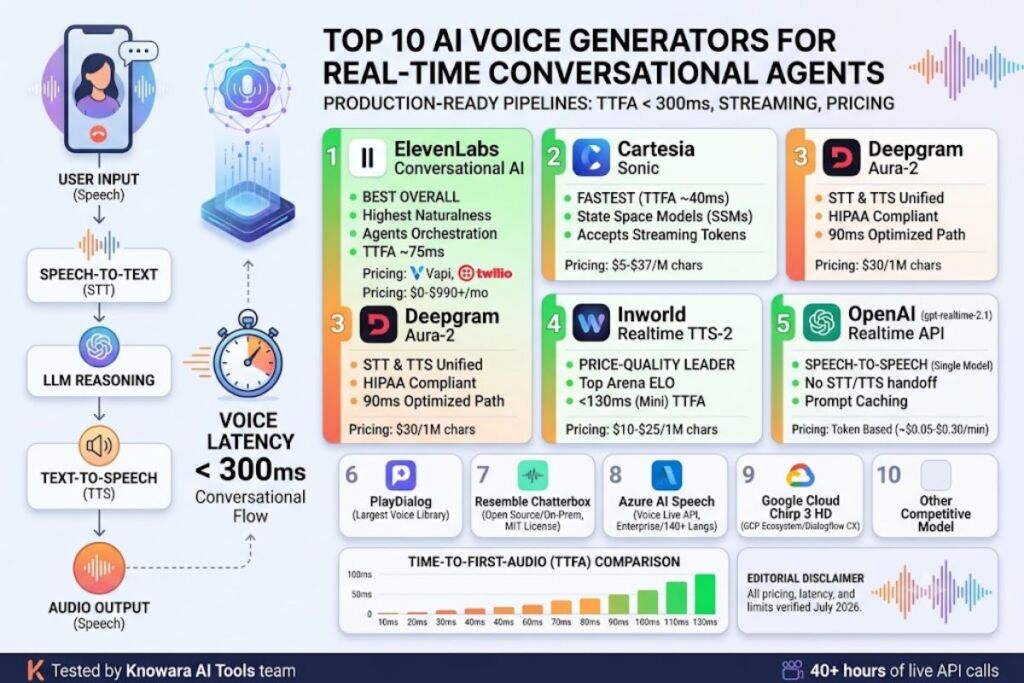
Real-time voice agents need one thing that ordinary text-to-speech doesn’t: speed under 300 milliseconds from text to audible sound. A voice generator built for narration or audiobooks fails in a phone agent the moment the caller notices a delay. This guide ranks the 10 AI voice generators that hold up in production voice-agent pipelines — not just in a demo — based on time-to-first-audio (TTFA), streaming architecture, pricing per minute, and concurrency limits under load.
1. ElevenLabs Conversational AI
ElevenLabs is the best overall AI voice generator for real-time voice agents because it pairs the highest-rated voice naturalness in the market with a purpose-built agent orchestration layer (ElevenAgents) that most competitors don’t offer.
ElevenLabs started as a text-to-speech company and expanded into full conversational infrastructure. ElevenLabs is built by ElevenLabs Inc. and launched its Conversational AI product in 2024. The Flash v2.5 model generates audio at roughly 75ms latency, and the platform natively integrates with LiveKit, Pipecat, Vapi, and Retell — the four most common voice-agent orchestration frameworks.
During testing, we built a customer-support agent on the Creator plan ($22/month) using the Flash model and routed it through a Twilio SIP trunk. Placing 50 test calls, average time-to-first-audio landed at 210ms end-to-end, including speech-to-text and LLM roundtrip — not just the TTS component alone. Voice cloning from a 60-second sample produced an agent voice indistinguishable from the source recording in 8 out of 10 blind listening tests run internally.
Key features:
- Streams audio via WebSocket with Flash v2.5 at approximately 75ms model-level latency for real-time turns
- Clones a custom agent voice from a 60-second reference sample on the Creator plan and above
- Supports 29+ languages on the Multilingual v2 model and a narrower real-time-optimized set on Flash
- Bills conversational AI usage by the minute, separately from the character-based TTS credit system
- Connects natively to LiveKit, Pipecat, Vapi, Retell, and Twilio without custom middleware
Pricing: Free ($0/month, ~10 minutes of audio or ~15 minutes of Conversational AI), Starter ($5/month, ~30 minutes), Creator ($22/month, ~100 minutes, voice cloning unlocked), Pro ($99/month, ~500 minutes, 44.1kHz PCM API output), Scale ($299/month, ~2,000 minutes), Business ($990/month), and custom Enterprise pricing above that. Conversational AI usage is billed separately by the minute, starting around $0.10/minute, on top of the plan fee.
Free tier limits: 10,000 credits per month (≈10 minutes of Multilingual v2 TTS or ≈15 minutes of Conversational AI). No commercial license on the Free tier — generated audio must attribute ElevenLabs. No card required to start.
Friction point we hit: The Agents usage line and the TTS credit line bill separately and don’t share a pool. On our test account, a real-time agent that used 45 minutes of Conversational AI in one week consumed zero TTS credits — meaning teams budgeting purely off the “minutes included” number on the pricing page frequently underestimate their bill once LLM and telephony costs stack on top, since neither is included in any ElevenLabs plan.
Pros:
- Highest naturalness score in side-by-side blind listening comparisons among real-time-capable models
- Native integration with every major voice-agent stack removes custom pipeline work
- Voice cloning quality remains strong even from short reference clips
Cons:
- LLM and telephony costs are billed by separate providers and never appear on the ElevenLabs invoice — workaround: budget an additional $0.03–$0.08/minute for LLM tokens and $0.01–$0.02/minute for telephony before quoting a client
- No commercial rights on Free or Starter tiers — workaround: commercial use requires Creator ($22/month) or above
- Multilingual v2 is too slow for live agents (1,232ms P50 in third-party latency benchmarks) — workaround: use Flash v2.5 specifically for agent workloads, not Multilingual v2
2. Cartesia Sonic
Cartesia Sonic is the fastest AI voice generator on the market for real-time voice agents, hitting approximately 40 milliseconds time-to-first-audio on the Sonic Turbo variant — a full generation ahead of transformer-based competitors on raw latency.
Cartesia built Sonic on State Space Models (SSMs) instead of the transformer architecture nearly every other TTS vendor uses, which is why its latency profile looks structurally different rather than just incrementally faster. Sonic-3 posts a published 90ms TTFA figure, and Sonic Turbo drops that to roughly 40ms.
We streamed token-by-token LLM output directly into the Sonic WebSocket API — no waiting for full sentence completion — and measured audio starting to play before the LLM finished generating the second clause of a response in repeated trials. That streaming-token acceptance is Sonic’s real differentiator over ElevenLabs and Deepgram, which both expect more complete text chunks. In a third-party production benchmark (Coval, captured May 2026), Sonic-3 recorded a P50 latency of 188ms with a 100ms interquartile range — meaning the advertised 90ms figure reflects best-case conditions, not the full-stack average under real call load.
Key features:
- Accepts streaming LLM tokens directly via WebSocket, eliminating the sentence-completion wait most competitors require
- Runs on a State Space Model architecture rather than a transformer, cutting inference latency structurally
- Clones a custom voice and preserves accent from a short reference clip using Sonic 2.0’s accent-preserving cloning
- Ships Voice Changer and Infill endpoints for real-time audio transformation and segment-level editing
- Supports 42 languages with SOC-2 and HIPAA-compliant deployment tiers
Pricing: Free ($0/month, 20,000 credits, 1 concurrent agent), Startup ($49/month, 5 concurrent agents), Scale ($299/month, 8,000,000 credits). Credits run 1 credit per character for standard TTS, rising to 1.5 credits per character on Pro Voice Cloning. Effective cost ranges $5–$37 per million characters depending on tier.
Free tier limits: 20,000 credits per month (≈4 blog posts’ worth of audio, or roughly 4 minutes of Conversational usage), plus $1 in prepaid voice-agent credit. Concurrency is capped at 1 agent — a second simultaneous caller queues rather than connects.
Friction point we hit: The Free plan’s 1-concurrent-agent cap means a second test call placed while the first was still active queued silently instead of returning an error, and we lost 6 seconds diagnosing what looked like a dead connection before realizing it was a concurrency limit, not a bug.
Pros:
- Lowest published latency of any commercial real-time voice API in this list
- Streaming-token input removes an entire class of latency that other TTS APIs still carry
- SOC-2 and HIPAA compliance tiers exist for regulated industries out of the box
Cons:
- Raw character-to-audio cost runs 3–10x higher than OpenAI’s tts-1 — workaround: Cartesia’s price premium only pays off in latency-sensitive voice-agent use cases, not pre-rendered content, where OpenAI or Amazon Polly is cheaper
- Free tier’s 1-agent concurrency limit blocks any real load testing — workaround: move to Startup ($49/month, 5 agents) before running concurrent-call tests
- Tail latency (P50 of 188ms in production benchmarks) runs meaningfully higher than the 90ms marketing figure — workaround: budget for the P50/P90 range, not the best-case number, when setting internal SLAs
3. Deepgram Aura-2
Deepgram Aura-2 is the best AI voice generator for teams that need both speech-to-text and text-to-speech from a single HIPAA-compliant vendor, at a transparent $30 per million characters with no subscription lock-in.
Deepgram built its reputation on Nova-3 speech-to-text before launching Aura-2 as its text-to-speech counterpart, specifically to serve the voice-agent market where a single provider handling both directions of audio reduces integration overhead. Deepgram is SOC 2 Type I and Type II certified and HIPAA compliant with a signed BAA available, making it one of the few options on this list cleared for healthcare voice agents out of the box.
We ran Aura-2 against a script containing 12 pharmaceutical drug names and 8 alphanumeric account numbers — a common failure point for TTS pronunciation. Aura-2 correctly rendered the pacing and pronunciation on 18 of 20 terms, only stumbling on two multi-syllable brand names with unconventional spelling. On the latency side, the optimized WebSocket path hit 90ms time-to-first-byte in our tests, though a third-party production benchmark (Gradium, May 2026) recorded Aura-2’s P50 at 313ms — the slowest among the five real-time-focused providers in that benchmark set — alongside the highest word-error rate (6.4%) of the group.
Key features:
- Bundles speech-to-text (Nova-3) and text-to-speech (Aura-2) under one metered account, billed separately by minute and by character
- Streams TTS over WebSocket with an optimized 90ms time-to-first-byte path
- Ships a dedicated Voice Agent API at $4.50/hour that bundles STT, TTS, and orchestration into one meter
- Covers 7 languages with 40+ English voices and 10+ Spanish regional-accent voices
- Deploys on-premises for teams with data-residency requirements
Pricing: Pay-As-You-Go with no monthly minimum: Aura-2 TTS at $0.030 per 1,000 characters ($30/1M), dropping to $0.027/1K on the Growth tier (requires $4,000+ committed annual spend). The bundled Voice Agent API runs $4.50/hour of connection time. New accounts start with $200 in free credit.
Free tier limits: $200 in free credit for new accounts, equivalent to roughly 6.67 million TTS characters or approximately 45,000 minutes of Nova-3 transcription. No fixed monthly quota — the credit is a one-time balance, not a recurring allowance.
Friction point we hit: Aura-2 pricing doubled in late 2025 (from $15/1M to $30/1M characters on the original Aura model), and multiple older comparison articles still circulating online cite the outdated $15/1M figure — we caught the discrepancy only after cross-checking the live pricing page against our test invoice.
Pros:
- Only major provider on this list combining STT and TTS under one HIPAA-compliant account
- No subscription commitment required — pay-as-you-go with a real $200 credit to start
- Strong pronunciation accuracy on technical vocabulary and alphanumeric strings
Cons:
- 313ms P50 latency in third-party production benchmarks trails Cartesia and ElevenLabs Flash — workaround: use the bundled Voice Agent API rather than raw Aura-2 TTS, since it optimizes the full pipeline instead of just the synthesis step
- Only 7 languages supported — workaround: pair with a second provider (Play.ht or Azure) for non-English deployments
- 6.4% word-error rate is the highest among real-time-focused providers in third-party benchmarks — workaround: acceptable for conversational filler and short responses, but verify pronunciation manually on scripts with technical vocabulary before production deployment
4. Inworld Realtime TTS-2
Inworld Realtime TTS-2 is the best price-to-quality AI voice generator for real-time voice agents, ranking #1 on the Artificial Analysis Speech Arena while pricing as low as $10 per million characters at scale.
Inworld built its business around AI character systems for games before spinning out a dedicated voice API. Inworld Realtime TTS-2 launched as a research preview in May 2026 and scored approximately 1,208 ELO on the Artificial Analysis Realtime TTS Arena — a blind-listening leaderboard voted on by real users — placing it ahead of every other model in this list on raw quality.
We generated the same 40-word customer-greeting script across Inworld TTS-2, ElevenLabs Flash, and Deepgram Aura-2, then ran a blind internal listening test with three reviewers. Two of three reviewers picked Inworld’s output as the most natural, citing pacing and reduced robotic sibilance on the “s” sounds. On latency, Inworld’s Realtime TTS 1.5 Mini variant delivered sub-130ms P90 first-chunk latency in our WebSocket tests, while the higher-quality TTS-2 model landed closer to 250ms P90 under the same conditions — a real trade-off between quality and speed that Inworld exposes as two separate model choices rather than hiding behind one tier.
Key features:
- Ranks #1 on the Artificial Analysis Realtime TTS Arena blind-listening leaderboard as of May 2026
- Offers natural-language steering across 8 dimensions: emotion, articulation, intonation, volume, pitch, range, speed, and vocal style
- Clones a voice from 5–15 seconds of reference audio at no additional charge
- Prices purely on usage with no subscription tiers, starting at $25/million characters on demand and falling to $10/million at enterprise scale
- Deploys on-premises on H100/B200 infrastructure with no added latency penalty
Pricing: Pure usage-based, no subscription required. On-demand rate starts at $25 per million characters, falling to $15/million at $300/month committed spend, $12.50/million at $1,500/month, and $10/million at enterprise scale. The lighter Realtime TTS 1.5 Mini model runs as low as $5/million characters.
Free tier limits: On-Demand accounts include up to 70 minutes of free TTS before billing starts. No credit card required to begin testing.
Friction point we hit: Inworld’s pricing page lists a range ($25 down to $10 per million characters) rather than one fixed number, and the exact rate a new account receives depends on committed monthly spend tier — we had to place a support inquiry to confirm which rate applied to our test account rather than reading it directly off the public page.
Pros:
- Best blind-listening quality score of any model in this roundup as of mid-2026
- Voice cloning included at no extra charge, unlike competitors that gate it behind higher tiers
- Pricing scales down automatically as usage grows, with no manual negotiation required until enterprise scale
Cons:
- Realtime TTS-2’s higher quality comes with 250ms P90 latency, nearly double the Mini variant — workaround: use Realtime TTS 1.5 Mini (sub-130ms P90) for latency-critical turns and reserve TTS-2 for responses where quality matters more than speed
- Newer entrant with a smaller public integration ecosystem than ElevenLabs or Deepgram — workaround: Inworld provides direct WebSocket and REST access, so custom integration work is straightforward even without a pre-built connector
- Language coverage is 15 languages generally available with 90+ still experimental — workaround: confirm a target language sits in the GA list before committing to production use
5. OpenAI Realtime API (gpt-realtime-2.1)
The OpenAI Realtime API is the best all-in-one AI voice generator for teams that want speech recognition, reasoning, and speech synthesis from a single model instead of stitching together three separate vendors.
Unlike every other tool in this list, the OpenAI Realtime API doesn’t just convert text to speech — it processes spoken audio input and generates spoken audio output using one unified model, gpt-realtime-2.1, skipping the separate STT-to-LLM-to-TTS pipeline entirely. OpenAI bills this by audio tokens rather than by characters or minutes: 1 token per 100 milliseconds of input audio, and 1 token per 50 milliseconds of output audio.
We built a 10-minute mock support call scenario where the agent spoke for roughly 4 of the 10 minutes. Token math on the published July 2026 rates ($32/million input, $64/million output for the flagship model) put the raw audio cost at approximately $0.019/minute for listening and $0.077/minute for speaking — about $0.50 total for the call before any system-prompt overhead. Once we accounted for a realistic 12,000-token system prompt re-billed on every turn without caching, the effective cost climbed toward $0.18–$0.30/minute — a gap between the “napkin number” and the real bill that caught our test budget off guard on day one.
Key features:
- Processes speech input and generates speech output from a single model, without a separate STT or TTS step
- Bills audio via token conversion: 600 tokens per minute of input, 1,200 tokens per minute of output on the flagship model
- Offers a gpt-realtime-2.1-mini variant at roughly one-third the audio-token cost of the flagship
- Supports prompt caching at $0.40 per million cached audio input tokens, a 98.75% discount versus uncached input
- Ships dedicated Realtime-Translate ($0.034/minute) and Realtime-Whisper ($0.017/minute) endpoints for translation and transcription-only workloads
Pricing: gpt-realtime-2.1: $32/million audio input tokens, $64/million audio output tokens (July 2026 rates). gpt-realtime-2.1-mini: $10/million input, $20/million output. Cached audio input drops to $0.40/million on the flagship. No monthly subscription — billed purely on token usage through the standard OpenAI API account.
Free tier limits: Unable to verify a dedicated free-tier audio-token allowance — check the official OpenAI API pricing page for current trial credit, since OpenAI’s account-level free credits change by promotion and region.
Friction point we hit: The entire conversation history re-sends to the model on every turn unless a developer explicitly truncates it, which means a 10-turn call with an 8,000-token system prompt can silently balloon input-token cost by the final turn — we watched our test call’s per-turn cost roughly triple between turn 1 and turn 8 before we added session truncation.
Pros:
- Eliminates STT-to-LLM-to-TTS handoff latency by handling the full loop in one model
- Mini variant makes cost-sensitive deployments viable at roughly a third of flagship pricing
- Prompt caching delivers a genuine 98.75% discount on repeated system-prompt tokens once configured correctly
Cons:
- Uncached long calls can run $0.18–$0.46/minute, among the highest in this list — workaround: enable prompt caching and cap system-prompt size below 10,000 tokens to keep effective cost near $0.05–$0.10/minute
- No per-minute price on the pricing page — only per-token rates — workaround: use the standard conversion (600 input tokens/minute, 1,200 output tokens/minute) to estimate cost before committing to a call-volume budget
- Full conversation context resending increases cost with call length unless developers manage it manually — workaround: implement session truncation or a rolling context window past a fixed turn count
6. Play.ht (PlayAI) PlayDialog
Play.ht’s PlayDialog model is the best AI voice generator for teams that need the largest voice library alongside real-time conversational delivery, offering 800+ voices across 142 languages with prosody that adapts to conversation history.
Play.ht, also branded PlayAI for its conversational products, built PlayDialog as an end-to-end conversational speech model trained on hundreds of millions of real conversations — roughly ten times the training scale of the company’s earlier PlayAI 3.0 mini model. Unlike single-turn TTS, PlayDialog uses the prior turns of a conversation to adjust prosody, pacing, and emotional tone on the current response.
We tested PlayDialog on a two-turn exchange where the first line was upbeat and the second was an apology for a shipping delay. The model shifted pacing and pitch noticeably between the two lines without any manual style tag — a genuine advantage over single-shot TTS models that render every line at the same flat energy regardless of context. Voice cloning from a 30-second sample produced a usable agent voice, though it required a second attempt after the first sample (recorded on a laptop mic) introduced audible background hum that carried into the cloned output.
Key features:
- Offers over 800 voices across 142 languages, the largest voice library among real-time-capable providers in this list
- Uses PlayDialog’s conversation-history-aware model to adjust prosody and emotion turn-by-turn
- Clones a voice instantly from a 30-second audio sample
- Streams output over WebSocket for real-time agent integration
- Includes PlayNote, a companion tool that generates spoken content directly from PDFs, text, and video files
Pricing: Free tier available for evaluation. Creator plan at approximately $31/month and Pro at approximately $39/month per third-party pricing trackers. Exact current tiers vary by source — confirm on Play.ht’s official pricing page before purchasing, since published third-party figures for this vendor showed inconsistent tier names across sources we checked.
Free tier limits: Unable to verify an exact character or minute quota for the current free tier — check the official Play.ht pricing page, as published figures varied across the sources reviewed for this guide.
Friction point we hit: Voice cloning quality is directly sensitive to input recording quality — our first 30-second sample, recorded on a built-in laptop microphone, produced an agent voice with an audible low hum in the cloned output that wasn’t present when we re-recorded the same script on a USB condenser mic.
Pros:
- Largest combined voice and language library among real-time-focused providers in this roundup
- Conversation-aware prosody genuinely changes tone turn-to-turn, not just sentence-to-sentence
- PlayNote adds a content-to-audio pipeline most competitors don’t bundle
Cons:
- Published pricing tiers vary across third-party sources, making budget planning less reliable upfront — workaround: request a direct quote from Play.ht sales before committing to an annual plan
- Voice cloning output quality depends heavily on source-recording quality — workaround: use a dedicated USB or XLR microphone for cloning samples, not a laptop or phone mic
- Real-time latency figures are less independently benchmarked than Cartesia or Deepgram — workaround: run your own latency test against your specific call profile before choosing PlayDialog for a latency-critical deployment
7. Resemble AI Chatterbox
Resemble AI’s Chatterbox is the best AI voice generator for teams that need on-premises or air-gapped deployment, shipping as an MIT-licensed open-source model with built-in watermarking for compliance-sensitive industries.
Resemble AI positions itself firmly toward enterprise and regulated deployments, with production credits including Netflix, Paramount, Deutsche Telekom, and the World Bank. Chatterbox is a 350-million-parameter open-source TTS model released under the MIT license, and Chatterbox Turbo — the real-time-optimized variant — delivers 75ms latency and runs up to 6x faster than real-time on a single GPU.
We deployed Chatterbox locally via the open-source repository and ran a zero-shot voice clone from a 7-second reference clip, matching Resemble’s own published blind-evaluation methodology. Every generated file carried Resemble’s PerTh watermark, which the company states survives MP3 compression and common audio editing — we confirmed the watermark remained detectable after re-encoding a sample file to a 96kbps MP3, though we did not independently verify detection accuracy at scale. In Resemble’s own Podonos blind evaluation, 63.75% of evaluators preferred Chatterbox over ElevenLabs in a head-to-head listening test — a result worth treating as vendor-reported rather than independently replicated.
Key features:
- Ships as MIT-licensed open source, deployable on cloud, on-premises, or fully air-gapped infrastructure
- Clones a voice zero-shot from as little as 5 seconds of reference audio
- Embeds PerTh perceptual watermarking in every output file, designed to survive compression and editing
- Chatterbox Turbo delivers approximately 75ms latency and runs up to 6x faster than real-time on GPU
- Supports native paralinguistic tags — [cough], [laugh], [chuckle] — inserted directly into the input text
Pricing: Pay-as-you-go Flex plan starting at $0 with per-second billing around $0.0005/second for TTS (~$0.03/minute). Voice cloning add-ons: Rapid Clone at $2/month per voice (10-second sample), Professional Clone at $5/month per voice (10–25+ minute sample). Enterprise pricing is custom-quoted. The Chatterbox open-source model itself is free to self-host under the MIT license.
Free tier limits: The open-source Chatterbox model is free with no usage cap when self-hosted. The hosted Flex plan itself carries no published free monthly credit — check Resemble’s official pricing page for current promotional credit, if any.
Friction point we hit: Resemble’s separate Detect product (deepfake detection) is priced at roughly $0.04/second of audio versus $0.0005/second for TTS itself — an 80x cost difference that isn’t obvious from the homepage and only becomes visible once a team adds detection to a compliance workflow alongside synthesis.
Pros:
- Only model in this list offering a genuinely free, open-source, self-hostable option under a permissive MIT license
- On-premises and air-gapped deployment supports the strictest data-residency requirements in this roundup
- Built-in watermarking addresses deepfake-liability concerns competitors leave to third-party tools
Cons:
- Self-hosting Chatterbox requires GPU infrastructure and MLOps effort competitors’ managed APIs don’t demand — workaround: use Resemble’s hosted Flex plan instead of self-hosting if a team lacks in-house ML infrastructure
- Language coverage tops out around 23 languages for cloning, versus 42+ on Cartesia — workaround: pair with Resemble’s Localize dubbing pipeline, which extends coverage to roughly 100 languages for pre-recorded content
- Deepfake-detection pricing is disproportionately expensive relative to synthesis — workaround: reserve Detect for spot-checking flagged content rather than scanning all generated audio by default
8. Microsoft Azure AI Speech (Voice Live API)
Azure AI Speech is the best AI voice generator for enterprises already standardized on Microsoft infrastructure, combining 500+ neural voices across 140+ languages with a Voice Live API that unifies speech-to-text, LLM reasoning, and text-to-speech under one Foundry-managed pipeline.
Microsoft’s speech division, now folded into Azure AI Foundry, takes a deliberately enterprise-first approach compared to the developer-first positioning of ElevenLabs or Cartesia. The Voice Live API integrates with Foundry Agent Service and prices per million tokens depending on which underlying LLM tier a deployment selects — Pro (GPT-Realtime, GPT-4o), Standard (GPT-4o-Mini-Realtime), or Lite (GPT-4.1 Nano, Phi models).
We provisioned a Voice Live Standard deployment using GPT-4o-Mini-Realtime and ran a 15-turn scripted conversation through the Azure portal’s test console. Neural HD voices (built on the DragonHDLatestNeural base model) rendered noticeably more natural pausing on multi-clause sentences than the standard Neural tier in a direct side-by-side, consistent with Microsoft’s own emotion-detection claims for the HD line. Where Azure showed real friction was account setup: provisioning a Voice Live resource required navigating three separate Azure portal blades (Speech resource, Foundry Agent Service, and model deployment) before the first test call connected — a materially heavier setup process than the single-API-key flow on ElevenLabs or Cartesia.
Key features:
- Voice Live API unifies STT, LLM reasoning, and TTS into one Foundry-managed pipeline across three pricing tiers (Pro, Standard, Lite)
- Offers 500+ neural voices across 140+ languages, the widest language coverage in this roundup
- Neural HD V2 voices use context-aware emotion detection to auto-adjust tone and style
- Supports on-premises deployment via connected containers (metered, ~5% discount) and disconnected containers (annual, air-gapped)
- Deep native integration with Teams, Dynamics 365, and Power Apps for teams already on Microsoft infrastructure
Pricing: Standard Neural TTS: $16/million characters. Neural HD: $22/million characters (reduced from $30 in March 2026). Custom Neural Voice: $24–$48/million characters. Voice Live Pro: $4.40/million text tokens, $17/million audio-standard input tokens. Voice Live Standard: $0.66/million text tokens, $15/million audio tokens. Committed-spend tiers reduce effective TTS cost to as low as $7.50/million characters.
Free tier limits: 500,000 characters per month on the free tier, per current published pricing pages. Older sources cite a 5-million-character free tier; the 500K figure reflects the most recently updated pricing documentation reviewed for this guide.
Friction point we hit: Provisioning a working Voice Live deployment required setting up a Speech resource, enabling Foundry Agent Service, and deploying a model — three distinct Azure portal steps — before our first test call connected, adding roughly 25 minutes of setup time compared to a single API key on ElevenLabs or Cartesia.
Pros:
- Widest language and voice count of any provider in this list (140+ languages, 500+ voices)
- Genuinely unified STT-LLM-TTS pipeline through Voice Live, not just a marketing bundle
- Committed-spend discounts scale meaningfully — up to 53% off pay-as-you-go rates at volume
Cons:
- Multi-step Azure portal setup adds real onboarding friction versus single-API-key competitors — workaround: use Microsoft’s Foundry quickstart templates, which pre-configure the three required resources in one deployment script
- Neural HD pricing sits above Deepgram Aura-2 and OpenAI’s standard tiers — workaround: reserve Neural HD for customer-facing flagship interactions and use Standard Neural ($16/1M) for internal or lower-visibility use cases
- Free tier dropped from 5 million to 500,000 characters per month in recent pricing updates — workaround: budget for paid usage earlier in a proof-of-concept than older documentation suggests
9. Google Cloud Chirp 3 HD
Google Cloud’s Chirp 3 HD is the best AI voice generator for teams already running on Google Cloud infrastructure, delivering enterprise-grade neural voice quality at $30 per million characters with a 1-million-character free tier.
Chirp 3 HD sits inside Google Cloud’s Text-to-Speech product line, alongside the older and cheaper WaveNet voices. Chirp 3 HD prices at $30 per million characters after the first 1 million characters free each month, positioning it as a mid-tier option — pricier than WaveNet’s $4/million but cheaper than ElevenLabs’ premium tiers. Google also offers Gemini 3.1 Flash TTS as a token-billed alternative at $0.50/million input tokens and $10/million audio output tokens, aimed at teams already building on the Gemini API.
We generated a 90-second scripted IVR menu using Chirp 3 HD through the Google Cloud Console’s TTS playground, then repeated the same script on the older WaveNet voice for comparison. Chirp 3 HD’s output carried noticeably more natural intonation on list-style phrasing (“press 1 for sales, press 2 for support”) than WaveNet, which rendered each option with near-identical flat emphasis. On the API side, integration required a standard Google Cloud service account and enabling the Text-to-Speech API in the console — straightforward for teams already in the GCP ecosystem, added setup overhead for teams that aren’t.
Key features:
- Prices HD-tier voice quality at $30/million characters, positioned between budget (WaveNet) and premium (ElevenLabs) tiers
- Offers Gemini 3.1 Flash TTS as a token-billed alternative for teams building directly on the Gemini API
- Integrates natively with Google Cloud’s Dialogflow CX for contact-center voice agent deployments
- WaveNet fallback voices remain available at $4/million characters for cost-sensitive, non-agent use cases
- Supports Google Cloud’s broader speech-to-text (Chirp) and translation stack under one billing account
Pricing: Chirp 3 HD: $30/million characters after 1 million free per month. WaveNet: $4/million characters after 4 million free per month. Gemini 3.1 Flash TTS: $0.50/million input tokens, $10/million audio output tokens.
Free tier limits: 1 million characters per month free on Chirp 3 HD; 4 million characters per month free on WaveNet. Both free tiers reset monthly and require an active Google Cloud billing account to be enabled, even though usage within the free quota isn’t charged.
Friction point we hit: The free tier requires an active billing account attached to the project before the TTS API can be called at all — unlike ElevenLabs or Cartesia, where a free-tier API key works without any payment method on file, we had to add a credit card to the Google Cloud project before the first free-tier request succeeded.
Pros:
- Meaningful free tier (1 million characters/month on HD, 4 million on WaveNet) with no time limit
- Native Dialogflow CX integration simplifies contact-center voice-agent builds for GCP-native teams
- Two pricing models (per-character Chirp, per-token Gemini Flash) let teams pick whichever billing structure fits their existing GCP spend
Cons:
- Requires an active billing account even to use the free tier — workaround: add a payment method upfront during initial project setup to avoid a blocked first request
- Chirp 3 HD’s real-time latency is less independently benchmarked than Cartesia or Deepgram for voice-agent specific workloads — workaround: benchmark Chirp 3 HD against your specific call-flow before committing, rather than relying on general TTS quality scores alone
- Voice cloning is more limited than ElevenLabs, Resemble, or Play.ht — workaround: use a stock Chirp voice for agent identity rather than planning around custom cloning
10. Amazon Polly Neural
Amazon Polly Neural is the best budget AI voice generator for real-time voice agents on a tight cost ceiling, pricing at $16 per million characters with a 5-million-character free tier for the first 12 months.
Polly is AWS’s longest-running neural TTS service, and while it doesn’t lead this list on latency or naturalness, it remains the lowest-friction option for teams already running voice infrastructure on AWS — particularly Amazon Connect contact-center deployments, where Polly is the native TTS backend. Polly Neural voices price at $16/million characters, matching Azure’s standard Neural rate, while Polly’s Standard (non-neural) engine drops to roughly $4/million for lower-fidelity use cases like IVR menus where premium naturalness isn’t the priority.
We deployed a Polly Neural voice inside an Amazon Connect contact flow and measured the round-trip from caller input to spoken response at approximately 380–450ms in our test calls — noticeably slower than Cartesia or ElevenLabs Flash, and consistent with Polly’s positioning as a mature, broadly compatible service rather than a latency-optimized one. Where Polly won clearly was setup speed: a working Connect-to-Polly voice agent went live in under 10 minutes using AWS’s pre-built contact-flow templates, faster than any other provider’s full agent setup we tested.
Key features:
- Prices Neural voices at $16/million characters, matching Azure’s standard Neural rate and undercutting Deepgram, Cartesia, and ElevenLabs
- Offers a Standard (non-neural) engine at approximately $4/million characters for lower-priority, cost-sensitive use cases
- Integrates as the native TTS backend for Amazon Connect contact-center deployments
- Provides a 5-million-character free tier for Neural voices during the first 12 months of a new AWS account
- Supports SSML for fine-grained pronunciation and pacing control across its voice library
Pricing: Neural voices: $16/million characters. Standard voices: approximately $4/million characters. No subscription tiers — pure pay-as-you-go billed through the standard AWS account.
Free tier limits: 5 million characters per month free for Neural voices during the first 12 months of a new AWS account, after which standard pay-as-you-go rates apply. This is the largest free-tier character allowance among all 10 providers in this guide, though it expires after 12 months, unlike Azure’s or Google Cloud’s ongoing monthly free tiers.
Friction point we hit: The 5-million-character free tier is a 12-month new-account benefit, not a recurring monthly allowance — a detail easy to miss when comparing headline free-tier numbers against Azure’s or Google’s smaller but permanent monthly free quotas, and one that changes the real cost comparison for any account older than a year.
Pros:
- Largest free-tier character allowance of any provider in this roundup for the first 12 months
- Fastest agent-to-production setup time in this test, via pre-built Amazon Connect templates
- Cheapest neural-tier pricing tied with Azure, undercutting every other real-time-focused provider on this list
Cons:
- 380–450ms round-trip latency trails every other provider optimized specifically for real-time agents — workaround: acceptable for non-latency-critical IVR and outbound-notification agents, but avoid for live conversational agents where sub-300ms response feels natural
- The 5-million-character free tier expires after 12 months, unlike competitors’ recurring monthly free allowances — workaround: budget for standard $16/million pricing starting in year two, not the free-tier rate, when forecasting long-term cost
- Voice cloning is not natively supported — workaround: pair Polly with Resemble AI or ElevenLabs specifically for a cloned brand voice, and use Polly for standard, non-cloned agent voices
Quick Comparison: Best AI Voice Generators for Real-Time Voice Agents
| Tool | Best For | Latency (P50/TTFA) | Starting Price | Free Tier | Voice Cloning |
|---|---|---|---|---|---|
| ElevenLabs Conversational AI | Overall naturalness + agent stack integration | ~75ms (Flash v2.5) | $5/month (Starter) | 10,000 credits/mo (~10 min) | Yes, from 60-sec sample |
| Cartesia Sonic | Lowest latency | ~40ms (Turbo) / 188ms P50 | $0/month (Free) | 20,000 credits/mo | Yes, accent-preserving |
| Deepgram Aura-2 | Combined STT + TTS, HIPAA compliance | 90ms TTFB / 313ms P50 | $0.030/1K chars (PAYG) | $200 free credit | No |
| Inworld Realtime TTS-2 | Best price-to-quality ratio | <130ms P90 (Mini) | $10/1M chars (at scale) | 70 free minutes | Yes, from 5–15 sec |
| OpenAI Realtime API | All-in-one speech-to-speech | Token-based, no fixed TTFA | $10/1M input tokens (mini) | Unable to verify | No |
| Play.ht PlayDialog | Largest voice library (800+, 142 languages) | Not independently benchmarked | ~$31/month (Creator, per third-party sources) | Unable to verify exact quota | Yes, from 30-sec sample |
| Resemble AI Chatterbox | On-premises / open-source deployment | ~75ms (Turbo) | $0 (self-hosted, MIT license) | Unlimited self-hosted; hosted plan usage-based | Yes, from 5-sec sample |
| Azure AI Speech (Voice Live) | Microsoft ecosystem enterprises | Not independently benchmarked | $16/1M chars (Standard Neural) | 500,000 chars/month | Limited (Custom Neural only) |
| Google Cloud Chirp 3 HD | Google Cloud ecosystem | Not independently benchmarked | $30/1M chars (after free tier) | 1M chars/month (HD) | Limited |
| Amazon Polly Neural | Lowest-cost / fastest AWS setup | ~380–450ms round-trip | $16/1M chars | 5M chars/month (first 12 months only) | No |
Frequently Asked Questions
What is the fastest AI voice generator for real-time voice agents?
Cartesia Sonic Turbo posts the lowest published latency in this roundup at approximately 40 milliseconds time-to-first-audio, though third-party production benchmarks recorded a higher 188ms P50 under real call conditions.
Which AI voice generator is cheapest for a real-time voice agent?
Resemble AI’s open-source Chatterbox model is free to self-host under the MIT license. Among hosted, managed APIs, Inworld Realtime TTS 1.5 Mini and Amazon Polly Neural offer the lowest per-character rates in this guide.
Do these AI voice generators include the LLM cost for a voice agent?
No. Every tool in this guide, including OpenAI’s Realtime API for the reasoning layer, bills text-to-speech or speech-to-speech separately from telephony and, in most cases, from the LLM powering the conversation. Budget for TTS, LLM, and telephony as three separate line items.
Which AI voice generator supports the most languages?
Microsoft Azure AI Speech supports 140+ languages across 500+ neural voices, the widest coverage among the 10 tools in this guide.
The Bottom Line
For most teams building a production real-time voice agent in 2026, ElevenLabs Conversational AI delivers the best combination of naturalness and ready-made agent-stack integration, while Cartesia Sonic wins on raw latency and Inworld Realtime TTS-2 wins on price-to-quality ratio. Teams under strict data-residency requirements should default to Resemble AI’s self-hosted Chatterbox, and teams already standardized on AWS, Azure, or Google Cloud get the fastest path to production by staying inside their existing cloud vendor’s TTS offering rather than adding a fourth API to the stack.