
⏱ 25 Reading Time
- 011. ElevenLabs — Best Overall Voice Quality for Multilingual Production
- 022. Murf AI — Best for Studio-Style Multilingual Voiceover and Dubbing Workflows
- 033. Play.ht — Best for Sheer Language Breadth and Developer API Access
- 044. LOVO AI (Genny) — Best for Bundling Multilingual Voice With Video Editing
- 055. Resemble AI — Best for Enterprise Voice Cloning With Compliance and Watermarking
- 066. Microsoft Azure AI Speech — Best Enterprise-Grade Pay-As-You-Go Multilingual API
- 077. Google Cloud Text-to-Speech — Best for Granular Voice-Tier Pricing Control
- 088. Speechify — Best for Multilingual Content Consumption Rather Than Production
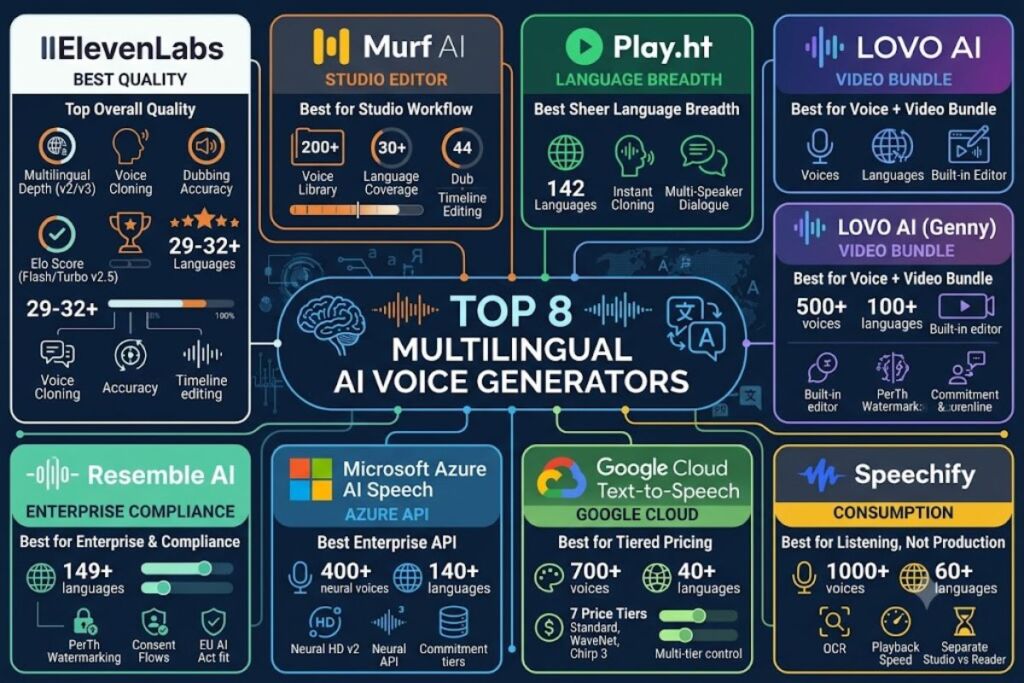
- 09Quick Comparison: All 8 Multilingual AI Voice Generators
- 10Frequently Asked Questions
- 11The Bottom Line
Editorial note: This guide was compiled by the Knowara AI Tools team by cross-referencing every vendor’s official pricing page, product documentation, and independent benchmark data (including TTS Arena leaderboard rankings) across all eight platforms listed below. Pricing, language counts, and free-tier limits change frequently in the AI voice market — every figure in this guide was checked against official sources in July 2026. Confirm current numbers on each vendor’s pricing page before purchasing, since plans and rates shift month to month.
ElevenLabs, Murf AI, Play.ht, LOVO AI, Resemble AI, Microsoft Azure AI Speech, Google Cloud Text-to-Speech, and Speechify rank as the eight best AI voice generators for multilingual content in 2026, based on language depth, voice cloning quality, dubbing accuracy, and pricing transparency.
1. ElevenLabs — Best Overall Voice Quality for Multilingual Production
ElevenLabs wins the top spot because its Multilingual v2 and v3 models produce the most natural-sounding non-English output of any platform tested, backed by a dedicated AI dubbing pipeline that preserves the original speaker’s voice.
ElevenLabs is a voice AI company that converts text into speech, clones voices from short audio samples, and dubs video content across languages while retaining the original speaker’s vocal identity. Independent TTS Arena leaderboard data places ElevenLabs’ Flash v2.5 model at an Elo score of 1549 and Turbo v2.5 at 1545, both ranking in the top 10 of the overall leaderboard as of April 2026.
Key attributes:
| Attribute | Value |
|---|---|
| Company | ElevenLabs |
| Founded | 2022 |
| Multilingual model coverage | 29–32 languages with deep quality optimization (marketing pages cite 70+ for basic support) |
| Dubbing languages | 29+ |
| Platforms | Web app, iOS/Android, REST API, WebSocket streaming |
| Free tier | 10,000 credits/month (~10 minutes of Multilingual v2 speech), 3 instant voice clones, no commercial rights |
| Entry paid tier | Starter, $5/month |
Three things separate ElevenLabs from the rest of the field for multilingual work:
- Dubbing Studio re-voices existing video in a target language while keeping the source speaker’s tone and pacing intact, and it accepts uploads directly from a local file or a pulled link from YouTube, TikTok, or X.
- Two synthesis models cover two different jobs: Flash is optimized for low latency and cheaper credit consumption during drafting, while Multilingual v2/v3 renders the higher-fidelity 192kbps stereo output used for final YouTube, podcast, or narration exports.
- Instant voice cloning needs only a short sample, while Professional Voice Cloning — reserved for paid tiers — trains on longer recordings for a closer match, and cloned voices carry across 20+ languages once trained.
Pricing: ElevenLabs runs a credit-based system rather than flat per-minute billing. The Free plan costs $0/month with no commercial usage rights. Starter costs $5/month with a 30,000-character monthly allotment. Creator, the tier most solo creators and freelancers need for professional dubbing and cloning, runs $22/month. Scale and Business tiers move to $330/month and $1,320/month respectively for high-volume teams, with Enterprise pricing negotiated separately. Annual billing cuts the effective monthly rate by roughly 17% (two months free) across every paid tier.
Free tier limits: 10,000 credits per month (~10 minutes of Multilingual v2 audio, or ~15 minutes of Conversational AI agent time), access to a limited voice library, and up to 3 instant voice clones — but zero commercial usage rights and no dubbing export.
The genuine friction point: ElevenLabs’ own documentation acknowledges that numbers, acronyms, and some foreign words in non-English scripts often get read back in English by default, which means multilingual scripts with mixed-language brand names or figures need manual SSML tagging or a second editing pass before they’re publish-ready.
Pros and Cons:
- Pro: Best-in-class non-English prosody and emotional range compared to every other platform reviewed here.
- Pro: Dubbing pipeline handles direct social-platform links, removing a manual download-and-reupload step.
- Con: Numbers, acronyms, and mixed-language text frequently default to English pronunciation — workaround: manually tag problem terms with phonetic SSML or split them into a separate audio segment before merging.
- Con: Commercial rights require at least the Starter plan — workaround: the $5/month tier is enough to unlock commercial use for low-volume creators who don’t need cloning yet.
How it compares: ElevenLabs trades language breadth for depth — Play.ht and LOVO AI cover more languages on paper, but ElevenLabs’ output quality on the languages it does support is consistently rated higher on independent leaderboards.
2. Murf AI — Best for Studio-Style Multilingual Voiceover and Dubbing Workflows
Murf AI earns the second spot for combining a timeline-based voiceover editor with AI dubbing across 44 languages, making it the most complete non-developer workflow for localizing training and marketing video.
Murf AI is a browser-based voice creation suite spanning three products: Murf Studio, a drag-and-drop voiceover editor; Murf Dub, a video localization tool; and the Murf API, powered by the Falcon low-latency engine. Founded in 2020, the company now serves more than 1 million users across 100+ countries.
Key attributes:
| Attribute | Value |
|---|---|
| Company | Murf Inc. |
| Founded | 2020 |
| Voice library | 200+ voices |
| Studio language coverage | 30+ languages |
| Dub language coverage | 44 languages |
| Platforms | Web app, Canva integration, PowerPoint integration, Google Slides integration, API |
| Free tier | 10 minutes of generation, no downloads, no commercial rights |
| Entry paid tier | Creator, listed between $19–$29/month depending on billing cycle |
Murf’s multilingual strengths center on three specific capabilities:
- Murf Dub translates and re-voices an uploaded video into a target language from a library covering 44 languages, while attempting to preserve the original speaker’s vocal characteristics — the feature large marketing agencies and corporate L&D teams use for course localization.
- The Studio editor includes emphasis, pronunciation, and timeline controls so a narration track can be corrected line-by-line without regenerating the entire script.
- Native integrations with Canva, PowerPoint, and Google Slides let non-technical teams drop a finished multilingual voiceover directly into an existing presentation file.
Pricing: Vendor and third-party pricing trackers show some variance in the Creator tier’s listed price — figures range from $19/month (annual billing) to $29/month (monthly billing) depending on the source and billing cycle checked. The Business tier is listed between $66/month and $99/month across sources, again reflecting the annual-vs-monthly split. Enterprise pricing, which unlocks voice cloning, unlimited generation, and SSO, is custom-quoted and reported to run from roughly $1,000 to $5,000+ per year once cloning and API add-ons are included. Annual billing saves approximately 33% versus paying monthly. Murf’s Falcon API bills separately at $0.01 per 1,000 characters for conversational use and $0.03 per 1,000 characters for Studio-quality output, with a $10/month free API credit.
Free tier limits: 10 projects, 10 minutes of total voice generation, 1 editor seat, no downloads, and no commercial usage rights — the free plan functions strictly as an in-browser voice preview, not a working evaluation copy.
The genuine friction point: Murf meters usage by hours of finished generation rather than by character count, and re-generating a single line to fix mispronunciation counts against that same hourly budget — a 2-hour monthly allotment on Creator disappears faster than expected once revision passes are factored in.
Pros and Cons:
- Pro: Only reviewed platform combining a full timeline editor with 44-language dubbing in one subscription.
- Pro: ISO 42001 AI management certification makes Murf a stronger fit for regulated industries like healthcare or finance.
- Con: Voice cloning is locked behind the Enterprise tier — workaround: for cloning under $30/month, ElevenLabs’ Creator plan is the more accessible route; use Murf for Studio/Dub work and a second tool for cloning if budget matters.
- Con: Non-English voice quality trails Murf’s English output, per multiple independent reviews — workaround: preview target-language voices in the free tier before committing budget to a localization project.
How it compares: Against ElevenLabs, Murf wins on editing tools and presentation integrations; ElevenLabs wins on raw voice cloning accessibility and non-English naturalness.
3. Play.ht — Best for Sheer Language Breadth and Developer API Access
Play.ht supports 142 languages and dialects — more than any other platform in this guide — paired with a developer-friendly API and instant voice cloning from a 30-second sample.
Play.ht is an AI voice platform offering text-to-speech generation, instant voice cloning, and the PlayDialog conversational voice model, aimed at podcasters, publishers, and developers building voice-enabled applications. The company is backed by Y Combinator and has raised $21 million in funding.
Key attributes:
| Attribute | Value |
|---|---|
| Company | Play.ht (PlayHT Inc.) |
| Voice library | 900+ voices |
| Language coverage | 142 languages and dialects (claimed) |
| Platforms | Web app, WordPress plugin, REST API |
| Free tier | 12,500 characters/month, 1 instant voice clone |
| Entry paid tier | Creator, $31–$39/month depending on source checked |
Three specifics matter most for multilingual buyers:
- The PlayHT 3.0 engine and PlayDialog model generate conversational, multi-speaker dialogue, not just single-narrator lines, which fits podcast-style multilingual content formats.
- Instant voice cloning trains from as little as 30 seconds of audio, tested by multiple independent reviewers who reported cloned voices sounding roughly 85% similar to the source speaker on the first pass.
- All voices and languages are unlocked starting on the Creator tier, with no separate paywall for specific language packs.
Pricing: The Free plan costs $0/month with 12,500 characters and one voice clone. The Creator plan is listed at $31.20/month by one independent review and $39/month by vendor-facing pricing aggregators — the discrepancy tracks with promotional and annual-versus-monthly billing differences, so treat $39/month as the standard list rate and confirm any lower figure directly on Play.ht’s checkout page. The Unlimited plan runs $49–$99/month depending on source, and removes the monthly character cap entirely. Premium/Enterprise pricing is custom-quoted.
Free tier limits: 12,500 characters per month and one instant voice clone, with commercial usage rights included even on the free tier — an advantage over Murf and LOVO AI, whose free tiers block commercial use entirely.
The genuine friction point: Independent testing found that while Play.ht advertises 142 languages, only around 20 have consistently reliable pronunciation and prosody; the remainder — including several African and Eastern European languages tested — produced noticeably robotic or mispronounced output. Multiple reviewers also reported 3/5 average reliability ratings tied to intermittent service outages and multi-day support response times on billing questions.
Pros and Cons:
- Pro: Broadest advertised language count of any tool in this guide, useful when a project needs a language ElevenLabs or Murf doesn’t support at all.
- Pro: Commercial rights included on the free tier, unlike most competitors.
- Con: Real-world usable language quality (~20 languages) falls well short of the marketed 142 — workaround: generate and manually review a test sample in the exact target language before committing a production budget, rather than trusting the language list alone.
- Con: Users have reported multi-day support response times on billing issues — workaround: budget extra lead time on any project with a hard deadline, and avoid relying on Play.ht as the sole vendor for time-sensitive localization.
How it compares: Play.ht undercuts ElevenLabs on price and beats it on raw language count, but ElevenLabs remains the safer choice when output quality on a specific supported language matters more than coverage breadth.
4. LOVO AI (Genny) — Best for Bundling Multilingual Voice With Video Editing
LOVO AI’s Genny platform pairs 500+ voices across 100+ languages with a built-in video editor, AI script writer, and AI art generator, letting a solo creator produce a finished multilingual video without leaving one tab.
LOVO AI, founded in 2019 by Tom Lee and based in Berkeley, California, has raised $13.4 million from investors including Kakao Entertainment and LG CNS, and reports more than 2 million users. Genny is the branded product name for LOVO’s voice and video creation suite; the company and product names are used interchangeably in practice.
Key attributes:
| Attribute | Value |
|---|---|
| Company | LOVO AI |
| Founded | 2019 |
| Voice library | 500+ voices |
| Language coverage | 100+ languages, with multiple regional variants per language |
| Platforms | Web app (genny.lovo.ai) |
| Free tier | 14-day trial, 20 minutes of generation |
| Entry paid tier | Basic, $24/month |
The multilingual-specific advantages here:
- 100+ language coverage significantly exceeds ElevenLabs’ 29–32 deep-quality languages, making Genny the practical choice when a target market’s language isn’t on ElevenLabs’ list at all.
- 30 distinct voice emotion tags — including documentary, whispering, and conversational styles — apply across the voice library, giving localized scripts tonal variety without needing a separate voice for every mood.
- Built-in AI script writing and AI art generation sit in the same timeline as the voice track, removing the need for a separate ChatGPT or Midjourney subscription for straightforward explainer-style videos.
Pricing: LOVO AI runs a four-tier structure: a 14-day free trial with 20 minutes of generation, Basic at $24/month, Pro at $48/month, Pro+ at $149/month, and custom Enterprise pricing. All paid tiers include commercial usage rights. The company has changed its pricing structure multiple times over the past two years, so the $24/$48/$149 figures reflect mid-2026 rates rather than a locked long-term price.
Free tier limits: A 14-day trial capped at 20 minutes of total voice generation — no permanent free tier exists, unlike ElevenLabs, Murf, or Play.ht, all of which offer an indefinite (if limited) free plan.
The genuine friction point: Independent reviewers testing side-by-side against ElevenLabs describe LOVO’s voices as sounding like “a professional voice actor” while ElevenLabs sounds like “a real person” — the difference shows up specifically in the absence of natural breathing and micro-pause artifacts that ElevenLabs’ Multilingual v2/v3 models render convincingly.
Pros and Cons:
- Pro: 100+ language coverage is a genuine differentiator when the target market sits outside ElevenLabs’ supported list.
- Pro: Built-in video editor removes the need for a second subscription for basic explainer or training video production.
- Con: No permanent free tier — only a 14-day, 20-minute trial — workaround: run the entire trial window against the exact target-language script before the clock runs out, rather than testing generic sample text.
- Con: The video editor is basic compared to dedicated tools like Descript or Premiere — workaround: use Genny for voice generation and script-to-timeline assembly, then export to a dedicated editor for any project needing multi-track audio mixing or complex transitions.
How it compares: LOVO AI beats Murf and ElevenLabs on raw language count and matches Murf on bundling voice with a lightweight editor, but trails both on per-language voice realism.
5. Resemble AI — Best for Enterprise Voice Cloning With Compliance and Watermarking
Resemble AI targets regulated enterprises and developers building voice agents, offering 149+ localization languages, per-second usage billing, and mandatory watermarking on every generated clip to meet emerging AI-disclosure regulations.
Resemble AI is a voice technology platform built around voice cloning, real-time text-to-speech APIs, and deepfake detection. Every voice Resemble generates carries a PerTh watermark that the company’s own detection model can identify — a compliance feature aimed squarely at the EU AI Act’s Article 50 synthetic-media disclosure requirement, which takes effect August 1, 2026, with fines up to €35 million for non-compliant synthetic media.
Key attributes:
| Attribute | Value |
|---|---|
| Company | Resemble AI |
| Language coverage | 149+ localization languages |
| Voice cloning options | Rapid Clone (10-second sample) and Professional Clone (10–25+ minute sample) |
| Platforms | Web app, real-time API |
| Free tier | Flex plan, pay-as-you-go from $0 base |
| Entry usage rate | $0.0005 per second of synthesized audio |
The features that matter for multilingual, compliance-conscious buyers:
- Consent verification is built into the clone-creation flow — Resemble’s terms of service prohibit cloning someone else’s voice without permission, and the platform requests consent confirmation before training a new voice.
- Chatterbox Multilingual, Resemble’s openly released model, covers 23 languages via zero-shot synthesis at roughly 75ms latency, aimed at developers who need to prototype before upgrading to the managed, higher-quality Resemble platform.
- Per-second billing replaces flat character quotas, which means a busy multilingual IVR system with unpredictable daily volume doesn’t need to guess a monthly character ceiling in advance.
Pricing: Resemble AI’s Flex plan starts at $0 with pay-as-you-go billing at $0.0005 per second of synthesized audio (roughly $1.80 per hour of audio before clone and seat fees). Rapid voice clones cost $2/month per voice; Professional voice clones cost $5/month per voice. Tiered plans reported by third-party trackers list Professional at $99/month (80,000 free seconds monthly, then $0.002/second) and Business at $499/month (320,000 free seconds monthly), though Resemble’s own site frames pricing primarily around the Flex/Enterprise structure — confirm the current tier names directly with Resemble before budgeting.
Free tier limits: The Flex plan has no fixed monthly free character or second allotment; costs accrue from the first second of usage at the base per-second rate, which is functionally different from every other platform in this guide and worth confirming carefully before a first production run.
The genuine friction point: Multiple pricing analyses flag ambiguity in Resemble’s own documentation over whether the mandatory watermarking process is billed as a separate line item on top of the standard per-second synthesis rate — get a written confirmation from Resemble sales before assuming watermarking is bundled into the quoted usage rate.
Pros and Cons:
- Pro: Built-in consent verification and mandatory watermarking make Resemble the strongest compliance fit heading into EU AI Act enforcement in August 2026.
- Pro: Per-second billing scales cleanly for unpredictable, high-volume voice-agent traffic rather than forcing a monthly character guess.
- Con: No flat monthly free tier makes casual evaluation harder than on ElevenLabs or Murf — workaround: the Chatterbox Multilingual open-source model can be tested locally at no cost before committing to managed Resemble usage.
- Con: Per-second pricing can outpace a flat competitor subscription at high volume — workaround: model expected monthly audio-minute volume against a flat ElevenLabs or Murf tier before choosing Resemble for steady, predictable workloads.
How it compares: Resemble is the compliance-and-developer specialist in this list; ElevenLabs and Murf serve the content-creator workflow better, while Resemble serves the regulated-enterprise and voice-agent-builder use case better.
6. Microsoft Azure AI Speech — Best Enterprise-Grade Pay-As-You-Go Multilingual API
Azure AI Speech, rebranded “Azure Speech in Foundry Tools” in 2026, converts text into 400+ neural voices across 140+ languages at transparent per-character API pricing, backed by Microsoft’s compliance certifications and global cloud infrastructure.
Microsoft Azure AI Speech is a cloud speech API bundling text-to-speech, speech-to-text, real-time speech translation, and the Voice Live API into a single Azure resource. Microsoft launched the underlying Cognitive Services Speech product in 2018, rebranded it Azure AI Speech in 2023, and folded it into Azure AI Foundry in 2026.
Key attributes:
| Attribute | Value |
|---|---|
| Company | Microsoft |
| Original launch | 2018 (as Cognitive Services Speech) |
| Voice library | 400+ neural voices |
| Language coverage | 140+ languages for TTS; 100+ languages for speech-to-text |
| Platforms | REST API, SDK, Azure AI Foundry |
| Free tier | 500,000 characters/month (TTS), 5 audio hours/month (STT) |
| Standard Neural rate | $16 per 1 million characters |
The specific capabilities that matter for multilingual content teams:
- Neural HD V2 voices, built on the DragonHDLatestNeural base model, add context-aware emotion detection that automatically adjusts tone and delivery style without manual SSML emotion tagging.
- Real-time speech translation bundles one audio input/output language plus up to two text translation languages in a single $2.50-per-audio-hour call, with additional languages billed through the separate Azure Translator service.
- Commitment tiers cut per-character costs by up to 53% for teams processing 80 million or more TTS characters monthly, a pricing lever none of the flat-subscription consumer tools in this guide offer.
Pricing: Standard Neural TTS costs $16 per 1 million characters. Neural HD voices dropped from $30 to $22 per 1 million characters starting March 2026. Real-time speech-to-text costs $1 per audio hour. Custom Neural Voice hosting runs $4.04 per model per hour, and custom model training can run up to $52 per compute hour. Disconnected, fully offline containers for air-gapped environments are priced annually — TTS Neural offline starts at $47,424/year for 4.8 billion characters.
Free tier limits: The F0 free tier includes 500,000 characters per month for neural text-to-speech, 5 audio hours per month for speech-to-text, 5 audio hours per month for speech translation, and 10,000 transactions per month for speaker recognition — all shared, non-stacking monthly allotments.
The genuine friction point: Neural HD voice coverage does not yet extend to all 140+ supported languages, so a project requiring the highest-fidelity HD tier in a less common language may need to fall back to Standard Neural quality for that specific locale, even while paying the premium HD rate elsewhere in the same project.
Pros and Cons:
- Pro: Per-character API pricing with volume commitment discounts fits large, predictable localization pipelines better than any flat consumer subscription in this guide.
- Pro: Deep integration with the Microsoft ecosystem (Teams, Dynamics 365, Power Apps) suits enterprises already standardized on Azure.
- Con: No polished creator-facing editor comparable to Murf Studio or Genny — workaround: pair Azure Speech’s API output with a separate timeline editor, or use Azure primarily for backend/application voice rather than manual creator workflows.
- Con: Neural HD doesn’t cover every supported language yet — workaround: test the specific target-language voice tier before locking a production budget around HD-only quality assumptions.
How it compares: Azure AI Speech competes directly with Google Cloud Text-to-Speech for the developer-and-enterprise segment; both undercut ElevenLabs and Murf on raw per-character API cost but require engineering resources that solo creators typically don’t have.
7. Google Cloud Text-to-Speech — Best for Granular Voice-Tier Pricing Control
Google Cloud Text-to-Speech spans seven distinct voice tiers priced from $4 to $160 per million characters across 700+ voices and 40+ languages, letting developers match voice quality to budget on a per-request basis rather than committing to one flat rate.
Google Cloud Text-to-Speech is a synthesis API that accepts text or SSML input and returns synthesized audio, using the same IAM, billing, and client libraries as the rest of Google Cloud. Google positions WaveNet, Studio, Standard, Neural2, and Polyglot as legacy model families, while Chirp 3: HD and Gemini-TTS represent its current generation of voice technology.
Key attributes:
| Attribute | Value |
|---|---|
| Company | Google Cloud |
| Voice library | 700+ voices across all tiers |
| Language coverage | 40+ languages, 100+ locales (some vendor materials cite 75+ languages when counting regional variants separately) |
| Platforms | REST API, client libraries, Vertex AI (Gemini-TTS) |
| Free tier | 4M Standard characters/month; 1M each for WaveNet, Neural2, Chirp 3; 100K for Studio |
| Cheapest tier | $4 per 1 million characters (Standard and WaveNet) |
Three specifics matter most for a multilingual buyer comparing Google against Azure:
- Polyglot voices maintain one consistent “character” voice across multiple languages, useful for a multilingual app that wants the same brand voice personality in every supported locale rather than a different voice per language.
- Chirp 3: HD, priced at $30 per 1 million characters, is Google’s newest conversational-quality tier, introduced in March 2026 and positioned for interactive, agent-style use cases rather than static narration.
- WaveNet dropped to price parity with Standard voices at $4 per 1 million characters in early 2026, which independent cost analyses now flag as the best value-to-quality tier for straightforward narration work.
Pricing: Google Cloud Text-to-Speech prices seven voice tiers separately: Standard and WaveNet at $4 per 1 million characters, Neural2 and Polyglot (Preview) at $16 per 1 million characters, Chirp 3: HD at $30 per 1 million characters, Instant custom voice at $60 per 1 million characters, and Studio voices at $160 per 1 million characters. Gemini 2.5 Flash TTS and Gemini 2.5 Pro TTS are billed separately through Vertex AI on a custom-quote basis.
Free tier limits: 4 million characters per month for Standard voices, 1 million characters per month each for WaveNet, Neural2, and Chirp 3, and 100,000 characters per month for Studio voices — all renewing monthly rather than expiring after a fixed trial window, which is more generous than LOVO AI’s one-time 14-day trial.
The genuine friction point: Google’s own pricing documentation notes that a five-minute Chirp 3: HD render can cost as little as $1.62 before retries, but retry costs from failed or unsatisfactory generations aren’t refunded, so testing a difficult multilingual script with heavy punctuation or code-switching before a full production run avoids paying for output that gets discarded.
Pros and Cons:
- Pro: Seven separately priced voice tiers let a team match spend precisely to the quality a given piece of content actually needs, rather than overpaying a flat subscription rate for simple narration.
- Pro: The largest free-tier character allotment in this guide (4 million Standard characters/month) supports substantial prototyping before any paid usage.
- Con: Legacy model labeling (WaveNet, Studio, Standard, Neural2, Polyglot) creates migration risk if Google deprecates a tier a project has built hundreds of voice IDs around — workaround: default new projects to Neural2 or Chirp 3: HD rather than the older legacy-labeled tiers to reduce future remapping work.
- Con: No creator-facing editor or dubbing studio comparable to Murf or ElevenLabs — workaround: use Google Cloud TTS for backend application voice and pair it with a separate editor for any manually produced video or podcast content.
How it compares: Google Cloud Text-to-Speech and Azure AI Speech serve nearly identical enterprise-API use cases; Google’s seven-tier pricing structure gives finer cost control, while Azure’s commitment-tier discounts scale better for teams already committed to tens of millions of monthly characters.
8. Speechify — Best for Multilingual Content Consumption Rather Than Production
Speechify is built primarily for listening to existing content rather than producing new voiceovers, but its 60+ language support and 1,000+ voice library make it the strongest choice for teams that need multilingual text read aloud rather than performed.
Speechify, founded in 2017 by Cliff Weitzman and based in Miami, Florida, converts documents, web pages, PDFs, and ebooks into spoken audio through mobile apps, a desktop app, and Chrome/Edge browser extensions. The platform separates its Reader product (for listening) from Speechify Studio (for voiceover creation).
Key attributes:
| Attribute | Value |
|---|---|
| Company | Speechify |
| Founded | 2017 |
| Voice library | 1,000+ voices (Reader); 200+ HD voices on Premium |
| Language coverage | 60+ languages |
| Platforms | iOS, Android, desktop app, Chrome/Edge extension, web player |
| Free tier | 10 basic voices, 1.5–2x speed cap, limited language access |
| Premium pricing | $139/year (~$11.58/month) annual, or $29/month monthly |
The features relevant to multilingual buyers specifically:
- OCR scanning converts a physical page or textbook photo into spoken audio, useful for multilingual print material that has no existing digital text file.
- Playback speed scales up to 4.5–5x, letting a multilingual team triage large volumes of translated source material for review far faster than reading it manually.
- Speechify Studio operates as a separate product and subscription from Reader Premium, aimed specifically at creators who need exportable voiceover files rather than in-app listening.
Pricing: Speechify Reader offers a free tier plus Premium at $139/year when billed annually (~$11.58/month) or $29/month when billed monthly — annual billing saves roughly 60%, one of the largest monthly-to-annual discount gaps in the category. Speechify Audiobooks is priced separately at $9.99–$14.99/month. Speechify Studio, the voiceover-creation product, is priced separately from $19 to $49/month depending on the tier. Multiple independent trackers flag post-trial cancellation charges reported between $139 and $230, so confirm the exact renewal terms before starting any trial.
Free tier limits: 10 basic voices, playback speed capped at 1.5–2x, and limited PDF/ebook import — functional for occasional personal use but restrictive for any regular multilingual workflow.
The genuine friction point: Speechify’s core product is optimized for consumption, not content creation — a team looking for a multilingual voiceover tool for video or podcast production needs the separate Speechify Studio subscription, not Reader Premium, and conflating the two products is the single most common buyer mistake reported across independent reviews.
Pros and Cons:
- Pro: OCR-based physical-page reading is not replicated by any other tool in this guide.
- Pro: The steepest annual-vs-monthly discount in this category (~60%) rewards a one-year commitment.
- Con: Reader Premium and Studio are entirely separate subscriptions covering different use cases — workaround: confirm which product a workflow actually needs before subscribing; most content-creation buyers want Studio, not Reader.
- Con: Users report unexpectedly high renewal charges after a trial — workaround: set a calendar reminder before any annual trial period ends and confirm the exact renewal price in account settings first.
How it compares: Speechify is not a direct production competitor to ElevenLabs or Murf — it occupies the accessibility/consumption category, and teams evaluating it for voiceover production should compare Speechify Studio specifically, not the better-known Reader product.
Quick Comparison: All 8 Multilingual AI Voice Generators
| Tool | Best For | Language Coverage | Free Tier | Entry Paid Price | Voice Cloning |
|---|---|---|---|---|---|
| ElevenLabs | Voice quality & dubbing | 29–32 (deep quality) | 10,000 credits/mo, no commercial rights | $5/mo | Yes, from 60-second sample |
| Murf AI | Studio voiceover + dubbing | 30+ (Studio), 44 (Dub) | 10 min, no downloads | $19–$29/mo | Enterprise only |
| Play.ht | Language breadth + API | 142 (claimed; ~20 reliable) | 12,500 characters/mo | $31–$39/mo | Yes, from 30-second sample |
| LOVO AI (Genny) | Voice + video bundle | 100+ | 14-day trial only, 20 min | $24/mo | Limited |
| Resemble AI | Enterprise compliance | 149+ | Pay-as-you-go, no fixed free quota | $0.0005/sec usage | Yes, Rapid & Professional |
| Microsoft Azure AI Speech | Enterprise API at scale | 140+ | 500K characters/mo | $16/1M characters | Custom Neural Voice (enterprise) |
| Google Cloud Text-to-Speech | Granular tiered pricing | 40+ (100+ locales) | 4M characters/mo (Standard) | $4/1M characters | Instant custom voice add-on |
| Speechify | Multilingual listening | 60+ | 10 voices, 1.5–2x speed | $11.58–$29/mo | No (Reader); limited (Studio) |
Frequently Asked Questions
Which AI voice generator supports the most languages for multilingual content?
Resemble AI and Play.ht advertise the highest language counts (149+ and 142 respectively), but Play.ht’s own independent testing found only around 20 languages deliver consistently reliable pronunciation. For guaranteed quality across a smaller set of languages, ElevenLabs’ 29–32 deeply optimized languages outperform broader-but-shallower alternatives.
Is ElevenLabs or Murf AI better for dubbing existing video into another language?
ElevenLabs’ Dubbing Studio covers 29+ languages and accepts direct uploads from YouTube, TikTok, or X links. Murf Dub covers more languages at 44, and includes a full timeline editor for manual correction. Choose ElevenLabs for voice-preservation quality; choose Murf when the workflow needs in-editor line-by-line correction.
What’s the cheapest way to test multilingual AI voice quality before paying?
Google Cloud Text-to-Speech’s free tier offers the largest monthly allotment in this guide at 4 million Standard characters per month, renewing every month rather than expiring after a single trial window. ElevenLabs, Murf, and Play.ht all offer smaller permanent free tiers; LOVO AI offers only a one-time 14-day trial.
Do these platforms include commercial usage rights on their free plans?
Play.ht is the only platform in this guide that includes commercial rights on its free tier. ElevenLabs, Murf AI, and LOVO AI all restrict their free plans to evaluation use only, requiring at minimum an entry-level paid plan before generated audio can be used commercially.
The Bottom Line
For most multilingual content teams, ElevenLabs delivers the best combination of voice quality and dubbing accuracy at the lowest committed cost ($5–$22/month for commercial use), while teams needing a language ElevenLabs doesn’t deeply support should evaluate LOVO AI or Play.ht against a manually tested sample in that specific target language before committing budget.
Related Reading
- Best AI Coding Tools in 2026 — Knowara’s pillar guide to AI-assisted development tools
- ElevenLabs vs. Murf AI: Which AI Voice Generator Should You Choose?
- Best Free AI Voice Generators (No Watermark, No Credit Card)
- AI Voice Cloning: Pricing Breakdown Across Every Major Platform
- Best 20 AI Writing Tools in 2026 (Tested & Ranked)