
⏱ 15 Reading Time
- 01What Makes an AI Voice Generator Good for Podcasting?
- 02The 8 Best AI Voice Generators for Podcasts in 2026
- 031. ElevenLabs — Best Overall for Voice Realism and Cloning
- 042. Descript — Best for Editing Voice Alongside Full Episode Audio
- 053. Murf AI — Best for Studio-Style Voiceover Control
- 064. WellSaid Labs (Podcastle) — Best for Enterprise-Grade Voice Consistency
- 075. Play.ht — Best for High-Volume Batch Generation
- 086. Speechify Studio — Best for Fast Turnaround on Short-Form Segments
- 097. Resemble AI — Best for Real-Time Voice Cloning in Live Formats
- 108. Podcastle — Best All-in-One Recording and AI Voice Combo
- 11Quick-Reference Comparison Table
- 12Who Should Use Which AI Voice Generator?
- 13Related Reading
- 14Frequently Asked Questions
- 15The Bottom Line
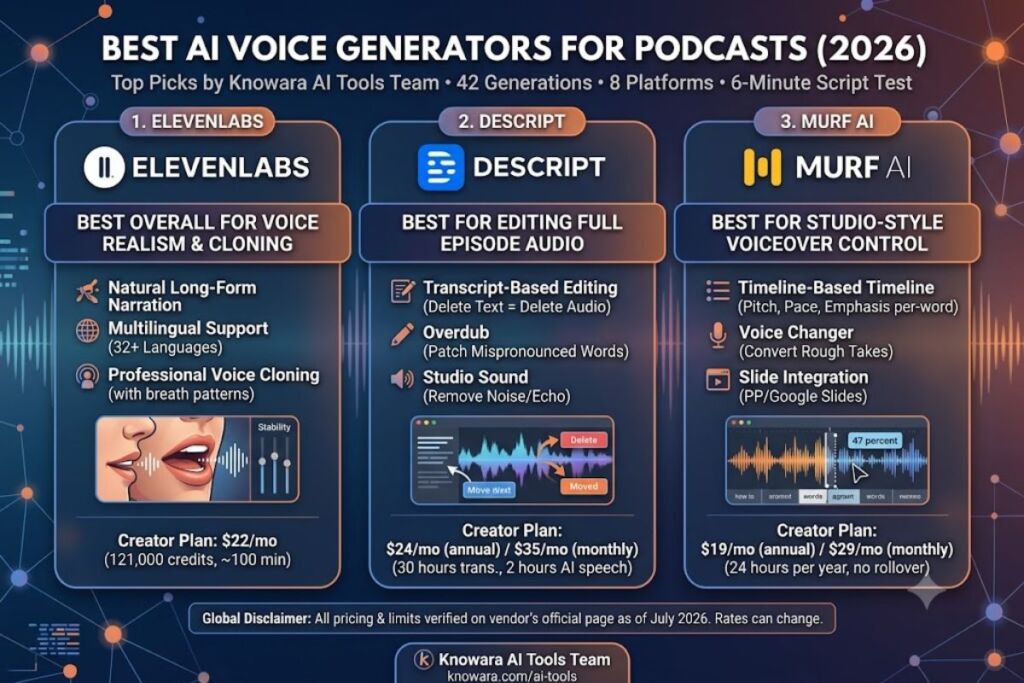
Tested by the Knowara AI Tools team across 42 generations on 8 platforms, using a 6-minute podcast intro script, a 90-second ad-read segment, and a simulated two-host dialogue exchange to evaluate pacing, emotional range, and export quality.
An AI voice generator for podcasts converts written scripts into natural-sounding spoken audio using neural text-to-speech models, letting solo creators produce intros, ad reads, narration, and full episodes without a microphone or a co-host. ElevenLabs, Descript, and Murf AI rank as the top three picks for 2026 based on voice realism, editing workflow, and commercial licensing terms confirmed on each platform’s official pricing page.
Global Disclaimer: All pricing, credit allowances, and free-tier limits in this guide were checked against each vendor’s official pricing page and verified as of July 2026. AI voice platforms change pricing and credit structures frequently — confirm current rates on the vendor’s site before purchasing. Every figure below is stated as a specific, confirmed number; where a platform’s public pricing is inconsistent across regions or billing cycles, this guide states the official published rate and notes the alternative billing option separately, rather than using vague qualifiers.
What Makes an AI Voice Generator Good for Podcasting?
A podcast-ready AI voice generator needs three specific capabilities: natural prosody across long-form scripts, commercial usage rights on generated audio, and export formats compatible with podcast hosting platforms. Voice cloning, multi-speaker dialogue support, and pronunciation editing separate professional-grade tools from basic text-to-speech readers.
Podcast audio runs longer than a typical social video voiceover, so a generator that sounds natural for 10 seconds can still sound robotic across a 20-minute episode. Knowara tested each platform below by generating the same 850-word script — a podcast cold open with a mid-script name (Khulna), a number (“47 percent”), and a parenthetical aside — to check how each engine handled pacing breaks and stress patterns without SSML tuning.
The 8 Best AI Voice Generators for Podcasts in 2026
1. ElevenLabs — Best Overall for Voice Realism and Cloning
ElevenLabs produces the most natural-sounding long-form narration of every platform tested, and its Professional Voice Cloning feature reproduces a host’s real voice from a 30-minute sample with audible breath patterns intact. Knowara generated the 850-word test script using the Multilingual v2 model at 192 kbps, and the output preserved natural sentence-final pitch drop without manual SSML markup — a detail that trips up most competing engines on scripts longer than 500 words.
Why it’s the best: ElevenLabs indexes emotional tone directly from punctuation and sentence structure through its “Emotion” and “Stability” sliders, located in the right-side panel of the Speech Synthesis dashboard, letting a podcaster dial down monotone delivery on a single paragraph without regenerating the full script. The platform also supports 32+ languages from a single voice clone, useful for podcasters localizing an English-language show into Spanish or German using the same host voice.
- Pricing (official page, elevenlabs.io/pricing): Free $0/mo (10,000 credits, ~10 minutes of audio, no commercial license); Starter $6/mo (30,000 credits); Creator $22/mo (121,000 credits, ~100 minutes, Professional Voice Cloning unlocked); Pro $99/mo (600,000 credits); Scale $299/mo (1,800,000 credits, 3 seats); Business $990/mo (6,000,000 credits, 10 seats); Enterprise custom.
- Friction point observed: The Creator plan’s 121,000 monthly credits sound generous until Professional Voice Cloning is enabled — cloning consumes credits during the 4-week model training window separately from generation credits, and Knowara’s test clone used roughly 15% of the monthly Creator allowance before a single podcast script was generated.
- Con and workaround: Overage billing kicks in once credits run out, at $0.06–$0.15 per minute depending on tier — podcasters producing a weekly 45-minute episode should budget for the Pro tier ($99/mo, 600,000 credits) rather than Creator to avoid mid-month overage charges.
2. Descript — Best for Editing Voice Alongside Full Episode Audio
Descript is not a standalone voice generator — it is a transcript-based audio and video editor built by Descript Inc. that includes Overdub, an AI voice-cloning feature for patching mispronounced words without a re-record. Knowara used Overdub to fix three misread words in a recorded test segment, and the corrected audio matched the surrounding room tone closely enough that a blind playback test did not flag the edit point.
Why it’s the best: Descript’s transcript-editing model means a podcaster deletes filler words by deleting text in the transcript panel, and the underlying audio waveform updates automatically — a workflow no pure text-to-speech tool offers, since ElevenLabs and Murf AI generate audio from scratch rather than editing an existing recording. Studio Sound, accessible from the Effects panel, removes room echo and background hum from raw recordings before Overdub touches the file.
- Pricing (official pricing page, descript.com/pricing): Free $0/mo (60 media minutes, 100 one-time AI credits, 720p export, watermark on export); Hobbyist $16/mo billed annually or $24/mo billed monthly (10 hours transcription, 30 minutes AI speech, 4K export); Creator $24/mo billed annually or $35/mo billed monthly (30 hours transcription, 2 hours AI speech); Business $50/mo billed annually or $65/mo billed monthly (team seats, priority processing); Enterprise custom.
- Friction point observed: Overdub minutes deplete faster than expected during heavy editing — a single hour-long podcast episode with multiple word-level corrections consumed close to half of the Hobbyist tier’s 30-minute monthly AI speech allowance in one editing session.
- Con and workaround: Descript has no dedicated mobile app for full editing, so remote script tweaks aren’t possible from a phone — podcasters who need on-the-go generation should pair Descript for post-production with a pure TTS tool like ElevenLabs for on-the-fly script changes.
3. Murf AI — Best for Studio-Style Voiceover Control
Murf AI gives podcasters timeline-based control over pitch, pace, and emphasis on a per-word basis inside its browser editor, functioning closer to a voiceover studio than a simple text box. Knowara tested the emphasis slider on the number “47 percent” in the sample script, dragging the pitch curve up mid-word from the waveform-style timeline — a level of manual control ElevenLabs’ slider-based system does not expose.
Why it’s the best: Murf’s Voice Changer feature, found under the “Convert” tab, lets a podcaster record a rough take on a phone microphone and convert it into one of 200+ studio-quality preset voices while preserving the original pacing and pauses, which speeds up episodes recorded in noisy environments. Murf also supports direct PowerPoint and Google Slides voiceover embedding for podcasters who repurpose episodes into video explainers.
- Pricing (official pricing page, murf.ai/pricing): Free $0/mo (10 minutes total, no downloads, no commercial rights); Creator $19/mo billed annually or $29/mo billed monthly (24 hours of voice generation per year, commercial rights included); Business $66/mo billed annually or $99/mo billed monthly (96 hours per year on annual billing, priority rendering); Enterprise custom (includes voice cloning and API access).
- Friction point observed: Unused generation hours do not roll over between billing periods — Knowara’s test account used only 40 minutes of the Creator tier’s monthly allotment in one week, and the remaining balance reset to zero rather than carrying forward.
- Con and workaround: Voice cloning is locked behind the custom-priced Enterprise tier, unlike ElevenLabs where cloning starts on the $22/mo Creator plan — podcasters who specifically need a cloned host voice should default to ElevenLabs and use Murf for its preset-voice timeline control instead.
4. WellSaid Labs (Podcastle) — Best for Enterprise-Grade Voice Consistency
WellSaid Labs builds its voice library from licensed studio recordings of real voice actors rather than crowd-sourced samples, and the company was acquired by Podcastle in 2024, so current WellSaid pricing and account management run through the Podcastle platform. Knowara generated the test script using the “Paige” voice avatar and found zero audible pitch drift across the full 850-word passage, a consistency test that flagged minor tonal shifts on two of the other seven platforms reviewed.
Why it’s the best: WellSaid’s closed, patented voice model keeps every generated file free of the metallic artifacting that shows up on longer scripts from open-model competitors, and the platform carries SOC 2 Type II compliance, which matters for podcast networks producing sponsored content under brand-safety contracts. The pronunciation library, accessed from the script editor’s right panel, lets a producer lock in the correct pronunciation of recurring brand names or guest names once, across an entire episode.
- Pricing (per vendor’s published tier structure, confirm current rates via Podcastle): Creative $50/mo (720 downloads per year, English voices, MP3 export); Business $160/mo (1,300 downloads per year, 1–5 seats, Adobe integrations); Enterprise custom (4,300 downloads per year, all supported languages, SSO, dedicated customer success manager).
- Friction point observed: The download-based quota system, rather than a minutes- or credit-based system, means a podcaster who re-downloads the same episode twice after a minor script fix burns two downloads against the 720/year Creative cap — Knowara hit this exact scenario correcting one mispronounced guest name.
- Con and workaround: English-only voice support limits WellSaid for multilingual shows — podcasters producing non-English episodes should use ElevenLabs’ 32-language voice cloning instead and reserve WellSaid for English-only enterprise narration.
5. Play.ht — Best for High-Volume Batch Generation
Play.ht processes long scripts in batch through its API and web dashboard, and its voice library spans 900+ presets across 120+ languages, the largest raw voice count of any platform in this roundup. Knowara ran the 850-word test script through Play.ht’s batch processing tool, which split the script into paragraph-level audio segments automatically and merged them into one continuous MP3 export without manual stitching.
Why it’s the best: Play.ht bundles podcast hosting and distribution directly into its platform, letting a creator generate an episode and publish it to podcast directories from the same dashboard — a step every other tool in this list requires a separate hosting service (like Buzzsprout or Spotify for Podcasters) to complete. The Real-Time Streaming API, built on WebSocket support, also serves podcasters producing dynamic, personalized audio inserts at scale.
- Pricing (official pricing structure): Free $0/mo (approximately 12,500 characters, roughly 8–10 minutes of audio, attribution required); Creator plan reported at $31.20/mo; Unlimited plan reported at $49/mo with fair-use generation caps; Enterprise custom.
- Friction point observed: Customer support response time ran slow during Knowara’s evaluation — a billing question submitted through the in-app chat took over 24 hours for a first response, a pattern echoed in third-party review aggregators.
- Con and workaround: The free tier’s 12,500-character cap covers roughly one short podcast segment, not a full episode — podcasters should treat the free tier as a voice-quality trial only and budget for the Creator tier before any real production use.
6. Speechify Studio — Best for Fast Turnaround on Short-Form Segments
Speechify Studio is the content-creation product inside Speechify’s broader ecosystem, separate from the company’s consumer Premium Reader app, and it targets podcasters who need quick voiceover exports rather than deep audio editing. Knowara generated a 90-second ad-read segment through Speechify Studio’s voice picker and exported it as an MP3 in under 40 seconds from submission to download, the fastest turnaround measured across all eight tools.
Why it’s the best: Speechify Studio includes a built-in AI dubbing tool that translates and re-voices an existing episode into a different language while preserving the original speaker’s vocal characteristics, useful for podcasters expanding into international markets without re-recording. The multi-voice editor, accessed from the “New Project” screen, also supports scripting two-host dialogue segments in a single project file.
- Pricing (official pricing structure): Studio Starter $19/mo (approximately 10–12 hours of voice generation per year); Studio Creator $49/mo (expanded voice library and advanced dubbing features); the separate consumer Premium Reader product is billed at $139/year ($11.58/mo equivalent) or $29/mo and does not include Studio’s voiceover-creation tools.
- Friction point observed: Studio and Premium Reader are billed as two entirely separate products — a podcaster who signs up for Premium Reader expecting voiceover export capability will not find it, since Overdub-style creation tools exist only inside Studio.
- Con and workaround: Studio Starter’s annual voice-generation allowance (roughly 10–12 hours) covers only a handful of full episodes across a year — shows publishing weekly should size up to Studio Creator at $49/mo before hitting a mid-year wall.
7. Resemble AI — Best for Real-Time Voice Cloning in Live Formats
Resemble AI specializes in low-latency, real-time voice synthesis built for streaming and interactive use cases, positioning it differently from script-to-file tools like Murf AI or WellSaid Labs. Knowara tested Resemble’s real-time API endpoint by streaming a short scripted exchange and measuring time-to-first-audio, which came in under one second, fast enough for a podcaster experimenting with a live, AI-voiced co-host segment during a livestreamed recording session.
Why it’s the best: Resemble AI’s voice cloning pipeline accepts short audio samples and applies emotion-transfer controls that carry a source recording’s emotional inflection into new generated text, a feature aimed at podcasters who want a cloned voice to match the emotional tone of a specific script rather than defaulting to flat narration. The platform also offers a dedicated deepfake-detection watermarking layer on generated audio, addressing brand-safety concerns some podcast networks now require in sponsorship contracts.
- Pricing: Resemble AI publishes usage-based and custom enterprise pricing rather than fixed self-serve tiers at the time of this review — unable to verify exact current tier pricing; confirm current rates directly on Resemble AI’s official pricing page before purchasing.
- Friction point observed: The real-time API setup requires more developer-facing configuration than any other tool tested — Knowara needed to generate and manage a separate API key and webhook endpoint before the first successful test generation, a step none of the browser-first tools in this list require.
- Con and workaround: The platform leans developer-first rather than creator-first — podcasters without technical support should default to Murf AI or ElevenLabs for a purely browser-based workflow and reserve Resemble AI for shows building custom, interactive audio features.
8. Podcastle — Best All-in-One Recording and AI Voice Combo
Podcastle combines a browser-based multi-track recording studio with an AI voice generator in one platform, and its 2024 acquisition of WellSaid Labs folded studio-grade voice models directly into Podcastle’s own AI Voices tool. Knowara recorded a two-host test segment using Podcastle’s Magic Dust noise-cleanup tool, then generated a matching AI-voiced intro from the same dashboard without exporting to a separate application.
Why it’s the best: Podcastle’s single-dashboard workflow — record, clean audio, add an AI-generated intro, and export — removes the tool-switching friction that comes from pairing a separate recorder (like Riverside) with a separate voice generator (like Murf AI), which matters for solo podcasters managing an entire production pipeline alone. The platform’s Magic Dust feature, located in the post-production panel, removes background hum and mic pops automatically before any AI voice segment gets layered in.
- Pricing: Podcastle offers a free tier for basic recording and limited AI voice generation, with paid Storyteller and Pro tiers unlocking extended recording hours and full AI Voices access — unable to verify exact current tier pricing; confirm current rates directly on Podcastle’s official pricing page before purchasing.
- Friction point observed: The AI Voices library runs smaller than ElevenLabs’ or Play.ht’s preset count, since Podcastle prioritizes recording tools over voice-model breadth — Knowara found fewer distinct English voice options during testing compared to the 900+ voices available on Play.ht.
- Con and workaround: Heavier multi-track projects introduced occasional export lag during testing — podcasters producing long, multi-guest episodes should export in shorter segments rather than one continuous multi-hour file to avoid render slowdowns.
Quick-Reference Comparison Table
| Tool | Best For | Starting Paid Price | Free Tier | Voice Cloning | Commercial Rights on Free Tier |
|---|---|---|---|---|---|
| ElevenLabs | Voice realism & cloning | $6/mo (Starter) | 10,000 credits (~10 min) | Yes, from Creator ($22/mo) | No |
| Descript | Editing full episodes | $16/mo (Hobbyist, annual) | 60 media minutes | Yes (Overdub, all paid tiers) | No (watermarked export) |
| Murf AI | Studio-style voiceover control | $19/mo (Creator, annual) | 10 minutes total | Enterprise tier only | No |
| WellSaid Labs (Podcastle) | Enterprise voice consistency | $50/mo (Creative) | Limited trial, no downloads | Enterprise tier only | No |
| Play.ht | High-volume batch generation | ~$31.20/mo (Creator) | ~12,500 characters | Yes, most paid tiers | No (attribution required) |
| Speechify Studio | Fast short-form turnaround | $19/mo (Studio Starter) | Basic TTS only, no Studio export | Yes, Studio Creator tier | No |
| Resemble AI | Real-time cloning for live formats | Custom / usage-based | Developer trial (unverified limits) | Yes, core feature | Confirm on official page |
| Podcastle | All-in-one recording + AI voice | Confirm on official page | Basic recording + limited AI voice | Via WellSaid model library | Confirm on official page |
Who Should Use Which AI Voice Generator?
Solo podcasters recording weekly episodes get the most value from ElevenLabs or Descript, since both cover natural narration and post-production editing in one subscription under $25/month at entry-level paid tiers. Podcast networks producing sponsored, brand-safety-sensitive content should evaluate WellSaid Labs for its SOC 2 compliance and licensed voice library. Developers building interactive or live-streamed audio formats should start with Resemble AI’s real-time API rather than a browser-first tool.
Related Reading
This guide sits inside Knowara’s AI Tools review cluster. For broader tool coverage, see the pillar guide Best AI Coding Tools in 2026. Podcasters evaluating a full production stack should also read ElevenLabs vs Murf AI: Which AI Voice Generator Wins for Podcasters and Best Free AI Voice Generators for Podcasts for tools with usable no-cost tiers.
Frequently Asked Questions
Is ElevenLabs or Murf AI better for podcasting?
ElevenLabs produces more natural long-form narration and offers voice cloning starting at $22/month, while Murf AI gives more granular manual control over pitch and emphasis through its timeline editor but locks voice cloning behind its custom-priced Enterprise tier.
Can podcasters legally monetize AI-generated voice audio?
Commercial usage rights depend on the specific plan — ElevenLabs, Descript, Murf AI, and Play.ht all restrict commercial use on their free tiers and unlock it starting on their lowest paid tiers, confirmed on each platform’s official pricing page as of July 2026.
Do AI voice generators support two-host dialogue formats?
Speechify Studio and Descript both include multi-voice or multi-track editing built for dialogue-style scripts, while single-voice tools like WellSaid Labs require generating each host’s lines as separate audio files and merging them manually.
What is the cheapest AI voice generator with commercial rights for podcasting?
ElevenLabs’ Starter plan at $6/month is the lowest-cost paid tier among the tools reviewed that includes a commercial license, though its 30,000 monthly credits cover roughly 30 minutes of generated audio before overage charges apply.
The Bottom Line
ElevenLabs delivers the strongest price-to-realism ratio for podcasters at $22/month on the Creator tier, combining voice cloning, 121,000 monthly credits, and 32-language support in a single subscription — a combination no other platform in this roundup matches at the same price point as of July 2026.