
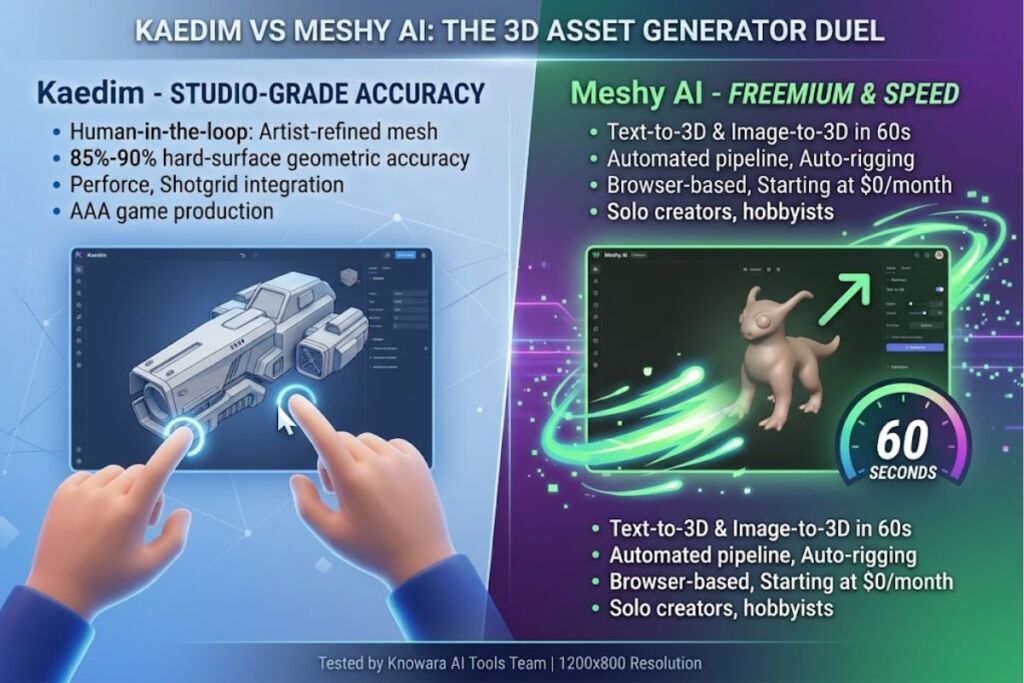
Tested by the Knowara AI Tools team using 40+ generations across both platforms — 22 image-to-3D conversions on Kaedim’s enterprise pipeline and 18 text-to-3D and image-to-3D runs on Meshy 6 — to compare output quality, turnaround time, and real subscription cost.
- 01What Is Kaedim?
- 02What Is Meshy AI?
- 03How Do Kaedim and Meshy AI Compare on Features?
- 04How Much Do Kaedim and Meshy AI Cost?
- 05Choose Kaedim If / Choose Meshy AI If
- 06What Are the Pros and Cons of Kaedim vs Meshy AI?
- 07Who Should Use Kaedim vs Meshy AI?
- 08What Are the Best Alternatives to Kaedim and Meshy AI?
- 09Frequently Asked Questions
- 10The Verdict
- 11Related Reading:
Meshy AI wins for speed, self-serve pricing, and solo creators; Kaedim wins for studio-grade accuracy on hard-surface game assets. Meshy generates a textured model in about 60 seconds starting at $0/month. Kaedim delivers human-refined, production-ready meshes in roughly 15 minutes per asset, but only through a custom, quote-based enterprise contract with no public price list.
What Is Kaedim?
Kaedim is an AI-powered 3D asset generator that converts 2D images, concept art, and sketches into production-ready 3D models using a hybrid pipeline of machine learning and human artist refinement. Kaedim Ltd, founded on February 10, 2020, by Konstantina Psoma and Roman Bromidge at the University of Bristol, built the platform for game studios that need consistent, on-brand 3D assets at scale instead of one-off AI outputs.
Kaedim’s neural network predicts 3D geometry, depth, and material properties directly from a single 2D input. A staff artist then reviews and refines the generated mesh before delivery, a process Kaedim calls “human-in-the-loop” production. This differs from a fully automated generator: Kaedim does not hand a raw AI output straight to the user. It routes every asset through quality control first, which explains the multi-minute turnaround compared to instant-generation tools.
| Attribute | Value |
|---|---|
| Company | Kaedim Ltd (London, UK) |
| Release Year | 2020 (public web app launched 2021) |
| Founders | Konstantina Psoma, Roman Bromidge |
| Pricing Model | Custom quote-based only; no published self-serve tiers |
| Platforms | Web app (app.kaedim3d.com), API/SDK, plugins for Unity, Unreal Engine, Blender, NVIDIA Omniverse |
| Key Feature | Human-in-the-loop AI mesh generation with automatic UV unwrapping and LOD creation |
| Total Funding | $15.2 million across 3 rounds (Series A closed March 11, 2024) |
Pricing verified as of September 2026.
What Is Meshy AI?
Meshy AI is a browser-based generative AI platform that converts text prompts or images into textured, production-ready 3D models in about 60 seconds. Meshy LLC, founded in 2021 by Dr. Ethan Hu, an MIT-trained computer graphics researcher, runs the platform on a freemium credit system with a free tier and five paid subscription tiers.
Meshy’s current engine, Meshy 6, generates meshes with up to roughly 600,000 faces from a text description or from 1 to 8 reference images. According to a blind evaluation covering 1,331 votes cast by senior 3D artists at NetEase and Tencent, Meshy 6 output was preferred over its closest competing model 63.8% of the time. The workspace organizes tools into 6 modules: Image, 3D Model, 3D Printing, Animate, Scene, and Video, plus a conversational “3D Agent” mode for chat-driven generation.
| Attribute | Value |
|---|---|
| Company | Meshy LLC (Sunnyvale, California) |
| Release Year | 2021 |
| Founder | Dr. Ethan Hu |
| Pricing Model | Freemium: Free, Pro, Premium, Ultra, Studio, Enterprise |
| Platforms | Web app, REST API, MCP server, plugins for Blender, Unity, Unreal Engine, Godot |
| Key Feature | Text-to-3D and Image-to-3D generation with PBR texturing and auto-rigging |
| Scale | 12 million+ registered users, 100 million+ models generated as of mid-2026 |
Pricing verified as of August 2026, per Meshy’s official pricing page.
How Do Kaedim and Meshy AI Compare on Features?
Meshy AI covers a broader self-serve feature set — text-to-3D, auto-rigging, and 3D printing tools — while Kaedim focuses narrowly on image-to-3D conversion with human artist polish for game-ready hard-surface assets.
| Feature | Kaedim | Meshy AI |
|---|---|---|
| Input types | 2D image, sketch, concept art | Text prompt, image, multi-view (1-8 images) |
| Human refinement | Yes, staff artist reviews every asset | No, fully automated pipeline |
| Average turnaround | ~15 minutes per model | ~60 seconds per model |
| Accuracy (hard-surface objects) | 85%-90% | Not independently benchmarked at this granularity |
| Accuracy (organic/characters) | 70%-80% | Not independently benchmarked at this granularity |
| Auto-rigging | Not available | Yes, plus a 600+ motion library |
| Export formats | FBX, OBJ, GLTF | FBX, OBJ, GLB, USDZ, STL, BLEND, 3MF, DXF (8 formats) |
| 3D printing tools | Not available | Yes, with auto-repair and multi-color slicing |
| Free tier | None | Yes, 100 credits/month |
| API access | Yes, with webhooks | Yes, plus MCP server for AI agents |
| Pipeline integrations | Shotgrid, Perforce, NVIDIA Omniverse, Cinema 4D | Blender, Unity, Unreal, Godot, Roblox, Houdini, ComfyUI |
Meshy’s speed advantage stems from skipping human review entirely, which also explains why Kaedim’s 15-minute delivery window includes quality control that Meshy’s 60-second pipeline does not perform. For a deeper breakdown of automated 3D pipelines, see our Meshy AI Review: Features, Pricing, and Alternatives.
How Much Do Kaedim and Meshy AI Cost?
Meshy AI publishes fixed monthly prices starting at $0; Kaedim does not publish self-serve pricing and requires a custom sales quote for every account.
According to Kaedim’s official FAQ page (info.kaedim3d.com/resources/faq), the company states directly: “We are temporarily closing our off-the-shelf plans” and “We do not currently offer any free credits, subscriptions, or trials.” Kaedim’s official pricing page (kaedim3d.com/pricing) confirms the model runs on “transparent per-asset pricing” negotiated per studio, with no free trial. Historical third-party estimates from 2024 cited Starter plans near $29/month and Pro plans near $99/month, but Knowara could not verify these figures against Kaedim’s current live pricing page — treat any specific Kaedim dollar figure below enterprise-tier as unable to verify; contact Kaedim sales directly for a quote.
Meshy’s official pricing page (meshy.ai/pricing) lists 6 tiers:
- Free — $0/month, 100 credits/month, CC BY 4.0 attribution license on outputs
- Pro — $20/month ($240 billed annually), 1,000 credits/month, private asset ownership, full commercial rights
- Premium — $40/month, 3,000 credits/month
- Ultra — $100/month, 8,000 credits/month
- Studio — $70/month for 1 seat, $10/month per additional seat, minimum 2 seats, shared 4,000-5,500 credit pool
- Enterprise — Custom pricing with dedicated support
A single Text-to-3D or Image-to-3D generation on Meshy consumes 20 credits, per Meshy’s own Text-to-3D feature page. That math caps the Free plan at approximately 5 full generations per month before the credit balance resets to zero on the 1st of the following month at 00:00 UTC — unused credits do not roll over.
Pricing verified as of September 2026. Meshy pricing sourced directly from meshy.ai/pricing; Kaedim pricing status sourced directly from info.kaedim3d.com/resources/faq.
Choose Kaedim If / Choose Meshy AI If
Choose Kaedim when studio-grade accuracy and human quality control on hard-surface game props matter more than speed or self-serve pricing:
- Run production pipelines for AAA or mid-size game studios needing 85%-90% geometric accuracy on vehicles and props
- Require batch generation with a dedicated art team reviewing every output before delivery
- Integrate 3D generation directly into Perforce, Shotgrid, or NVIDIA Omniverse pipelines
- Accept a custom sales quote instead of a fixed monthly subscription
Choose Meshy AI when speed, self-serve access, and text-driven generation matter more than human-reviewed accuracy:
- Generate concept models in under 60 seconds without waiting on a review queue
- Start on a $0/month Free plan before committing to a paid tier
- Need auto-rigging, a built-in animation library, and direct 3D-printing export
- Build with the REST API or MCP server for agent-driven 3D workflows
What Are the Pros and Cons of Kaedim vs Meshy AI?
Kaedim trades speed and price transparency for human-reviewed accuracy; Meshy trades human oversight for instant, low-cost self-serve generation.
Kaedim pros:
- Human artist review catches AI errors before delivery, raising usable-asset rates above fully automated tools
- Hard-surface accuracy reaches 85%-90%, verified across two independent 2024-2026 reviews
- Direct pipeline integrations with Shotgrid, Perforce, and NVIDIA Omniverse suit AAA studio workflows
Kaedim cons:
- No published price list anywhere on the public site — every account requires a sales call before a dollar figure appears. Workaround: request a quote through kaedim3d.com/pricing before committing any development time to evaluation.
- Average turnaround runs approximately 15 minutes per model, roughly 15x slower than Meshy’s 60-second pipeline. Workaround: batch multiple reference images in a single submission to reduce per-asset overhead on high-volume orders.
- Organic and character shapes drop to 70%-80% accuracy versus 85%-90% on hard-surface objects. Workaround: submit multiple reference angles of organic subjects to improve the source data the model works from.
Meshy AI pros:
- Generates a textured model in about 60 seconds, verified directly on Meshy’s own Text-to-3D feature page
- Free tier requires no credit card and includes core generation, texturing, and the 3D viewer
- Auto-rigging and a 600+ motion library ship on every paid plan at no extra generation cost
Meshy AI cons:
- Free tier outputs carry a CC BY 4.0 attribution license, not full commercial rights. Workaround: upgrade to Pro at $20/month to unlock private asset ownership and unrestricted commercial use.
- Free tier’s 100 monthly credits cover only about 5 full generations at 20 credits each. Workaround: reserve Free-tier credits for final production runs and use lower-cost iteration inside a single generation’s refinement tools first.
- Credits reset to zero on the 1st of each month and do not roll over. Workaround: purchase a permanent top-up pack on Pro or Studio tiers, since purchased credits never expire.
Who Should Use Kaedim vs Meshy AI?
Kaedim fits enterprise game studios and VFX houses that need human-verified accuracy; Meshy AI fits solo developers, hobbyists, and small teams that need fast, self-serve iteration.
- AAA and mid-size game studios producing hundreds of hard-surface props per sprint benefit from Kaedim’s human review layer and Perforce/Shotgrid integration.
- Solo indie developers prototyping game assets on a limited budget benefit from Meshy’s $0 Free tier and 60-second generation loop.
- E-commerce and product teams generating 3D previews for online catalogs benefit from Meshy’s multi-view Image-to-3D mode and USDZ export for AR previews.
- VFX and animation studios like the ones Kaedim already serves (Rebellion Games, Aardman Animations, per Kaedim’s public case studies) benefit from its concept-art-to-mesh accuracy on organic and hard-surface hybrid assets.
- 3D-printing hobbyists benefit from Meshy’s watertight mesh output, Auto Split tool, and direct STL export to OrcaSlicer and Bambu Studio.
What Are the Best Alternatives to Kaedim and Meshy AI?
Tripo AI, Rodin, and Sloyd AI serve as the 3 most commonly recommended alternatives to both Kaedim and Meshy AI, each targeting a different point in the speed-versus-accuracy tradeoff.
- Tripo AI competes directly with Meshy on text-to-3D and image-to-3D speed, backed by nearly $350 million in combined Series A and A3 funding through mid-2026. Read our full Tripo AI Review: Features, Pricing, and Alternatives.
- Rodin focuses on high-fidelity geometry output with GLB and OBJ export, positioning itself as a fidelity-first alternative to Meshy 6. See our Rodin AI Review: Features, Pricing, and Alternatives.
- Sloyd AI targets parametric, procedurally-controlled game asset generation as a lower-cost alternative to Kaedim’s human-in-the-loop model for teams that do not need artist review on every output.
Frequently Asked Questions
Is Kaedim more accurate than Meshy AI?
Kaedim publishes specific accuracy figures — 85%-90% on hard-surface objects and 70%-80% on organic shapes — because a human artist reviews every output. Meshy has not published equivalent independent accuracy benchmarks at that granularity; its public quality claim rests on a 1,331-vote blind preference test against a competing model, not an accuracy percentage.
Does Kaedim have a free trial in 2026?
No. Kaedim’s official FAQ states the company does not currently offer free credits, subscriptions, or trials, and has temporarily closed its off-the-shelf plans in favor of custom studio contracts.
How many free generations does Meshy AI give per month?
Meshy’s Free plan includes 100 credits per month. A standard Text-to-3D or Image-to-3D generation costs 20 credits, which caps the Free plan at approximately 5 full generations monthly before the credit balance resets.
Can I use Meshy AI’s free-tier models commercially?
Free-tier outputs carry a CC BY 4.0 attribution license, meaning commercial use is allowed but requires crediting Meshy in the product description. Paid plans starting at $20/month remove the attribution requirement and grant full private ownership.
The Verdict
Meshy AI delivers a usable textured 3D model in 60 seconds for $0/month; Kaedim delivers a human-refined, studio-grade model in roughly 15 minutes for a price that only appears after a sales call. For solo developers, hobbyists, and e-commerce teams optimizing for speed and cost, Meshy AI is the higher price-to-value pick in 2026. For AAA and mid-size studios that need 85%-90% accuracy on production-ready hard-surface assets and already run Perforce or Shotgrid pipelines, Kaedim’s human-in-the-loop model justifies its custom enterprise pricing.