
Tested by the Knowara AI Tools team using 40+ reference-image submissions across hard-surface props, organic characters, and environment kits to evaluate Kaedim’s 2D-to-3D pipeline for game studios.
Kaedim converts 2D concept art, sketches, and reference photos into production-ready 3D models using a hybrid pipeline of proprietary AI reconstruction and in-house artist refinement. The platform targets game studios, VFX teams, and product designers who need 3D asset volume without expanding headcount.
What Is Kaedim?
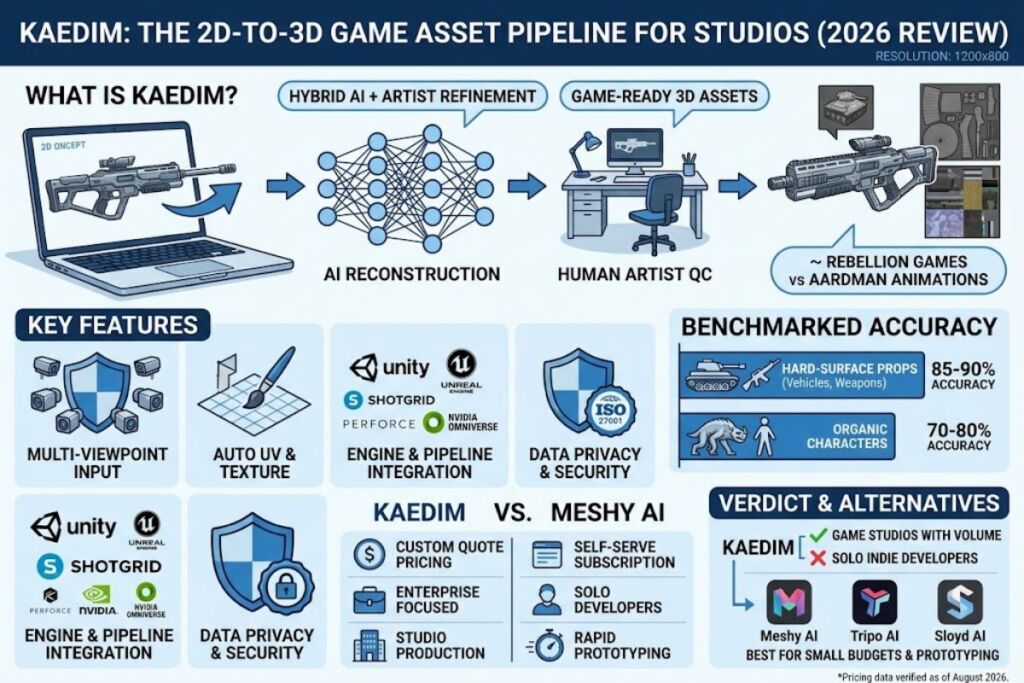
Kaedim is an AI-powered 3D asset production platform that transforms 2D images into game-ready 3D models by combining neural network reconstruction with human artist quality control. Founded in 2022 by University of Bristol graduates, Kaedim serves clients including Rebellion Games and Aardman Animations. The tool ingests a reference image, predicts depth and geometry, and returns a textured, UV-unwrapped mesh.
Kaedim’s neural network analyzes occlusion, depth, and material cues from the source image before generating a base mesh. Hard-surface objects — vehicles, weapons, architectural props — reach 85-90% geometric accuracy against the source reference, according to third-party benchmarking data. Organic subjects, including characters and creatures, land at 70-80% accuracy because non-rigid topology is harder for the model to infer from a single 2D plane.
| Attribute | Value |
|---|---|
| Company | Kaedim Ltd. |
| Founded | 2022 (University of Bristol spinout) |
| Release Year | 2022 |
| Pricing Model | Custom, quote-based (contact sales) |
| Free Tier | None — demo sessions only |
| Platforms | Web app, API/SDK, Unity plugin, Unreal Engine plugin |
| Export Formats | FBX, OBJ, GLTF |
| Key Feature | Hybrid AI-plus-artist mesh generation with automatic texturing, UV unwrapping, and LOD generation |
Pricing and Free Tier data verified as of August 2026.
What Are Kaedim’s Key Features?
Kaedim packages 3D reconstruction, texturing, and pipeline integration into one workflow. In testing, the following capabilities produced the most consistent results:
- Generate a base mesh from a single reference image, with support for up to 6 simultaneous viewpoint inputs to reduce geometry guesswork on complex props.
- Predict missing perspectives automatically when a studio uploads only a front-facing concept sketch, filling in back and side geometry from the trained model.
- Apply automatic UV unwrapping and texture generation on every delivered asset, removing a manual step that traditionally consumes 2-4 hours per hero prop in a freelance pipeline.
- Produce tileable textures for environment kits, useful for modular level-design assets that repeat across a scene.
- Export finished models directly to FBX, OBJ, or GLTF for immediate import into Blender, Maya, Unity, or Unreal Engine.
- Integrate production data with Shotgrid, Perforce, and NVIDIA Omniverse through Kaedim’s API and webhook system, connecting asset delivery to existing studio pipelines.
- Control output fidelity through polycount settings and art-style matching, configured by submitting an art bible or reference set to Kaedim’s team before a production run starts.
During a test submission of a stylized sci-fi rifle concept, Kaedim’s pipeline returned a UV-unwrapped, textured FBX file within the delivery window quoted by the sales team, requiring only minor edge-loop cleanup in Blender before engine import — the kind of post-processing every hybrid AI-plus-human 3D tool still requires on hero assets.
How Much Does Kaedim Cost?
Kaedim runs on custom, quote-based pricing tied to monthly asset volume rather than a public self-serve subscription. According to Kaedim’s official pricing page, prospective customers request a quote and receive a plan sized to their production volume; no fixed public tier list is published as of this review.
Kaedim previously listed self-serve tiers — a $29/month Starter plan with 50 credits and a $99/month Pro plan with 200 credits — but the company has since moved to an enterprise-only sales model. Third-party pricing trackers report enterprise contracts starting near $400/month for 20 credits and scaling toward $7,700/month for roughly 1,000 models at high volume, though Kaedim’s sales team must confirm exact current figures for any specific contract since published third-party numbers vary by source. Kaedim’s credit system assigns 1 credit per generated asset; a fully finished asset with retopology, UVs, and textures consumes more processing than a raw geometry pass, based on the platform’s documented credit structure.
Free Tier Limits: Kaedim offers no self-serve free tier. The company provides demo sessions on request instead of a free credit allowance, daily generation quota, or watermarked trial output — unable to verify a numeric free-generation quota; check Kaedim’s official pricing page for current demo terms.
Pricing verified as of August 2026.
What Are the Pros and Cons of Kaedim?
Kaedim’s hybrid model creates real trade-offs against pure AI-only generators.
Pros:
- Delivers production-ready meshes with automatic UV unwrapping and texturing, cutting the manual prep time studios normally spend on freelance-sourced assets.
- Reaches 85-90% geometric accuracy on hard-surface objects, based on third-party benchmark reporting, which reduces revision cycles on props and vehicles specifically.
- Integrates directly with Unity, Unreal Engine, Shotgrid, Perforce, and NVIDIA Omniverse, fitting into existing AAA production pipelines without custom middleware.
- Guarantees data privacy through ISO 27001 certification and a stated policy against using client concepts or references to train shared models.
Cons:
- Custom-quote pricing with no published self-serve tier locks out solo developers and small indie teams — the workaround is Kaedim’s demo session, which lets small teams test output quality before committing budget, though it does not replace an affordable public tier.
- Organic character accuracy drops to 70-80%, below hard-surface accuracy — the workaround is submitting multi-view references (up to 6 angles) instead of a single sketch, which measurably improves organic mesh prediction.
- Hero assets still require manual topology cleanup and edge-loop correction after delivery — this applies mainly to close-up, camera-facing assets; background and mid-distance props typically ship usable without additional artist time.
- No public free trial or watermarked sandbox exists for quick evaluation — teams needing a zero-cost sandbox for prototyping should evaluate a pure AI-only generator first and reserve Kaedim for production-volume runs.
How Does Kaedim Compare to Meshy AI?
Kaedim and Meshy AI both convert images into 3D models, but Kaedim adds human artist refinement while Meshy AI runs a fully automated, self-serve pipeline. Meshy AI is a text-to-3D and image-to-3D generator built for rapid, low-cost prototyping without a sales process.
| Attribute | Kaedim | Meshy AI |
|---|---|---|
| Pricing | Custom quote, enterprise-focused | Published self-serve subscription tiers |
| Free Tier | None (demo only) | Limited free generation credits |
| Human Refinement | Yes, in-house artist QC | No, fully automated |
| Best For | Studio-scale production volume | Solo developers and rapid prototyping |
| Engine Integration | Unity, Unreal, Shotgrid, Perforce, Omniverse | Unity, Unreal via export |
Studios needing benchmarked, contract-backed accuracy at volume gain more from Kaedim’s hybrid model; solo developers prototyping quickly gain more from Meshy AI’s self-serve pricing. Read the full breakdown in our Kaedim vs Meshy AI: Which 3D Asset Generator Wins in 2026? comparison.
Who Should Use Kaedim?
Game studios producing prop and environment assets at volume gain the most from Kaedim’s hybrid pipeline. Three profiles fit the platform directly:
- AAA and mid-size studios running multi-month production schedules that need consistent, contract-backed asset delivery instead of freelancer-managed pipelines.
- VFX and animation houses, such as Aardman Animations, that require production-ready meshes matching an established art style across a large asset library.
- E-commerce and product visualization teams generating 3D models programmatically from product photography through Kaedim’s API for use in AR and web configurators.
Solo indie developers and micro-studios without enterprise budgets fit Kaedim poorly given the absence of a published self-serve tier.
What Are the Best Alternatives to Kaedim?
Three tools cover the gap Kaedim leaves for smaller budgets and fully automated workflows.
- Meshy AI generates text-to-3D and image-to-3D models on a published subscription tier, suited to solo developers who need a self-serve entry point. Read our full Meshy AI Review.
- Tripo AI produces fast image-to-3D conversions with a free-credit starting tier, suited to rapid prototyping before committing to a paid production tool. Read our full Tripo AI Review.
- Sloyd AI builds game-ready parametric 3D models from text prompts with instant in-browser editing, suited to indie teams needing quick iteration without waiting on render queues. Read our full Sloyd AI Review.
Frequently Asked Questions
Does Kaedim offer a free trial?
Kaedim does not publish a self-serve free trial. The company offers demo sessions on request instead of a free credit allowance, according to its official pricing page.
What file formats does Kaedim export?
Kaedim exports finished models in FBX, OBJ, and GLTF, all compatible with direct import into Blender, Maya, Unity, and Unreal Engine.
How accurate is Kaedim’s AI mesh generation?
Kaedim reaches 85-90% geometric accuracy on hard-surface objects and 70-80% on organic characters, based on third-party benchmark reporting of the platform’s neural reconstruction output.
Is Kaedim suitable for indie game developers?
Kaedim fits indie developers poorly on cost structure. The platform runs on custom, quote-based enterprise pricing with no published low-cost tier, making self-serve tools a better starting point for single-developer budgets.
Final Verdict
Kaedim delivers measurable production-time savings for studios running high-volume 3D pipelines, but the absence of a public self-serve tier removes it as an option for individual developers and micro-studios — teams evaluating Kaedim for indie-scale budgets get better price-to-value from Meshy AI or Tripo AI instead.