
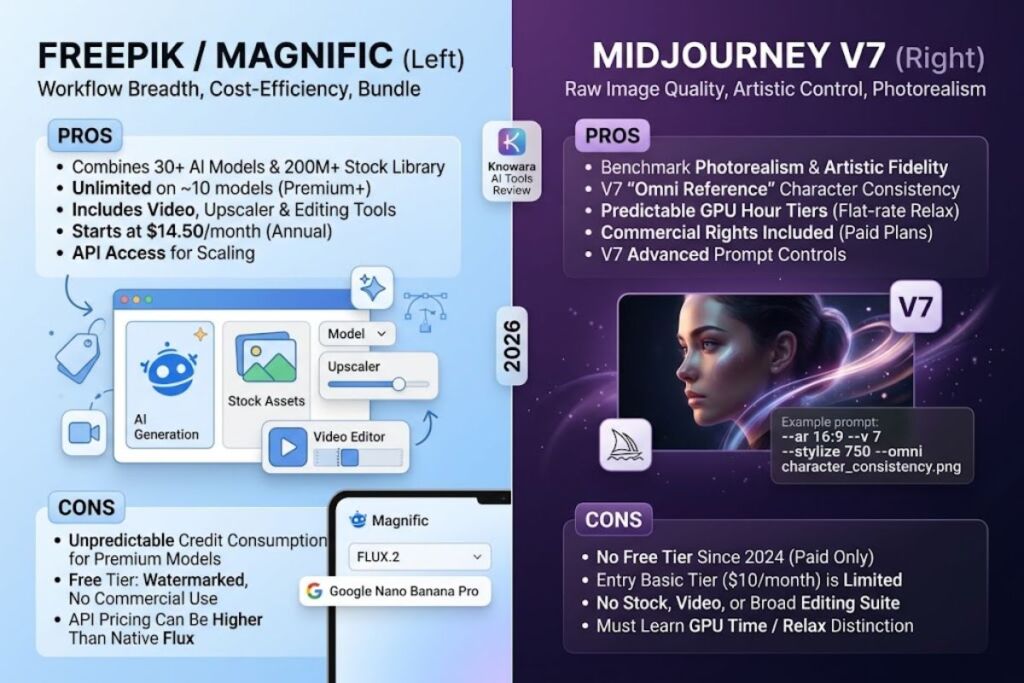
Midjourney wins on raw image quality and artistic control, while Freepik wins on price, workflow breadth, and total cost of ownership. Midjourney remains the photorealism and stylistic-consistency leader following its V7 release, while Freepik (rebranded to Magnific in April 2026) bundles AI generation with a 200M+ stock library, upscaling, and video tools in one subscription.Midjourney remains the photorealism leader among text-to-image AI models in 2026, and V7’s Omni Reference feature closed the biggest historical gap versus competitors in character consistency. This comparison uses the vendors’ official pricing pages and third-party pricing audits (checked between April and August 2026) to compare cost, features, and use-case fit for a US audience choosing between the two in late 2026.
- 01What Is Freepik’s AI Image Generator?
- 02What Is Midjourney?
- 03How Do Freepik and Midjourney Compare on Pricing?
- 04How Do Freepik and Midjourney Compare on Image Quality and Output Control?
- 05What Are the Pros and Cons of Freepik vs Midjourney?
- 06When Should You Choose Freepik Over Midjourney?
- 07When Should You Choose Midjourney Over Freepik?
- 08Which Tool Wins for Free AI Image Generators in 2026?
- 09What Are the Best Alternatives to Freepik and Midjourney?
- 10Frequently Asked Questions
- 11The Verdict
What Is Freepik’s AI Image Generator?
Freepik’s AI Image Generator is a web-based text-to-image tool built into the Freepik/Magnific AI Suite, combining 30+ third-party models with a 200M+ stock asset library. It targets marketers, bloggers, and small design teams who need fast, licensable visuals without managing separate subscriptions for stock, generation, and editing.
Freepik Company S.L., founded in Málaga, Spain in 2010 by Joaquín Cuenca Abela, operated as a stock-asset marketplace before acquiring Magnific AI, a Spanish AI upscaler, in May 2024, and rebranded the combined platform to Magnific on April 28, 2026. The platform routes prompts through more than 30 models from providers including Google, OpenAI, ByteDance, xAI, Alibaba, and Runway, rather than running a single proprietary model like Midjourney does.
| Attribute | Value |
|---|---|
| Company | Freepik Company S.L. (rebranded Magnific, April 2026) |
| Release Year | Stock platform: 2010; AI Suite: 2023 |
| Underlying Models | 30+ third-party models (Flux, Kling, ChatGPT-derived models, ElevenLabs for audio) |
| Platforms | Web browser only |
| Key Feature | Combined stock library (200M+ assets) + AI generation + upscaling in one credit system |
| Free Tier | 20 images/day, “Auto” model only, watermark/attribution required |
Pricing verified as of August 2026 (Freepik’s public pricing page, checked August 14, 2026).Freepik’s public pricing page checked August 14, 2026 showed Premium, Premium+, and Pro as the current individual paid tiers, with the older Essential label no longer reflecting a current recommended plan
What Is Midjourney?
Midjourney is an independent, subscription-only AI image generator that converts text prompts into high-resolution visuals, built and operated without outside venture funding. It has no free tier, no stock library, and no third-party model marketplace — every image runs through Midjourney’s own model.
David Holz, the co-founder and former CTO of Leap Motion, founded Midjourney in 2022 and operates it as a self-funded, independent research lab based in San Francisco, publicly stating he has refused outside venture capital. The current model generation, V7, introduced the Omni Reference feature for precise character consistency across multiple generations, addressing a limitation that previously separated Midjourney from character-driven workflows like comic panels and brand mascots.
| Attribute | Value |
|---|---|
| Company | Midjourney, Inc. (independent, self-funded) |
| Release Year | 2022 |
| Underlying Model | Proprietary Midjourney model, current version V7 |
| Platforms | Web browser (midjourney.com), Discord |
| Key Feature | Omni Reference for character-consistent multi-image generation |
| Free Tier | None |
Pricing verified as of June 2026 (Midjourney’s official plan comparison page).Midjourney runs on a subscription model with four tiers: Basic at $10/month, Standard at $30, Pro at $60, and Mega at $120, with all figures vendor-reported and verified June 9, 2026
How Do Freepik and Midjourney Compare on Pricing?
Freepik costs less at the entry level, but Midjourney’s flat-rate tiers are more predictable than Freepik’s variable credit system. Freepik’s cheapest paid plan starts under $8/month, while Midjourney’s cheapest plan starts at $10/month with no free option at all.
| Factor | Freepik (Magnific) | Midjourney |
|---|---|---|
| Free tier | 20 images/day, watermarked, Auto model only | None |
| Cheapest paid plan | Premium, $14.50/month (annual billing) | Basic, $8/month (annual billing) |
| Mid-tier plan | Premium+, $33.75/month, 600K credits + unlimited on ~10 models | Standard, $24/month (annual), ~900 fast images + unlimited Relax mode |
| Top individual plan | Pro, $210/month, 4M credits | Mega, $96/month (annual) |
| Billing unit | Credits (variable per model/resolution) | Fast GPU hours, not per-image |
| Commercial rights | Included on all paid plans | Included on all paid plans |
| Team pricing | Business, $55/seat/month (2-seat minimum) | Same per-tier pricing applies per seat |
Freepik reintroduced credits for premium models just before the Magnific rebrand in April 2026, after briefly offering unlimited generation across 30+ models starting in July 2025; only about 10 specific image models remained credit-free after the reversal. This billing history matters for budgeting: a team that priced out Freepik under the “unlimited” 2025 policy will pay materially more under the 2026 credit structure. On the Midjourney side, Turbo-speed jobs cost 2x the GPU-time of a standard job and Draft jobs cost half, a distinction that caught early V7 adopters off guard because the speed-mode setting was not obvious in the interface.
How Do Freepik and Midjourney Compare on Image Quality and Output Control?
Midjourney produces more consistent artistic and photorealistic output; Freepik produces more inconsistent results because it routes prompts across dozens of third-party models rather than one tuned system. Midjourney’s single-model approach trades model variety for output predictability.
Freepik’s platform shows occasional anatomical errors in complex human poses, particularly hands, and lacks the granular parameter controls found in Midjourney. Freepik compensates for weaker native generation with a Magnific Upscaler — the same acquired technology that triggered the 2026 rebrand — plus Reimagine (style/variation regeneration on an existing image), Background Remover, Retouch, and Expand (outpainting).Reimagine creates new versions of an existing image for testing different styles, moods, and colors, while Retouch removes, replaces, or improves specific parts of an image to fix unwanted objects or small AI errors These sit inside the same credit pool as generation, so a single marketing asset can consume credits across three or four tool calls before it is publish-ready.
Midjourney’s advantage concentrates in one place: prompt-to-final-image fidelity on the first or second attempt, reinforced by V7’s Omni Reference for keeping a character’s face, outfit, or object consistent across a multi-image set — a capability Freepik’s multi-model architecture does not natively replicate, since consistency depends on which underlying model handled the original generation.
What Are the Pros and Cons of Freepik vs Midjourney?
Freepik’s biggest advantage is bundled value across content types; its biggest limitation is unpredictable credit consumption. Midjourney’s biggest advantage is output consistency; its biggest limitation is the complete absence of a free tier.
Freepik Pros:
- Combines stock assets, AI image/video generation, upscaling, and editing in one subscription
- Offers a genuine free tier (20 images/day) rather than a time-limited trial
- Starts at $14.50/month for a real commercial-use plan, undercutting Midjourney’s Basic tier
Freepik Cons:
- Credit cost per generation only becomes clear after the image renders, complicating budget planning — workaround: the Premium+ tier’s ~10 unlimited models remove credit math entirely for standard image generation, at $33.75/month
- Free tier requires attribution and blocks commercial use — workaround: the $14.50/month Premium tier removes the attribution requirement and adds commercial licensing
- No API access on lower tiers, and Freepik’s API pricing runs above native Flux API pricing (from $0.014/image) — exception: this only matters for developers building programmatic pipelines, not for manual marketing or design use
Midjourney Pros:
- V7’s Omni Reference delivers character-consistent output across a generation set
- Flat, predictable GPU-hour billing once a user learns the Fast/Relax/Turbo distinction
- Recognized as the photorealism benchmark among text-to-image models in 2026
Midjourney Cons:
- No free tier of any kind since Midjourney removed free access in late 2024 — workaround: none inside Midjourney itself; test the prompt style on a free tool like Freepik’s Auto model first, then move confirmed prompts to a paid Midjourney plan
- Basic tier’s 3.3 fast hours exhaust quickly, and Basic provides no access to Relax mode at all — workaround: Standard at $24–30/month adds unlimited Relax generation, which most reviewers identify as the practical minimum tier
- No native stock library, upscaler, or video-first editing suite comparable to Freepik’s bundle — exception: this does not matter for users who only need static image generation, not a full content-production pipeline
When Should You Choose Freepik Over Midjourney?
Choose Freepik when the workflow needs more than image generation alone.
- Choose Freepik if the project requires blending AI-generated visuals with licensed stock photography or vector templates in the same file.
- Choose Freepik if the budget caps out below $15/month and commercial usage rights are required from day one.
- Choose Freepik if the team already produces video, audio, or 3D content and wants one credit pool instead of separate subscriptions.
- Choose Freepik if occasional anatomical imperfections in generated humans are acceptable for the use case (social graphics, illustrations, backgrounds) rather than hero photography.
When Should You Choose Midjourney Over Freepik?
Choose Midjourney when output quality and character consistency outweigh price and toolset breadth.
- Choose Midjourney if the deliverable is client-facing artwork, concept art, or brand imagery where first-pass quality matters more than cost per image.
- Choose Midjourney if the project needs the same character or object to appear consistently across multiple generated images.
- Choose Midjourney if predictable flat-rate billing matters more than access to a stock library or bundled editing tools.
- Choose Midjourney if the $24–30/month Standard tier fits the budget and the team can operate through midjourney.com or Discord without needing an integrated stock-asset workflow.
Which Tool Wins for Free AI Image Generators in 2026?
Freepik wins outright for free-tier access because Midjourney offers no free plan at all. Midjourney has no free plan or free trial, making its $10 Basic tier the only entry point, while Freepik’s free tier provides 20 images per day with mandatory attribution, making it usable for personal projects but not professional client work. Readers comparing free options specifically should reference Knowara’s Best Free AI Image Generators in 2026 roundup, which benchmarks Freepik’s free tier against other no-cost tools rather than against Midjourney, since Midjourney does not compete in that category.
What Are the Best Alternatives to Freepik and Midjourney?
Three tools cover the gap between Freepik’s bundled-suite approach and Midjourney’s single-model precision.
- Adobe Firefly integrates directly into Creative Cloud at $55/month for 250 generative credits, appealing to teams already paying for Photoshop and Illustrator.Adobe Firefly comes included with Creative Cloud at $55/month with 250 generative credits, working out to roughly $0.22 per image standalone
- Leonardo AI offers a free tier positioned as a lower-commitment alternative for testing prompt styles before paying for Midjourney.
- Stable Diffusion (self-hosted) eliminates per-image cost entirely after hardware investment, requiring either a $500+ local GPU or a $0.30–$1.00/hour cloud GPU rental, fitting developers who need full parameter control.
Read Knowara’s dedicated reviews of each for full pricing and feature breakdowns.
Frequently Asked Questions
Is Freepik or Midjourney better for commercial use?
Both include commercial usage rights on every paid plan. Freepik’s free tier blocks commercial use and requires attribution; Midjourney has no free tier, so every Midjourney image a subscriber generates carries commercial rights by default.
Does Freepik use the same AI model as Midjourney?
No. Freepik routes generation through more than 30 third-party models from providers like Google, OpenAI, ByteDance, and xAI, while Midjourney runs exclusively on its own proprietary model, currently V7.
Why did Freepik change its name to Magnific?
Freepik’s co-founder announced the rebrand to Magnific on April 28, 2026, following the May 2024 acquisition of the Magnific AI upscaler, positioning the combined platform as a full AI creative suite rather than a stock-asset marketplace.
Can I try Midjourney for free before subscribing?
No. Midjourney has offered no free tier since 2024, so the only way to test the platform is the $10/month Basic plan.
The Verdict
Midjourney costs more at every comparable tier and offers no free access, but its V7 Omni Reference output quality and consistency remain unmatched in the category as of 2026. Freepik costs less, includes a genuine free tier, and bundles stock assets, video, and editing into one subscription, but its multi-model architecture produces less predictable results than Midjourney’s single tuned model. Teams optimizing for pure image fidelity pay the Midjourney premium; teams optimizing for cost-per-deliverable across a full content pipeline choose Freepik.