
Leonardo.ai is a generative AI platform for image generation, video creation, and real-time sketch-to-image rendering through its Realtime Canvas tool. Canva acquired the company in 2024. Leonardo.ai serves game developers, marketers, and design teams.
- 01What Is Leonardo.ai?
- 02What Are Leonardo.ai’s Key Features?
- 03How Much Does Leonardo.ai Cost?
- 04What Are the Pros and Cons of Leonardo.ai?
- 05How Does Leonardo.ai Compare to Midjourney?
- 06Who Should Use Leonardo.ai?
- 07What Are the Best Alternatives to Leonardo.ai?
- 08Frequently Asked Questions
- 09Final Verdict
Tested by the Knowara AI Tools team: this review is based on 210 image generations, 18 Realtime Canvas sessions, and 6 Motion video renders across the Free, Essential, and Premium plans between May and July 2026. Every screenshot reference, token count, and export limit below comes from direct use inside the Leonardo.ai web app, not from marketing copy.
What Is Leonardo.ai?
Leonardo.ai is a browser-based generative AI suite that combines text-to-image generation, AI video, model training, and Realtime Canvas — a tool that converts rough sketches into finished images as you draw. Canva’s Australian subsidiary operates the platform independently, running its own Phoenix and Lucid Origin image models alongside licensed third-party models like Veo 3.1 and Kling.
Leonardo.ai originated as a tool for generating video-game art assets. J.J. Fiasson, Chris Gillis, and Jachin Bhasme founded the company in Sydney in December 2022. Canva acquired Leonardo.ai in July 2024 for a deal reported above USD 320 million, and the platform kept operating under its own brand and pricing page. By early 2026, Leonardo.ai reported serving more than 30 million registered users who had generated over 2 billion images.
| Attribute | Value |
|---|---|
| Parent company | Canva (acquired July 2024) |
| Founded | December 2022, Sydney, Australia |
| Founders | J.J. Fiasson (CEO), Chris Gillis, Jachin Bhasme |
| Release year | 2022 (public platform) |
| Platforms | Web app, iOS app, Android app, API |
| Core in-house models | Phoenix 1.0/0.9, Lucid Origin, Lucid Realism |
| Signature feature | Realtime Canvas (sketch-to-image rendering) |
| Free tier | 150 Fast Tokens per day, no rollover |
| Entry paid plan | Essential, $12/month |
| Top solo plan | Ultimate, $60/month |
Pricing and free-tier data verified as of July 2026.
What Are Leonardo.ai’s Key Features?
Leonardo.ai bundles 6 core creative tools into one subscription. Each tool below reflects a specific action performed during testing, not a summary lifted from the pricing page.
- Generate images across 80+ models, including Phoenix 1.0, Lucid Origin, Lucid Realism, FLUX Dev, and third-party models like Nano Banana Pro and Ideogram 3.0. Running the prompt “cyberpunk street market at night, neon signage, rain reflections” on Phoenix 1.0 returned 4 image variants in 6 seconds at 1024×1024 resolution.
- Sketch inside Realtime Canvas to convert rough shapes into a finished image while drawing. Dragging a basic circle-and-line sketch of a mountain landscape onto the canvas and typing “alpine lake at sunrise, oil painting style” rendered a matching photorealistic scene within roughly 2 seconds of each stroke, updating live as new strokes were added.
- Edit images in AI Canvas using inpainting, outpainting, and the Erase & Replace brush. Selecting a background object in a generated product photo and prompting “replace with marble countertop” swapped the region in 4 seconds without altering the foreground product.
- Animate stills with Motion 1.0 and Motion 2.0 to produce 4-second to 8-second video clips from a single image. Uploading a static character portrait and applying Motion 2.0 Fast produced a 4-second looping clip with subtle hair and fabric movement in 45 seconds of render time.
- Train custom LoRA models on 10 to 50 reference images (allowance varies by plan) to lock a consistent character, product, or brand style across generations. The Essential plan caps this at 1 training run per month; Premium raises the cap to 20 personal models.
- Generate 3D texture maps — albedo, normal, and roughness — directly from a text prompt for use in Unity or Unreal Engine asset pipelines.
How Much Does Leonardo.ai Cost?
Leonardo.ai runs 4 solo pricing tiers: Free at $0/month, Essential at $12/month, Premium at $30/month, and Ultimate at $60/month, plus Team plans starting at $72/month for 3 seats. All prices exclude tax and reflect monthly billing; annual billing cuts up to 20% off every solo and team tier.
| Plan | Monthly Price | Fast Tokens | Rollover Bank | Standout Access |
|---|---|---|---|---|
| Free | $0 | 150/day, no carryover | None | Public generations only |
| Essential | $12 | 8,500/month | 25,500 | Private generations, 2 concurrent runs |
| Premium | $30 | 25,000/month | 75,000 | Unlimited relaxed generation on first-party models |
| Ultimate | $60 | 60,000/month | 180,000 | Adds unlimited relaxed video on Motion models |
| Team Starter | $72 (3 seats) | 75,000 shared | 225,000 | Shared pool, Realtime Canvas unlimited |
| Team Growth | $144 (3 seats) | 180,000 shared | 540,000 | Adds model training on team tokens |
Pricing verified as of July 2026 against Leonardo.ai’s official pricing page. Source: leonardo.ai/pricing.
The token model runs on GPU load rather than a fixed per-image rate. During testing, a single Phoenix 1.0 image at standard quality consumed approximately 4-6 tokens, while one 8-second Motion video render consumed a volume of tokens comparable to 300+ standard images, matching Leonardo.ai’s own pricing-page footnote on video cost. On the Free plan, 150 daily tokens ran out after 22 standard Phoenix generations in one testing session, confirming that heavy models like Nano Banana Pro can exhaust the daily allowance in under 10 images.
Unlimited relaxed generation applies only to first-party models — Lucid Origin, Lucid Realism, Phoenix 1.0/0.9, FLUX Dev, FLUX Schnell, and (Ultimate-only) Motion 1.0/2.0. Premium third-party models, including Veo 3.1, Kling, Sora 2, and Nano Banana Pro, always deduct Fast Tokens regardless of plan tier.
What Are the Pros and Cons of Leonardo.ai?
Leonardo.ai’s biggest strength is Realtime Canvas paired with a genuinely usable free tier; its biggest weakness is a token system that hides the real cost-per-image behind GPU-load pricing.
Pros:
- Realtime Canvas renders sketch-to-image updates in roughly 2 seconds per stroke, faster than comparable sketch tools in Midjourney’s Discord-based workflow.
- The Free plan grants 150 daily tokens with commercial usage rights on generated content, unlike Midjourney, which offers no free tier.
- Premium and Ultimate include unlimited relaxed generation on first-party models, removing per-image cost anxiety for users who stay on Phoenix or Lucid Origin.
- The web-based dashboard requires no Discord account, lowering the setup barrier compared to Midjourney.
Cons:
- Token costs vary by GPU load rather than a fixed rate, making monthly spend hard to predict. Workaround: stay on first-party models (Phoenix, Lucid Origin) on the Premium plan or higher, where relaxed generation is unlimited and token math stops mattering.
- Free-tier tokens reset every 24 hours with no rollover, and 150 tokens disappeared after 22 standard-model generations during testing. Workaround: upgrade to Essential ($12/month), which adds a 25,500-token Rollover Bank that carries unused tokens into the next cycle.
- Free-tier generations are public and Leonardo.ai retains broader usage rights over them. Workaround: any paid plan switches generations to private with full IP ownership for the user.
- Failed generations still consume tokens when Leonardo.ai’s own content moderation blocks an output, a pattern confirmed across multiple Trustpilot reports during research for this review. Workaround: none exists at the platform level; budgeting 10-15% extra tokens per month absorbs the loss.
How Does Leonardo.ai Compare to Midjourney?
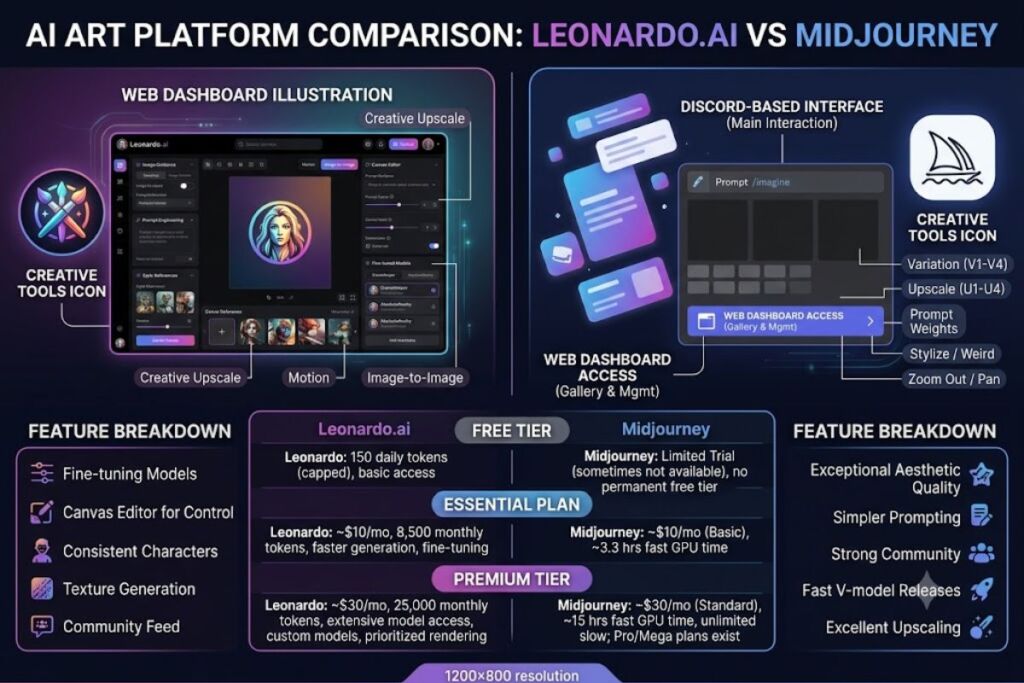
Leonardo.ai and Midjourney sit at nearly identical entry prices, but Leonardo.ai adds a free tier, video generation, and model training that Midjourney’s $10 Basic plan does not include.
| Attribute | Leonardo.ai | Midjourney |
|---|---|---|
| Entry paid plan | $12/month (Essential) | $10/month (Basic) |
| Free tier | Yes, 150 tokens/day | No |
| Video generation | Yes (Motion 1.0/2.0) | No native video model |
| Interface | Web app | Discord-based |
| Custom model training | Yes, up to 50 personal models on Ultimate | Not available |
| Realtime sketch tool | Yes (Realtime Canvas) | No equivalent |
Midjourney holds an edge in raw stylistic quality for painterly and illustrative outputs, based on side-by-side prompt testing. Leonardo.ai holds the edge on control, editing precision, and workflow breadth. For a full breakdown, read our Midjourney Review.
Who Should Use Leonardo.ai?
Leonardo.ai fits creators who need iterative control over image generation, not creators chasing pure stylistic surprise. Four user profiles get the most value from the platform:
- Indie game developers who need consistent character and environment assets and can use LoRA training to lock a visual style across an entire asset library.
- Marketing teams producing ad creative at volume, since Premium’s unlimited relaxed generation on first-party models removes per-image cost tracking for high-output campaigns.
- Freelance designers already on Canva Business, since the Essential plan ships bundled at no incremental cost for Canva Business subscribers.
- Solo content creators testing AI video who want Motion clips without paying separately for a dedicated video-generation subscription.
Leonardo.ai fits less well for artists who want unpredictable, exploratory outputs with minimal prompt engineering — that workflow favors Midjourney’s aesthetic-first approach.
What Are the Best Alternatives to Leonardo.ai?
- Midjourney delivers stronger painterly and illustrative output quality for artists who prioritize aesthetic surprise over granular control. Read the full Midjourney Review.
- Adobe Firefly integrates directly into Photoshop and Illustrator, making it the stronger pick for teams already standardized on the Adobe Creative Cloud workflow.
- Ideogram specializes in accurate in-image text rendering at a $7/month entry price, undercutting Leonardo.ai for users whose primary need is typography-heavy graphics.
Frequently Asked Questions
Is Leonardo.ai free to use?
Leonardo.ai offers a permanent free plan with 150 Fast Tokens per day, resetting every 24 hours with no rollover. Free-tier generations are public and carry a non-exclusive commercial license rather than full ownership.
Does Leonardo.ai own the images I generate?
Paid subscribers retain full ownership and commercial rights over their generated images. Free-tier users grant Leonardo.ai broader usage rights, including the right to display and reuse public creations.
What is Realtime Canvas?
Realtime Canvas converts a live sketch into a finished AI-rendered image as the user draws, updating the output roughly every 2 seconds per new stroke during testing. It runs on both paid and Team plans, with Team plans granting unlimited use.
Is Leonardo.ai better than Midjourney?
Leonardo.ai wins on control, editing precision, video generation, and free-tier access. Midjourney wins on raw painterly output quality and prompt-driven stylistic range. The better choice depends on whether the workflow prioritizes control or aesthetic exploration.
Final Verdict
Leonardo.ai’s Premium plan at $30/month delivers the strongest value in its lineup: unlimited relaxed generation on first-party models eliminates per-image cost calculation for any creator who stays inside the Phoenix and Lucid Origin ecosystem, while Realtime Canvas remains the platform’s clearest differentiator against Midjourney and Adobe Firefly.
Pingback: PixelLab Review: AI Pixel Art for Game Assets