
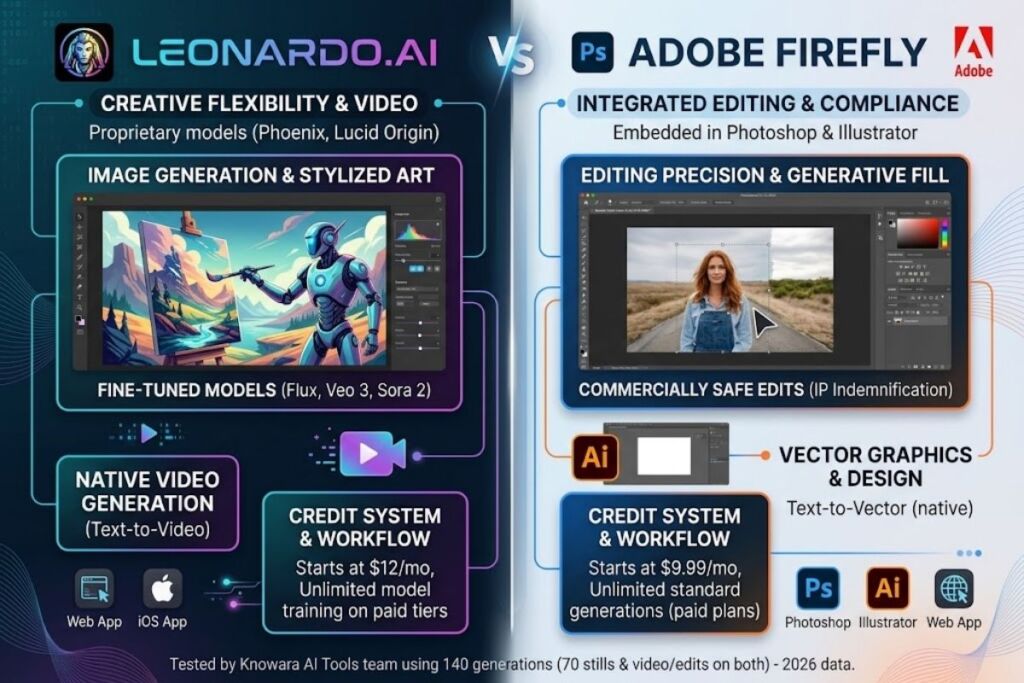
Tested by the Knowara AI Tools team using 140 generations across both platforms — 70 stills and 12 short video clips on Leonardo.ai, and 70 stills and 8 Generative Fill edits on Adobe Firefly — to compare output quality, credit consumption, and workflow speed.
- 01What Are Leonardo.ai and Adobe Firefly?
- 02Leonardo.ai at a Glance
- 03Adobe Firefly at a Glance
- 04How Do Leonardo.ai and Adobe Firefly Compare on Features?
- 05How Much Do Leonardo.ai and Adobe Firefly Cost?
- 06Leonardo.ai Pricing Tiers
- 07Adobe Firefly Pricing Tiers
- 08What Are the Pros and Cons of Leonardo.ai and Adobe Firefly?
- 09Leonardo.ai Pros
- 10Leonardo.ai Cons
- 11Adobe Firefly Pros
- 12Adobe Firefly Cons
- 13Choose Leonardo.ai or Adobe Firefly?
- 14Who Should Use Leonardo.ai vs Adobe Firefly?
- 15What Are the Best Alternatives to Leonardo.ai and Adobe Firefly?
- 16Frequently Asked Questions
- 17The Bottom Line
Leonardo.ai runs on proprietary models like Phoenix and Lucid Origin for creators who need stylized art, game assets, and video, while Adobe Firefly runs inside Photoshop and Illustrator for commercially licensed edits. Leonardo.ai starts at $12/month; Adobe Firefly starts at $9.99/month.
What Are Leonardo.ai and Adobe Firefly?
Leonardo.ai is a standalone generative AI platform for image and video creation built around custom-trainable models, while Adobe Firefly is Adobe’s generative AI engine embedded inside Photoshop, Illustrator, and Express for commercially safe edits.
Leonardo.ai launched in December 2022 in Sydney, Australia, founded by JJ Fiasson, Christopher Gillis, and four co-founders. Canva acquired Leonardo.ai in July 2024 for a reported $320 million, and the platform now operates as an independent product inside Canva’s portfolio, serving more than 30 million registered users who have generated over 2 billion images as of early 2026, according to Leonardo.ai’s own product data. Leonardo.ai builds its own foundation models, including Phoenix and Lucid Origin, and layers in third-party models such as Flux, Veo 3, and Sora 2 inside a single interface.
Adobe Firefly launched in March 2023 as Adobe’s answer to generative AI inside its Creative Cloud ecosystem. Firefly trains exclusively on Adobe Stock images, openly licensed content, and public domain material, a distinction Adobe uses to offer IP indemnification to enterprise customers. Firefly crossed 24 billion cumulative generated assets by mid-2025, according to Adobe’s newsroom announcements, with 85% of that usage happening inside Photoshop and Illustrator rather than the standalone Firefly web app.
Leonardo.ai at a Glance
| Attribute | Value |
|---|---|
| Company | Leonardo Interactive (owned by Canva since July 2024) |
| Release Year | December 2022 |
| Pricing | Free, $12/mo, $30/mo, $60/mo |
| Platforms | Web app, iOS app, API |
| Key Feature | Custom model fine-tuning on the Phoenix foundation model |
Pricing verified as of August 2026, cross-checked against Leonardo.ai’s official pricing page and third-party pricing trackers.
Adobe Firefly at a Glance
| Attribute | Value |
|---|---|
| Company | Adobe Inc. |
| Release Year | March 2023 |
| Pricing | Free, $9.99/mo, $19.99/mo, $49.99/mo, $199.99/mo |
| Platforms | Web app, Photoshop, Illustrator, Express, Substance 3D |
| Key Feature | Generative Fill and Generative Expand inside Photoshop |
Pricing verified as of August 2026, cross-checked against Adobe’s Creative Cloud generative-credits documentation and the Firefly pricing page.
A one-sentence bridge connects these two profiles directly to the feature test below: Leonardo.ai’s model breadth and Firefly’s Photoshop integration produce measurably different workflows once you generate real assets in each tool.
How Do Leonardo.ai and Adobe Firefly Compare on Features?
Leonardo.ai wins on model variety and video generation; Adobe Firefly wins on in-app editing precision and commercial-use licensing clarity. Knowara ran the same prompt set through both tools to isolate the practical differences.
Testing the Phoenix model on Leonardo.ai, we generated a 1024×1024 image from the prompt “cyberpunk city at night, neon reflections on wet pavement” using the Image Generation tool with the Alchemy Refiner toggle enabled in the right-side Generation panel. The render completed in 14 seconds and consumed 12 Fast Tokens. Testing the equivalent prompt on Adobe Firefly’s Text to Image module, accessed from the left sidebar’s “Generate” tab, the same prompt rendered in 8 seconds at 2048×2048 resolution and consumed 1 generative credit under the unlimited-standard-generation policy on paid plans.
| Feature | Leonardo.ai | Adobe Firefly |
|---|---|---|
| Native foundation model | Phoenix, Lucid Origin | Firefly Image Model 5 |
| Third-party model access | Flux, Veo 3, Sora 2 | Limited partner models (select video) |
| In-app photo editing | Canvas Editor (inpainting, outpainting) | Generative Fill, Generative Expand inside Photoshop |
| Video generation | Native text-to-video and image-to-video | Firefly Video Model (credit-metered) |
| Custom model training | Yes, unlimited on paid plans | No consumer-facing fine-tuning |
| Commercial IP indemnification | Not offered on standard plans | Included on Firefly and Creative Cloud paid plans |
| Vector generation | Not supported | Yes, via Illustrator integration |
Leonardo.ai’s Canvas Editor exposes an inpainting brush directly on the canvas toolbar, letting a user mask a specific region and regenerate only that section without leaving the tab. Adobe Firefly’s Generative Fill sits as a context-aware option that appears automatically when you make a selection with the Lasso or Marquee tool inside Photoshop, which speeds up masking for users already working in a layered PSD file.
How Much Do Leonardo.ai and Adobe Firefly Cost?
Leonardo.ai charges $12, $30, and $60 per month across three paid tiers plus a free plan; Adobe Firefly charges $9.99, $19.99, $49.99, and $199.99 per month across four paid tiers plus a free plan. Both companies bill monthly credits or tokens that reset without rollover on most tiers.
Leonardo.ai Pricing Tiers
| Plan | Monthly Price | Tokens/Credits | Commercial Rights |
|---|---|---|---|
| Free | $0 | 150 Fast Tokens/day | Not included |
| Essential | $12 | 8,500 tokens/month | Included |
| Premium | $30 | 25,000 tokens/month | Included |
| Ultimate | $60 | 60,000 tokens/month | Included |
Source: Leonardo.ai’s official pricing page, verified against third-party pricing trackers on 2026-06-05. Pricing verified as of June 2026. Leonardo’s Free tier generates roughly 25 standard-quality images per day before the 150-token allowance depletes, and every Free-tier creation is made public on Leonardo’s community feed since the platform does not grant IP ownership on that plan.
Adobe Firefly Pricing Tiers
| Plan | Monthly Price | Generative Credits | Commercial Rights |
|---|---|---|---|
| Free | $0 | 25 credits/month | Not included |
| Standard | $9.99 | 2,000 credits/month | Included |
| Pro | $19.99 | 4,000 credits/month | Included |
| Pro Plus | $49.99 | 10,000 credits/month | Included |
| Premium | $199.99 | 50,000 credits/month | Included |
Source: Adobe’s official Firefly pricing page and Creative Cloud generative-credits FAQ, verified against independent pricing trackers on 2026-08-25. Pricing verified as of August 2026. Adobe’s paid plans include unlimited generations on standard image models; credits deduct only for premium features such as video generation, translation, and partner models, which pushes the effective per-image cost toward $0 for ordinary text-to-image work.
Both companies changed their credit structures within the past 12 months, so verify current allowances against the official pricing pages linked above before purchasing an annual plan.
What Are the Pros and Cons of Leonardo.ai and Adobe Firefly?
Leonardo.ai’s strength is model flexibility and video output; its weakness is inconsistent credit consumption across features. Adobe Firefly’s strength is Photoshop-native editing; its weakness is a narrow 25-credit free tier that exhausts in a single session.
Leonardo.ai Pros
- Generates video natively without a separate subscription, unlike Firefly’s credit-gated Video Model.
- Supports unlimited custom model fine-tuning on paid tiers starting at $12/month.
- Provides access to third-party models including Flux and Sora 2 inside one interface.
Leonardo.ai Cons
- Audio generation ships enabled by default and consumes tokens at a higher rate than image generation — disabling it manually in Settings > Generation Preferences prevents the drain, a workaround that resolves the issue entirely once applied.
- Private video output requires at minimum the $12 Essential plan; Free-tier videos remain public — upgrading removes this restriction.
- The token economy spans multiple consumption rates per model, which complicates budgeting until a user tracks usage for one full billing cycle.
Adobe Firefly Pros
- Ships IP indemnification on paid plans, reducing legal exposure for enterprise design teams.
- Integrates directly into Photoshop and Illustrator, so no file export/import step interrupts the workflow.
- Offers unlimited standard-model generations on every paid tier, keeping per-image cost near $0 for text-to-image work.
Adobe Firefly Cons
- The Free tier’s 25 monthly credits exhaust after roughly 12–15 standard image generations — upgrading to the $9.99 Standard plan raises the pool to 2,000 credits, which resolves the shortfall for regular use.
- Firefly’s Single App generative-credit allocation dropped from 500 to 25 credits per month starting July 1, 2025, a change that caught existing Photoshop-only subscribers off guard.
- Video generation credit costs run high relative to image generation, since a single 5-second premium video clip can consume the equivalent of 100+ image generations.
Choose Leonardo.ai or Adobe Firefly?
Choose Leonardo.ai if the workflow demands stylized art, game assets, or native video generation outside the Adobe ecosystem. Choose Adobe Firefly if the workflow already runs through Photoshop or Illustrator and requires commercially indemnified output.
Choose Leonardo.ai if:
- Build game assets, concept art, or illustration-style visuals as the primary output.
- Generate short-form video content without paying for a separate video-specific tool.
- Train a custom model on a specific art style or product catalog for repeated brand-consistent generations.
- Operate outside the Adobe Creative Cloud ecosystem entirely.
Choose Adobe Firefly if:
- Edit existing photographs with Generative Fill or Generative Expand inside an active Photoshop file.
- Require IP indemnification for enterprise or client-facing commercial work.
- Produce vector graphics through Illustrator’s Firefly-powered text-to-vector tools.
- Already pay for a Creative Cloud subscription and want generative credits bundled into that cost.
Verdict: Adobe Firefly delivers lower cost-per-image at the entry tier ($9.99 vs. $12) and stronger legal protection for commercial output, while Leonardo.ai delivers broader model access and native video generation that Firefly gates behind higher-priced tiers starting at $49.99/month.
Who Should Use Leonardo.ai vs Adobe Firefly?
Solo game developers and concept artists get more value from Leonardo.ai’s model-training tools; in-house design teams already using Photoshop get more value from Adobe Firefly’s native integration.
Indie game developers use Leonardo.ai’s fine-tuning feature to train a model on a specific character style, then generate consistent asset variations across an entire game without re-prompting from scratch each time. Marketing teams inside enterprises with existing Adobe licenses use Firefly’s Generative Fill to extend product photography backgrounds directly inside Photoshop, skipping the file-transfer step a standalone tool would require. Freelance illustrators producing commissioned art at high volume find Leonardo.ai’s $30 Premium plan’s 25,000 monthly tokens sufficient for 4,100 to 6,250 standard images. Legal and compliance-sensitive teams at Fortune 500 companies, of which 72% report Firefly adoption according to Adobe’s internal data, prioritize Firefly for its indemnified training data.
What Are the Best Alternatives to Leonardo.ai and Adobe Firefly?
Midjourney, Ideogram, and Canva’s Magic Studio serve as the three most direct alternatives, each targeting a different segment of the image-generation market that Leonardo.ai and Adobe Firefly both compete in.
- Midjourney starts at $10/month and produces the highest average output quality in independent user-preference rankings, making it the closest direct competitor to Leonardo.ai on artistic image quality.
- Ideogram focuses on accurate in-image text rendering, a gap in both Leonardo.ai’s and Adobe Firefly’s default output when a prompt requires legible typography.
- Canva Magic Studio, now Leonardo.ai’s sister product under Canva ownership, bundles lighter generative tools directly into Canva’s design-template workflow for users who need speed over model depth.
Frequently Asked Questions
Is Leonardo.ai cheaper than Adobe Firefly?
Adobe Firefly’s entry-level Standard plan costs $9.99/month against Leonardo.ai’s Essential plan at $12/month, making Firefly the cheaper entry point by $2.01/month as of August 2026.
Does Adobe Firefly work without a Creative Cloud subscription?
Firefly operates as a standalone web app with its own $9.99–$199.99/month pricing, independent of a full Creative Cloud subscription, though credits carry over across both Firefly-only and Creative Cloud plans.
Can Leonardo.ai generate video content?
Leonardo.ai generates native text-to-video and image-to-video content on paid plans starting at $12/month, while Adobe Firefly meters video generation separately through its credit-based Video Model.
Which tool offers better commercial usage rights?
Adobe Firefly includes IP indemnification on every paid tier because it trains exclusively on licensed Adobe Stock content, while Leonardo.ai grants commercial rights on paid plans but does not offer indemnification.
The Bottom Line
Adobe Firefly costs $2.01 less per month at the entry tier and ships IP-indemnified output for commercial and enterprise use; Leonardo.ai costs more at entry but includes native video generation and unlimited custom model training that Firefly reserves for its $49.99-and-above tiers.