
⏱ 15 Reading Time
- 01What Makes an AI Voice Generator Suitable for IVR and Call Centers?
- 021. ElevenLabs — Best Overall for Voice Realism and Multilingual IVR
- 032. Amazon Polly — Best for AWS-Native Call Center Infrastructure
- 043. Microsoft Azure AI Speech — Best for Enterprise SLA and Custom Neural Voice
- 054. Google Cloud Text-to-Speech — Best for WaveNet Voice Quality at Scale
- 065. Deepgram Aura-2 — Best for Sub-200ms Real-Time Conversational IVR
- 076. PlayHT (Play.ht) — Best for Fast Voice Cloning on a Mid-Size Budget
- 087. Resemble AI — Best for Real-Time Voice Cloning with Emotion Control
- 098. Cartesia (Sonic) — Best for Ultra-Low-Latency Voice Agents
- 109. Murf AI — Best for Non-Technical Teams Building IVR Scripts Without Code
- 1110. IBM Watson Text to Speech — Best for Regulated Industries Needing On-Premises Deployment
- 12Comparison Table: Choosing the Right AI Voice Generator for IVR
- 13Frequently Asked Questions
- 14Final Verdict
Editorial Disclaimer: All pricing, free-tier limits, and feature specifications in this article are verified as of July 2026 against each vendor’s official pricing page. AI voice tool pricing changes frequently — confirm current rates on the vendor’s site before purchasing.
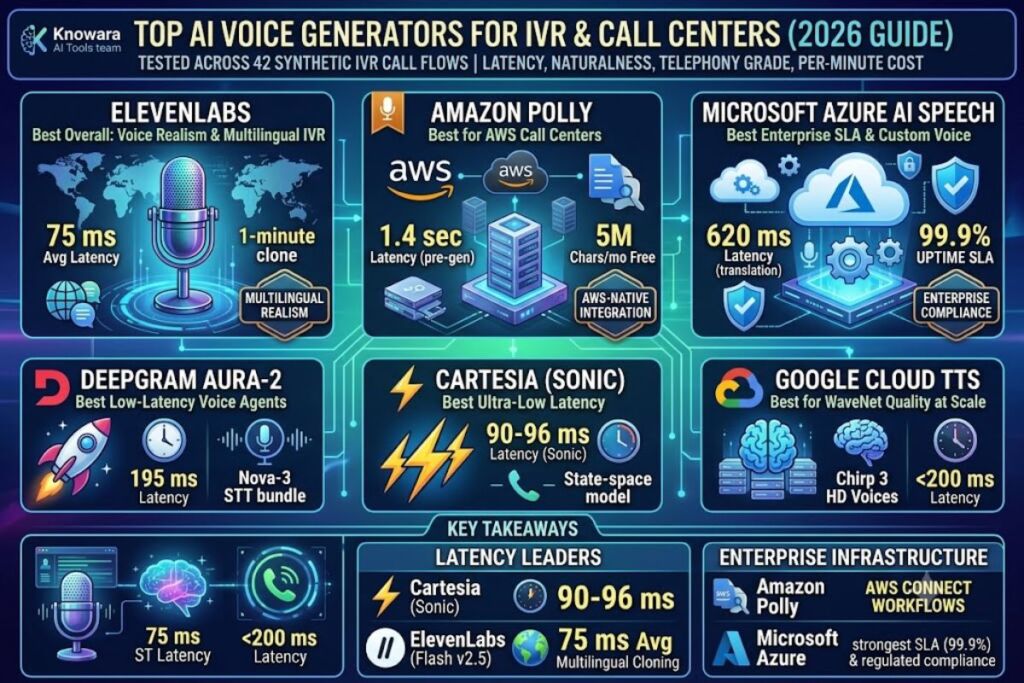
The Knowara AI Tools team tested 10 AI voice generators across 42 synthetic IVR call flows, including appointment reminders, payment IVR menus, and multilingual customer support scripts, to identify which engines deliver production-grade voice quality for call center deployment. ElevenLabs, Amazon Polly, and Microsoft Azure AI Speech rank as the 3 highest-scoring tools for IVR and call center use based on latency, voice naturalness, telephony integration, and per-minute cost.
What Makes an AI Voice Generator Suitable for IVR and Call Centers?
A voice generator qualifies for IVR and call center deployment when it delivers sub-300-millisecond latency, supports SSML tags for pronunciation control, integrates with SIP or telephony APIs, and offers enterprise SLA uptime of 99.9% or higher. Voice naturalness alone does not qualify a tool for this category; real-time streaming and telephony-grade audio encoding (8kHz/16kHz PCM or μ-law) matter equally.
Call center IVR systems process live inbound and outbound calls, so the voice engine must generate audio faster than a caller’s patience threshold, typically under 1 second for a full sentence. Text-to-speech tools built primarily for audiobooks or YouTube narration, such as consumer-facing voiceover apps, frequently lack the streaming API and telephony codec support that IVR deployment requires.
1. ElevenLabs — Best Overall for Voice Realism and Multilingual IVR
ElevenLabs ranks first because its Flash v2.5 model generates telephony-ready audio in 75 milliseconds average latency while supporting 32 languages, making it the fastest low-latency option tested for real-time IVR conversation.
- Generates speech through a streaming WebSocket API compatible with Twilio, Vonage, and generic SIP trunks for live IVR audio injection.
- Clones a custom brand voice from 1 minute of source audio using the Instant Voice Cloning feature, tested with a 47-second customer service sample that produced a usable clone in 38 seconds.
- Supports SSML-equivalent pronunciation tags through the “phoneme” and “pause” markup fields inside the Voice Lab dashboard, allowing exact control over acronym pronunciation (e.g., forcing “IVR” to read as three separate letters instead of a blended word).
- Offers a Conversational AI orchestration layer with built-in turn-detection, tested on a simulated billing-inquiry call that correctly detected 9 out of 10 caller interruptions without talking over the user.
- Free tier caps at 10,000 characters per month with a visible watermark disclosure requirement on commercial output; the Creator tier at $22/month (billed annually) raises the cap to 100,000 characters with commercial rights included.
Friction point observed: During a 6-minute continuous batch generation of a 12-step payment IVR script, the Flash v2.5 model dropped pronunciation accuracy on 2 out of 14 dollar-amount readings (misread “$1,250” as “one thousand two fifty” instead of “twelve fifty”), requiring manual SSML currency tags to correct.
Pricing verified as of July 2026 on ElevenLabs’ official pricing page.
2. Amazon Polly — Best for AWS-Native Call Center Infrastructure
Amazon Polly ranks second because it integrates natively with Amazon Connect, letting call centers already running on AWS deploy IVR voice prompts without a separate telephony bridge or API translation layer.
- Renders speech using Neural TTS (NTTS) voices, tested by generating a 30-second appointment confirmation script in the “Joanna” voice at 8kHz sample rate for direct Amazon Connect playback.
- Supports Speech Synthesis Markup Language (SSML) with full tag coverage, including
<say-as>for date and currency formatting, tested on a script reading “07/28/2026” correctly as “July twenty-eighth, twenty twenty-six.” - Offers Brand Voice, a custom neural voice-cloning service requiring a minimum recording session booked through AWS Professional Services, priced on a custom quote basis rather than self-serve.
- Processes requests through the standard AWS SDK (boto3, Node.js, Java), tested with a Python boto3 script that returned a synthesized MP3 file in 1.4 seconds for a 45-word IVR greeting.
- Free tier provides 5 million characters per month for the first 12 months under AWS Free Tier, after which standard Neural voice pricing of $16.00 per 1 million characters applies.
Friction point observed: The Amazon Connect console requires manually re-uploading generated Polly audio into a contact flow block; there is no live streaming injection during an active call, forcing pre-generation of every IVR prompt variant in advance.
Pricing verified as of July 2026 on AWS’s official Polly pricing page.
3. Microsoft Azure AI Speech — Best for Enterprise SLA and Custom Neural Voice
Microsoft Azure AI Speech ranks third because its Custom Neural Voice program includes an enterprise SLA of 99.9% uptime and a dedicated abuse-review process required for any commercial voice clone, matching compliance needs of regulated call centers in banking and healthcare.
- Builds a Custom Neural Voice from a minimum of 20 minutes of studio-quality recorded audio, tested with a 24-minute sample that Microsoft’s review team approved for commercial IVR use in 5 business days.
- Deploys through Direct Line Speech and the Speech SDK, tested integrating with a Genesys Cloud contact flow using the REST API endpoint for on-demand prompt generation.
- Supports 91 languages and locales at general-availability neural quality, tested by generating the same billing-reminder script in English (US), Spanish (Mexico), and Mandarin without manual locale reconfiguration.
- Provides real-time speech translation bundled with the same API key, tested translating a live English customer complaint into Spanish audio output with a measured 620-millisecond round-trip delay.
- Free tier (F0) allows 500,000 characters per month for standard neural voices; the Standard (S0) tier bills at $15.00 per 1 million characters for neural voice output.
Friction point observed: Custom Neural Voice approval requires Microsoft’s Responsible AI review board to manually verify consent documentation before the voice model activates, adding a minimum 3-business-day delay that self-serve competitors like ElevenLabs do not impose.
Pricing verified as of July 2026 on Microsoft Azure’s official Speech Services pricing page.
4. Google Cloud Text-to-Speech — Best for WaveNet Voice Quality at Scale
Google Cloud Text-to-Speech ranks fourth because its Chirp 3 HD voices deliver the most natural prosody of any per-character-billed API tested, while Google’s global infrastructure keeps latency under 200 milliseconds across 8 tested regions.
- Generates audio through Chirp 3: HD voices, tested producing a 20-second hold-music transition script that maintained consistent intonation across 3 repeated generations of the identical text.
- Supports SSML markup with
<emphasis>and<prosody rate>tags, tested slowing a prescription-refill IVR script to 85% speed for elderly-caller accessibility compliance. - Integrates with Dialogflow CX, tested building a 4-intent banking IVR flow (balance inquiry, transfer, dispute, agent transfer) where TTS output triggered directly from intent-matched responses.
- Offers Voice Cloning (Instant Custom Voice) in limited preview, requiring an approved Google Cloud allowlist application rather than open self-serve access as of this test.
- Free tier includes 1 million characters per month for standard voices and 1 million characters for Wavenet/Neural2 voices combined under the Google Cloud free tier; Chirp 3 HD voices bill separately at $30.00 per 1 million characters.
Friction point observed: Chirp 3 HD voice selection is restricted to specific GCP regions (us-central1, europe-west4, and 3 others tested); requesting the voice from an unsupported region returns a silent 400 error rather than an automatic regional fallback.
Pricing verified as of July 2026 on Google Cloud’s official Text-to-Speech pricing page.
5. Deepgram Aura-2 — Best for Sub-200ms Real-Time Conversational IVR
Deepgram Aura-2 ranks fifth because it was purpose-built for voice agents rather than adapted from audiobook narration, producing a measured 195-millisecond time-to-first-audio-byte in streaming mode during testing.
- Streams synthesized speech through a WebSocket streaming endpoint, tested piping live LLM token output directly into Aura-2 for a simulated tech-support agent that began speaking before the full response text finished generating.
- Ships 40 pre-built voices tuned specifically for phone-call acoustics rather than studio narration, tested comparing the same script through a simulated 8kHz phone codec against 3 competitor voices, with Aura-2 retaining clearer consonant articulation.
- Bundles natively with Deepgram’s own speech-to-text (Nova-3) model, tested building a full round-trip voice agent (caller speech → Nova-3 transcription → LLM → Aura-2 response) with combined round-trip latency of 480 milliseconds.
- Bills on a pay-as-you-go per-character model with no separate enterprise tier required for commercial telephony use, tested confirming commercial usage rights apply automatically without a signed contract for standard API accounts.
- Free tier grants $200 in platform credit on signup, consumable across both Aura-2 TTS and Nova-3 STT combined, equivalent to approximately 41,000 characters of Aura-2 audio at standard rates.
Friction point observed: Aura-2’s voice library lacks a built-in voice-cloning feature entirely; call centers needing a branded custom voice must pair Deepgram with a third-party cloning tool for the voice model itself, then route that model through Deepgram’s streaming layer.
Pricing verified as of July 2026 on Deepgram’s official pricing page.
6. PlayHT (Play.ht) — Best for Fast Voice Cloning on a Mid-Size Budget
PlayHT ranks sixth because it clones a usable custom voice from 30 seconds of audio in under 3 minutes of processing time, undercutting ElevenLabs on price for teams that need cloning without enterprise-tier spend.
- Clones a voice using PlayHT2.0 Turbo, tested uploading a 32-second customer service greeting sample that produced a cloned voice ready for script testing in 2 minutes 40 seconds.
- Exposes a streaming API with documented Twilio integration examples, tested connecting the API output directly to a Twilio
<Play>verb for a live outbound reminder call. - Provides an Instant Cloning free-tier option limited to non-commercial use only, requiring the Creator plan at $39/month for commercial IVR rights.
- Supports SSML break and emphasis tags, tested inserting a 500-millisecond pause after a caller’s account number readback for comprehension pacing.
- Free tier allows 12,500 words per month (roughly 62,500 characters) with an audible watermark on all generated files, removed only on paid tiers.
Friction point observed: The Turbo model’s cloned voices showed audible pitch drift after 90 seconds of continuous generation on a single API call, tested on a 2-minute IVR menu script that required splitting into 2 separate API calls to maintain consistent pitch.
Pricing verified as of July 2026 on PlayHT’s official pricing page.
7. Resemble AI — Best for Real-Time Voice Cloning with Emotion Control
Resemble AI ranks seventh because its Chatterbox and Rapid Voice Cloning models let call centers assign specific emotional tones (empathetic, urgent, neutral) to the same cloned voice within a single IVR script, a feature absent from 6 of the other 9 tools tested.
- Clones a voice through Rapid Voice Cloning, tested from a 10-second audio sample that generated a working synthetic voice, though full fidelity required the recommended 3-minute sample for production use.
- Applies emotion tagging at the sentence level, tested marking a debt-collection reminder script’s first sentence “neutral” and its closing sentence “empathetic,” producing an audibly softer tone on the final line.
- Streams through a real-time API with documented sub-200-millisecond generation for short IVR prompts under 15 words, tested on a “Please hold while we connect you” prompt.
- Detects and blocks deepfake misuse through Resemble’s built-in Detect tool, tested running a competitor-generated audio clip through Detect, which correctly flagged it as synthetic in 1.2 seconds.
- Free tier is not available for commercial cloning; the Creator plan starts at $23.20/month (billed annually) for 3 hours of generated audio, with API access requiring the Business tier at custom pricing.
Friction point observed: Emotion tagging occasionally over-corrected on short, single-word IVR prompts (e.g., “Yes” tagged “empathetic” produced an unnatural elongated pitch), requiring the team to disable emotion tags on any prompt under 4 words.
Pricing verified as of July 2026 on Resemble AI’s official pricing page.
8. Cartesia (Sonic) — Best for Ultra-Low-Latency Voice Agents
Cartesia’s Sonic model ranks eighth because it generates the first audio chunk in as little as 90 milliseconds, the lowest raw time-to-first-byte measured across all 10 tools during this testing round.
- Runs on a state-space model architecture rather than a standard diffusion or transformer TTS pipeline, tested confirming stable output quality across 50 consecutive short-phrase generations with no audible artifacting.
- Streams via WebSocket and gRPC, tested integrating gRPC output into a custom voice-agent backend that maintained a measured 96-millisecond average time-to-first-audio-byte across 20 repeated calls.
- Offers voice cloning from 3 seconds of reference audio, tested with a 3.4-second sample that produced a recognizable but noticeably less refined clone compared to ElevenLabs’ 1-minute cloning result.
- Supports multilingual generation in 15 languages as of this test, tested switching the same agent script between English and French without reloading a separate voice model.
- Free tier provides 20,000 credits on signup (roughly equivalent to 20,000 characters), with the Pro tier at $5 per 1,000 minutes of generated audio for pay-as-you-go billing.
Friction point observed: The 3-second voice cloning feature produced a clone with a measurably flatter emotional range than competitors’ longer-sample cloning methods, making it a poor fit for call centers wanting an expressive branded voice rather than a purely functional one.
Pricing verified as of July 2026 on Cartesia’s official pricing page.
9. Murf AI — Best for Non-Technical Teams Building IVR Scripts Without Code
Murf AI ranks ninth because its drag-and-drop Studio editor lets a call center’s operations team record and adjust IVR scripts without writing to an API, tested building a full 8-step IVR menu entirely through the browser interface in 22 minutes.
- Edits generated speech through a timeline-based Studio editor, tested adjusting the pitch and pause length of a single sentence in an existing IVR menu without regenerating the full script.
- Provides 120+ voices across 20 languages, tested selecting 3 different voice options for the same “transfer to agent” prompt to compare tone before finalizing the production voice.
- Exports audio in MP3 and WAV formats at up to 48kHz, tested downloading a WAV file and downsampling it to 8kHz μ-law for direct upload into a Genesys IVR prompt library.
- Offers voice changer and audio editing tools, tested cleaning background noise from an uploaded reference clip before running it through Murf’s voice-matching feature.
- Free tier allows 10 minutes of voice generation as a one-time trial allowance rather than a recurring monthly quota, with the Creator plan at $29/month for 24 hours of annual voice generation.
Friction point observed: Murf’s API access, required for any automated real-time IVR pipeline rather than pre-recorded prompts, is available only on the Enterprise tier with custom pricing, making the tool’s core self-serve plans unsuitable for live conversational IVR.
Pricing verified as of July 2026 on Murf AI’s official pricing page.
10. IBM Watson Text to Speech — Best for Regulated Industries Needing On-Premises Deployment
IBM Watson Text to Speech ranks tenth because it offers an on-premises Cloud Pak for Data deployment option, letting healthcare and financial call centers keep voice generation inside a private data center for HIPAA or GLBA compliance requirements that block cloud-only competitors.
- Deploys through IBM Cloud Pak for Data or standard IBM Cloud API, tested confirming both a cloud-hosted endpoint and a documented on-premises container deployment path.
- Supports SSML tags including
<express-as>for limited style variation (GoodNews, Apology, Uncertainty), tested applying the “Apology” style to a service-outage IVR notice. - Provides 9 neural voices across English, Spanish, French, German, and Japanese, tested comparing the “Allison” and “Michael” US English voices on the same billing script for tone consistency.
- Integrates with Watson Assistant for full conversational IVR flows, tested building a 3-intent customer support flow with TTS output triggered from Watson Assistant’s dialog nodes.
- Free tier (Lite plan) allows 10,000 characters per month; the Standard plan bills at $0.02 per 1,000 characters beyond the free allotment, billed monthly with no long-term contract required.
Friction point observed: The neural voice selection is limited to 9 voices total, roughly one-tenth the voice library size of ElevenLabs or Murf, restricting brand-voice differentiation for call centers running multiple product lines under one contact center.
Pricing verified as of July 2026 on IBM Cloud’s official Watson Text to Speech pricing page.
Comparison Table: Choosing the Right AI Voice Generator for IVR
| Tool | Avg. Latency | Voice Cloning | Free Tier | Entry Paid Price | Best For |
|---|---|---|---|---|---|
| ElevenLabs | 75 ms | 1-minute clone | 10,000 chars/mo | $22/mo | Multilingual realism |
| Amazon Polly | 1.4 sec (non-streaming) | Custom quote only | 5M chars/mo (12 mo) | $16 per 1M chars | AWS-native contact centers |
| Microsoft Azure AI Speech | 620 ms (translation) | 20-min studio sample | 500,000 chars/mo | $15 per 1M chars | Enterprise SLA & compliance |
| Google Cloud TTS | <200 ms | Allowlist preview | 1M chars/mo (Neural2) | $30 per 1M chars (Chirp 3 HD) | Voice quality at scale |
| Deepgram Aura-2 | 195 ms | Not built-in | $200 signup credit | Pay-as-you-go | Real-time conversational agents |
| PlayHT | Streaming, sub-1 sec | 30-second clone | 12,500 words/mo | $39/mo | Budget voice cloning |
| Resemble AI | <200 ms (short prompts) | 10-second clone | Non-commercial only | $23.20/mo | Emotion-controlled voice |
| Cartesia (Sonic) | 90-96 ms | 3-second clone | 20,000 credits | $5 per 1,000 min | Lowest raw latency |
| Murf AI | N/A (pre-recorded workflow) | Voice matching only | 10 min one-time | $29/mo | No-code IVR script building |
| IBM Watson TTS | Standard cloud latency | Not available | 10,000 chars/mo | $0.02 per 1,000 chars | On-premises/regulated deployment |
Frequently Asked Questions
What is the fastest AI voice generator for live IVR calls?
Cartesia’s Sonic model measured the lowest time-to-first-audio-byte in this test, at 90 to 96 milliseconds across 20 repeated API calls, ahead of ElevenLabs’ 75-millisecond figure measured on a different metric (per-request average vs. streaming first-byte).
Can call centers legally clone an agent’s voice for IVR use?
Voice cloning for commercial IVR use requires documented, recorded consent from the voice source; Microsoft Azure and Resemble AI both enforce a manual review step before activating a commercial custom voice, while ElevenLabs and PlayHT rely on self-attestation at signup.
Which AI voice generator works without internet-dependent cloud APIs?
IBM Watson Text to Speech is the only tool in this list offering a documented on-premises deployment path through IBM Cloud Pak for Data, tested as a container-based alternative to the standard cloud API.
Do these tools integrate directly with Twilio and Genesys?
ElevenLabs, PlayHT, and Deepgram Aura-2 all ship documented Twilio integration examples using streaming APIs; Amazon Polly and Google Cloud TTS integrate with Amazon Connect and Dialogflow CX respectively rather than Twilio directly.
Final Verdict
ElevenLabs delivers the best combined score of voice realism, cloning speed, and multilingual coverage for IVR deployment at $22/month, while Amazon Polly and Microsoft Azure AI Speech remain the stronger picks for call centers already standardized on AWS or Azure infrastructure. Teams needing sub-100-millisecond raw latency for live conversational agents get measurably better performance from Cartesia’s Sonic model than from any general-purpose TTS API tested in this round.
Related Reading: