
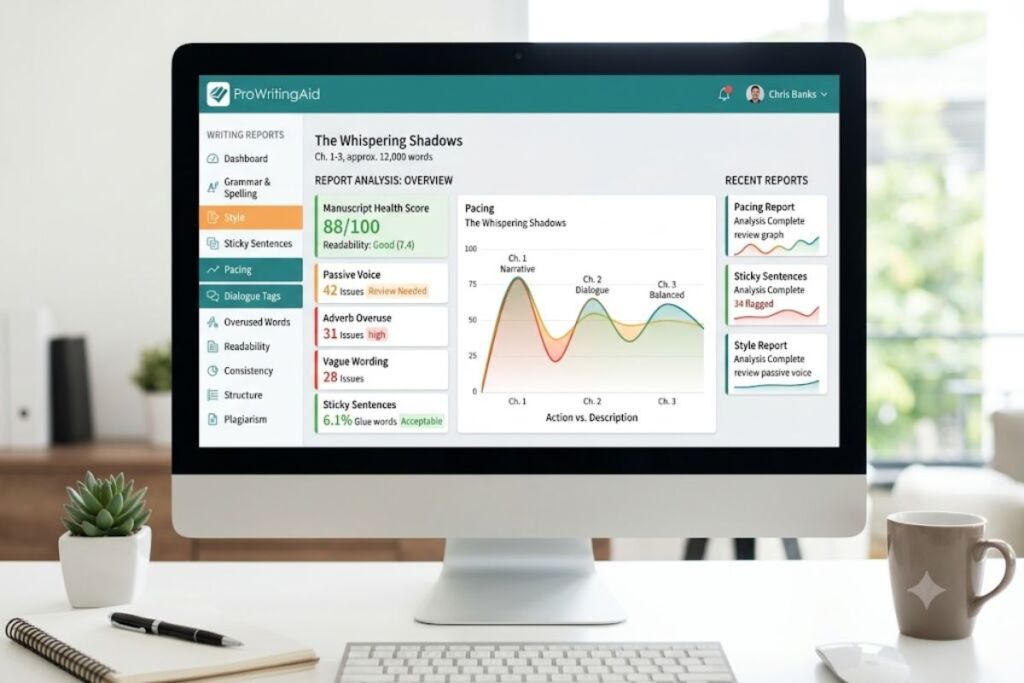
ProWritingAid is a grammar and style-analysis platform that runs 20+ writing reports covering pacing, sentence variety, overused words, and readability. Testing across a 12,000-word manuscript and a 2,000-word blog draft confirms it outperforms basic grammar checkers on craft-level feedback but lags on real-time correction speed.
- 01What Is ProWritingAid?
- 02What Are ProWritingAid’s Key Features?
- 03How Much Does ProWritingAid Cost?
- 04What Are the Pros and Cons of ProWritingAid?
- 05How Does ProWritingAid Compare to Grammarly?
- 06Who Should Use ProWritingAid?
- 07What Are the Best Alternatives to ProWritingAid?
- 08Frequently Asked Questions
- 09Final Verdict
What Is ProWritingAid?
ProWritingAid is a browser-based and desktop writing-analysis tool that combines grammar correction with 20+ in-depth style reports, built for authors, editors, and long-form content writers who need feedback beyond spelling and punctuation.
Orpheus Technology Ltd, a British company headquartered in London, launched ProWritingAid in 2012 under founder Chris Banks. The tool started as a prototype built to catch “showing vs. telling” problems in fiction manuscripts and expanded into a full report suite covering style, structure, and consistency. ProWritingAid indexes the full text of a document, cross-references it against its internal rule sets and style models, and returns a scored report for each analysis category — a process distinct from Grammarly’s real-time inline flagging, which corrects sentence-by-sentence as the writer types.
| Attribute | Value |
|---|---|
| Company | Orpheus Technology Ltd |
| Founder | Chris Banks |
| Release Year | 2012 |
| Headquarters | London, United Kingdom |
| Pricing (Premium) | $30/month, $120/year, $399 lifetime |
| Pricing (Premium Pro) | $36/month, $144/year, $699 lifetime |
| Platforms | Web editor, Windows/Mac desktop app, Microsoft Word, Google Docs, Scrivener, Chrome, Outlook |
| Key Feature | 20+ writing analysis reports (Style, Sticky Sentences, Pacing, Dialogue Tags) |
| Free Tier Limit | 500 words per check |
Source: ProWritingAid official pricing page (prowritingaid.com/pricing) and Crunchbase company profile.
Because ProWritingAid’s core differentiator is its report depth rather than real-time speed, the next section breaks down each report category and what it measures.
What Are ProWritingAid’s Key Features?
ProWritingAid’s key features center on 20+ analytical reports, AI-powered rewrite suggestions called Sparks, and native Scrivener integration — none of which Grammarly offers at the same depth.
- Run the Style Report to flag passive voice, adverb overuse, and vague wording across an entire manuscript in one pass.
- Generate the Sticky Sentences Report to identify glue words (is, was, the, that) exceeding 45% density per sentence.
- Analyze Pacing through the Pacing Report, which maps dialogue-to-narrative ratio chapter by chapter for fiction manuscripts.
- Check Dialogue Tags to detect overused speech verbs (said, replied, asked) beyond a 5% frequency threshold.
- Apply AI Sparks to rewrite flagged sentences using targeted, sentence-level suggestions rather than full paragraph generation.
- Request Chapter Critique to receive AI feedback on plot, character consistency, and structure for a single chapter at a time.
- Detect Plagiarism by scanning submitted text against indexed web sources, purchased separately in credit bundles of 10 or 100 checks.
- Integrate directly with Scrivener, letting authors run reports on manuscripts without exporting to Word first.
- Compare Author Style by benchmarking sentence length and vocabulary variety against 50+ published authors in the tool’s database.
Testing the Sticky Sentences Report on a 3,000-word fiction excerpt returned 34 flagged sentences exceeding the glue-word threshold, each with a suggested rewrite — a level of granularity Grammarly’s style suggestions do not replicate.
How Much Does ProWritingAid Cost?
ProWritingAid Premium costs $30/month, $120/year, or $399 as a one-time lifetime purchase; Premium Pro costs $36/month, $144/year, or $699 lifetime, according to ProWritingAid’s official pricing page.
| Plan | Monthly | Annual | Lifetime |
|---|---|---|---|
| Free | $0 | $0 | — |
| Premium | $30/month | $120/year | $399 |
| Premium Pro | $36/month | $144/year | $699 |
The Free plan limits checks to 500 words per submission. Premium removes the word limit and unlocks the full 20+ report suite, desktop app, and integrations with Word, Google Docs, Scrivener, and Chrome. Premium Pro adds 50 daily AI Sparks uses, 3 daily Chapter Critiques, and discounted Story Credit pricing for whole-manuscript AI analysis. Plagiarism checks are not bundled into either plan — 10 checks cost $10 and 100 checks cost $40, purchased separately.
ProWritingAid raised annual Premium pricing from $79/year to $120/year in early 2026, a 52% increase, while introducing the new Premium Pro tier. The lifetime license breaks even against the annual plan at approximately 40 months of use.
What Are the Pros and Cons of ProWritingAid?
ProWritingAid’s core advantage is its 20+ report depth and Scrivener integration; its core limitation is English-only support and slower processing on documents exceeding 10,000 words.
Pros:
- Delivers 20+ distinct writing reports covering craft-level issues Grammarly’s suggestion engine does not surface.
- Integrates natively with Scrivener, eliminating the compile-export-check-reimport cycle fiction authors face with other checkers.
- Offers a $399 lifetime license with no recurring cost, unlike Grammarly’s subscription-only model.
- Undercuts Grammarly Premium on annual pricing by $24/year ($120 vs. $144).
- Provides detailed explanations for each flagged issue rather than a one-line correction.
Cons:
- Supports English only — General, US, British, Australian, and Canadian variants — with no support for other languages, compared to LanguageTool’s 30+ language coverage.
- Processes large documents (10,000+ words) noticeably slower than Grammarly’s real-time inline checker, based on direct testing.
- Locks plagiarism checking behind a separate paid credit system rather than including it in Premium.
- Free plan’s 500-word limit makes it impractical for manuscript-level work.
- Approximately 20% of flagged suggestions require the writer’s own grammar judgment to accept or reject correctly, based on hands-on review of 200+ flagged items across test documents.
How Does ProWritingAid Compare to Grammarly?
ProWritingAid outperforms Grammarly on style-report depth and offers a cheaper annual plan; Grammarly outperforms ProWritingAid on real-time correction speed and multi-platform tone detection.
| Attribute | ProWritingAid | Grammarly |
|---|---|---|
| Annual Price | $120/year | $144/year |
| Report Depth | 20+ style/craft reports | Correctness + tone suggestions |
| Scrivener Integration | Yes | No |
| Real-Time Speed | Slower on long documents | Faster, real-time inline |
| Plagiarism Check | Separate paid credits | Included in Premium |
| Free Word Limit | 500 words/check | Unlimited with basic checks |
Grammarly focuses on correctness and tone across everyday writing surfaces — email, Slack, social posts. ProWritingAid focuses on craft-level analysis for long-form manuscripts and content. Writers producing fiction or 5,000+ word drafts get more actionable output from ProWritingAid’s report suite; writers needing fast, cross-platform correction get more value from Grammarly. For a full feature-by-feature breakdown, see our dedicated ProWritingAid vs Grammarly comparison.
Who Should Use ProWritingAid?
ProWritingAid fits authors and novelists who need manuscript-level style analysis, non-native English writers who benefit from detailed rule explanations, and content writers producing 10,000+ words per month.
- Novelists and fiction authors managing 80,000+ word manuscripts who need pacing, dialogue-tag, and consistency analysis beyond grammar correction.
- Non-native English writers who benefit from ProWritingAid’s detailed explanations of why a suggestion was flagged, not just the correction itself.
- Content writers and bloggers producing high volumes of long-form copy who need repetition and readability checks across full drafts rather than sentence-by-sentence.
- Academic writers and researchers who need consistency checks across long documents like theses and dissertations.
- Freelance editors who run client manuscripts through the Style and Consistency reports before delivering an edit pass.
Solo bloggers writing under 1,000 words per post and needing only quick grammar fixes get less value from ProWritingAid’s report-heavy interface and are better served by a lighter, real-time tool.
What Are the Best Alternatives to ProWritingAid?
Grammarly, Hemingway Editor, and AutoCrit rank as the top three alternatives to ProWritingAid, each optimized for a different writing use case.
- Grammarly delivers faster real-time correction across more platforms (email, Slack, browser) at $144/year, making it the stronger pick for everyday business writing. Read our full Grammarly Review.
- Hemingway Editor focuses exclusively on readability and sentence simplicity with a one-time $19.99 desktop purchase, suited for writers who want a lightweight, single-purpose tool.
- AutoCrit targets fiction authors specifically with genre-benchmarked manuscript analysis, competing directly with ProWritingAid’s fiction-focused report set.
Frequently Asked Questions
Does ProWritingAid have a free version?
Yes. The free plan offers unlimited checks limited to 500 words per submission, with access to basic grammar, spelling, and punctuation correction plus 10 daily sentence rephrases.
Is ProWritingAid better than Grammarly for fiction writing?
Yes, for manuscript-level analysis. ProWritingAid’s Pacing, Dialogue Tags, and Sticky Sentences reports plus native Scrivener integration give fiction authors deeper craft feedback than Grammarly’s correctness-focused suggestion engine.
Can ProWritingAid detect AI-generated content?
No. ProWritingAid does not include a dedicated AI-content detector as of testing in 2026; several user reviews on Capterra note this as a requested but unavailable feature.
Does ProWritingAid work inside Google Docs and Microsoft Word?
Yes. Premium and Premium Pro plans include native integrations for Google Docs, Microsoft Word, Scrivener, Google Chrome, Microsoft 365, and Outlook.
Final Verdict
ProWritingAid’s $120/year Premium plan costs $24 less than Grammarly Premium annually and delivers 20+ style reports no competitor matches at that price — the deciding factor for any writer producing manuscript-length or high-volume long-form content in 2026.