
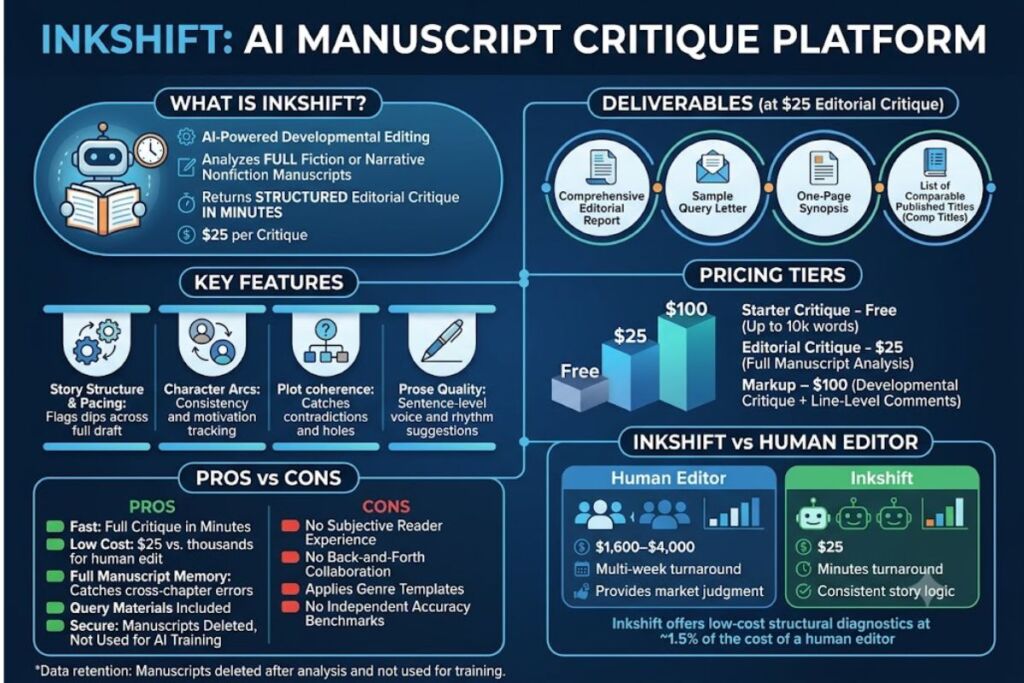
Inkshift is an AI-powered developmental editing platform that analyzes a full fiction or narrative nonfiction manuscript and returns a structured editorial critique in minutes. A full manuscript critique costs $25, covers structure, pacing, character arcs, and prose, and includes a sample query letter and comp-title list.
What Is Inkshift?
Inkshift is a web-based AI manuscript critique tool that reads an entire novel draft and produces a developmental editorial report covering structure, pacing, character, prose, and market positioning. Inkshift reads the complete manuscript as one continuous work, not isolated pages or paragraphs, which lets it track a character’s motivation from chapter 1 through the final chapter and flag contradictions a single human read-through misses.
Novelists preparing to query literary agents use Inkshift to identify structural problems before an agent sees the manuscript. Self-published authors use it between drafts to prioritize revision work instead of guessing which scenes need rewriting.
| Attribute | Value |
|---|---|
| Platform | Web app (Inkshift.io) |
| Accepted formats | .docx, .txt |
| Maximum manuscript length | 250,000 words |
| Free tier | Up to 10,000 words (Starter Critique) |
| Paid entry price | $25 (Editorial Critique) |
| Genres supported | Fantasy, romance, literary fiction, contemporary fiction, and other fiction/narrative-nonfiction genres |
| Subscription required | No — pay-per-critique pricing |
| Parent company / founding year | Not publicly disclosed on Inkshift.io |
| Data retention | Manuscript deleted after analysis; not used for AI model training |
Source: Inkshift official site, Inkshift AI manuscript critique page.
What Are Inkshift’s Key Features?
Inkshift structures its output around seven core deliverables, each tied to a specific stage of manuscript revision.
- Analyzes story structure and flags pacing dips across the full manuscript, not per chapter.
- Evaluates character motivation, emotional arcs, and consistency for every major character across all chapters.
- Assesses setting and worldbuilding for internal consistency and genre-appropriate atmosphere.
- Reviews prose at the sentence level for clarity, voice, and rhythm, with concrete rewrite suggestions.
- Identifies plot holes and unresolved subplots by cross-referencing every chapter against earlier chapters.
- Generates a sample query letter, a one-page synopsis, and a list of comparable published titles for agent submission.
- Organizes every finding into a prioritized revision roadmap, ranking issues by story-level impact before prose-level polish.
Each critique from the $25 Editorial Critique tier runs over 10,000 words of analysis, according to Inkshift’s own guide to novel critiques.
How Much Does Inkshift Cost?
Inkshift uses pay-per-critique pricing with no subscription: $25 for a full Editorial Critique, $35 for a Revision Plan, and $100 for a full-manuscript Markup. Inkshift offers 3 paid tiers plus one free option, according to the official pricing page.
- Starter Critique — Free. Covers up to 10,000 words, typically one chapter.
- Editorial Critique — $25. Full-manuscript analysis of structure, character, pacing, plot coherence, emotional resonance, prose quality, and genre positioning, plus a query letter, synopsis, and comp titles.
- Revision Plan — $35. Everything in the Editorial Critique plus chapter-by-chapter implementation guidance.
- Markup — $100. Line-level comments applied across the entire manuscript, in addition to the developmental critique.
For comparison, a traditional developmental edit from a professional human editor costs between $1,600 and $4,000 for an 80,000-word novel, based on figures Inkshift published in its AI-vs-editor comparison. At $25 per pass, a writer can commission 16 to 40 Inkshift critiques for the price of one traditional edit.
Source: Inkshift pricing, AI Manuscript Critique vs. Human Editor comparison.
What Are the Pros and Cons of Inkshift?
Inkshift’s strengths are speed, price, and full-manuscript memory; its limitation is that it cannot replace the subjective market judgment of a human editor or agent.
Pros:
- Delivers a full critique in minutes instead of the multi-week or multi-month turnaround of a human developmental editor.
- Prices a full Editorial Critique at $25, versus $1,600–$4,000 for a comparable traditional edit.
- Holds the entire manuscript in memory simultaneously, catching cross-chapter contradictions — such as a protagonist’s motivation in chapter 15 conflicting with chapter 3 — that a single human read can miss.
- Includes agent-facing materials (query letter, synopsis, comp titles) with every full critique, at no added cost.
- Supports manuscripts up to 250,000 words, covering everything from novellas to epic fantasy.
- Deletes the manuscript after analysis and does not use submitted text to train AI models.
Cons:
- Provides no subjective reader experience or market relationship-building the way a human editor or agent does.
- Offers no ongoing collaboration or back-and-forth revision discussion within a single critique purchase.
- Applies genre-tailored critique templates, which means highly experimental or cross-genre manuscripts may receive less precisely calibrated feedback.
- Discloses no independent benchmark scores for critique accuracy, so quality claims rely on Inkshift’s own published examples rather than third-party validation.
How Does Inkshift Compare to ProWritingAid?
Inkshift specializes in full-manuscript developmental critique at $25 per report; ProWritingAid is a broader grammar and style suite that sells manuscript-level AI analysis as an add-on at $50 per credit.
| Feature | Inkshift | ProWritingAid |
|---|---|---|
| Core focus | Full-manuscript developmental critique | Grammar/style checking plus add-on manuscript analysis |
| Manuscript-level critique price | $25 (Editorial Critique) | $50 per analysis credit (bulk discounts available) |
| Subscription required | No | Yes, for full grammar/style feature set |
| Query letter + synopsis included | Yes | No |
| Editor/writing-app integration | Standalone web upload | Integrates with Word, Google Docs, Scrivener |
ProWritingAid’s integration with Word, Google Docs, and Scrivener makes it convenient for writers who want grammar checking inside their existing workflow. Inkshift trades that in-editor integration for a critique built specifically around fiction structure rather than sentence-level grammar. Writers who need both often run Inkshift for developmental feedback and ProWritingAid for line-level grammar passes.
Source: Best Manuscript Critique Services for Fiction Writers in 2026.
See our full [ProWritingAid review] for a complete breakdown of its grammar and style feature set.
Who Should Use Inkshift?
Inkshift fits writers who have a complete or near-complete draft and need story-level feedback before investing time in prose polish or money in a human editor.
- Debut novelists preparing to query literary agents who need a sample query letter, synopsis, and comp titles alongside structural feedback.
- Self-published authors on tight budgets who cannot allocate $1,600–$4,000 for a traditional developmental edit.
- Writers running multiple revision passes who want feedback after each of 5 to 10 drafts at $25–$35 per pass instead of one expensive human edit.
- Screenwriters and narrative nonfiction authors who need full-manuscript structural analysis outside standard novel formats.
Inkshift does not fit writers still working on a first draft with major unresolved plot problems; Inkshift’s own guidance recommends waiting for a complete draft, since early-draft feedback produces noise rather than actionable signal.
What Are the Best Alternatives to Inkshift?
ProWritingAid, AutoCrit, and SudoWrite each cover a different part of the fiction-writing workflow than Inkshift’s full-manuscript developmental critique.
- ProWritingAid combines grammar and style checking with an optional AI manuscript analysis add-on priced at $50 per credit, better suited to writers who want an all-in-one editing suite. See our full [ProWritingAid review].
- AutoCrit focuses on genre-benchmarked prose analytics, comparing sentence-level metrics like pacing and dialogue ratio against published books in the same genre. See our full [AutoCrit review].
- SudoWrite functions as a generative writing partner rather than a critique tool, offering brainstorming, prose rewriting, and scene generation through its custom Muse model. See our full [SudoWrite review].
Frequently Asked Questions
Does Inkshift require a subscription?
No. Inkshift charges per critique — $25 for an Editorial Critique, $35 for a Revision Plan, and $100 for a Markup — with no recurring fee.
What file formats does Inkshift accept?
Inkshift accepts .docx and .txt manuscript files, up to 250,000 words per upload.
Does Inkshift use submitted manuscripts to train its AI models?
No. Inkshift deletes the manuscript after analysis and states it does not use submitted work to train AI models.
Can Inkshift replace a human developmental editor?
No. Inkshift provides fast, low-cost structural diagnostics; it does not replace the subjective market judgment, relationship-building, and creative negotiation a human editor or literary agent provides.
Inkshift’s $25 Editorial Critique delivers full-manuscript developmental feedback at roughly 1.5% of the cost of a traditional human developmental edit, making it the fastest entry point for a writer to identify structural problems before revising.