
⏱ 13 Reading Time
- 01How Do You Clone Your Voice With AI?
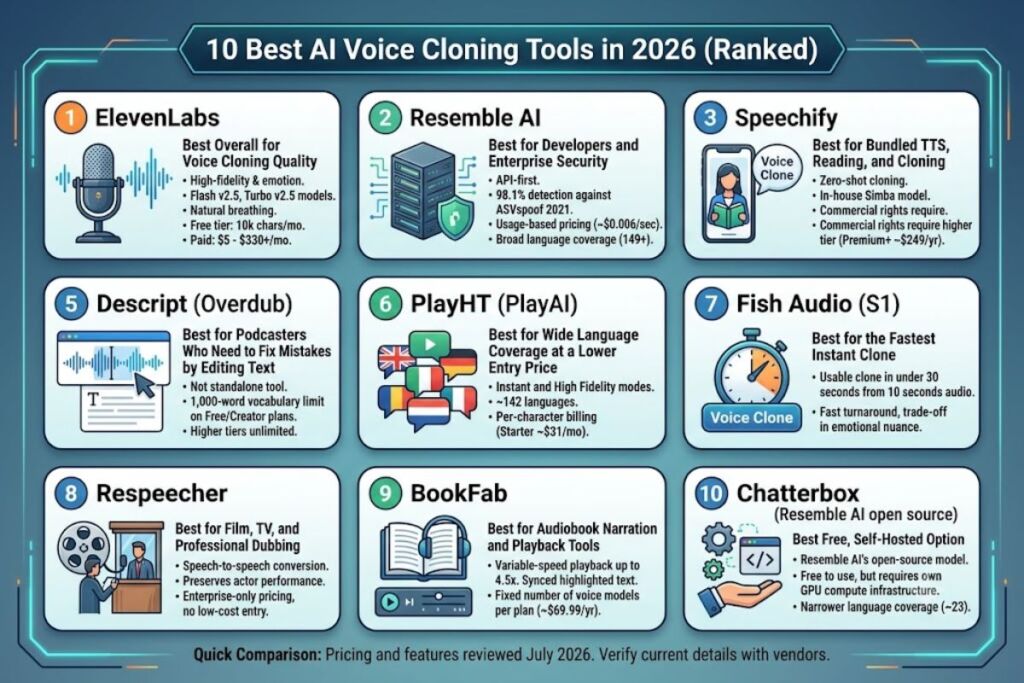
- 0210 Best AI Voice Cloning Tools in 2026 (Ranked)
- 031. ElevenLabs — Best Overall for Voice Cloning Quality
- 042. Resemble AI — Best for Developers and Enterprise Security
- 053. Speechify — Best for Bundled TTS, Reading, and Cloning
- 064. Murf AI — Best for Polished Business and Training Video Voiceovers
- 075. Descript (Overdub) — Best for Podcasters Who Need to Fix Mistakes by Editing Text
- 086. PlayHT (PlayAI) — Best for Wide Language Coverage at a Lower Entry Price
- 097. Fish Audio (S1) — Best for the Fastest Instant Clone
- 108. Respeecher — Best for Film, TV, and Professional Dubbing
- 119. BookFab — Best for Audiobook Narration and Playback Tools
- 1210. Chatterbox (Resemble AI open source) — Best Free, Self-Hosted Option
- 13Quick Comparison: 10 AI Voice Cloning Tools at a Glance
- 14Which AI Voice Cloning Tool Should You Pick?
- 15Frequently Asked Questions
Editorial disclaimer: Pricing, free-tier limits, and feature specs below were checked against each vendor’s official pricing page and independent benchmark sources (TTS Arena, Artificial Analysis, ASVspoof 2021) during research for this guide in July 2026. AI voice pricing changes often — confirm current numbers on the vendor’s site before purchasing. Where sources disagreed on an exact figure, this guide states the range and names the source rather than picking one number arbitrarily.
Voice cloning uses a short audio sample of a real speaker to train a model that generates new speech in that person’s voice from typed text. The fastest tools need 10 seconds of audio; the highest-fidelity tools need 10–25 minutes. This guide ranks the 10 platforms worth using in 2026 and walks through the exact cloning workflow.
How Do You Clone Your Voice With AI?
Record a clean 30-second-to-5-minute sample, upload it to a cloning tool, verify consent, generate a test line, and compare it against your real voice before publishing anything. The steps below apply to every tool in this guide, with minor UI differences.
- Record 30 seconds to 5 minutes of clear speech in a quiet room, free of background music or overlapping voices. Longer samples (10+ minutes) produce more accurate emotional range on tools like Descript Overdub and Resemble AI’s Professional Clone.
- Upload the file as WAV or MP3 into the tool’s voice-cloning panel (labeled “Instant Voice Cloning” on ElevenLabs, “My Voice” on BookFab, “Voice ID” on Descript).
- Complete consent verification — most reputable tools require you to read an on-screen attestation script aloud before the clone activates. Skipping this step is the single biggest sign a tool has weak safeguards.
- Generate a test script of 100–200 words that includes numbers, acronyms, and at least one proper noun to check pronunciation accuracy.
- Compare pacing and breath sounds against the source recording. Cloned voices that skip natural pauses read as robotic even when the timbre matches.
- Export in the format your project needs (MP3 for podcasts, WAV for broadcast, or direct API streaming for apps).
Once the clone is trained, most platforms let you type any script and receive narration in that voice in under 60 seconds.
10 Best AI Voice Cloning Tools in 2026 (Ranked)
1. ElevenLabs — Best Overall for Voice Cloning Quality
ElevenLabs ranks first because its Flash v2.5 and Turbo v2.5 models sit inside the top 10 of the TTS Arena leaderboard, and its cloned voices retain natural breathing patterns and emotional inflection that most competitors flatten out. Instant Voice Cloning trains from a 1–5 minute sample in a few minutes; Professional Voice Clone (enterprise-only) uses longer sessions for near-indistinguishable results.
- Cloning speed: Instant clone from a 1–5 minute sample, ready in minutes; Professional Clone requires enterprise onboarding.
- Language coverage: 100+ languages with cross-lingual cloning, meaning a clone trained on English audio can speak Spanish or Japanese in the same voice.
- Pricing: Free tier gives 10,000 characters/month with Instant Voice Cloning included. Paid tiers: Starter at $5/month, Creator at $22/month (100K characters), Pro at $99/month (500K characters), Scale at $330/month (2M characters). Overage runs $0.30 per 1,000 characters.
- Friction point: The free tier’s 10,000-character monthly cap is consumed by roughly 6–7 minutes of narration, which is not enough to test cloning across more than one or two short scripts before hitting the wall.
- Best for: Audiobook narrators, YouTube creators dubbing content into multiple languages, and studios that need consistent character voices across long scripts.
2. Resemble AI — Best for Developers and Enterprise Security
Resemble AI leads for teams that need API-first voice cloning with compliance controls, not a consumer dashboard. Rapid Voice Clone trains from as little as 5–10 seconds of audio in about a minute, while its Detect model claims 98.1% accuracy against the ASVspoof 2021 deepfake benchmark — the strongest built-in fraud-detection rate among tools in this list.
- Consent framework: Resemblyzer speaker-verification confirms the person granting consent matches the voice being cloned, and every generated file carries a neural watermark by default.
- Pricing model: Usage-based at roughly $0.006 per second of generated audio (about $21.60 per hour of output) rather than flat monthly tiers; custom Enterprise plans require a sales quote.
- Language coverage: Rapid Voice Clone 2.0 supports 149+ languages, the broadest commercial coverage of any tool reviewed here.
- Friction point: There is no self-service published price list for the Professional Clone tier — you have to submit a sales inquiry and wait for a quote, which slows down budget planning for smaller teams.
- Best for: Development teams embedding voice cloning into a product, call-center IVR systems, and companies with strict compliance or deepfake-liability requirements.
3. Speechify — Best for Bundled TTS, Reading, and Cloning
Speechify built its base as a document-reading app and layered zero-shot voice cloning on top, which is why it remains the most mobile-friendly tool on this list. Its in-house Simba model reportedly ranked #1 on the Artificial Analysis TTS leaderboard in July 2026, ahead of ElevenLabs and Google DeepMind’s TTS stack on that specific benchmark run.
- Cloning speed: Zero-shot clone from roughly 10–30 seconds of audio, one of the fastest turnaround times in this guide.
- Pricing: Free “Studio” plan includes around 600 credits but no voice cloning or commercial rights. Paid Studio plans start near $19–24/month; annual Premium runs roughly $139/year ($11.58/month), and commercial cloning rights require Premium+ at approximately $249/year.
- Language coverage: 60+ languages.
- Friction point: Speechify’s usage-limits policy restricts accounts generating audio for resale, broadcast, or distribution on standard consumer plans — commercial use needs the higher Premium+ or Studio tier confirmed in writing before you build a paid product on top of it.
- Best for: People who primarily consume written content as audio and want a personal voice clone as a secondary feature, not their main workflow.
4. Murf AI — Best for Polished Business and Training Video Voiceovers
Murf AI earns its spot for the cleanest “corporate narrator” sound in this comparison — a specific niche where over-emotive cloning from other tools actually works against the tone a company training video needs.
- Cloning access: Custom voice cloning is gated behind higher tiers or an Enterprise add-on rather than available on entry plans; check the current tier map before subscribing, since Murf has moved cloning between plan levels more than once in 2026.
- Pricing: Reported entry pricing sits around $19–24/month for plans with commercial rights; per-minute usage caps apply rather than per-character billing, which makes budgeting easier for video-length projects.
- Language coverage: 35+ languages.
- Friction point: Because Murf bills by finished audio minutes rather than characters, a heavily edited or re-generated script can burn through the monthly minute cap faster than expected mid-project.
- Best for: Marketing teams producing internal training videos, product demo voiceovers, and e-learning modules where a consistent, professional tone matters more than emotional range.
5. Descript (Overdub) — Best for Podcasters Who Need to Fix Mistakes by Editing Text
Descript is not a standalone voice-cloning tool — it is a full audio and video editor with a cloning feature, Overdub, built inside it. That distinction is exactly why it ranks here: for anyone who edits their own recordings, Overdub removes re-recording entirely by letting you fix a flubbed line by retyping the transcript.
- Training requirement: Historically needed a 10-minute guided script read plus a 24–48 hour training window; 2026 updates have shortened this on some plans to under 60 seconds using an existing recording plus a short Voice ID statement — confirm which flow your plan uses.
- Pricing: Free plan includes roughly 60 minutes/month of transcription and a limited Overdub trial (about 1,000-word vocabulary). Paid tiers reported across sources range from Hobbyist near $12–16/month, Creator near $24–35/month, up to Business around $50–65/month, with unlimited Overdub vocabulary unlocked at the higher tiers.
- Friction point: Overdub’s usable vocabulary is capped at roughly 1,000 common words on Free and entry Creator plans — any proper noun, brand name, or technical term outside that list gets flagged for re-recording rather than cloned cleanly.
- Best for: Podcast hosts and video editors who need to patch recording errors without a re-take, not creators who need fresh, standalone narration.
6. PlayHT (PlayAI) — Best for Wide Language Coverage at a Lower Entry Price
PlayHT clones a voice from roughly 30 seconds of audio and supports one of the widest language libraries in this comparison, reported at up to 142 languages depending on the voice model selected.
- Cloning modes: Offers both an Instant mode (under 30 seconds to generate a usable clone) and a High Fidelity mode for higher-accuracy output on longer scripts.
- Pricing: Entry plans reported starting around $31/month for cloning access.
- Friction point: The per-character billing model used across most PlayHT tiers is harder to estimate for long-form projects than Murf’s per-minute model, so heavy users report needing to track character counts manually to avoid mid-month overage.
- Best for: Multilingual content teams and developers who need broad language reach without committing to Resemble AI’s custom-quote enterprise pricing.
7. Fish Audio (S1) — Best for the Fastest Instant Clone
Fish Audio’s S1 model produces a usable clone in under 30 seconds from just 10 seconds of source audio, matching Speechify for the fastest turnaround in this guide.
- Pricing: Offers a freemium entry tier; exact paid-tier pricing is reported inconsistently across sources as of this review — confirm current figures on the official Fish Audio pricing page before committing.
- Friction point: The speed advantage trades off against accent and emotional-nuance accuracy on longer, more expressive scripts compared to ElevenLabs’ slower Instant Clone.
- Best for: Quick prototyping, short-form social content, and use cases where turnaround speed matters more than maximum fidelity.
8. Respeecher — Best for Film, TV, and Professional Dubbing
Respeecher specializes in speech-to-speech conversion rather than pure text-to-speech cloning — an actor’s real-time performance gets converted into a target voice, which is the workflow film and game studios actually use for dubbing and de-aging voice work.
- Pricing: Enterprise-only; no public self-service tier. Requires a direct sales conversation.
- Friction point: There is no low-cost entry point for solo creators — this tool is built for studio budgets, not individual YouTubers or podcasters testing voice cloning for the first time.
- Best for: Film and TV production teams, game studios needing consistent character voices across sessions, and dubbing houses converting one actor’s performance into another character’s voice.
9. BookFab — Best for Audiobook Narration and Playback Tools
BookFab focuses specifically on audiobook production, pairing Premium Voice Cloning with playback features built for long-form listening, like variable-speed playback up to 4.5x without pitch distortion and synced highlighted text for accessibility.
- Cloning requirement: Minimum 30-second sample through the Premium Voice Cloning feature.
- Pricing: Reported options include a 1-year license around $69.99 supporting up to 30 voice models, and a bundled lifetime AudioBook Creator plus 1-year Cloud Enhancer package around $99.99.
- Friction point: Licensing is structured around a fixed number of voice models per plan rather than unlimited cloning, so a narrator managing more than 30 character voices across a catalog will need to plan model slots carefully.
- Best for: Independent audiobook narrators and self-publishing authors producing multiple titles who want playback and accessibility tools bundled with the cloning engine.
10. Chatterbox (Resemble AI open source) — Best Free, Self-Hosted Option
Chatterbox is Resemble AI’s open-source cloning model, aimed at developers who want zero-shot cloning from roughly 5 seconds of audio without paying per-character or per-second fees — as long as you can self-host it.
- Pricing: Free and open source. Requires your own compute infrastructure; there is no managed hosting fee, but there is no included cloud generation either.
- Language coverage: Reported around 23 languages, narrower than Resemble AI’s own commercial Rapid Voice Clone product.
- Friction point: Self-hosting means you absorb GPU cost and setup time that a managed tool like ElevenLabs or Speechify handles for you — this is not a same-day solution for non-technical users.
- Best for: Developers and researchers building a custom voice pipeline who need full control over the model and are comfortable running inference infrastructure themselves.
Quick Comparison: 10 AI Voice Cloning Tools at a Glance
| Tool | Min. Sample Length | Starting Price | Best For |
|---|---|---|---|
| ElevenLabs | 1–5 minutes (Instant) | Free / $5/mo | Overall cloning quality |
| Resemble AI | 5–10 seconds | ~$0.006/sec usage-based | Developers, enterprise security |
| Speechify | 10–30 seconds | Free / ~$19–24/mo | Bundled reading + cloning |
| Murf AI | Varies by tier | ~$19–24/mo | Business/training voiceovers |
| Descript (Overdub) | ~60 sec–10 min | Free / ~$12–16/mo | Podcast editing by text |
| PlayHT | 30 seconds | ~$31/mo | Language coverage |
| Fish Audio (S1) | 10 seconds | Free tier available | Fastest instant clone |
| Respeecher | Performance-based | Enterprise/custom | Film & TV dubbing |
| BookFab | 30 seconds | ~$69.99/yr | Audiobook narration |
| Chatterbox (open source) | ~5 seconds | Free (self-hosted) | Developers, no license fee |
Pricing figures are approximate and drawn from vendor pages and independent comparison sources reviewed in July 2026; several vendors changed plan structures during 2026, so verify the current tier before purchasing.
Which AI Voice Cloning Tool Should You Pick?
Pick ElevenLabs for the highest overall quality, Resemble AI for developer/API and enterprise security needs, Descript if you already edit your own audio, and Chatterbox if you need a free, self-hosted option and have the infrastructure to run it. Everything else in this list solves a narrower use case — audiobooks, dubbing, or bundled document reading — where a specialist tool outperforms a generalist.
Frequently Asked Questions
Do I need consent to clone someone else’s voice?
Yes. Cloning a voice without the speaker’s explicit written consent violates the terms of service of every tool in this guide and, in the EU, can violate GDPR since a voice can qualify as biometric data. In the US, proposed legislation like the No FAKES Act targets non-consensual voice cloning directly.
How much audio do I need to clone my own voice?
Fast tools like Resemble AI’s Rapid Clone and Chatterbox need as little as 5–10 seconds. Higher-fidelity options like ElevenLabs’ Instant Clone use 1–5 minutes, and professional-grade clones on tools like Resemble AI’s Professional Clone or Descript’s older Overdub flow use 10–25 minutes for maximum emotional range.
Which AI voice cloning tool is free?
Chatterbox is free and open source if you self-host it. ElevenLabs, Speechify, and Descript all offer free tiers with limited cloning access, but commercial usage rights typically require a paid plan on each.
Can I use a cloned voice for commercial projects like ads or audiobooks?
Only on plans that explicitly grant commercial rights. Speechify requires Premium+, Descript includes commercial rights from its Hobbyist tier upward, and Murf ties commercial usage to its Creator tier and above — check the specific plan page before publishing paid work.
This is a sensitive topic in terms of impersonation and consent — if you’re building a product around voice cloning, confirm your legal obligations under applicable state and federal law before launch, separate from any tool’s own terms of service.
The tool you choose in 2026 comes down to one trade-off: ElevenLabs and Resemble AI deliver the highest fidelity and strongest safeguards but cost more at scale, while Chatterbox and Fish Audio’s free tiers deliver usable clones at zero licensing cost in exchange for either self-hosting effort or reduced accent accuracy.