
⏱ 7 Reading Time
- 01What Is Acapela My-Own-Voice?
- 02What Are Acapela My-Own-Voice’s Key Features?
- 03How Much Does Acapela My-Own-Voice Cost?
- 04What Are the Pros and Cons of Acapela My-Own-Voice?
- 05How Does Acapela My-Own-Voice Compare to ModelTalker?
- 06Who Should Use Acapela My-Own-Voice?
- 07What Are the Best Alternatives to Acapela My-Own-Voice?
- 08Frequently Asked Questions
- 09The Bottom Line
Acapela My-Own-Voice is a voice-banking web service that builds a synthetic copy of a person’s own voice from 50 recorded sentences, letting people with ALS, MND, or other progressive speech conditions keep speaking in their own identity through an assistive device. Acapela Group, a subsidiary of Tobii Dynavox, has run the service since 2015.
What Is Acapela My-Own-Voice?
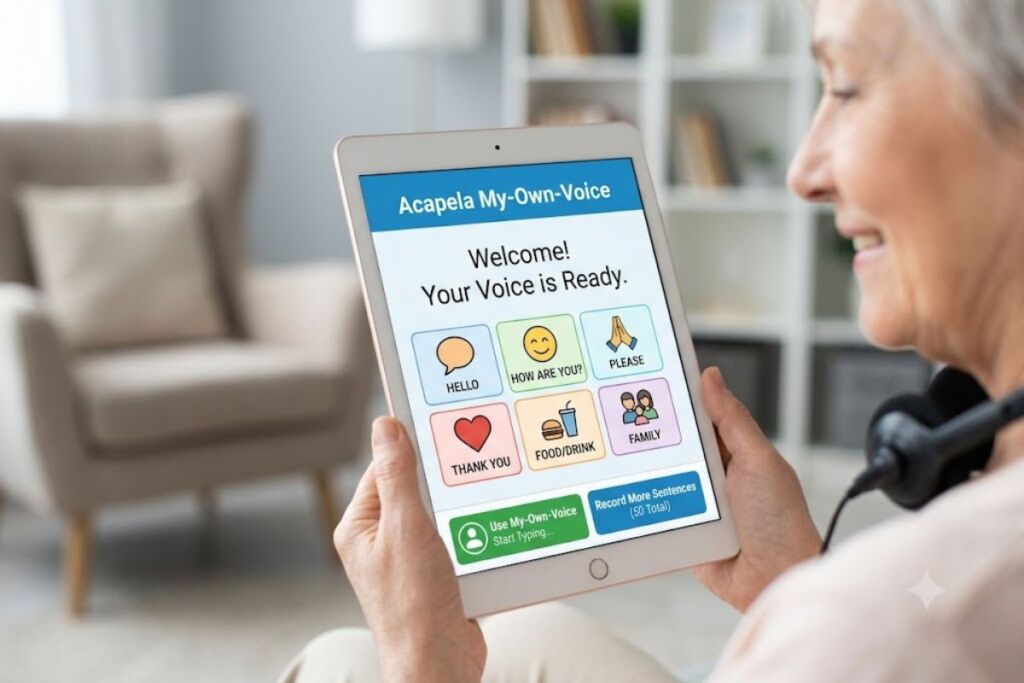
Acapela My-Own-Voice is a browser-based voice-cloning tool that converts 50 recorded sentences into a personal text-to-speech (TTS) voice for use on assistive communication devices. Acapela Group launched the service in 2015 as the first commercial voice-banking platform built specifically for patients at risk of losing their speech. The system records a script of sentences, processes the audio through Acapela’s Deep Neural Network (DNN) speech-synthesis engine, and outputs a system voice that preserves the original speaker’s timbre, accent, and intonation. Users test the synthetic voice for free through an online “type&talk” demo before deciding to purchase a license. Acapela Group was founded in 2003 in Mons, Belgium, and Tobii Dynavox — the global leader in assistive technology for communication — completed its acquisition of the company on April 29, 2022, for EUR 9.8 million, according to Tobii Dynavox’s official acquisition announcement.
| Attribute | Value |
|---|---|
| Developer | Acapela Group (subsidiary of Tobii Dynavox / Dynavox Group) |
| Founded | 2003, Mons, Belgium |
| My-Own-Voice launch | 2015 (Version 1); Version 2 added DNN synthesis in 2018; Version 5 is the current release in 2026 |
| Pricing | $99/year subscription or $999 one-time license (excl. VAT) |
| Platforms | Windows (SAPI), Android (TTS extended API), iOS (bundled partner app) |
| Sentences required | 50 (reduced from 350 in earlier DNN builds and 1,500 in the original unit-selection engine) |
| Key feature | Neural voice cloning from a short recorded script, deployable as a system TTS voice |
| Recognition | CES 2023 Innovation Award |
What Are Acapela My-Own-Voice’s Key Features?
Acapela My-Own-Voice records a 50-sentence script, synthesizes a neural voice clone, and deploys that voice to Windows, Android, or iOS as a usable system voice — all before the user pays anything. The core workflow breaks down into these functions:
- Record 50 target sentences through a browser using only a headset and an internet connection — no recording studio required.
- Reuse existing recordings through “double dipping,” which imports message-banking audio from platforms such as MyMessageBanking.com, Acapela-format files, or RAW audio instead of a fresh recording session.
- Test the finished voice for free in an online type&talk box, or for three months on a personal device through the AcapelaMOV app, before purchasing a license.
- Deploy the licensed voice as a native SAPI voice on Windows, through the Android TTS extended API, or bundled inside a compatible iOS partner app.
- Preserve custom vocabulary — names, medications, places — by recording additional personal phrases the DNN engine incorporates into the final voice.
- Support more than 20 languages across the platform, based on the standard voice catalog Acapela Group maintains for its TTS engine, per EatSpeakThink’s independent voice-banking tutorial.
How Much Does Acapela My-Own-Voice Cost?
Acapela My-Own-Voice costs $99 per year for a single-platform subscription or $999 as a one-time license covering Windows, Android, and iOS together. According to Acapela Group’s official pricing page (mov.acapela-group.com/pricing), account creation and the three-month voice trial are free of charge under both purchase models. The yearly subscription delivers the voice to one platform — Windows (SAPI), Android (TTS extended API), or iOS — chosen at checkout. The one-time license fee delivers the voice to all three platforms simultaneously and includes message-banking support and basic customer support in both tiers. Adding a second platform to the subscription plan, or adding an extra voice format, is billed as a case-by-case quotation rather than a fixed published rate.
What Are the Pros and Cons of Acapela My-Own-Voice?
Acapela My-Own-Voice’s biggest advantage is its short 50-sentence recording script, which lets patients with low energy or advancing speech loss finish voice banking in one sitting; its biggest limitation is per-platform pricing that adds cost for multi-device households.
Pros:
- Cuts the recording burden to 50 sentences, down from the 1,500-sentence script the original unit-selection engine required.
- Offers a free three-month trial of the finished digital voice before any purchase decision.
- Supports message-banking double-dipping, so patients who already recorded phrases elsewhere don’t have to re-record from zero.
- Won the CES 2023 Innovation Award and is distributed through Team Gleason’s ALS technology program.
- Backs the service with Tobii Dynavox’s assistive-technology distribution network across 60+ countries.
Cons:
- The $99/year tier delivers the voice to only one operating system; a household needing Windows and iOS pays the $999 one-time fee or a case-by-case add-on quote.
- iOS delivery requires a compatible partner application rather than a system-wide iOS voice.
- Acapela Group has not published an independent Mean Opinion Score (MOS) or third-party benchmark comparing My-Own-Voice’s naturalness against competing voice-banking engines.
- The tool is scoped to personal voice banking, not general-purpose multi-speaker TTS for developers or content creators.
How Does Acapela My-Own-Voice Compare to ModelTalker?
Acapela My-Own-Voice requires fewer recorded sentences than ModelTalker but charges a license fee, while ModelTalker is free but demands a longer recording script. ModelTalker, built by the Nemours Speech Research Laboratory, is the oldest voice-banking research platform in the US.
| Attribute | Acapela My-Own-Voice | ModelTalker |
|---|---|---|
| Sentences required | 50 | 800–1,600 |
| Cost | $99/year or $999 one-time | Roughly $100 flat, per Amy & Pals’ 2020 voice-banking comparison |
| Languages | 20+ | English only |
| Delivery | Windows, Android, iOS | Compatible speech-generating devices |
| Developer | Acapela Group (commercial, Tobii Dynavox) | Nemours Speech Research Laboratory (nonprofit research platform) |
Read the full breakdown in Acapela My-Own-Voice vs. ModelTalker: Which Voice Banking Tool Is Better?
Who Should Use Acapela My-Own-Voice?
Acapela My-Own-Voice fits patients newly diagnosed with ALS or another degenerative speech condition who want to bank their voice quickly and in more than one language. Three user profiles get the most value from the service:
- Newly diagnosed ALS or MND patients with enough remaining vocal stamina to complete a single 50-sentence recording session before speech deteriorates further.
- Non-English speakers who need voice banking in one of the 20+ supported languages, a gap many English-only competing platforms leave open.
- Multi-device households willing to pay the $999 one-time fee for simultaneous Windows, Android, and iOS delivery instead of a single-platform subscription.
What Are the Best Alternatives to Acapela My-Own-Voice?
ModelTalker, VocalID, and SpeakUnique are the three most-cited alternatives to Acapela My-Own-Voice in ALS voice-banking literature. Each targets a different recording capacity or budget than Acapela’s DNN engine.
- ModelTalker — a free, nonprofit voice-banking platform from the Nemours Speech Research Laboratory that requires 800 to 1,600 recorded sentences and supports English only.
- VocalID — offers three tiers (Legacy, BeSpoke, and a donor-matched voice), priced around $1,499, and can match a synthetic voice to a donor’s voice when a patient’s speech is already too impaired to record.
- SpeakUnique — powers the “I Will Always Be Me” voice-banking platform and adds Voice Repair and Voice Design options for patients whose speech has already changed before they start banking.
Frequently Asked Questions
How many sentences does Acapela My-Own-Voice require to build a voice?
Acapela My-Own-Voice’s current DNN engine requires 50 recorded sentences, reduced from 350 sentences in the prior release and 1,500 sentences in the original unit-selection engine.
Can I test my digital voice before paying?
Yes. Acapela Group offers a free online type&talk demo of the finished voice and a three-month device trial through the AcapelaMOV app before requiring a license purchase.
Which devices support the finished My-Own-Voice voice?
The licensed voice installs as a native SAPI voice on Windows, through the Android TTS extended API, or inside a compatible partner application on iOS.
Do any programs subsidize the cost of Acapela My-Own-Voice?
Acapela Group lists partnerships with the VA Department, which serves eligible military veterans, and the Jay S. Fishman ALS Augmentative Communication Program, both of which can sponsor licenses for qualifying patients according to Acapela Group’s official solutions page.
The Bottom Line
Acapela My-Own-Voice’s 50-sentence recording requirement makes it the fastest commercial voice-banking option to complete for patients running low on vocal stamina, at a fixed $99/year or $999 one-time price that undercuts VocalID’s roughly $1,499 tiers while covering more languages than the free ModelTalker platform.