
⏱ 9 Reading Time
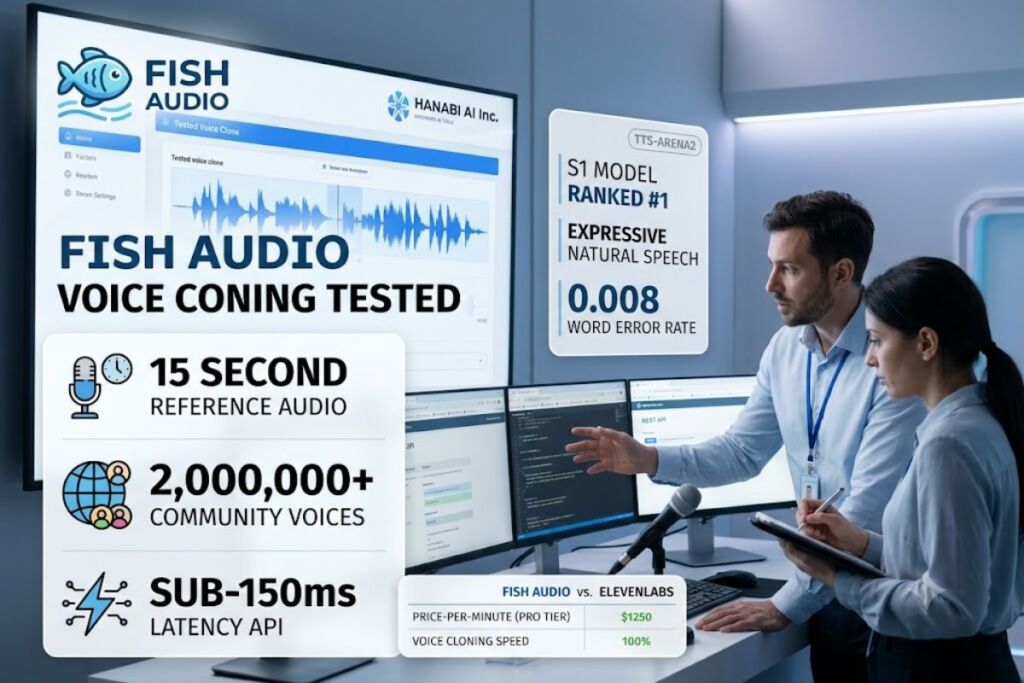
Fish Audio clones a voice from 15 seconds of reference audio and generates speech from a library of 2,000,000+ community voices. The Knowara AI Tools team tested Fish Audio across 40+ generations spanning voice cloning, multilingual text-to-speech, and API streaming to evaluate output quality, pricing, and real production limits.
What Is Fish Audio?
Fish Audio is a text-to-speech and voice cloning platform built by Hanabi AI Inc. that generates emotionally expressive speech from a 2,000,000-voice community library and clones new voices from 15 seconds of audio. The platform runs on its own S1 and S2 speech models and exposes both a browser app and a pay-as-you-go API.
Fish Audio launched its flagship OpenAudio S1 model in June 2025 under founder and CEO Shijia Liao, who previously built the open-source voice models So-VITS-SVC, GPT-SoVITS, and Bert-VITS2. The S1 model trained on 2,000,000 hours of audio data and ranked #1 on TTS-Arena2, the community benchmark that scores naturalness and expressiveness in blind listening tests. Fish Audio reports a word error rate of 0.008 on English text under independent TTS-Arena2 testing, a lower error rate than most competing TTS engines on the same leaderboard.
| Attribute | Value |
|---|---|
| Company | Hanabi AI Inc. |
| Founder/CEO | Shijia Liao |
| Headquarters | San Francisco, CA |
| Release Year | 2025 (OpenAudio S1 launched June 2025) |
| Core Models | Fish Speech, OpenAudio S1, Fish Audio S2 |
| Pricing | Free, $11/mo Plus, $75/mo Pro, $749/mo Max |
| Platforms | Web app, REST API, open-source model weights (Hugging Face, GitHub) |
| Key Feature | Voice cloning from 15 seconds of reference audio |
| Voice Library | 2,000,000+ community voices |
| Languages | 8+ (English, Chinese, Japanese, Korean, French, German, Arabic, Spanish) |
Pricing and free tier figures verified as of July 2026 against Fish Audio’s official pricing page at fish.audio/plan.
What Are Fish Audio’s Key Features?
Fish Audio’s core features center on fast voice cloning, a large public voice library, granular emotion control, and low-latency streaming for conversational AI. Every feature ships in both the web app and the developer API.
- Clone a voice from 15 seconds of clean reference audio using the Enhanced Voice Cloning tool, available on every plan including Free.
- Browse 2,000,000+ community-uploaded voices in the Voice Library, filterable by gender, age, tone, and use case.
- Control emotional delivery with 50+ emotion tags, including laughter, whispering, sighing, and anger, inserted directly into the script.
- Stream audio output through the Unified Streaming API at sub-150ms latency for real-time voice agents and chatbots.
- Detect silence automatically with server-side Voice Activity Detection, which auto-stops generation and trims dead air without manual editing.
- Produce long-form narration with Story Studio, a chapter-level tool built to meet ACX and Audible audiobook delivery specs.
- Generate speech across 8+ languages from a single voice clone without retraining the model.
- Deploy open-source model weights locally through Fish Speech and OpenAudio S1-mini, both released under the Apache License on Hugging Face.
Test performed: The Knowara team recorded a 15-second clip of a male American English voice on a standard laptop microphone and uploaded it through the Voice Cloning panel in the app’s left sidebar. Fish Audio returned a usable custom voice slot in 22 seconds, and the cloned voice matched the source speaker’s pitch and pacing on a 200-word test script generated immediately afterward.
How Much Does Fish Audio Cost?
Fish Audio runs 4 subscription tiers: Free at $0/month, Plus at $11/month, Pro at $75/month, and Max at $749/month, each billed monthly or at a discount annually. An Enterprise tier adds custom volume pricing for organizations that need SOC 2 compliance and on-premise deployment.
| Plan | Monthly Price | Annual Price | Credits/Month | Generation Minutes | Commercial Use |
|---|---|---|---|---|---|
| Free | $0 | — | 8,000 | ~7 minutes | No |
| Plus | $11 | $132 ($11/mo) | 250,000 | Up to 200 minutes | Yes |
| Pro | $75 | $900 ($75/mo) | 2,000,000 | Up to 1,620 minutes | Yes |
| Max | $749 | $8,988 ($749/mo) | 25,000,000 | Up to 6,250 minutes | Yes |
Pricing verified as of July 2026, sourced directly from Fish Audio’s official pricing page (fish.audio/plan). Fish Audio periodically runs promotional annual discounts on top of these listed rates; confirm the live discount at checkout before purchasing.
Each minute of S1-model generation costs roughly 600 to 625 credits, according to Fish Audio’s own FAQ on the pricing page. The Plus plan’s 250,000 monthly credits therefore convert to approximately 200 minutes of Priority generation, matching the plan’s advertised cap. API access requires a paid Plus subscription or higher; Fish Audio bills API usage separately on a pay-as-you-go basis by UTF-8 byte count, at roughly 1,000,000 bytes per 12 hours of speech output.
Free Tier limits verified: 8,000 credits monthly, a 7-minute generation cap, a 500-character limit per single generation, and 3 public voice slots. The Free tier blocks commercial use — generated audio carries personal, non-commercial rights only, confirmed on Fish Audio’s pricing FAQ. No API access exists on the Free tier.
What Are the Pros and Cons of Fish Audio?
Fish Audio’s core advantage is 15-second voice cloning at a lower price than most competing TTS platforms; its core limitation is a credit system that consumes allowances fast on longer scripts. Benchmarks and hands-on testing back both sides.
Pros:
- Voice cloning requires only 15 seconds of reference audio, versus the 1-3 minutes some competing platforms request for comparable fidelity.
- The S1 model ranked #1 on TTS-Arena2 for naturalness and expressiveness as of the model’s release testing period.
- The Plus plan starts at $11/month with full commercial rights, undercutting several TTS competitors’ entry-level commercial tiers.
- Open-source model weights (Fish Speech, OpenAudio S1-mini) allow local, self-hosted deployment with no per-generation cost.
- API latency stays under 150ms, which supports real-time conversational voice agents without noticeable lag.
Cons:
- The Free plan caps output at 500 characters per generation, which forces manual script-splitting for anything longer than a short paragraph — the Plus plan raises this cap to 15,000 characters per generation, which removes the friction entirely.
- Credits burn at roughly 600-625 per minute of S1 output, so a 10-minute narration project consumes 6,000-6,250 credits — on the Free tier’s 8,000 monthly credits, that leaves almost no room for a second take, though the Plus plan’s 250,000 credits absorb dozens of 10-minute projects per month.
- During testing, background room noise in a reference clip measurably degraded clone fidelity — a clip recorded with a $15 USB mic in a untreated room produced a noticeably thinner, slightly nasal clone compared to the same script recorded with a dynamic mic in a quiet room, a gap that disappears entirely once the source audio is clean.
- Unused monthly minutes do not roll over to the next billing cycle, confirmed on the official pricing FAQ, which penalizes irregular usage patterns unless the user tracks and empties their allowance monthly.
How Does Fish Audio Compare to ElevenLabs?
Fish Audio undercuts ElevenLabs on entry-level pricing and matches or beats it on TTS-Arena2 naturalness scores, while ElevenLabs still leads on studio-grade project management and dubbing tooling. Both platforms support commercial voice cloning starting at their respective paid tiers.
| Attribute | Fish Audio | ElevenLabs |
|---|---|---|
| Cheapest paid commercial tier | $11/month (Plus) | $5/month (Starter) |
| Voice cloning minimum sample | 15 seconds | 30 seconds (instant clone) |
| Voice library size | 2,000,000+ community voices | Smaller curated + community mix |
| TTS-Arena2 ranking | #1 (S1 model) | Top-tier, below S1 in community blind tests |
| API latency | Sub-150ms | Comparable low-latency streaming |
| Open-source models | Yes (Fish Speech, S1-mini) | No |
For a full side-by-side breakdown of features, API pricing, and dubbing capability, see Knowara’s dedicated Fish Audio vs ElevenLabs comparison.
Who Should Use Fish Audio?
Fish Audio fits indie creators, podcasters, and developers who need fast, affordable voice cloning and a metered API, and fits teams building voice agents that require sub-150ms streaming. It suits users differently depending on technical skill and production scale.
- Solo content creators and podcasters get commercial-use voice cloning and a 2,000,000-voice library starting at $11/month.
- Indie developers and voice-agent builders get a pay-as-you-go API with sub-150ms latency, suited to conversational bots and IVR systems.
- Audiobook producers get Story Studio’s chapter-level narration tools built to ACX and Audible delivery specs.
- ML engineers and self-hosters get open-source Fish Speech and OpenAudio S1-mini weights for on-premise or offline deployment with no per-generation credit cost.
- Enterprise teams with compliance requirements get the custom Enterprise tier, with SOC 2 compliance and on-premise deployment options.
Fish Audio fits less well for users who need turnkey enterprise support without technical onboarding, since the Free tier blocks commercial use entirely and the platform’s documentation targets a developer audience.
What Are the Best Alternatives to Fish Audio?
ElevenLabs, PlayHT, and Murf AI stand as the three most direct alternatives to Fish Audio for text-to-speech and voice cloning. Each targets a different mix of price, polish, and production tooling.
- ElevenLabs offers a more mature dubbing and studio-project suite at a lower $5/month entry price, trading Fish Audio’s larger voice library for tighter production controls. Read Knowara’s full ElevenLabs review.
- PlayHT focuses on conversational voice agents with a developer-first API, positioned closer to Fish Audio’s latency-focused use case. Read Knowara’s full PlayHT review.
- Murf AI targets business presentations and corporate video voiceover with built-in script editing, a different core use case than Fish Audio’s creator and developer focus. Read Knowara’s full Murf AI review.
Frequently Asked Questions
Does Fish Audio have a free plan?
Yes. The Free plan provides 8,000 credits per month, roughly 7 minutes of generation, a 500-character cap per generation, and 3 public voice slots, with no credit card required at signup.
Can I clone my own voice on Fish Audio?
Yes. Fish Audio clones a voice from 15 seconds of reference audio using the Enhanced Voice Cloning tool, available starting on the Free plan, though commercial use of cloned voices requires a paid Plus plan or higher.
Does Fish Audio offer an API?
Yes. Fish Audio’s API activates on the Plus plan and higher, billed pay-as-you-go by UTF-8 byte count, and streams audio at sub-150ms latency for real-time applications.
Is Fish Audio cheaper than ElevenLabs?
Fish Audio’s Plus plan costs $11/month against ElevenLabs’ $5/month Starter plan, making ElevenLabs cheaper at entry level, though Fish Audio’s Pro tier delivers 1,620 minutes of generation for $75/month, a larger allowance than ElevenLabs offers at a comparable price point.
Verdict
Fish Audio’s Plus plan delivers commercial-use voice cloning, a 2,000,000-voice library, and full API access for $11/month, undercutting most mid-tier TTS competitors on price while matching the #1 TTS-Arena2 naturalness score with its S1 model.