
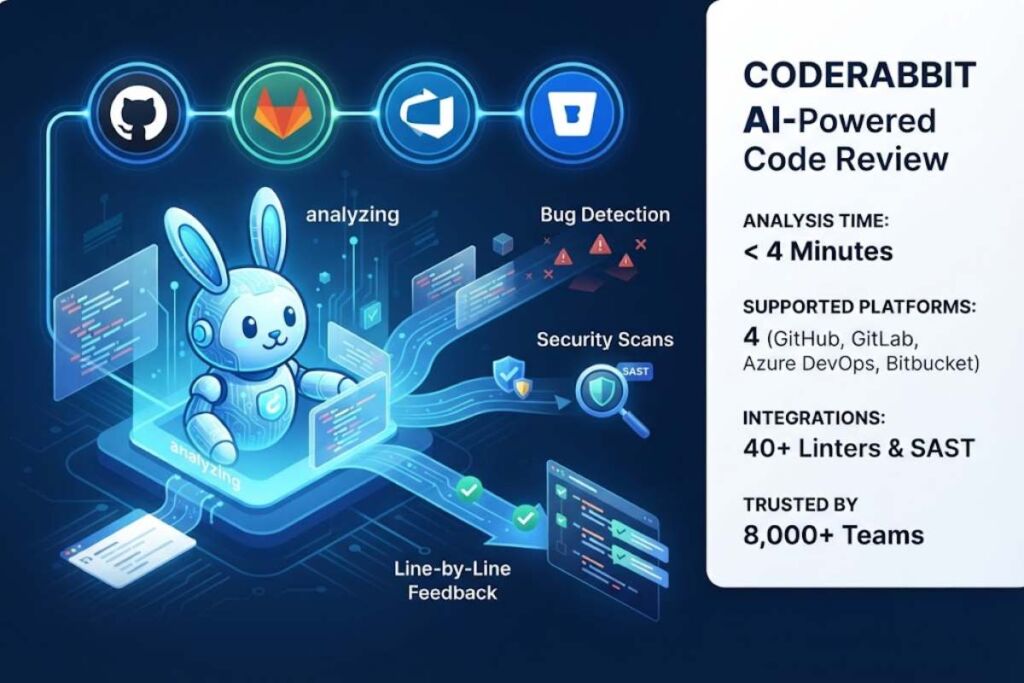
CodeRabbit is an AI-powered code review platform that automatically analyzes every pull request on GitHub, GitLab, Azure DevOps, and Bitbucket, posting line-by-line feedback, bug detection, and security scans within minutes of a PR opening. Founded in 2023, CodeRabbit now connects to over 2 million repositories and serves more than 8,000 paying customers.
- 01What Is CodeRabbit?
- 02What Are CodeRabbit’s Key Features?
- 03How Much Does CodeRabbit Cost?
- 04What Are the Pros and Cons of CodeRabbit?
- 05Pros
- 06Cons
- 07How Does CodeRabbit Compare to GitHub Copilot Code Review?
- 08Who Should Use CodeRabbit?
- 09What Are the Best Alternatives to CodeRabbit?
- 10Frequently Asked Questions
- 11Does CodeRabbit store my code?
- 12Does CodeRabbit write application code?
- 13Is CodeRabbit free for open-source projects?
- 14Does CodeRabbit replace human code reviewers?
What Is CodeRabbit?
CodeRabbit is an AI code review platform, founded in 2023 by Harjot Gill, that connects to a Git host and reviews every pull request automatically, combining code-graph analysis with 40+ linters to flag bugs, security issues, and style violations before human review.
CodeRabbit, Inc. builds an automated reviewer that installs on a repository and posts a plain-English summary, a sequence diagram of the code change, and inline comments on every pull request. Harjot Gill founded CodeRabbit in early 2023 after running the observability startup FluxNinja, where he watched AI-generated code from GitHub Copilot create a review bottleneck on his own engineering team. Co-founders Guritfaq Singh and Vishu Kaur joined him at launch. The company is headquartered in San Francisco, California, with additional offices in Boston and London.
CodeRabbit raised a $60 million Series B in September 2025 led by Scale Venture Partners, with participation from NVIDIA’s NVentures and returning investor CRV, bringing total funding to $88 million at a $550 million valuation. As of early 2026, CodeRabbit has connected more than 2 million repositories, processed over 13 million pull requests, and serves over 8,000 paying customers, including Chegg, Groupon, Life360, and Mercury.
| Company | CodeRabbit, Inc. |
| Founded | 2023 (Harjot Gill, Guritfaq Singh, Vishu Kaur) |
| Headquarters | San Francisco, California |
| Pricing | Free, then $24/mo/user (Pro, annual billing) |
| Platforms | GitHub, GitLab, Azure DevOps, Bitbucket |
| Key Feature | Code-graph analysis across files with 40+ integrated linters and SAST scanners |
| Total Funding | $88 million ($550M valuation, Series B Sept. 2025) |
What Are CodeRabbit’s Key Features?
CodeRabbit generates a walkthrough and sequence diagram for every pull request, runs 40+ linters and SAST scanners, builds a cross-file code graph, and posts one-click autofix suggestions, docstrings, and agentic chat replies inside the PR thread.
- Generates a plain-English PR summary and sequence diagram for every pull request within roughly 4 minutes of submission.
- Runs 40+ integrated linters and SAST scanners, including ESLint, Ruff, Pylint, golangci-lint, Clippy, RuboCop, Brakeman, TruffleHog for secrets detection, and Trivy for infrastructure-as-code security.
- Builds a code graph that maps cross-file dependencies, so reviews account for the full codebase instead of an isolated diff.
- Posts one-click autofix suggestions for flagged issues directly inside the pull request thread.
- Generates docstrings automatically on every paid tier, and unit tests on the Pro Plus tier.
- Integrates with Jira and Linear to link review comments to open tickets.
- Pulls external context through MCP server connections to Slack, Confluence, Notion, Datadog, and Sentry.
- Launched the Issue Planner in February 2026, which auto-generates a Coding Plan from a Linear, Jira, GitHub Issues, or GitLab ticket before code is written.
- Supports agentic chat inside PR comments to explain findings, generate tests, or open a new pull request with a fix.
- Reviews code across GitHub, GitLab, Azure DevOps, and Bitbucket — the only major AI code review tool supporting all four Git platforms.
According to CodeRabbit’s official pricing page, every plan includes unlimited pull request reviews and unlimited repositories, with feature depth — not review volume — separating the Free, Pro, and Pro Plus tiers.
How Much Does CodeRabbit Cost?
CodeRabbit costs $0/month on the Free plan, $24 per developer per month on Pro when billed annually ($30 monthly), and $48 per developer per month on Pro Plus. Enterprise pricing is custom, and only pull request authors are billed.
| Plan | Price | Includes |
| Free | $0/mo/user | Unlimited public & private repos, PR summarization, IDE/CLI reviews, 14-day Pro Plus trial |
| Pro | $24/mo/user (annual) or $30/mo (monthly) | 40+ linters/SAST, Jira & Linear integration, agentic chat, analytics dashboards, docstrings, autofix, 5 MCP connections |
| Pro Plus | $48/mo/user (annual) | All Pro features, custom pre-merge checks, unit test generation, Issue Planner, 15 MCP connections |
| Enterprise | Custom | Self-hosting, SSO, custom RBAC, audit logging, API access, SLA, dedicated CSM |
CodeRabbit bills only developers who open pull requests, not the full engineering headcount, so reviewers and managers who never submit code stay unbilled. CodeRabbit also sells a usage-based CLI and PR review add-on for unrestricted agentic coding loops, and a separate CodeRabbit Agent for Slack priced at $0.50 per active agent minute. Public repositories remain free forever on every tier. Pricing figures are sourced from CodeRabbit’s official pricing page as of July 2026.
What Are the Pros and Cons of CodeRabbit?
CodeRabbit’s strengths are its four-platform Git coverage, 40+ linter integration, and sub-4-minute review speed; its weaknesses are limited business-logic validation and per-seat costs that scale quickly on large teams.
Pros
- Reviews pull requests on all four major Git platforms — GitHub, GitLab, Azure DevOps, and Bitbucket — where most competitors support only one or two.
- Completes most reviews in under 4 minutes, removing the wait for a human reviewer’s availability.
- Combines 40+ static analysis tools with AI-generated context, catching both rule-based issues and logic-level bugs in one pass.
- Retains zero code after a review completes, and holds SOC 2 Type II, GDPR, and HIPAA compliance.
- Stays free permanently for public repositories and open-source maintainers.
Cons
- Cannot validate business logic specific to a company’s domain, such as whether a discount calculation matches a custom pricing model.
- Does not generate application code; it is a review-only tool and won’t scaffold features the way an AI coding assistant does.
- Scales cost with active PR authors, so a 50-developer team on Pro annual runs $14,400–$18,000 per year.
- Limits the Free plan to roughly 200 files and 4 pull request reviews per hour, which throttles high-volume private-repo teams.
How Does CodeRabbit Compare to GitHub Copilot Code Review?
CodeRabbit covers four Git platforms and runs 40+ dedicated linters starting at $24/month; GitHub Copilot Code Review costs less per seat at $19/month but works only inside GitHub and bundles review into the broader Copilot suite.
| Attribute | CodeRabbit | GitHub Copilot Code Review |
| Git platforms | GitHub, GitLab, Azure DevOps, Bitbucket | GitHub only |
| Entry price | $24/mo/user (Pro, annual) | $19/mo/user (bundled in Copilot) |
| Linters/SAST | 40+ dedicated integrations | Limited, tied to Copilot’s model |
| External context | Jira, Linear, MCP servers | GitHub ecosystem only |
| Billing model | Per active PR author | Per Copilot seat |
CodeRabbit is a purpose-built, standalone code review layer, while GitHub Copilot Code Review ships as one feature inside a broader AI coding assistant. Teams already standardized on GitHub and Copilot may find the bundled option cheaper; teams running GitLab, Bitbucket, or Azure DevOps alongside GitHub need CodeRabbit’s four-platform coverage. For a deeper platform-by-platform breakdown, see our Best AI Coding Tools in 2026 pillar guide.
Who Should Use CodeRabbit?
CodeRabbit fits engineering teams of 10 to 200 developers running multiple Git platforms, open-source maintainers, and teams pairing AI coding assistants like Copilot or Cursor with an automated review layer.
- Mid-size engineering teams running a high volume of pull requests across GitHub, GitLab, Azure DevOps, or Bitbucket who need a consistent first-pass review.
- Open-source maintainers who want unlimited, permanently free AI review on public repositories with no setup cost.
- Teams using AI coding agents such as GitHub Copilot, Cursor, or Claude Code, where automated review catches AI-generated bugs before merge.
- Regulated organizations that require SOC 2 Type II, GDPR, or HIPAA compliance and zero code retention after review.
What Are the Best Alternatives to CodeRabbit?
The strongest alternatives to CodeRabbit are GitHub Copilot Code Review, Qodo Merge, and Sourcery, each trading CodeRabbit’s four-platform breadth for a narrower, deeper, or cheaper focus.
- GitHub Copilot Code Review bundles AI review into the existing Copilot subscription at $19 per seat, best for teams fully standardized on GitHub.
- Qodo Merge (formerly CodiumAI) focuses on test-aware PR review with deep IDE integration for teams prioritizing test coverage.
- Sourcery focuses on Python-specific refactoring and review, covered in our Sourcery AI Code Review Tool Review, best for teams working primarily in a single language.
Frequently Asked Questions
Does CodeRabbit store my code?
No. CodeRabbit disposes of code immediately after a review completes, with zero data retention. The platform holds SOC 2 Type II, GDPR, and HIPAA compliance.
Does CodeRabbit write application code?
No. CodeRabbit is review-only. It flags bugs, applies one-click fixes, and generates tests and docstrings, but it does not scaffold or write new application features.
Is CodeRabbit free for open-source projects?
Yes. CodeRabbit remains permanently free for public repositories on every tier, with no credit card required and no expiration.
Does CodeRabbit replace human code reviewers?
No. CodeRabbit automates the repetitive first pass — summarizing changes, flagging bugs and security issues, and suggesting fixes — while final approval and architectural judgment stay with the development team.
Verdict: CodeRabbit’s Free plan costs $0 and includes unlimited public and private repositories, making four-platform, zero-cost private-repo coverage the deciding factor for teams comparing it against single-platform AI review tools as of July 2026.