
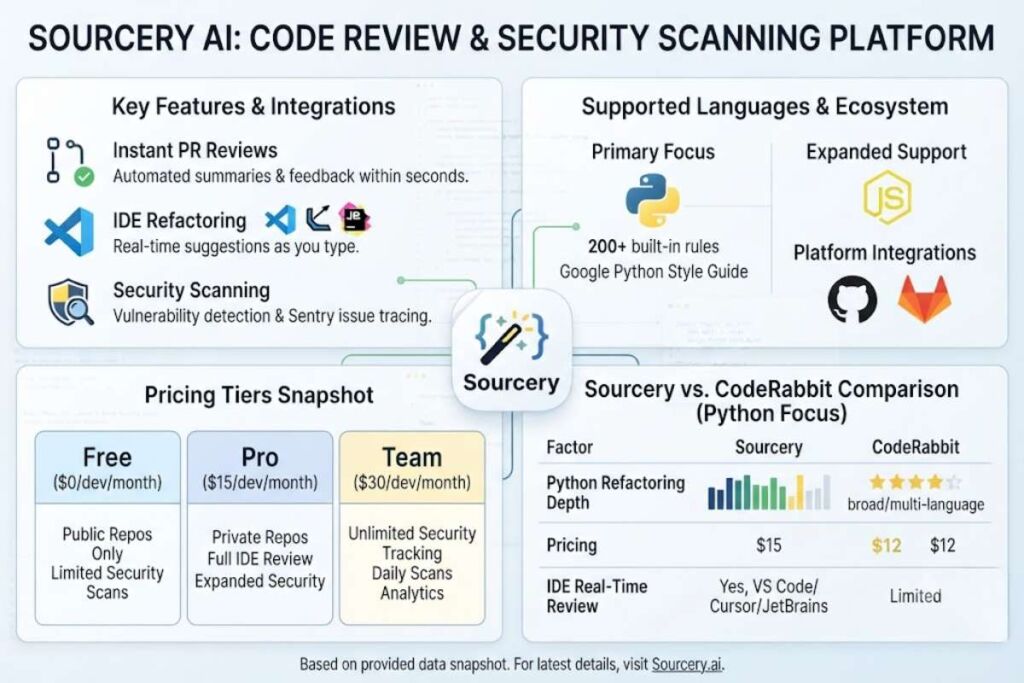
Sourcery is an AI-powered code review and security scanning platform that posts automated pull request feedback on GitHub and GitLab and delivers real-time refactoring suggestions inside VS Code, Cursor, and JetBrains IDEs. Pro pricing starts at $15 per developer per month, and the platform originated as a Python-specific refactoring engine before expanding into JavaScript support and full security scanning.
What Is Sourcery?
Sourcery is an automated code review and security scanning tool built for teams shipping AI-generated code, with a Free tier for public repositories, a $15/developer/month Pro tier for private repos, and a $30/developer/month Team tier that adds unlimited security issue tracking and daily scans.
Sourcery indexes pull requests on connected repositories and generates a review within seconds of the PR opening. The review includes a change summary, a visual diagram of the modification scope, and line-by-line inline comments that flag logic errors, edge cases, and coding-standard violations. Sourcery runs a second surface inside the IDE, scanning code as a developer types and surfacing refactoring suggestions before a commit ever reaches a PR. The company reports over 300,000 developers use the platform, including engineering teams at HelloFresh, Sky, Cisco, Red Hat, and Ant Group, according to Sourcery’s own marketing materials.
| Attribute | Value |
|---|---|
| Company | Sourcery AI |
| Primary Language Focus | Python (200+ built-in rules), with JavaScript support |
| Free Tier Price | $0/developer/month |
| Pro Tier Price | $15/developer/month |
| Team Tier Price | $30/developer/month |
| IDE Integrations | VS Code, Cursor, JetBrains |
| Git Integrations | GitHub, GitLab |
| Key Feature | Instant PR reviews with change diagrams and inline fixes |
What Are Sourcery’s Key Features?
Sourcery’s feature set splits across three products: pull request review, IDE-based refactoring, and security scanning.
- Generate automated PR summaries that describe the scope and intent of a code change within seconds of the pull request opening.
- Post line-by-line inline comments on GitHub and GitLab pull requests that identify logic errors, edge cases, and violations of configured coding standards.
- Apply 200+ built-in Python rules covering refactoring patterns such as extracting duplicate methods, simplifying comprehensions, and replacing manual loops with idiomatic constructs.
- Enforce custom rules defined through pattern syntax in a
.sourcery.yamlconfiguration file, letting teams codify internal standards the built-in rule set doesn’t cover. - Adopt the Google Python Style Guide as an optional rule set for teams that want to align with that published standard.
- Scan repositories for security vulnerabilities on a schedule that ranges from twice weekly on the Free and Pro tiers to daily on the Team tier.
- Investigate and fix Sentry-linked production issues by tracing a reported error back to its root cause and generating a code fix, available as a separate Production Issues product.
- Review code in real time inside the IDE through extensions for VS Code, Cursor, and JetBrains, surfacing suggestions before code is committed.
How Much Does Sourcery Cost?
Sourcery’s Code Review and Security product has three tiers: Free at $0/developer/month for public repos, Pro at $15/developer/month for private repos, and Team at $30/developer/month for full security coverage and analytics — all confirmed on Sourcery’s official pricing page.
The Free tier matches Pro-level review functionality but restricts it to public, open source repositories, and it covers security scans across 3 repos with up to 10 flagged issues per repo, scanned twice weekly. The Pro tier unlocks code reviews on private repositories and IDE reviews for any project, expands security scanning to 10 repos, and keeps the twice-weekly scan frequency. The Team tier removes the security issue cap, scans up to 200+ repos daily, and adds repository-level analytics. Sourcery applies a 20% discount to all three tiers when billed annually. The separate Production Issues product for Sentry-linked fixes has its own Free tier capped at 20 issue investigations per month, with a Resolution Plus tier that raises the cap to 200+ investigations monthly.
What Are the Pros and Cons of Sourcery?
Sourcery’s core advantage is Python-specific refactoring depth from 200+ built-in rules; its main limitation is that language coverage concentrates on Python and JavaScript while competitors like DeepSource cover 16 languages and SonarQube covers 35+.
On the pros side, Sourcery combines PR-level review with IDE-level real-time feedback, so issues surface before a commit instead of only at review time. The platform supports SOC 2 certification, zero-retention data options, no training on customer code, and a bring-your-own-LLM option for teams with strict security requirements. On the cons side, teams working primarily in Go, Rust, Java, or PHP get minimal rule coverage compared to Python. Security scanning on the Free and Pro tiers caps at 10 flagged issues per repo, which can undercount findings on larger codebases. Unlimited issue visibility and daily scan frequency require the $30/developer/month Team tier.
How Does Sourcery Compare to CodeRabbit?
Sourcery specializes in Python refactoring depth at a lower entry price of $15/developer/month; CodeRabbit covers more languages and git platforms at $12-25/user/month with a more mature, broadly adopted review engine.
CodeRabbit supports GitHub, GitLab, and Bitbucket with a generous free tier and configurable AI model choice, while Sourcery’s Free tier restricts private-repo access entirely. Teams with polyglot codebases spanning multiple languages tend to get broader coverage from CodeRabbit; teams with Python-heavy codebases get deeper, more idiomatic suggestions from Sourcery.
| Factor | Sourcery | CodeRabbit |
|---|---|---|
| Entry Price (paid) | $15/developer/month | $12/user/month |
| Language Depth | Python-specialized, plus JavaScript | Broad multi-language |
| Git Platforms | GitHub, GitLab | GitHub, GitLab, Bitbucket |
| IDE Real-Time Review | Yes (VS Code, Cursor, JetBrains) | Limited |
Read the full breakdown in our dedicated CodeRabbit vs Sourcery comparison.
Who Should Use Sourcery?
Sourcery fits Python-heavy engineering teams, solo Python developers who want IDE-level refactoring, and teams already using AI coding assistants that need a fast first-pass reviewer before human review.
Solo developers get unlimited local code analysis and up to 3 GitHub repositories on the Free tier without paying anything. Tech leads managing teams that ship Python or JavaScript at high volume get automated first-pass reviews that reduce senior-engineer review time. Open source maintainers get full Pro-level review functionality at no cost, since the Free tier applies Pro features to public repos. Teams working primarily in languages outside Python and JavaScript should evaluate a broader-coverage tool instead.
What Are the Best Alternatives to Sourcery?
- CodeRabbit reviews pull requests across GitHub, GitLab, and Bitbucket with broader language support and a free tier for individual developers. Read our full CodeRabbit review.
- DeepSource runs 5,000+ static analysis rules across 16 languages with a sub-5% false-positive rate and an Autofix AI feature, priced at $24/user/month for its Team plan. Read our full DeepSource review.
- Codacy provides a unified code-quality dashboard across 40+ languages aimed at enterprise teams that need centralized visibility, priced from $15/user/month. Read our full Codacy review.
Frequently Asked Questions
Does Sourcery support languages other than Python?
Sourcery supports JavaScript alongside its primary Python rule set, but built-in rule depth for other languages remains limited compared to Python.
Can Sourcery apply fixes automatically without approval?
Sourcery surfaces suggested fixes in the IDE and on pull requests, and a developer applies each one with a single click rather than having changes committed automatically.
Does the Sourcery Free tier work for private repositories?
No. The Free tier applies Pro-level review functionality only to public, open source repositories; private-repo access requires the $15/developer/month Pro tier.
Does Sourcery offer a trial of the paid tiers?
New accounts start with a 2-week free trial of the Team tier, then move to the Free tier automatically unless a payment method is added, per Sourcery’s official billing documentation.
Final Verdict
Sourcery costs $15/developer/month for Pro and delivers its strongest value to Python-focused teams that want both PR-level review and real-time IDE refactoring in one subscription; teams needing broad multi-language coverage get better value from CodeRabbit or DeepSource.