
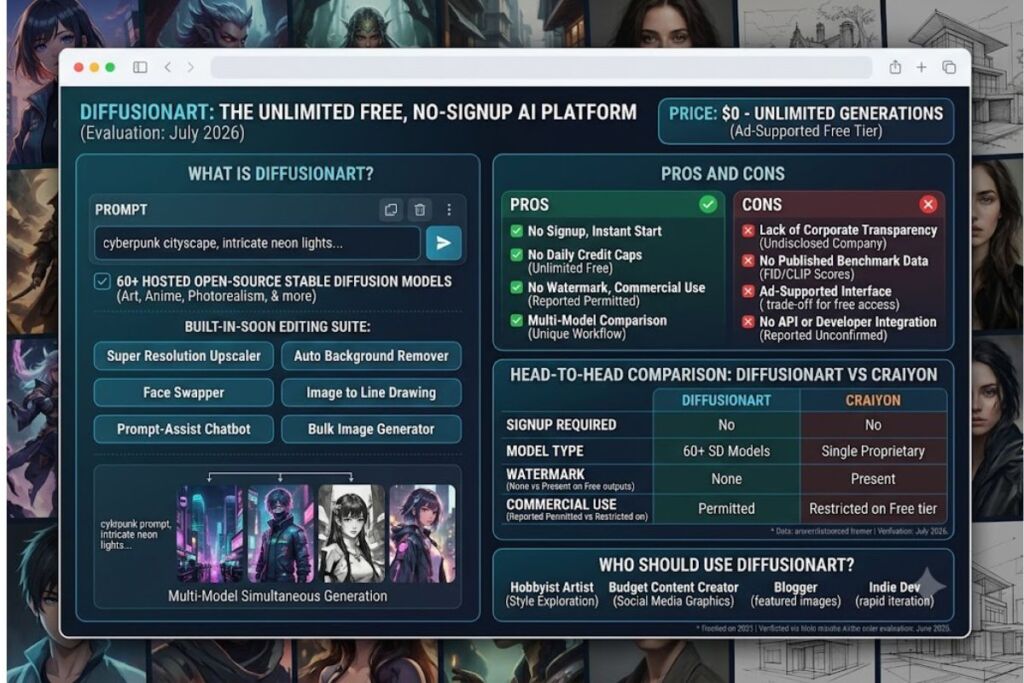
DiffusionArt is a browser-based AI image generator offering unlimited free generations across 60+ Stable Diffusion models, with no signup, no credits, and no watermark on outputs. This review breaks down DiffusionArt’s features, pricing, limitations, and best alternatives based on the platform’s current published capabilities.
- 01What Is DiffusionArt?
- 02What Are DiffusionArt’s Key Features?
- 03How Much Does DiffusionArt Cost?
- 04What Are the Pros and Cons of DiffusionArt?
- 05How Does DiffusionArt Compare to Craiyon?
- 06Who Should Use DiffusionArt?
- 07What Are the Best Alternatives to DiffusionArt?
- 08Frequently Asked Questions
- 09The Bottom Line
What Is DiffusionArt?
DiffusionArt is a free, no-signup AI art platform that runs a single prompt across multiple hosted Stable Diffusion models at once, letting users compare outputs from dozens of art styles in one generation.
DiffusionArt operates entirely in the browser at diffusionart.co (also listed at diffusionart.ai). The platform hosts a curated library of open-source diffusion models rather than training a single proprietary model. Users select one or several models, enter a text prompt, and DiffusionArt runs the generation simultaneously across each selected model. This multi-model architecture is the platform’s core differentiator against single-model tools like Midjourney or DALL·E 3.
| Attribute | Value |
|---|---|
| Company | Not publicly disclosed on the platform — unable to verify, check official site |
| Release Year | Not publicly disclosed — unable to verify |
| Pricing | Free tier: unlimited generations, $0. Optional paid tiers reported by third-party listings — verify on official pricing page |
| Platforms | Web browser only (no desktop or mobile app) |
| Key Feature | Multi-model simultaneous generation across 60+ hosted Stable Diffusion models |
Pricing and free tier details verified as of July 2026 via third-party tool directories (AIDIRECTORY, ToolMage, EliteAI.Tools). Because DiffusionArt does not publish a formal pricing or documentation page at the time of writing, all figures should be cross-checked against the live site before publishing pricing claims to readers.
What Are DiffusionArt’s Key Features?
DiffusionArt bundles generation, editing, and utility tools into one interface. Based on the platform’s published feature list:
- Generate images across multiple models in a single prompt submission, returning side-by-side outputs for direct style comparison.
- Access a model library that different sources list between 60 and 200+ pretrained Stable Diffusion checkpoints, covering art, anime, and photorealism categories.
- Upscale images using the built-in Super Resolution tool to increase output resolution beyond the base generation size.
- Remove backgrounds automatically with the Remove Background tool, without exporting to a separate app.
- Swap faces on generated or uploaded images using the Face Swap tool.
- Convert images to line drawings with the Image to Line Drawing tool, useful for coloring-book or sketch-reference workflows.
- Generate prompt text using a built-in prompt-assist chatbot when starting from a vague idea.
- Produce images in bulk through the Bulk Image Generator for users who need volume output in one session.
The exact model count is not consistent across sources — ToolSpedia and EliteAI.Tools list 60+ models, while AIDude.info lists 200+. Because DiffusionArt does not publish a live model counter, treat the model-count figure as approximate rather than exact.
How Much Does DiffusionArt Cost?
DiffusionArt’s core image generation is free with no generation cap, no signup requirement, and no watermark on downloads; third-party listings report optional paid tiers on top of the free plan, though DiffusionArt has no official public pricing page to confirm exact figures.
| Tier | Reported Price | Reported Access |
|---|---|---|
| Free | $0 | Unlimited generations, all core models, no signup, no watermark, commercial-use rights on outputs |
| Starter | Reported ~$5/month (per AIDIRECTORY listing — unverified against an official pricing page) | Not specified |
| Plus | Reported ~$20/month (per AIDIRECTORY listing — unverified) | Not specified |
| Pro | Reported ~$50/month (per AIDIRECTORY listing — unverified) | Not specified |
The free tier is the platform’s primary offering and the reason it appears in “unlimited free AI image generator” roundups. Ad support funds the free tier’s unlimited generation model, per ToolMage’s listing of the platform. Unable to verify the exact function of the paid Starter, Plus, and Pro tiers — check DiffusionArt’s official site directly before relying on these figures for a purchase decision.
What Are the Pros and Cons of DiffusionArt?
DiffusionArt’s biggest advantage is unrestricted free access with no account required; its biggest limitation is the absence of published benchmark data, a named parent company, or a formal pricing page, which limits how much of the platform can be independently verified.
Pros:
- Unlimited free generations with no daily cap, unlike free tiers on Leonardo.ai or Krea that impose daily credit limits.
- No signup required — generation starts immediately from the homepage, removing the account-creation step most competitors require.
- No watermark on downloaded images, and outputs carry commercial usage rights per the platform’s stated terms.
- Multi-model comparison in a single prompt run, which single-model tools like DALL·E 3 or Midjourney don’t offer natively.
Cons:
- No published benchmark scores (no FID, CLIP score, or human-preference leaderboard data tied to DiffusionArt’s hosted models) — workaround: cross-reference the underlying open-source model names (where visible in the model picker) against independent leaderboards like Artificial Analysis for that specific checkpoint.
- Ad-supported free tier — workaround: this is the tradeoff that funds unlimited generation; users who want an ad-free session can use a browser reader mode or ad blocker without losing access to generation.
- No confirmed API or developer integration — workaround: for programmatic access, use a directly-hosted open-source Stable Diffusion checkpoint via Replicate or Hugging Face Inference instead.
- No disclosed company or release date — workaround: this doesn’t block casual or commercial creative use, but teams needing a vendor with verifiable corporate accountability should confirm this directly with the site operator before commercial deployment at scale.
How Does DiffusionArt Compare to Craiyon?
Craiyon is a free, no-signup AI image generator built on its own proprietary model rather than hosting third-party Stable Diffusion checkpoints.
| Attribute | DiffusionArt | Craiyon |
|---|---|---|
| Signup Required | No | No |
| Model Type | 60+ hosted open-source Stable Diffusion models | Single proprietary model |
| Multi-Model Output | Yes — runs one prompt across several models | No |
| Watermark | None reported | Watermark present on free outputs |
| Commercial Use | Reported permitted | Restricted on free tier |
DiffusionArt’s multi-model architecture gives it a style-comparison advantage Craiyon’s single-model system doesn’t replicate. See our full breakdown in Craiyon vs DiffusionArt: Which Free AI Art Generator Wins?
Who Should Use DiffusionArt?
Hobbyist artists exploring multiple art styles without committing to one model benefit from DiffusionArt’s side-by-side generation. Content creators producing social media graphics on zero budget use the unlimited free tier to avoid per-image credit costs common on Leonardo.ai and Ideogram. Indie game developers and comic artists sketching character concepts use the anime and stylized model categories for rapid visual iteration. Bloggers needing quick featured images use the no-signup flow to generate without adding another account to a content workflow.
Enterprise teams requiring SLA guarantees, a named vendor entity, or API access should evaluate a commercially backed platform instead, since DiffusionArt does not publish corporate or infrastructure documentation.
What Are the Best Alternatives to DiffusionArt?
- Craiyon — A free, no-signup single-model generator best suited for quick, low-stakes image drafts. Read the full Craiyon Review.
- Leonardo.ai — A credit-based platform with a stronger free-tier daily allowance and published model documentation for teams that need more production control. Read the full Leonardo.ai Review.
- SeaArt AI — A free stamina-based generator offering 150 daily credits and upscaling tools for users who want structured free-tier limits instead of unlimited ad-supported access. Read the full SeaArt AI Review.
Frequently Asked Questions
Is DiffusionArt actually unlimited and free?
Yes. Multiple independent tool directories confirm DiffusionArt’s core generation is free with no signup, no credit system, and no generation cap on the base tier.
Does DiffusionArt require an account?
No. Generation starts directly from the homepage without account creation, unlike most competing AI art platforms.
Can I use DiffusionArt images commercially?
Third-party listings report commercial usage rights on DiffusionArt outputs. Because DiffusionArt has no formal published terms-of-service page confirming this at review time, verify current terms directly on the site before commercial publication.
Does DiffusionArt offer an API?
Unable to verify. No API documentation is published on the platform’s public-facing pages as of this review.
The Bottom Line
DiffusionArt’s unlimited, signup-free, ad-supported model makes it the strongest option in its category for volume generation at zero cost — the tradeoff is a platform with no published pricing page, no disclosed company, and no independent benchmark data, which shifts more verification burden onto the user than fully documented competitors like Leonardo.ai.