
⏱ 12 Reading Time
- 011. ElevenLabs
- 022. Fish Audio (S2)
- 033. Resemble AI
- 044. Murf AI
- 055. Descript (AI Speech)
- 066. Speechify
- 077. PlayHT
- 088. Notevibes
- 099. Fish Audio (Free Tier) / Qwen3-TTS
- 1010. LOVO AI — Do Not Purchase a New Plan
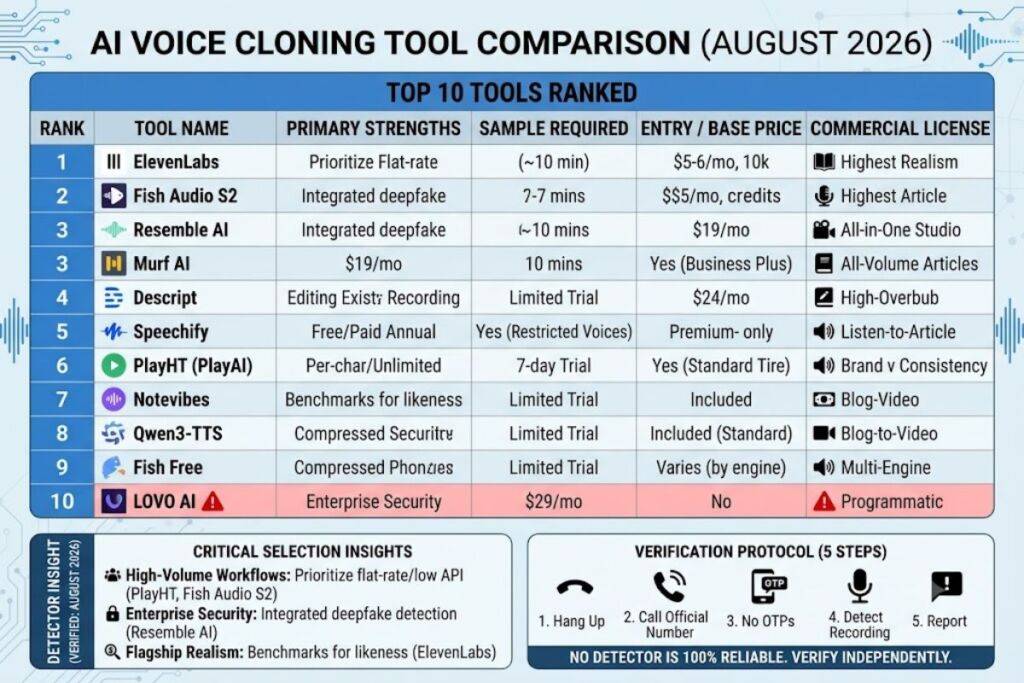
- 11Quick Comparison Table
- 12How to Choose the Right Voice for Your Brand
- 13Frequently Asked Questions
Global Disclaimer: Pricing, feature limits, and quotas for AI tools change frequently. All figures below are sourced from official pricing pages and independent benchmark trackers as cited, checked as of August 2026. Confirm current terms on each vendor’s pricing page before purchasing.
ElevenLabs, Fish Audio, and Resemble AI rank as the top three AI voice cloning tools in 2026 based on cloning fidelity, licensing terms, and API cost-per-character. This guide ranks 10 tools on voice quality, minimum sample length required for cloning, pricing structure, and commercial usage rights.
1. ElevenLabs
ElevenLabs is the highest-fidelity voice cloning tool available in 2026, ranking in the top 10 of the TTS Arena leaderboard. Its Flash v2.5 model sits at Elo 1549 and Turbo v2.5 at Elo 1545 on the TTS Arena leaderboard, both placing in the top 10 overall as of April 2026.
Key features:
- Clones a target voice from a 10–30 second reference sample using Instant Voice Cloning.
- Produces breathing patterns and pacing through the v3 model, distinguishing it from competitors that output flatter prosody.
- Translates and dubs voiceovers across multiple languages while preserving the cloned speaker’s tone.
- Includes a built-in sound-effects generator and voice isolator inside the same workspace — features competitors sell as separate add-ons.
Pricing (verified August 2026): Instant cloning is included on the Creator plan ($22/month, 100,000 characters), Pro plan ($99/month, 500,000 characters), and Scale plan ($330/month, 2 million characters), with overage billed at $0.30 per 1,000 characters. Voice cloning is not available on the free tier; the entry-level Starter plan starts at $5/month with a limited character allowance.
Con: The character-based pricing model punishes high-volume publishing workflows — a 500,000-character monthly cap on the Pro plan is roughly 100,000 words, which a daily content site burns through fast. Workaround: the Scale plan’s 2-million-character allowance, or the API’s pay-as-you-go overage rate, absorbs high-volume output without a full-tier jump.
Best for: Voice actors building a licensed digital clone, studios needing consistent character voices across long scripts, and brands that need dubbing and SFX in one tool instead of stitching three subscriptions together.
2. Fish Audio (S2)
Fish Audio S2 is the best value voice cloning tool on the API side in 2026, running roughly six times cheaper than ElevenLabs per character. It ranks #1 on TTS-Arena blind listening tests and beat ElevenLabs V3 by a 60–40 margin in published A/B testing.
Key features:
- Clones a voice from a 10-second sample using zero-shot cloning — no fine-tuning step required.
- Supports 80+ languages natively in a single model, avoiding the per-language add-ons some competitors charge for.
- Runs open-source, so development teams can self-host the model instead of routing every request through a vendor API.
- Delivers production-grade latency suitable for real-time conversational agents, not just pre-recorded narration.
Pricing (verified August 2026): Fish Audio Plus costs $11/month with commercial rights, and the API runs approximately $15 per 1 million characters, compared to roughly $165 per 1 million characters on ElevenLabs.
Con: The open-source distribution model means support is community-driven rather than a dedicated account team — enterprise buyers who need SLA-backed support should budget for a managed hosting partner. Workaround: several third-party hosts offer managed Fish Audio deployments with support contracts layered on top.
Best for: Developers building conversational voice agents at scale, and any team where API cost-per-character is the deciding budget line.
3. Resemble AI
Resemble AI requires the shortest voice sample of any tool on this list — approximately 5 seconds — and has repositioned around enterprise security rather than pure content creation. Resemble AI requires the least audio (~5 seconds) and is the top pick for enterprise security, offering SOC 2 compliance and deepfake detection.
Key features:
- Generates a usable clone from a 5-second sample via its open-source Chatterbox model family.
- Clones across 23+ languages using the Chatterbox model.
- Runs a companion deepfake-detection product (DETECT-3B Omni) inside the same account, letting security teams verify audio authenticity without a separate vendor.
- The DETECT-3B Omni model claims 98% accuracy across 38+ languages for deepfake detection.
Pricing (verified August 2026): Resemble AI retired its previous Creator and Professional subscription tiers in favor of Flex, a pay-as-you-go plan billed at $0.03 per minute of generated audio. A $13 million strategic funding round in December 2025, backed by Sony Innovation Fund, Okta Ventures, and Google’s AI Futures Fund, was earmarked specifically for the deepfake-detection platform.
Con: The pivot away from flat subscription tiers toward pay-per-minute pricing makes monthly cost less predictable for high-volume creators than a flat-rate competitor. Workaround: budget-conscious teams can cap spend by pre-generating scripts in batches and monitoring per-minute usage through the dashboard rather than generating on demand.
Best for: Enterprise security teams, compliance-heavy industries needing deepfake verification, and developers who want pay-as-you-go billing over a fixed subscription.
4. Murf AI
Murf AI is the strongest choice for a clean, studio-quality “corporate narrator” sound rather than emotionally expressive cloning. It trades some emotional realism for consistency and a strict consent-verification process before allowing any custom clone.
Key features:
- Adjusts pitch, pace, and emphasis at the word level through an inline waveform editor.
- Inserts pause markers and pronunciation overrides through a right-click “Edit Pronunciation” menu.
- Translates voiceovers into 20+ languages while preserving the original speaker’s cloned tone.
- Requires a documented consent step before activating custom voice cloning, which slows onboarding but reduces misuse risk.
Pricing: The free plan includes 10 minutes of generation per month but blocks downloads entirely. The Creator plan, at $19/month, adds 24 hours of generation per year plus download access.
Con: Custom voice cloning sits behind an Enterprise contract with no published self-service price, which locks solo creators out of cloning their own voice on any individual-tier plan. Workaround: solo creators who specifically need self-service cloning should use ElevenLabs or Resemble AI instead and reserve Murf for its stock-voice narration strength.
Best for: Corporate training videos, e-learning narration, and teams that want a licensed, low-risk stock voice rather than a personal clone.
5. Descript (AI Speech)
Descript bundles voice cloning into its video and podcast editor, making it the best pick for creators who need an editor first and cloning second. Its core workflow lets users edit spoken audio like a text document — delete a word from the transcript, and the audio cut follows automatically.
Key features:
- Edits audio and video by editing the transcript directly, removing filler words and re-ordering sentences without touching a waveform.
- Cleans background noise and room echo through the “Studio Sound” feature.
- Clones a voice for corrections and re-dubs inside the same timeline used for editing.
- Transcribes and screen-records natively, removing the need for a separate capture tool.
Pricing: The free plan includes 1 hour of media per month with limited AI Speech access, and the Creator plan at $24/month unlocks 30 hours of media plus full AI Speech access.
Con: Voice cloning is not sold as a standalone product — buyers pay for the full editing suite even if cloning is the only feature they want. Workaround: creators who already need a podcast or video editor get voice cloning bundled in at effectively no added cost.
Best for: Podcasters and video editors who want cloning folded into an existing production workflow rather than a separate subscription.
6. Speechify
Speechify bundles voice cloning with commercial usage rights starting at its entry-level paid tier, removing the licensing ambiguity some competitors leave to a support ticket. Speechify bundles cloning and commercial rights from $19/month.
Key features:
- Grants commercial usage rights on the cloned voice by default at the paid tier, instead of gating licensing behind an enterprise contract.
- Reads back long-form text at variable speed, originally built for accessibility and repurposed for narration workflows.
- Runs on mobile and desktop with synced playback position across devices.
- Supports bulk document import for narrating long PDFs and articles in one pass.
Con: The accessibility-first origin of the product means its voice-editing controls are less granular than a dedicated cloning tool like ElevenLabs — word-level emphasis and breath control are limited. Workaround: creators needing fine-grained prosody control should pair Speechify’s commercial-rights simplicity with an export into a tool like Murf for final polish.
Best for: Creators who want commercial rights included without a licensing negotiation, and users converting long documents to audio in bulk.
7. PlayHT
PlayHT is the strongest option for unlimited-volume value, charging a flat rate rather than a per-character or per-minute meter. PlayHT prices at $31.20/month for unlimited use.
Key features:
- Generates unlimited audio output on its paid plan without a character or minute cap.
- Offers a real-time streaming API for conversational voice agents.
- Supports multi-speaker dialogue generation in a single request for podcast-style scripts.
- Provides a voice-cloning studio with adjustable stability and similarity sliders per generation.
Con: Flat-rate unlimited pricing works against light users who generate small volumes — a per-character competitor can be cheaper below a certain usage threshold. Workaround: creators generating under roughly 50,000 characters per month should compare against Fish Audio’s per-character API rate before committing to the flat plan.
Best for: High-volume publishers who want predictable flat billing instead of a metered plan that scales with output.
8. Notevibes
Notevibes is the best choice for teams that need a large stock-voice catalog rather than a personal clone. Notevibes offers 550+ premium AI voices with 80+ emotion tags, requiring no audio samples or training.
Key features:
- Ships 550+ pre-built voices spanning accents, ages, and languages without any cloning setup step.
- Tags 80+ emotional deliveries per voice, letting writers select tone directly from a dropdown instead of prompting for it.
- Skips the consent and sample-upload workflow entirely, since no personal cloning is involved.
- Exports directly to common video and podcast formats without a separate render step.
Con: The absence of voice cloning means brands cannot create a proprietary “signature voice” distinct from every other customer using the same catalog. Workaround: brands that need catalog variety today but a proprietary voice later should pair Notevibes for volume content with ElevenLabs or Resemble AI for flagship brand assets.
Best for: Content teams producing high volumes of narrated video who don’t need a specific person’s cloned voice.
9. Fish Audio (Free Tier) / Qwen3-TTS
Qwen3-TTS is the strongest free voice-cloning option in 2026 for creators who can’t justify a paid plan yet. Voice cloning ranges from free options like Qwen3-TTS, CloneMyVoice.ai, and the Fish Audio free tier up to $5–99/month for commercial tools.
Key features:
- Generates a voice clone at zero cost without a credit card requirement.
- Runs as an open-weight model, allowing self-hosting for teams with in-house infrastructure.
- Supports zero-shot cloning consistent with the paid Fish Audio S2 architecture it shares lineage with.
Con: Free tiers of this kind typically omit commercial usage rights and impose a watermark or generation cap — verify the specific free-tier terms on the provider’s page before publishing commercial content, since limits change without notice. This detail could not be independently verified for the current month and should be confirmed on the official page rather than assumed.
Best for: Hobbyists, students, and developers prototyping a voice feature before committing budget to a paid plan.
10. LOVO AI — Do Not Purchase a New Plan
LOVO AI filed for Chapter 7 bankruptcy in May 2026, and the platform is not a safe purchase despite still processing new subscriptions. LOVO AI filed Chapter 7 bankruptcy in May 2026, the site still sells subscriptions with no notice of the bankruptcy, and paying users report account lockouts.
Con: No workaround applies here — this is a direct financial-risk warning, not a feature limitation. Existing subscribers should export all cloned voice assets immediately and migrate to an active vendor such as ElevenLabs, Fish Audio, or Resemble AI.
Best for: No one, at this time. Included in this ranking only to warn readers actively searching for LOVO AI pricing.
Quick Comparison Table
| Tool | Best For | Min. Sample | Starting Price | Commercial Rights Included |
|---|---|---|---|---|
| ElevenLabs | Highest cloning fidelity | 10–30 sec | $5/mo (cloning from $22/mo) | Yes, paid tiers |
| Fish Audio S2 | API cost efficiency | 10 sec | $11/mo (~$15/1M chars API) | Yes, Plus tier |
| Resemble AI | Enterprise security/detection | ~5 sec | $0.03/min (Flex, pay-as-you-go) | Yes |
| Murf AI | Corporate narration | N/A (consent-gated) | $19/mo | Enterprise only |
| Descript | Bundled editing + cloning | N/A | $24/mo | Yes, Creator tier |
| Speechify | Commercial rights simplicity | N/A | $19/mo | Yes, included |
| PlayHT | Unlimited flat-rate volume | N/A | $31.20/mo | Yes |
| Notevibes | Large stock-voice catalog | No cloning | Not disclosed in source data | N/A (no cloning) |
| Qwen3-TTS | Free prototyping | Varies | Free | Unverified — check terms |
| LOVO AI | Avoid — bankruptcy risk | N/A | N/A | N/A |
Pricing verified as of August 2026 from cited sources; confirm on each vendor’s official pricing page before purchasing.
How to Choose the Right Voice for Your Brand
The right voice choice depends on three factors: whether you need a real person’s likeness cloned, your monthly content volume, and your commercial licensing requirement. A brand publishing daily video content at high volume needs flat-rate or low-per-character pricing (PlayHT, Fish Audio); a brand cloning an executive’s or spokesperson’s actual voice needs documented consent workflows and enterprise licensing (Murf, ElevenLabs Professional Voice Cloning); a brand testing the concept needs a free tier without a credit card requirement (Qwen3-TTS).
Volume publishers should prioritize cost-per-character or flat-rate pricing over voice-quality benchmarks, since even a small quality gap matters less than a pricing model that scales with output. Brand-identity use cases — a signature spokesperson voice used across years of content — justify paying a premium for the highest MOS (Mean Opinion Score) fidelity, since inconsistency in a recognizable brand voice damages trust more than a higher subscription cost.
Frequently Asked Questions
Is voice cloning legal for commercial use?
Voice cloning is legal when the cloned individual has given documented consent and the platform’s terms of service grant commercial usage rights on the output. Cloning a real person’s voice without consent creates legal exposure independent of which tool is used.
How much audio does a tool need to clone a voice?
The lowest requirement among current tools is approximately 5 seconds for Resemble AI’s Chatterbox model, while ElevenLabs recommends a 10–30 second reference clip for commercial-grade output.
Can I use a free voice cloning tool for a business podcast?
Free tiers frequently exclude commercial usage rights, add a watermark, or cap monthly output — confirm the specific free-tier terms on the provider’s official pricing page before publishing business content, since these terms change frequently and were not independently verifiable for every tool at time of writing.
What happened to LOVO AI?
LOVO AI filed for Chapter 7 bankruptcy in May 2026, and the platform continues selling subscriptions without disclosing this to new customers. Do not purchase a new plan.
For the highest fidelity clone available in 2026, ElevenLabs remains the price-to-quality benchmark against which every other tool on this list is measured — but Fish Audio S2 delivers comparable output at roughly one-sixth the API cost, which is the more decision-relevant fact for any team billing by volume.