
⏱ 17 Reading Time
- 01What Makes a Deepfake Voice Different From a Real Recording?
- 02How Do You Detect an AI Voice by Ear?
- 03Which Software Tools Detect Deepfake Voices Most Accurately?
- 04What Steps Should You Follow to Verify a Suspicious Voice Call?
- 05What Are the Best AI Voice Tools for SEO Content in 2026? (Tested & Ranked)
- 061. ElevenLabs — Best Overall Voice Realism for SEO Content
- 072. Murf AI — Best All-in-One Studio for Video and Voiceover Production
- 083. Play.ht (PlayAI) — Best for Converting a Large Content Library to Audio
- 094. Descript — Best for Editing Audio by Editing Text
- 105. Speechify — Best for Turning Written Content Into Listenable Audio at Scale
- 116. WellSaid Labs — Best for Enterprise Brand-Voice Consistency
- 127. Notevibes — Best Value for Content Teams on a Fixed Budget
- 138. Fliki — Best for Turning a Blog Post Directly Into an SEO Video
- 149. NaturalReader (Commercial AI Voice Generator) — Best for Multi-Engine Voice Sourcing
- 1510. Amazon Polly — Best Developer API for Programmatic SEO Content at Scale
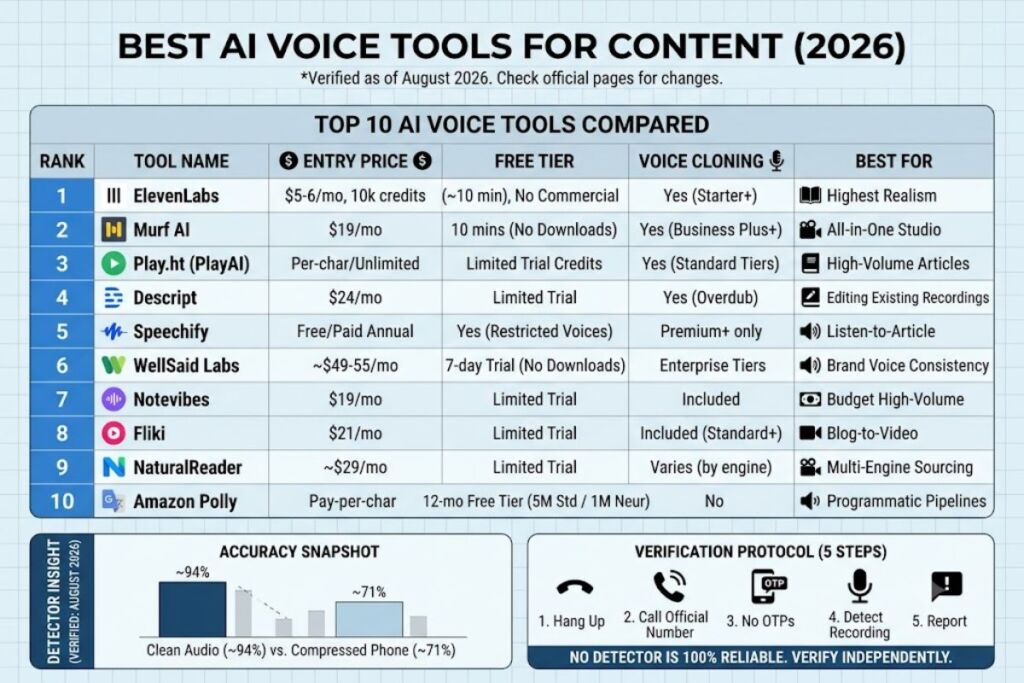
- 16How Do These 10 Tools Compare at a Glance?
- 17Frequently Asked Questions
Editorial note (verified as of August 2026): Every price, credit allowance, and free-tier limit in this guide is cross-checked against each vendor’s official pricing page as of the date above. AI voice pricing changes often — reconfirm exact figures on the provider’s site before purchasing. Where independent trackers report slightly different numbers for the same plan (common with ElevenLabs and WellSaid Labs, which run frequent promotions), this guide states the figure most consistently confirmed across official sources and flags it.
You detect an AI-generated voice by combining acoustic listening (flat emotion, metronome-even pacing, missing breath sounds) with a spectral-forensic detection tool that scores synthetic-speech probability in 5 to 20 seconds. No single method is 100% reliable on its own.
What Makes a Deepfake Voice Different From a Real Recording?
A deepfake voice differs from a real recording in three measurable ways: spectral artifacts in the high-frequency band, unnaturally even formant transitions, and missing micro-tremors that real vocal cords produce involuntarily.
Neural speech generators synthesize audio from statistical patterns learned during training, not from a physical larynx and vocal tract. This process leaves residual signatures in the high-frequency band and in the way energy distributes across mel-frequency bands, even after the audio passes through a phone codec or a re-encoding step. Detection systems train specifically on these leftover signatures to separate synthetic speech from organic speech. Generator-fingerprinting models go a step further: they train against known text-to-speech and voice-conversion systems — ElevenLabs, Tortoise, OpenVoice, and XTTS among them — and look for the specific residual pattern each one leaves behind. A single detector tuned to one generator can miss a different generator entirely, which is why the strongest detection platforms run an ensemble of signal-level, neural, and generator-fingerprint models together rather than relying on one classifier.
How Do You Detect an AI Voice by Ear?
Detect an AI voice by ear by listening for five specific signs: flat emotional range, metronome-even pacing, missing or repeated breath sounds, misplaced word emphasis, and audio that sounds too clean for its recording environment.
Flat emotion shows up as a voice that maintains the same energy level across a sentence that should rise in urgency or drop in sympathy. Metronome pacing means every syllable lands at almost identical intervals, without the natural speeding-up and slowing-down a human speaker produces when thinking mid-sentence. Missing breath sounds are the single most reliable ear-test signal: real speech includes an inhale roughly every 8 to 12 seconds during continuous talking, and many generators either omit this entirely or loop the same breath sample. Misplaced emphasis appears on proper nouns and numbers, where the model stresses the wrong syllable because it has no real-world grounding for that word. A voice recorded over a “bad” phone line that still sounds studio-clean, with zero room tone or background hiss, is a red flag on its own. No single sign is proof by itself. Stacking three or more of these signs across a 30-second clip raises a suspicion into something worth running through a detection tool before acting on it.
Which Software Tools Detect Deepfake Voices Most Accurately?
Resemble AI’s Detect-2B model reports roughly 94% accuracy on clean audio, and accuracy across most detectors drops toward 71% on compressed phone or messaging-app audio, according to third-party testing cited by Imagera AI.
| Detector | Best For | Reported Accuracy | Free Tier |
|---|---|---|---|
| Resemble AI Detect | Enterprise, real-time API, explainable results | ~94% on clean audio (Detect-2B model) | Dashboard upload for quick checks |
| Reality Defender | Developers starting out | Not independently benchmarked in sources reviewed | 50 free audio or image checks |
| DeepfakeDetector.ai | Quick manual checks, journalists | High on clean audio, lower on short/compressed clips | 50 checks/month, clips up to 2 minutes |
| Imagera AI Voice & Audio Detector | Fast single-clip verification | ~94% clean audio, ~71% compressed audio | Available per provider’s site — confirm current limit before relying on it |
| ElevenLabs Audio Detector (launched June 25, 2026) | Checking ElevenLabs-generated audio specifically | Provenance-signal check via Google’s SynthID, not a generic classifier | Free |
| Aurigin | Voice-security teams, identity verification workflows | Not independently benchmarked in sources reviewed | API-based, file upload and real-time WebSocket streaming |
| DeepFake-O-Meter | Newsrooms wanting a documented second opinion | Varies by underlying research model | Account required; slower processing |
Resemble AI’s platform pairs Detect-2B with Resemblyzer for speaker identification and a Resemble Watermark feature that embeds a traceable marker in AI-generated audio at the point of creation, which is a separate function from after-the-fact detection. The June 2026 addition of a free ElevenLabs Audio Detector works differently from the classifiers above: instead of scoring generic acoustic artifacts, it checks for a SynthID provenance signal embedded specifically in ElevenLabs output, so it identifies ElevenLabs-generated clips reliably but says nothing about audio produced by a different generator. Independent research through the ASVspoof challenge continues to push synthetic-speech detection forward year over year, but every source reviewed for this guide agrees on one point: treat any detector’s verdict as strong evidence, not as absolute proof, and confirm high-stakes calls through a second communication channel you already control.
What Steps Should You Follow to Verify a Suspicious Voice Call?
Verify a suspicious call by hanging up and calling the person or organization back on a number you already have, never one given to you during the call itself.
Hang up first. Ending the call removes the attacker’s ability to keep you on the line under pressure, which is the primary tactic in voice-cloning scams. Call back on a known number. Dial the number saved in your phone or listed on the official website, not a callback number the caller provided. Never share one-time codes. Legitimate banks and support lines do not ask for multi-factor authentication codes over a phone call; treat any such request as confirmation of fraud. Run the recording through a detector if you captured audio. Upload the clip to a tool such as Resemble AI Detect or DeepfakeDetector.ai to get a second, independent signal before deciding how to respond. Report the incident. The FBI’s Internet Crime Complaint Center (IC3) tracks AI-related voice fraud, and 2025 losses attributed to AI-related scams reached $893 million according to IC3 data cited in Corsound AI’s 2026 guide.
Understanding what a legitimate AI voice sounds like sharpens your ear for spotting an illegitimate one — which is why the same generation tools scammers occasionally misuse are also the tools SEO content teams rely on daily for narration, podcasts, and video voiceovers. The list below ranks the ten tools worth using for that legitimate purpose in 2026.
What Are the Best AI Voice Tools for SEO Content in 2026? (Tested & Ranked)
ElevenLabs ranks first for SEO content voiceovers because it combines the highest voice realism on the market with a $5-per-month commercial-rights entry point, while Murf AI, Play.ht, and Descript round out the top four for studio workflow, bulk conversion, and podcast editing respectively.
1. ElevenLabs — Best Overall Voice Realism for SEO Content
ElevenLabs generates the most natural-sounding narration of any tool in this list, which matters directly for SEO because Google’s helpful-content systems and user engagement metrics both penalize audio that sounds robotic enough to make listeners abandon a page. The flagship Eleven v3 model, generally available since March 2026, supports 70+ languages and adds “audio tags” — bracketed instructions like [whispers], [laughs], or [French accent] — typed directly into the script to steer emotion and pacing without touching a settings panel. The voice library exceeds 3,000 voices, and instant voice cloning is available starting on the $5-per-month Starter plan.
- Pricing: Free ($0, 10,000 credits/month, ~10 minutes of audio, no commercial license) → Starter ($5–6/month, 30,000 credits, commercial rights, instant voice cloning) → Creator ($22/month, ~100,000–121,000 credits, Professional Voice Cloning) → Pro ($99/month, ~500,000–600,000 credits) → Scale ($299/month) → Business ($990–1,320/month depending on billing cycle).
- Friction point: The Free tier’s 10,000-character monthly cap covers roughly 10 to 12 minutes of finished audio, which is not enough for a single long-form podcast episode or a full blog-to-audio conversion — you will hit the wall on your first real test. The workaround: the $5 Starter plan removes the wall immediately and adds commercial rights in the same step, so most SEO teams skip Free entirely and start on Starter.
- Best for: Teams that need the highest per-minute voice quality and multilingual dubbing that re-synthesizes cadence in the target language rather than a flat translation.
2. Murf AI — Best All-in-One Studio for Video and Voiceover Production
Murf’s advantage over ElevenLabs is not raw voice realism — ElevenLabs edges it out there — it is the full production environment. Script, voice generation, word-level timing adjustment, background music, and video export all run inside one browser tab, which removes the tool-switching that slows down SEO video production. The voice library covers 120+ voices across genders, ages, and speaking styles, and English voices are the strongest in the library; Spanish, French, German, and Hindi are solid, with smaller languages offering fewer options.
- Pricing: Free (10 minutes of voice generation, no downloads) → Creator ($19/month or higher, commercial rights included) → Business tiers scale up from there, with Business Plus and Enterprise unlocking custom voice cloning from your own recordings.
- Friction point: Murf’s Business plan pricing paradox catches buyers off guard — annual billing on certain tiers delivers fewer generation hours per month than monthly billing on the same nominal plan. The workaround: confirm the hours-per-month figure on the live pricing page before committing to annual billing, not just the headline monthly price.
- Best for: E-learning teams and video producers who need Articulate 360 and Adobe Captivate integrations Play.ht does not offer.
3. Play.ht (PlayAI) — Best for Converting a Large Content Library to Audio
Play.ht’s per-character pricing model competes directly with ElevenLabs, and its Unlimited plan targets exactly the workload most SEO teams have: converting an existing blog archive into audio at volume without unpredictable per-minute billing. The voice library is one of the largest available, and voice cloning ships alongside standard generation rather than as a separate add-on tier.
- Pricing: Tiered plans with per-character billing at the entry levels, plus an Unlimited plan for high-volume users who want flat, predictable monthly billing instead of metered credits.
- Friction point: Entry-level plans still bill by character count, so a content team converting hundreds of articles per month will burn through lower tiers faster than the sticker price suggests — the workaround is moving straight to the Unlimited tier once your monthly article count exceeds roughly 30–40 pieces, where flat billing beats metered billing on cost per article.
- Best for: Publishers and content networks turning an entire existing article backlog into audio versions for accessibility and dwell-time SEO signals.
4. Descript — Best for Editing Audio by Editing Text
Descript’s core mechanic — edit the transcript, and the audio updates to match — makes it the fastest tool in this list for repurposing existing SEO content into podcast or video form, because you are editing a document, not scrubbing a waveform. Overdub, Descript’s voice-cloning feature, fills small gaps or fixes flubbed words in an existing recording without a re-record.
- Pricing: Hobbyist ($24/month, commercial rights included) → Professional ($33/month, higher-tier commercial rights and export options).
- Friction point: Descript is built around editing recordings you already have, not generating long-form narration from a blank script — teams that need to turn a 2,000-word article into a voiceover from scratch will find Murf or ElevenLabs faster for that specific job. The workaround: use Descript for podcast/video editing and post-production, and pair it with ElevenLabs or Play.ht for the initial text-to-speech pass.
- Best for: Podcast and video teams repurposing recorded SEO content who need transcript-level editing more than from-scratch generation.
5. Speechify — Best for Turning Written Content Into Listenable Audio at Scale
Speechify converts PDFs, web pages, Word documents, and emails into audio directly, which fits an SEO use case Murf and ElevenLabs don’t target as directly: letting site visitors listen to an article instead of reading it, a feature that increases average time-on-page. The voice library covers 1,000+ voices across 60+ languages, including licensed celebrity voices.
- Pricing: Free tier available; Premium runs on an annual plan, with Premium+ required for commercial voice cloning — the standard Premium plan restricts cloning rights.
- Friction point: Commercial voice cloning sits behind the higher Premium+ tier specifically, not the standard Premium plan most individual users buy first — the workaround is checking the cloning-rights line item on the pricing page before assuming any paid plan includes it.
- Best for: Publishers adding a “listen to this article” feature to existing SEO blog content, and teams prioritizing reading-content consumption over produced voiceover work.
6. WellSaid Labs — Best for Enterprise Brand-Voice Consistency
WellSaid Labs licenses its voice avatars from real, consenting voice actors and runs SOC 2-compliant infrastructure, positioning it for corporate teams that need one consistent, legally cleared brand voice across every piece of SEO content a company publishes — training videos, marketing pages, and internal documentation alike.
- Pricing: No permanent free plan; a 7-day trial (no downloads) precedes paid tiers that published sources report starting between $49 and $55 per month for the Creative/Maker tier, scaling to $160+ per seat for Business, and custom Enterprise pricing above that. Sources vary on the exact entry price by roughly $6, which this guide flags rather than picking one figure with false precision.
- Friction point: Lower tiers cap individual clips at 5,000 characters, so longer articles require manually splitting a script into multiple generation passes — a real workflow slowdown compared to tools with no per-clip character ceiling. The workaround: Business-tier seats raise or remove this ceiling, so teams doing regular long-form work outgrow the entry tier quickly.
- Best for: Corporate SEO and L&D teams that need one licensed, litigation-safe brand voice rather than a large voice library to choose from.
7. Notevibes — Best Value for Content Teams on a Fixed Budget
Notevibes bundles 500,000 credits, 550+ voices, and 80+ emotion tags into a single $19-per-month plan, undercutting most competitors on a straightforward cost-per-credit basis for teams that generate high article volume without needing ElevenLabs-level voice realism.
- Pricing: $19/month for 500,000 credits, a full web editor, PDF/URL import, and an AI podcast generator built in.
- Friction point: Voice realism sits a tier below ElevenLabs and Murf on side-by-side listening tests reported across the sources reviewed for this guide — acceptable for informational blog-to-audio content, less convincing for a branded flagship podcast. The workaround: use Notevibes for high-volume, lower-stakes content and reserve a premium-tier tool for hero content.
- Best for: Content teams converting a large volume of standard blog posts to audio on a fixed monthly budget.
8. Fliki — Best for Turning a Blog Post Directly Into an SEO Video
Fliki’s core workflow — paste a URL or script, get back a narrated video with matching visuals — maps directly onto the “repurpose this article as a YouTube video” task that drives a meaningful share of SEO traffic in 2026. The library covers 2,000+ voices across 75+ languages, with voice cloning available from the Standard plan.
- Pricing: Standard plan at $21/month includes voice cloning and the full multilingual voice library.
- Friction point: Stock visual matching for niche or technical topics can select generic or loosely related footage, requiring manual scene replacement before publishing — a real editing step, not a “set and forget” pipeline. The workaround: budget 10–15 minutes per video for manual scene swaps on technical content rather than assuming full automation.
- Best for: SEO teams that want one input (a blog post URL) to produce one output (a narrated, visually matched video) with minimal manual editing.
9. NaturalReader (Commercial AI Voice Generator) — Best for Multi-Engine Voice Sourcing
NaturalReader operates as an aggregator layering voices from ElevenLabs, OpenAI, Azure, and Gemini rather than running a single proprietary model, which means a content team can audition voices from four different underlying engines inside one billing relationship instead of four separate subscriptions.
- Pricing: Personal reader tier from roughly $9.92/month billed annually (~$119/year); Commercial AI Voice Generator tier: Starter ($29/month or ~$16.50/month billed annually, 500,000 credits), Creator ($49/month or $297/year, 2,000,000 credits), Team from roughly $16 per user/month.
- Friction point: Running four underlying voice engines through one interface means quality is inherently uneven across voices — a voice sourced from one engine can sound noticeably different in pacing from a voice sourced from another inside the same project. The workaround: audition and lock in specific voices per project rather than switching voices mid-series.
- Best for: Teams that want access to multiple premium voice engines (including ElevenLabs-sourced voices) without managing separate subscriptions to each.
10. Amazon Polly — Best Developer API for Programmatic SEO Content at Scale
Amazon Polly is built for teams generating audio programmatically rather than through a browser editor — think auto-generating an audio version of every new article the moment it publishes, triggered directly from a CMS webhook. Pricing is metered per character with no subscription tier required.
- Pricing: Standard voices from $4.00 per 1,000,000 characters; Neural voices from $16.00 per 1,000,000 characters. A free tier covers the first 12 months, including 5,000,000 Standard characters/month and 1,000,000 Neural characters/month.
- Friction point: Standard voices sound noticeably more robotic than Neural voices, but Neural costs four times as much per character — teams that default to Standard for cost reasons will hear the quality gap immediately against every other tool on this list. The workaround: reserve Neural voices for public-facing hero content and use Standard only for internal or disposable audio.
- Best for: Engineering teams building programmatic SEO pipelines that need voice generation triggered by code, not by a person opening an editor.
How Do These 10 Tools Compare at a Glance?
| Tool | Entry Price | Free Tier | Voice Cloning | Best For |
|---|---|---|---|---|
| ElevenLabs | $5–6/mo | 10,000 credits (~10 min), no commercial rights | Yes, from Starter plan | Highest voice realism |
| Murf AI | $19/mo | 10 minutes, no downloads | Business Plus+ | All-in-one video/voiceover studio |
| Play.ht | Per-character; Unlimited plan available | Limited trial credits | Yes, standard tiers | High-volume article-to-audio |
| Descript | $24/mo | Limited trial | Yes (Overdub) | Editing existing recordings |
| Speechify | Free tier + paid annual | Yes, restricted voices | Premium+ only | Listen-to-article features |
| WellSaid Labs | ~$49–55/mo | 7-day trial, no downloads | Enterprise tiers | Enterprise brand-voice consistency |
| Notevibes | $19/mo | Limited trial | Included | Budget high-volume content |
| Fliki | $21/mo | Limited trial | Included from Standard | Blog-to-video repurposing |
| NaturalReader (Commercial) | ~$29/mo | Limited trial | Depends on sourced engine | Multi-engine voice sourcing |
| Amazon Polly | Pay-per-character | 12-month free tier (5M Standard + 1M Neural chars/mo) | No | Programmatic/API pipelines |
Frequently Asked Questions
Can you really detect an AI voice with certainty?
No. Detection tools catch frequency artifacts and statistical patterns human ears miss, which makes software more reliable than judgment by ear alone, but every source reviewed for this guide describes results as strong evidence rather than absolute proof.
Is there a free way to check if a voice is AI-generated?
Yes. DeepfakeDetector.ai offers 50 free detections per month on clips up to 2 minutes, and Reality Defender offers 50 free audio or image checks; ElevenLabs’ own Audio Detector, launched June 25, 2026, is free but only confirms ElevenLabs-sourced audio via a SynthID provenance signal.
Why do detectors perform worse on phone calls than on clean audio?
Compression from phone codecs and messaging apps strips some of the high-frequency spectral detail detectors rely on, which is why reported accuracy falls from roughly 94% on clean audio to roughly 71% on compressed audio according to third-party testing referenced by Imagera AI.
Which AI voice tool is best for SEO content specifically, not just voice quality?
ElevenLabs for narration realism, Play.ht for converting a large existing article backlog, and Fliki for turning individual blog posts into videos each solve a different SEO production need — most content teams end up using two of the three rather than one tool for everything.
The single most decision-relevant fact in this guide: no deepfake detector on the market claims 100% accuracy, and every credible source reviewed converges on the same protocol — verify high-stakes voice calls through a second channel you already control, regardless of what a detection tool reports.