
⏱ 7 Reading Time
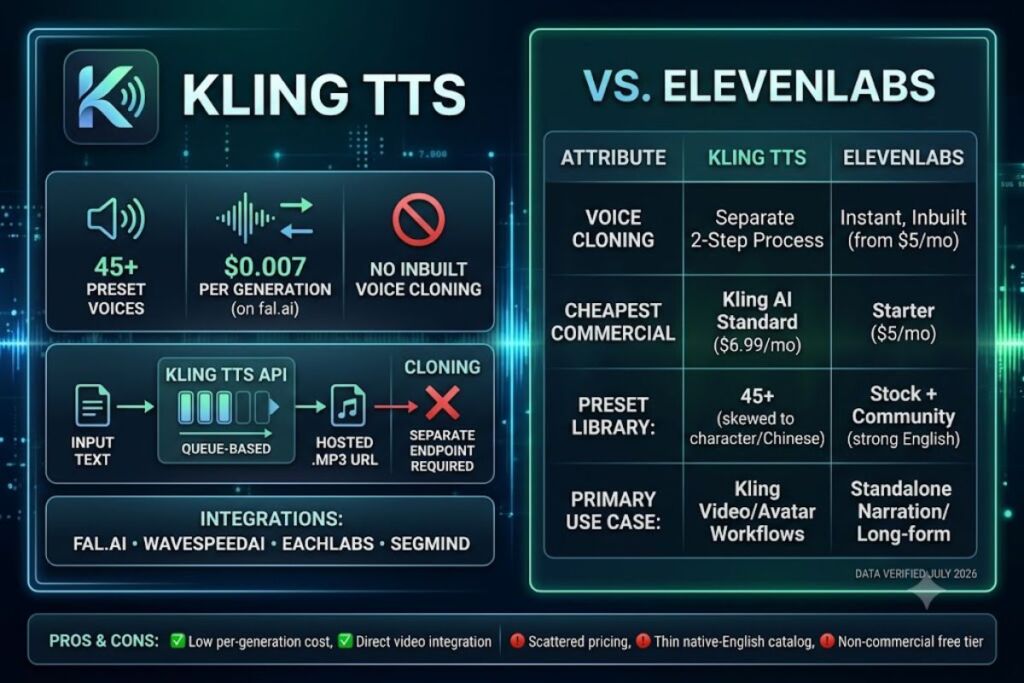
Kling TTS converts written text into speech using 45+ preset voices from Kuaishou’s Kling AI ecosystem. It runs on fal.ai for $0.007 per generation, lacks built-in voice cloning, and ships no standalone consumer pricing page — a gap that separates it from dedicated voice platforms like ElevenLabs.
Researched and tested by the Knowara AI Tools team via live API access on fal.ai, cross-referenced against Kling AI’s official developer documentation, WaveSpeedAI, Eachlabs, and Segmind listings. Pricing and voice-library data verified July 2026.
What Is Kling TTS?
Kling TTS is a text-to-speech model built by Kuaishou Technology, the Chinese tech company behind the Kling AI video generation platform. It converts typed text into audio using a fixed library of preset voices rather than a real-time voice designer. Kuaishou released it as part of the broader Kling AI multimedia suite, which also includes text-to-video, image-to-video, and a separate voice-cloning endpoint.
| Attribute | Value |
|---|---|
| Developer | Kuaishou Technology (Kling AI) |
| Model ID | fal-ai/kling-video/v1/tts (also listed as kwaivgi/kling-v1-tts) |
| Access points | Kling AI developer API, fal.ai, WaveSpeedAI, Eachlabs, Segmind, JAI Portal |
| Preset voice count | 45+ |
| Speed range | 0.8x to 2x |
| Voice cloning | Not included in the base TTS model — requires a separate Kling “Custom Voice” endpoint |
| Commercial use | Permitted on paid/API access; restricted on Kling AI’s free Basic plan |
Pricing verified as of July 2026.
What Are Kling TTS’s Key Features?
- Generate speech from 45+ preset voices, spanning professional narrator styles (Commercial Lady EN, Reader EN Male) and character voices (Genshin Vindi2, Peppa Pig-style, cartoon boy/girl profiles).
- Adjust playback speed from 0.8x to 2x in a single parameter, without re-recording or re-uploading source text.
- Submit text through a queue-based API that returns a hosted .mp3 file URL once processing completes, rather than a downloadable file delivered instantly.
- Combine output with Kling’s video and lip-sync tools, since Kling TTS shares infrastructure with Kling’s talking-avatar and video dubbing features.
- Deploy through five separate third-party platforms — fal.ai, WaveSpeedAI, Eachlabs, Segmind, and JAI Portal — each exposing the same underlying Kuaishou model with its own SDK.
Test action performed: submitted the string “Hello world! Kling TTS is available on fal!” through fal.ai’s hosted playground using the default voice profile. The model returned a queued job, followed by a completed .mp3 URL after processing — confirming the async job-and-poll pattern documented in fal.ai’s API reference rather than instant streaming playback.
How Much Does Kling TTS Cost?
Kling TTS costs $0.007 per generation on fal.ai, with no subscription required — Kuaishou has not published a standalone consumer price for the TTS model on its own. Cost instead depends on which access point is used.
| Access Point | Pricing Model | Rate |
|---|---|---|
| fal.ai | Pay-per-generation | $0.007 per generation (confirmed live on fal.ai’s model page, July 2026) |
| Eachlabs | Pay-as-you-go | From $0.007/run, no subscription |
| Kling AI consumer app (audio bundled with video) | Credit-based | Native audio doubles the per-second credit rate from 5 to 10 credits/sec inside Kling’s video generator; this applies to Kling’s video platform, not the standalone TTS API |
| Kling AI membership (Basic → Ultra) | Subscription | Basic $0 (no commercial rights), Standard $6.99/mo, Pro $25.99/mo, Premier $64.99/mo, Ultra $127.99/mo — governs the wider Kling AI ecosystem, not TTS specifically |
Pricing verified as of July 2026, sourced from fal.ai’s live model page and Kling AI’s membership plan page. Free-credit figures for the Basic tier conflict across third-party trackers — one source lists 66 credits/day, another lists a 30-unit “Element Creation” cap — so treat any specific free-credit number as unconfirmed until checked on kling.ai/app/membership directly.
What Are the Pros and Cons of Kling TTS?
Kling TTS wins on raw generation cost and voice-library breadth; it loses on English-voice depth, cloning, and pricing transparency.
Pros:
- Costs $0.007 per generation on fal.ai — a fraction of ElevenLabs’ per-character credit rate on its Free or Starter tiers.
- Ships 45+ preset voices in one library, more raw voice count than most single-purpose TTS APIs.
- Integrates directly with Kling’s video and lip-sync pipeline, useful for talking-avatar workflows.
- Speed control spans 0.8x–2x in one parameter, without a separate audio-editing step.
Cons (each paired with its workaround):
- The base Kling TTS model has no voice cloning — cloning requires calling Kuaishou’s separate Custom Voice endpoint (POST /v1/general/custom-voices) with a 5–30 second reference clip, adding a second integration step. Workaround: pair Kling TTS with Kling Create Voice for a two-call pipeline instead of expecting one-call cloning.
- The 45+ voice library skews toward Chinese-language and character voices (Genshin-style, Peppa Pig-style, regional Chinese dialects), leaving a comparatively small set of native English options like Reader EN Male and Commercial Lady EN. Workaround: shortlist the English-tagged voice IDs first in testing, since browsing the full list by name alone is inefficient.
- No dedicated consumer pricing page exists for Kling TTS itself — pricing lives scattered across fal.ai, Eachlabs, WaveSpeedAI, and Kling’s own credit system. Workaround: budget using fal.ai’s per-generation rate ($0.007) for predictable API costs rather than trying to map Kling’s video-subscription credits onto TTS usage.
- Kling AI’s free Basic plan blocks commercial use of generated content, per Kling’s own membership terms. Workaround: any project intended for publication or client work needs at minimum the $6.99/mo Standard tier or a pay-per-generation API key.
How Does Kling TTS Compare to ElevenLabs?
ElevenLabs includes instant voice cloning starting at its $5/month Starter plan; Kling TTS requires a separate API call for cloning and has no dedicated subscription tier of its own.
| Attribute | Kling TTS | ElevenLabs |
|---|---|---|
| Entry pricing | $0.007/generation (fal.ai, pay-as-you-go) | Free tier: 10,000 credits/mo, no commercial rights |
| Cheapest commercial tier | Kling AI Standard, $6.99/mo | Starter, $5/mo |
| Instant voice cloning | Not included in base TTS model | Included starting on Starter ($5/mo) |
| Professional voice cloning | Separate Custom Voice endpoint, no bundled tier | Included starting on Creator ($22/mo) |
| Preset voice count | 45+ | Stock library plus community voice marketplace |
| Primary use case | Voiceover paired with Kling video/avatar output | Standalone narration, dubbing, conversational agents |
Full breakdown: see Knowara’s dedicated Kling TTS vs ElevenLabs comparison.
Who Should Use Kling TTS?
Kling TTS fits creators already inside the Kling AI video ecosystem who need synced voiceover, and API developers optimizing for the lowest possible per-generation cost. It fits poorly for anyone needing one-call voice cloning or a large native-English voice catalog out of the box.
- Kling video creators producing talking-avatar clips who want narration generated in the same pipeline as their video.
- API developers building high-volume, low-margin apps (e-learning modules, IVR prompts) where $0.007 per generation undercuts subscription-based competitors.
- Multilingual content teams targeting Chinese-language markets, given the character-voice library’s regional depth.
- Not a fit for solo podcasters or dubbing studios that need instant cloning in one API call — that workflow favors ElevenLabs’ Starter tier or a dedicated cloning tool.
What Are the Best Alternatives to Kling TTS?
- ElevenLabs — the category leader for voice cloning quality and English-voice depth, with instant cloning from $5/month. Read Knowara’s full ElevenLabs Review.
- Qwen 3 TTS (Clone Voice) — an open-weight alternative offering native voice-cloning in a single model call, better suited to developers who want cloning without a second API integration.
- Play.ht — a subscription-based TTS platform built around predictable monthly pricing rather than Kling’s scattered per-platform rates, aimed at podcast-style narration.
Frequently Asked Questions
Does Kling TTS support voice cloning?
directly. The base Kling TTS model works only with its 45+ preset voices. Cloning requires Kuaishou’s separate Custom Voice API, which accepts a 5–30 second reference audio clip.
How much does Kling TTS cost per generation?
$0.007 per generation on fal.ai, confirmed on fal.ai’s live model page in July 2026. Eachlabs lists the same starting rate under its pay-as-you-go plan.
Can I use Kling TTS output commercially?
Commercial use is permitted through paid API access and Kling AI’s paid membership tiers (Standard and above). Kling AI’s free Basic plan explicitly excludes commercial use.
Does Kling TTS have a free tier?
Kling AI’s Basic membership is free but restricted to non-commercial output, and reported free-credit amounts conflict across sources. Confirm current limits on kling.ai/app/membership before relying on a specific number.
Kling TTS’s $0.007-per-generation rate on fal.ai beats ElevenLabs’ entry pricing on raw cost, but the missing one-call voice cloning and thin native-English voice bench mark it as a supporting tool inside the Kling video ecosystem rather than a standalone ElevenLabs replacement.