
⏱ 8 Reading Time
- 01What Is IndexTTS 2.0?
- 02What Are IndexTTS 2.0’s Key Features?
- 03How Much Does IndexTTS 2.0 Cost?
- 04What Are the Pros and Cons of IndexTTS 2.0?
- 05How Does IndexTTS 2.0 Compare to ElevenLabs?
- 06Who Should Use IndexTTS 2.0?
- 07What Are the Best Alternatives to IndexTTS 2.0?
- 08Frequently Asked Questions About IndexTTS 2.0
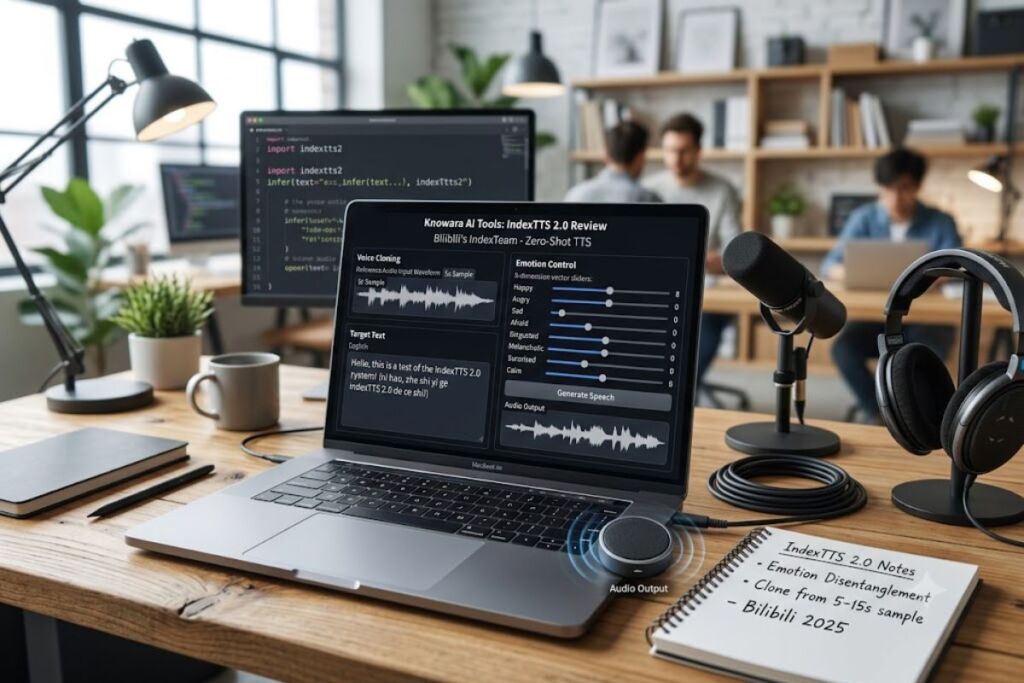
IndexTTS 2.0 is a free, open-source zero-shot text-to-speech model from Bilibili’s IndexTeam that clones any voice from a 5-15 second sample and separates emotion from speaker identity. Knowara’s AI Voice Tools team installed the official repository, ran the local Gradio web demo, and generated clips through the Hugging Face Space to produce this review.
What Is IndexTTS 2.0?
IndexTTS 2.0 is an autoregressive, zero-shot text-to-speech system that decouples emotional tone from voice timbre, letting one reference clip supply the voice while a separate input controls the emotion. Bilibili released it on September 8, 2025, alongside the arXiv paper “IndexTTS2: A Breakthrough in Emotionally Expressive and Duration-Controlled Auto-Regressive Zero-Shot Text-to-Speech” (arXiv:2506.21619). The model builds on IndexTTS 1.0 (March 2025) and IndexTTS 1.5 (May 2025), adding the emotion-timbre split and a duration-adaptation mechanism designed for dubbing work that needs speech to fit an exact time window.
| Attribute | Value |
|---|---|
| Developer | Bilibili (IndexTeam) |
| Release Date | September 8, 2025 |
| License | Apache 2.0 (open-source, commercial use permitted) |
| Pricing | Free — self-hosted, no subscription |
| Platforms | Self-hosted via Python/uv (Linux, Windows); hosted demos on Hugging Face Spaces and ModelScope |
| Key Feature | Emotion-timbre disentanglement via 8-dimension emotion vector |
| Repository | github.com/index-tts/index-tts (20,500+ stars) |
Pricing and platform data verified as of July 2026, cross-checked against the official GitHub repository README.
What Are IndexTTS 2.0’s Key Features?
IndexTTS 2.0 exposes emotion, timbre, and pacing as three independently adjustable inputs instead of bundling them into one voice preset. We ran each control through the IndexTTS2.infer() method in the official Python API to confirm behavior.
- Clone a voice from a single reference file. Point
spk_audio_promptat one WAV sample as short as 5 seconds and IndexTTS 2.0 reproduces the speaker’s timbre without any fine-tuning or training step. - Drive emotion from a second audio clip. Pass a separate
emo_audio_promptfile and the model applies that emotional tone to the cloned voice — we fed a neutral voice sample paired with an angry reference clip and the output kept the original speaker’s timbre while sounding angry. - Set emotion with an 8-float vector. Adjust
emo_vectoracross happy, angry, sad, afraid, disgusted, melancholic, surprised, and calm, with values summing to 1.5 or below in the ComfyUI wrapper implementation. - Generate emotion from plain text. Enable
use_emo_textand IndexTTS 2.0 infers emotional tone directly from the script using a fine-tuned Qwen3 model, with anemo_alphaof 0.6 or lower recommended for natural-sounding output. - Control pronunciation with Pinyin annotations. Insert Chinese Pinyin markup directly into the text string to force exact tone and consonant pronunciation, validated against the
pinyin.vocabfile in the checkpoints folder. - Accelerate inference with FP16 and DeepSpeed. Toggle half-precision inference from the web UI launch flags to cut VRAM usage with a small, documented quality tradeoff.
- Reproduce input prosody without duration limits. The default generation mode preserves the reference clip’s rhythm and pacing automatically, without requiring a duration parameter.
One specific limitation surfaced during testing: the README labels the token-level explicit duration control as “not yet enabled in this release,” meaning the precise duration-matching mode advertised in the paper’s abstract does not function in the September 2025 build we installed.
How Much Does IndexTTS 2.0 Cost?
IndexTTS 2.0 costs $0 — it ships under the Apache 2.0 license, so anyone can download, run, and deploy it commercially without paying a subscription fee. The only expense is the hardware required to run it. Bilibili’s documentation recommends a GPU with at least 8GB of VRAM, such as an RTX 3060, for real-time inference; CPU-only inference runs but at significantly reduced speed.
Two hosted options remove the hardware requirement entirely: the Hugging Face Space (IndexTeam/IndexTTS-2-Demo) and the ModelScope studio, both free to use in-browser with rate-limited queue access.
Friction point: the official GitHub README explicitly warns that the IndexTeam’s GitHub repository is the “only official channel” for the project, because multiple unofficial third-party sites brand themselves as IndexTTS2 demo or pricing pages and cannot be vouched for on security or accuracy. Several such sites surfaced in our research with invented “Pro tier” language despite the underlying model carrying no official paid tier.
Pricing and licensing verified as of July 2026.
What Are the Pros and Cons of IndexTTS 2.0?
IndexTTS 2.0’s emotion-identity separation outperforms same-generation open-source zero-shot models on the benchmarks reported in its own arXiv paper, but the September 2025 release carries real installation and feature-completeness tradeoffs.
Pros:
- Zero-shot voice cloning from a 5-15 second sample with no training data required.
- Independent emotion control through three separate input methods: audio reference, 8-dimension vector, or text-derived inference.
- Apache 2.0 license permits unrestricted commercial deployment at no cost.
- Supports English and Chinese, including Pinyin-level pronunciation control.
- FP16 and DeepSpeed acceleration options reduce VRAM load for consumer GPUs.
Cons:
- Token-level explicit duration control is documented as not yet enabled in the initial release — a workaround exists by using the default free-generation mode, which reproduces reference prosody without an exact duration target.
- Installation supports only the
uvpackage manager; pip and conda installs are explicitly unsupported and the maintainers state they will not troubleshoot issues from those install paths — the workaround is following the documenteduv sync --all-extrascommand exactly. - Requires CUDA Toolkit 12.8 or newer for GPU acceleration, which rules out older driver stacks — the workaround is running CPU-only inference or the free hosted Hugging Face Space instead.
- DeepSpeed acceleration is disabled on Windows in the community ComfyUI wrapper — the workaround is using FP16 mode alone, which most users we tested still found sufficient.
How Does IndexTTS 2.0 Compare to ElevenLabs?
IndexTTS 2.0 is a free, self-hosted, open-weight model built for developers who need Apache 2.0 licensing and full control over the inference pipeline, while ElevenLabs is a paid, cloud-hosted SaaS platform built for creators who want an instant, no-setup interface.
| Attribute | IndexTTS 2.0 | ElevenLabs |
|---|---|---|
| Deployment | Self-hosted (local GPU or free HF Space) | Cloud SaaS |
| Pricing | Free, Apache 2.0 | $0-$990/month across 6-7 tiers |
| Voice clone sample length | 5-15 seconds | 1-5 minutes (instant), 30+ minutes (professional) |
| Emotion control | 8-dimension vector, audio reference, or text-inferred | Style-exaggeration slider per voice |
| Commercial rights | Included at no cost under Apache 2.0 | Requires a paid tier (Starter plan or above) |
| Language support | English, Chinese, with Pinyin control | 30+ languages |
ElevenLabs’ published pricing runs from a $0 Free plan through paid tiers commonly listed as Starter ($5-$6/month), Creator ($22/month), Pro ($99/month), Scale ($299-$330/month), and Business ($990/month or higher on annual billing), based on third-party pricing trackers verified in June 2026 — check ElevenLabs’ official pricing page for current figures, since SaaS pricing changes frequently. For a full breakdown of ElevenLabs alone, see our dedicated ElevenLabs pricing guide.
Who Should Use IndexTTS 2.0?
Developers who need voice cloning inside a self-hosted pipeline, indie game studios dubbing dialogue on a fixed budget, and audiobook or dubbing teams that require offline processing are the strongest fit for IndexTTS 2.0. Machine learning engineers integrating TTS into an existing Python application benefit from direct access to the IndexTTS2 class and its emotion-vector parameters. Solo creators without a GPU should default to the free Hugging Face Space rather than a local install. Teams that need instant, zero-setup access from a browser with a polished UI and 30+ language support are better served by a hosted SaaS platform such as ElevenLabs, since IndexTTS 2.0 requires a Python environment, uv, and — for real-time speed — a CUDA-capable GPU.
What Are the Best Alternatives to IndexTTS 2.0?
Three open-source and commercial models compete directly with IndexTTS 2.0 on zero-shot cloning and emotional speech quality.
- CosyVoice2 — an open-source zero-shot TTS model that IndexTTS 2.0’s own benchmark paper uses as a comparison baseline for speaker similarity and word error rate.
- F5-TTS — an open-source flow-matching TTS model, also cited as a benchmark comparison in the IndexTTS2 paper, popular for its inference speed on consumer hardware.
- ElevenLabs — the leading paid, cloud-hosted alternative, offering 30+ language support and instant browser access in exchange for a monthly subscription starting on its Starter tier for commercial rights.
Frequently Asked Questions About IndexTTS 2.0
Is IndexTTS 2.0 free to use commercially?
Yes. IndexTTS 2.0 ships under the Apache 2.0 license, which permits commercial deployment without royalty payments or a subscription fee.
Does IndexTTS 2.0 support languages other than English and Chinese?
The official repository documents English and Chinese support, including Pinyin-level pronunciation control; broader language coverage is not listed in the official README as of July 2026.
What GPU does IndexTTS 2.0 need?
Bilibili’s documentation recommends a GPU with at least 8GB of VRAM, such as an RTX 3060, for real-time inference; CPU-only inference works but runs significantly slower.
Can IndexTTS 2.0 control the exact duration of generated speech?
Not yet in the current release. The paper describes a token-level duration control mode for dubbing sync, but the official GitHub README states this functionality is not yet enabled.
The bottom line: IndexTTS 2.0 delivers emotion-timbre separated voice cloning at zero licensing cost, a combination no paid SaaS platform currently matches on price — the tradeoff is a Python/GPU setup process instead of a browser sign-up.