
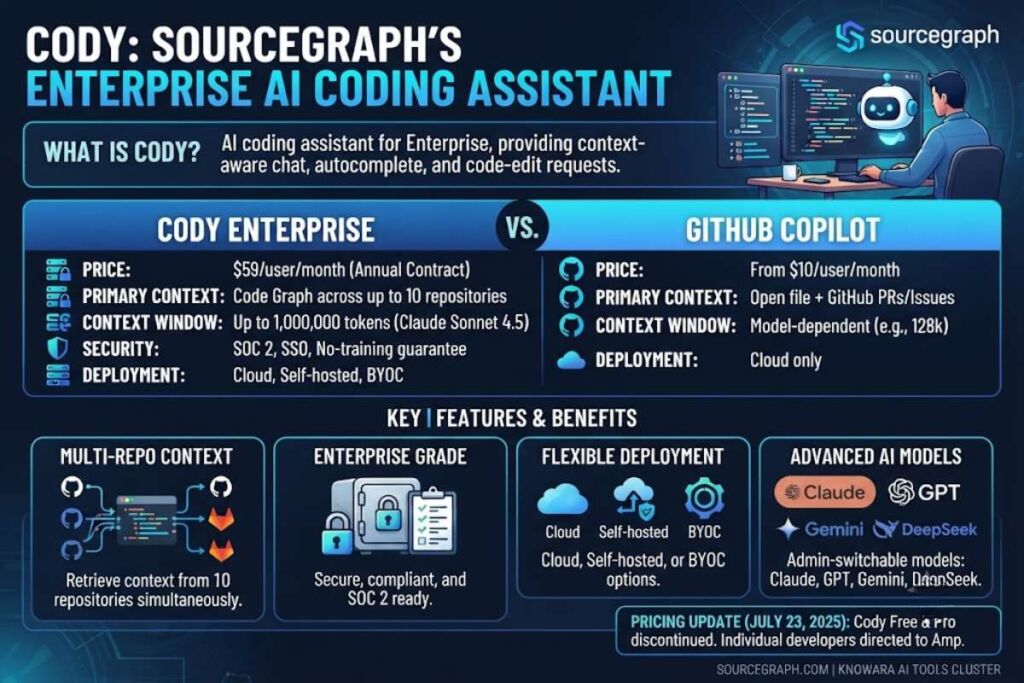
Cody is Sourcegraph’s AI coding assistant, sold exclusively as an Enterprise product starting at $59 per user per month on an annual contract. It retrieves context from up to 10 repositories simultaneously through Sourcegraph’s code graph and pairs that context with Claude, GPT, and Gemini models. Sourcegraph discontinued Cody’s free and Pro tiers on July 23, 2025, and now directs individual developers to a separate tool called Amp.
What Is Cody by Sourcegraph?
Cody is an AI coding assistant built by Sourcegraph that indexes an organization’s full remote codebase and injects that context into chat, autocomplete, and code-edit requests. Sourcegraph builds Cody on its code search and code graph platform, founded in 2013.
| Attribute | Value |
| Company | Sourcegraph, Inc. |
| Founded | 2013, by Quinn Slack and Beyang Liu |
| Cody Release Year | Unveiled June 2023; general availability December 14, 2023 |
| Current Pricing | $59 per user per month, Enterprise only, annual contract required |
| Platforms | VS Code, JetBrains, Visual Studio (experimental), Neovim, web app, CLI |
| Key Feature | Multi-repository code graph context across up to 10 repositories at once |
| Default Chat Model | Claude Sonnet 4.5 (admin can switch to GPT-4o, o3-mini, or Gemini 2.5) |
| Free Tier | None. Cody Free and Cody Pro were discontinued in July 2025 |
What Are Cody’s Key Features?
Cody retrieves context from 10 repositories at once, supports context windows up to 1,000,000 tokens, verifies generated code against 290,000 indexed open-source repositories, and lets administrators switch between Claude, GPT, and Gemini models.
- Retrieve context from up to 10 repositories simultaneously through Sourcegraph’s code graph, rather than only the file currently open in the editor.
- Support context windows up to 1,000,000 tokens when the organization selects Claude Sonnet 4 as the underlying model.
- Integrate with GitHub, GitLab, Bitbucket, and Perforce as code hosts for repository indexing.
- Verify generated code against a database of 290,000 indexed open-source repositories, flagging any matched snippet of 10 lines or longer to reduce open-source attribution risk.
- Connect to Jira, Linear, Notion, and Google Docs through Sourcegraph’s OpenCtx integration layer, and to additional external systems via the Model Context Protocol.
- Default to Claude Sonnet 4.5 for chat and DeepSeek V2 Lite Base for autocomplete, with administrators able to switch to GPT-4o, o3-mini, or Gemini 2.5.
- Enforce Context Filters that block specific repositories or file paths from being transmitted to the model, a feature that requires Sourcegraph version 5.4.0 or later.
- Deploy through cloud-hosted, self-hosted, or bring-your-own-cloud (BYOC) infrastructure for regulated environments.
How Much Does Cody Cost?
Cody costs $59 per user per month on an annual Enterprise contract, according to Sourcegraph’s official pricing page. Cody Free and Cody Pro were discontinued on July 23, 2025, and Enterprise Starter no longer includes Cody.
| Plan | Status | Price |
| Cody Free | Discontinued July 23, 2025 | Was $0 |
| Cody Pro | Discontinued July 23, 2025 | Was $9/user/month |
| Enterprise Starter | No longer includes Cody | N/A |
| Cody Enterprise | Current, only active plan | $59/user/month, annual contract |
What Are the Pros and Cons of Cody?
Cody’s advantage is code graph context across 10 repositories with SOC 2 compliance and no training on customer code. Its drawback is $59/user/month enterprise-only pricing that prices out teams under 25 developers compared with per-seat rivals.
Pros
- Multi-repository code graph context across up to 10 repositories at once, a capability GitHub Copilot and Cursor do not match with local-file-based context.
- SOC 2 compliance, single sign-on (SSO), and audit logging included in the Enterprise plan.
- No-training guarantee: Sourcegraph does not use Enterprise customer code to train AI models.
- Self-hosted and BYOC deployment options for air-gapped or regulated environments.
- Open-source attribution guardrails that check generated code against 290,000 indexed repositories.
Cons
- $59/user/month annual-contract pricing is mathematically expensive for teams under 25 developers versus Cursor Teams at $40/developer/month or GitHub Copilot from $10/month.
- Onboarding requires an Enterprise contract or self-hosted setup, a multi-week process compared with Cursor’s instant subscription flow.
- No prominent free evaluation path for individual developers on Sourcegraph’s public pricing page.
- The Visual Studio extension remains in an experimental state with a more limited feature set than the VS Code and JetBrains clients.
How Does Cody Compare to GitHub Copilot?
Cody costs $59/user/month and wins on cross-repository code graph context up to 10 repositories and a 1,000,000-token context window. GitHub Copilot starts at $10/month and wins on price, GitHub-native workflow integration, and individual accessibility.
| Attribute | Cody Enterprise | GitHub Copilot |
| Entry Price | $59/user/month, annual contract | From $10/user/month, monthly billing available |
| Primary Context Source | Sourcegraph code graph across up to 10 repositories | Open file plus GitHub Issues and Pull Requests |
| Context Window | Up to 1,000,000 tokens with Claude Sonnet 4 | Model-dependent, typically 128,000 tokens |
| Deployment | Cloud, self-hosted, or BYOC | Cloud only |
| IDE Support | VS Code, JetBrains, Visual Studio, Neovim | VS Code, JetBrains, Visual Studio, Neovim, Xcode |
| Model Choice | Admin-selectable: Claude, GPT, Gemini | GPT-4o, Claude, Gemini, model-dependent by plan |
Teams evaluating both tools in depth should read the full comparison at Cody vs GitHub Copilot, part of Knowara’s AI coding tools cluster.
Who Should Use Cody?
Enterprise engineering teams of 50 or more developers managing dozens of microservice repositories, and regulated organizations requiring self-hosted deployment with SOC 2 compliance, get the most value from Cody Enterprise.
- Enterprise engineering organizations with 50 or more developers spread across dozens of microservice repositories that need cross-repository context to trace how services call each other.
- Regulated industries, including finance, healthcare, and government, that require self-hosted or BYOC deployment, SOC 2 compliance, and a contractual no-training guarantee.
- Organizations already running Sourcegraph Code Search that want to add AI chat, autocomplete, and code edits on the same underlying platform.
What Are the Best Alternatives to Cody?
Cursor AI, GitHub Copilot, and Amp by Sourcegraph are the three leading alternatives to Cody for developers who do not need enterprise-scale, multi-repository code graph context.
- Cursor AI — an AI-native code editor forked from VS Code, priced from $20/month, built for individual developers who want agentic multi-file editing and fast Tab-complete. Read the full Cursor AI Review.
- GitHub Copilot — the most widely installed AI coding assistant, priced from $10/month, integrated directly with GitHub Issues and Pull Requests. Read the full GitHub Copilot Review.
- Amp by Sourcegraph — a free agentic coding tool built by the Cody team for individual developers, offering access to current models but lacking Cody Enterprise’s multi-repository context and Context Filters.
The Bottom Line on Cody
Cody Enterprise costs $59 per user per month on an annual contract and delivers code graph context across up to 10 repositories simultaneously, a capability per-seat competitors under 25-developer teams do not match. The pricing model becomes cost-competitive with Cursor and GitHub Copilot once an organization reaches 50 or more developers; below that threshold, Amp, Cursor, or GitHub Copilot deliver more value per dollar.