
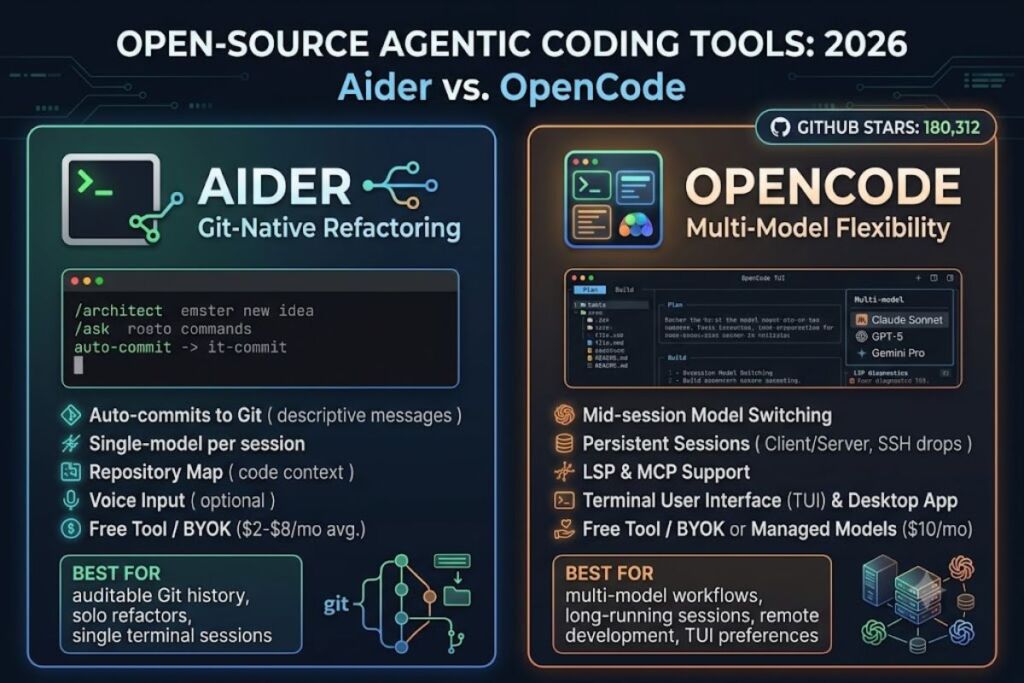
Aider and OpenCode are the two most-starred open-source, terminal-based AI coding agents in 2026. Aider wins for git-native, single-model refactoring workflows; OpenCode wins for multi-model flexibility and persistent, session-based agentic work.
- 01What Is Aider?
- 02What Is OpenCode?
- 03How Do Aider and OpenCode Compare Feature-by-Feature?
- 04How Do Aider and OpenCode Compare on Pricing?
- 05Should You Choose Aider or OpenCode?
- 06How Do Aider and OpenCode Perform on Coding Benchmarks?
- 07Who Should Use Aider vs OpenCode?
- 08What Are the Best Alternatives to Aider and OpenCode?
- 09Frequently Asked Questions
What Is Aider?
Aider is a free, open-source, terminal-based AI pair programmer created by Paul Gauthier that edits code directly in your repository and auto-commits every change to git. It runs entirely in the command line, connects to any LLM through an API key, and builds a repository map so the model understands file relationships across large codebases.
| Attribute | Value |
|---|---|
| Developer | Paul Gauthier (independent, open source) |
| License | Apache 2.0, open source |
| Interface | Command-line (terminal only) |
| Pricing model | Free tool; bring-your-own-API-key (BYOK) |
| Language support | 100+ programming languages |
| Git integration | Automatic commit per AI edit, with descriptive messages |
| Benchmark | 88.0% on Aider’s own polyglot coding leaderboard using GPT-5 (high), according to Aider’s official leaderboard |
Aider defines two core interaction modes: /architect mode, which plans multi-step changes before writing code, and /ask mode, which answers questions about the codebase without editing it. Developers add AI? comments directly in source files to flag lines for Aider to fix.
What Is OpenCode?
OpenCode is a free, open-source AI coding agent built by Anomaly Innovations, the team formerly known as SST, that runs a persistent background server and connects through a terminal user interface (TUI). OpenCode reached 180,312 GitHub stars by June 28, 2026, making it the most-starred open-source coding agent, ahead of Claude Code, Gemini CLI, and OpenAI Codex, according to Terminal-Bench 2.1 leaderboard data verified on that date.
| Attribute | Value |
|---|---|
| Developer | Anomaly Innovations (formerly SST), founded by Jay V and Frank Wang |
| License | MIT, open source |
| Interface | Terminal user interface (TUI), plus desktop app |
| Pricing model | Free tool; BYOK across 75+ providers; optional OpenCode Zen managed model access |
| Architecture | Client/server — sessions persist through SSH drops and machine sleep |
| Model switching | Switch models mid-session (e.g., Claude to GPT-5 to Gemini) without restarting |
| GitHub stars | 180,312 as of June 28, 2026 |
OpenCode toggles between two built-in agents using the Tab key: Plan mode, a read-only agent for codebase analysis, and Build mode, a full-access agent that edits files and executes shell commands. OpenCode integrates the Language Server Protocol (LSP) to surface diagnostics and connects to Model Context Protocol (MCP) servers for external tool access.
How Do Aider and OpenCode Compare Feature-by-Feature?
Aider specializes in git-tracked, single-model refactoring; OpenCode specializes in multi-model, session-persistent agentic coding. The table below compares both tools across the attributes that determine daily workflow fit.
| Feature | Aider | OpenCode |
|---|---|---|
| License | Apache 2.0 | MIT |
| Interface | Plain terminal chat | Full TUI with file-tree and diff panel |
| Auto-commit to git | Yes, every edit | No, manual git workflow |
| Session persistence | No, single terminal session | Yes, survives SSH disconnects |
| Model switching mid-task | No, one model per session | Yes, switch providers mid-session |
| LSP integration | No | Yes |
| MCP support | No | Yes |
| Codebase mapping | Repository map (custom algorithm) | LSP-based diagnostics and context |
| Voice input | Yes | No |
| Desktop app | No | Yes |
| Platform support | macOS, Linux, Windows | macOS, Linux; Windows support incomplete |
How Do Aider and OpenCode Compare on Pricing?
Both tools are free to install, but neither includes free model access — total cost depends entirely on the API provider and model you connect. Aider’s typical BYOK cost runs $2–$8 per month for moderate daily use, according to third-party testing that logged 50 completed coding tasks. OpenCode adds an optional $10/month “OpenCode Go” plan that bundles usage limits for open-source models, on top of its standard BYOK model, according to OpenCode’s own documentation. Neither tool charges a markup on top of raw API token costs when using BYOK mode.
Running Claude Sonnet 4.6 through either tool costs the same per-token rate, since both pull directly from the provider’s API pricing. The cost difference between Aider and OpenCode comes from workflow efficiency, not list price: OpenCode’s persistent sessions reduce re-explaining context after disconnects, while Aider’s auto-commit reduces manual git overhead.
Should You Choose Aider or OpenCode?
Choose Aider for git-centric refactoring with a single, consistent model. Choose OpenCode for multi-model workflows that need session persistence and IDE-grade diagnostics.
Choose Aider if:
- Refactor large codebases and want every AI edit committed to git automatically.
- Work primarily from one terminal session without SSH interruptions.
- Need voice-driven prompts for hands-free coding sessions.
- Prefer a minimal, distraction-free chat interface over a full TUI.
Choose OpenCode if:
- Switch between multiple LLM providers depending on task complexity.
- Run long agentic sessions that need to survive SSH drops or laptop sleep.
- Require Language Server Protocol diagnostics inside the AI’s context.
- Connect external tools and data sources through MCP servers.
How Do Aider and OpenCode Perform on Coding Benchmarks?
Aider scores 88.0% on its own polyglot coding leaderboard using GPT-5 at high reasoning effort; OpenCode has no fixed agent-plus-model score on the public Terminal-Bench 2.1 leaderboard because it runs as a bring-your-own-key, model-agnostic tool. Terminal-Bench 2.1, verified June 28, 2026, ranks fixed agent-plus-model pairs like Codex CLI with GPT-5.5 (83.4%) and Claude Code with Opus 4.8 (78.9%). Model-agnostic agents such as OpenCode and Aider are excluded from that fixed-pair ranking because their scores shift with whichever model the user connects.
This distinction matters when evaluating either tool: the coding quality you get from Aider or OpenCode reflects the underlying model you connect, not the agent itself. Connecting Claude Opus 4.8 through either tool inherits Opus 4.8’s 69.2% SWE-bench Pro score, according to the self-reported SWE-bench Pro aggregate published at llm-stats.com.
Who Should Use Aider vs OpenCode?
Solo developers who want an auditable git history should use Aider; developers who juggle multiple model providers on long-running tasks should use OpenCode.
- Solo indie developers running frequent, small refactors benefit from Aider’s auto-commit workflow, which creates a revertible history without extra git commands.
- Neovim and terminal-first developers who want a polished, keyboard-driven interface get more from OpenCode’s TUI and Plan/Build mode toggle.
- Teams standardizing on one model (e.g., always Claude Sonnet) fit Aider’s single-model-per-session design.
- Developers who compare model output across providers on the same task benefit from OpenCode’s mid-session model switching.
- Remote and SSH-based workflows favor OpenCode’s client/server architecture, which keeps sessions alive through disconnects.
What Are the Best Alternatives to Aider and OpenCode?
- Cline — an open-source VS Code and JetBrains extension with Plan/Act approval modes and full MCP support, built for developers who want AI inside their existing IDE rather than a separate terminal tool.
- Claude Code — Anthropic’s terminal-native agent, available in VS Code, JetBrains, desktop, and web, built for developers who want the deepest agentic reasoning depth at a $20/month starting subscription.
- Cursor — a VS Code fork with AI built into every layer, including tab completion and a visual diff review UI, built for developers who want a full IDE replacement instead of a terminal tool.
Frequently Asked Questions
Is Aider completely free? Aider itself costs $0 and is fully open source under the Apache 2.0 license. You pay only for the API tokens consumed by whichever model you connect — typically $2 to $8 per month for moderate daily use.
Is OpenCode free to use?
OpenCode is free and open source under the MIT license, with BYOK access to 75+ model providers. An optional $10/month OpenCode Go plan bundles usage limits for open-source models if you don’t want to manage separate API keys.
Can OpenCode use my Claude Pro subscription instead of API keys?
OpenCode supports Anthropic API key authentication for Claude models. Anthropic OAuth login through a Claude.ai account is not supported in OpenCode, unlike Claude Code.
Does Aider support multiple AI models in one session?
No. Aider runs one model per session. Switching models requires restarting the session with a different --model flag, unlike OpenCode, which switches models mid-session.
Which tool has more GitHub stars?
OpenCode leads with 180,312 GitHub stars as of June 28, 2026, making it the most-starred open-source AI coding agent, ahead of Claude Code, Gemini CLI, and OpenAI Codex CLI.
Aider delivers the better return for developers who value an auditable, git-committed history of every AI-generated change. OpenCode delivers the better return for developers who need persistent, multi-model sessions and IDE-grade code diagnostics in the terminal. Both cost $0 to install — the deciding factor is workflow architecture, not price.