
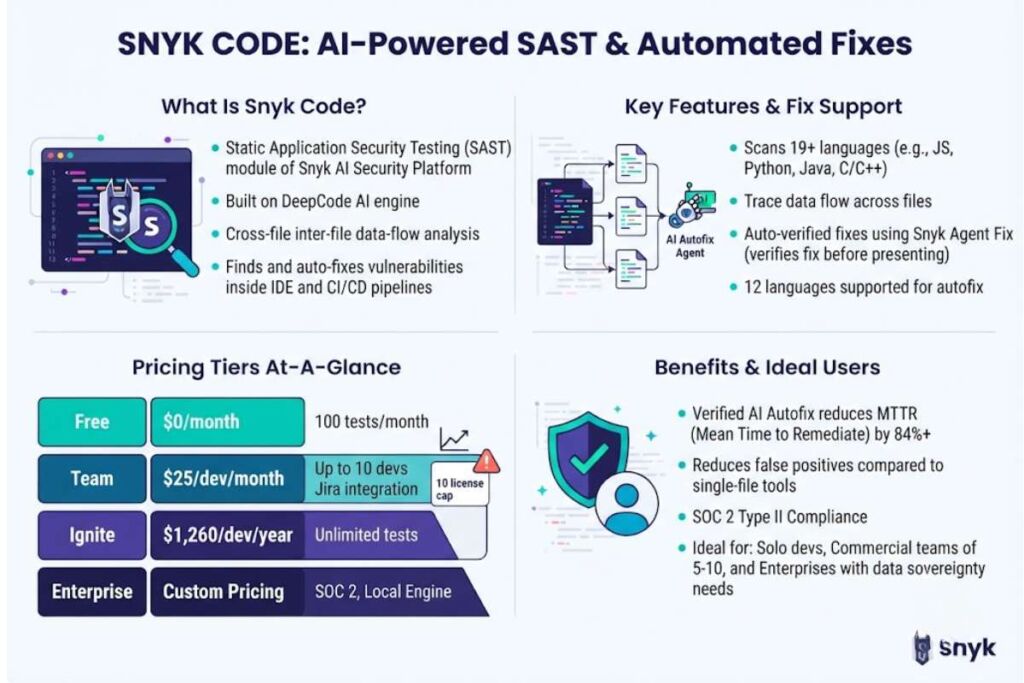
Snyk Code is a static application security testing (SAST) tool that scans source code for security vulnerabilities using DeepCode AI, a hybrid engine combining symbolic program analysis with generative AI models. Snyk Code costs $0 per month on the Free plan and starts at $25 per contributing developer per month on the Team plan.
What Is Snyk Code?
Snyk Code is the SAST module of the Snyk AI Security Platform, built on the DeepCode AI engine to find and auto-fix vulnerabilities directly inside the IDE and CI/CD pipeline. Snyk acquired DeepCode in September 2020 and rebuilt it into Snyk Code, the product’s current inter-file data-flow analysis engine.
Snyk Limited is the company behind the platform. Snyk was founded in 2015 in London and Tel Aviv by Guy Podjarny, Assaf Hefetz, and Danny Grander, and it now operates out of Boston, Massachusetts. Snyk Code tracks vulnerability propagation paths across files rather than scanning each file in isolation, which distinguishes it from single-file, rules-only SAST tools.
| Attribute | Value |
|---|---|
| Company | Snyk Limited |
| Founded | 2015 |
| Headquarters | Boston, Massachusetts |
| Release of Snyk Code | 2020 (via DeepCode acquisition) |
| Pricing | Free ($0), Team ($25/dev/month), Ignite ($1,260/dev/year), Enterprise (custom) |
| Platforms | VS Code, Visual Studio, Eclipse, JetBrains IDEs, CLI, CI/CD pipelines |
| Key Feature | Snyk Agent Fix (AI-generated, auto-verified code fixes) |
What Are Snyk Code’s Key Features?
Snyk Code combines cross-file SAST scanning with an AI auto-fix agent that verifies its own output before presenting a fix to the developer. The platform packages the following capabilities into the Code module:
- Scan source code across 19+ programming languages using DeepCode AI’s hybrid symbolic-and-generative analysis engine, trained on more than 25 million data-flow cases from permissively licensed open-source repositories.
- Trace vulnerability data flow across multiple files in a single project, rather than flagging isolated lines without propagation context.
- Generate automated fixes through Snyk Agent Fix (the successor to DeepCode AI Fix, upgraded to an agentic architecture in May 2026), which draws on a database of more than 35,000 expert-written vulnerability-and-fix pairs during inference.
- Verify each proposed fix by re-running it through the static analysis engine before surfacing it, then retrying automatically if the first fix fails verification.
- Integrate directly into VS Code, Visual Studio, Eclipse, and JetBrains IDEs, plus CLI and CI/CD pipelines through pull-request gating.
- Isolate enterprise codebases with a Local Engine (Snyk Broker) deployment option, keeping source code inside the customer’s own infrastructure for organizations with data-sovereignty requirements.
Snyk Agent Fix currently generates fixes for 12 languages: Apex, C, C++, C#, Go, Java, JavaScript, PHP, Python, Ruby, Swift, and TypeScript. Snyk Code’s broader scanning coverage extends to 19+ languages total, including Kotlin and Scala, though not every scanned language yet has autofix support.
How Much Does Snyk Code Cost?
Snyk Code is bundled into four platform tiers: Free at $0, Team starting at $25 per developer per month, Ignite starting at $1,260 per developer per year, and Enterprise at custom pricing. These figures come directly from Snyk’s official pricing page.
| Plan | Price | Code Test Limit | Notable Inclusions |
|---|---|---|---|
| Free | $0/month per contributing developer | 100 Code tests/month | Real-time scanning, IDE/CLI/SCM integrations |
| Team | From $25/month per contributing developer | Increased limits | Jira integration, next-business-day support (capped at 10 licenses/org) |
| Ignite | From $1,260/year per contributing developer | Unlimited | Custom security rules, risk-based prioritization |
| Enterprise | Custom (contact sales) | Unlimited | Zero-day risk prevention, full SDLC automation, Local Engine option |
Snyk defines a “contributing developer” as anyone who has committed code to a private repository monitored by Snyk within the last 90 days; commits to public open-source repositories don’t count toward the total. Team is capped at 10 licenses per organization — teams that grow past that threshold must move to Ignite or negotiate an Enterprise contract, a jump that raises per-developer cost significantly. Annual Team billing applies a “12 months for the price of 11” discount, an effective 8.3% reduction versus paying monthly.
What Are the Pros and Cons of Snyk Code?
Snyk Code’s biggest advantage is verified AI autofixing; its biggest drawback is a steep price jump once a team outgrows the 10-license Team tier cap. Both strengths and weaknesses trace directly to Snyk’s own published architecture and pricing structure.
Pros:
- Cross-file data-flow tracking catches vulnerabilities that single-file scanners miss.
- Snyk Agent Fix verifies each generated fix against the static analysis engine before it reaches the developer, reducing the hallucinated-fix risk common to LLM-only tools.
- Snyk reports Snyk Agent Fix reduces mean time to remediate (MTTR) by 84% or more, according to Snyk’s DeepCode AI product page.
- SOC 2 Type II compliance and a Local Engine deployment option support enterprises with strict data-residency requirements.
Cons:
- Team tier’s 10-license cap forces a 4.2x per-developer cost increase for organizations moving to Ignite, based on third-party pricing analysis of Snyk’s published rates.
- Enterprise pricing isn’t published; teams must negotiate custom quotes.
- Snyk Agent Fix generates fixes for 12 languages, while Snyk Code scans 19+ — some scanned languages have no autofix path yet.
- Multiple independent buyer reviews report recurring false positives on larger codebases.
How Does Snyk Code Compare to SonarQube?
Snyk Code is a cloud-hosted, AI-powered SAST tool with paid autofixing; SonarQube Community Edition is a free, self-hosted static analyzer without built-in generative AI remediation. The two tools serve different budget and infrastructure priorities.
| Factor | Snyk Code | SonarQube Community Edition |
|---|---|---|
| Cost | Free tier, then $25+/developer/month | Free (self-hosted) |
| Hosting | Cloud-hosted SaaS | Self-managed infrastructure |
| AI Autofix | Yes (Snyk Agent Fix, 12 languages) | No |
| Language Coverage | 19+ languages | 30+ languages |
| Maintenance Overhead | None (managed by Snyk) | Requires in-house server upkeep |
Teams with limited budget and existing DevOps capacity to self-host commonly pair SonarQube Community with a separate SCA tool. Teams that want AI-verified autofixing without managing scanning infrastructure typically choose Snyk Code instead. Read the full breakdown in Snyk vs GitHub Advanced Security for a comparison against GitHub’s native code-scanning option.
Who Should Use Snyk Code?
Snyk Code fits engineering teams that want AI-assisted vulnerability remediation inside the IDE without hosting their own scanning infrastructure. Three profiles benefit most:
- Solo developers and small teams evaluating security tooling on the Free plan’s 100 monthly Code tests before committing budget.
- Commercial teams of 5 to 10 developers on the Team plan, who need Jira integration and next-business-day support without governance overhead.
- Enterprises with data-sovereignty requirements that need the Local Engine deployment option alongside SOC 2 Type II compliance.
Organizations planning to scale past 10 contributing developers should budget for the Ignite or Enterprise cost jump before committing to the Team tier.
What Are the Best Alternatives to Snyk Code?
Semgrep, Checkmarx, and GitHub Advanced Security are the three most common alternatives evaluated alongside Snyk Code. Each targets a different combination of budget and deployment preference.
- Semgrep offers a free, open-source rule engine for teams that want self-hosted static analysis without per-developer licensing costs. Read the full Semgrep Review for pricing and feature details.
- Checkmarx targets large enterprises already standardized on a broader Checkmarx AppSec suite, and Snyk publishes a direct Snyk vs Checkmarx comparison.
- GitHub Advanced Security integrates CodeQL scanning natively into GitHub repositories for teams already consolidated on GitHub’s platform, covered in Snyk vs GitHub Advanced Security.
Frequently Asked Questions
Is Snyk Code free?
Yes. The Free plan includes 100 Snyk Code tests per month at $0 per contributing developer, with unlimited tests for public open-source projects.
What languages does Snyk Code support?
Snyk Code scans 19+ languages, including JavaScript, TypeScript, Python, Java, Go, C, C++, C#, PHP, Ruby, Swift, Kotlin, Scala, and Apex. Snyk Agent Fix generates automated fixes for 12 of those languages.
Does Snyk Code train its AI on customer code?
No. According to Snyk’s own documentation, Snyk Agent Fix does not use customer code to train its underlying models, add to datasets, or improve performance; training data comes from permissively licensed open-source projects.
Can Snyk Code run entirely on-premises?
Yes, for Enterprise customers. The Local Engine (Snyk Broker) option keeps source code inside the customer’s own infrastructure instead of sending it to Snyk’s cloud.
Snyk Code’s Free plan removes the cost barrier for evaluation, but the real decision point is the Team-to-Ignite pricing cliff at 11 contributing developers — teams should model that cost jump before scaling adoption past the 10-license Team cap.