
⏱ 10 Reading Time
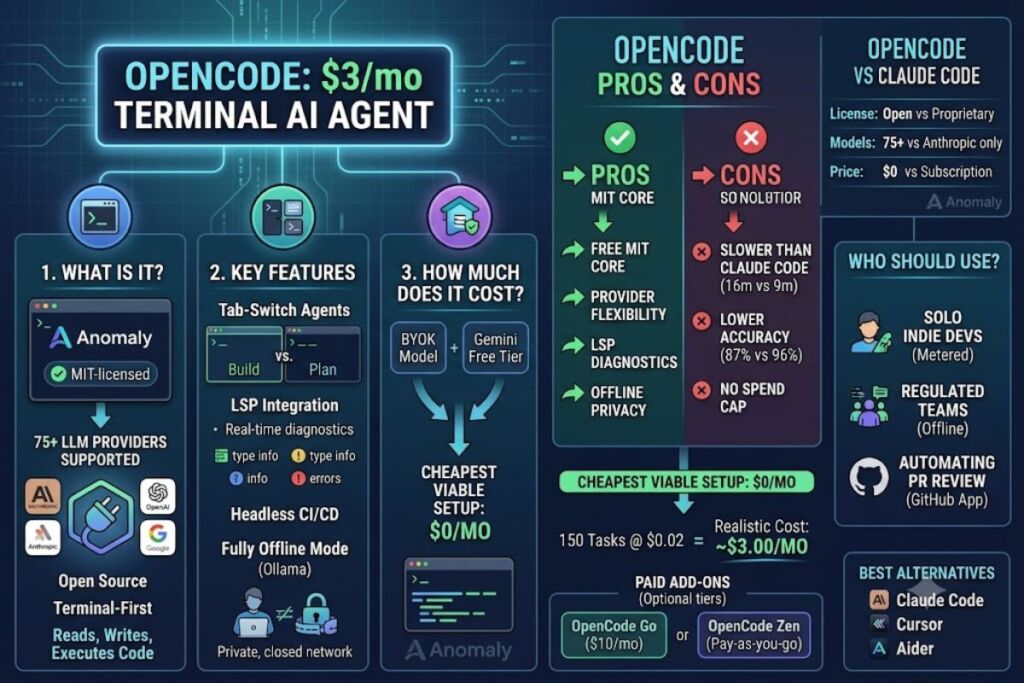
OpenCode is a free, open-source, terminal-native AI coding agent built by Anomaly (formerly the SST team). It edits files, runs shell commands, and debugs code through a bring-your-own-key model, and it reaches a realistic $3/month cost when paired with Google Gemini’s free API tier.
What Is OpenCode?
OpenCode is an MIT-licensed, terminal-first AI coding agent that reads, writes, and executes code directly inside a developer’s command line, connecting to 75+ LLM providers instead of locking users into one model.
Anomaly, the company formerly known as Serverless Stack (SST), builds OpenCode. Jay V (CEO) and Frank Wang (CTO) co-founded Anomaly after meeting at the University of Waterloo, and the same team maintains SST, OpenNext, OpenAuth, and OpenTUI under the Anomaly portfolio.<cite index=”10-1″>Developed by Anomaly Innovations, formerly known as the SST (Serverless Stack) team, opencode provides a terminal user interface (TUI) through which developers can interact with large language models to read, write, and edit code, run shell commands, and navigate complex codebases</cite>. <cite index=”10-1″>opencode launched publicly on June 19, 2025, and required no account, email address, or credit card to run — a user could download it and start coding immediately with their own API keys</cite>.
The project’s TypeScript rewrite, maintained under github.com/anomalyco/opencode, is the version referenced throughout this review. It reached <cite index=”13-1″>178,000 GitHub stars and 21,800 forks as of June 2026, with 900 contributors and 827 releases</cite>, and the founder told BetaKit the tool <cite index=”13-1″>had reached 8 million users within roughly a year of launch</cite>.
| Attribute | Value |
|---|---|
| Company | Anomaly (formerly SST / Serverless Stack) |
| Founders | Jay V (CEO), Frank Wang (CTO) |
| Release Year | 2025 (public launch June 19, 2025) |
| License | MIT (open source) |
| Core Pricing | $0 (BYOK — free core software) |
| Paid Add-ons | OpenCode Go ($5 first month, then $10/month); OpenCode Zen (pay-as-you-go, $20 minimum top-up) |
| Platforms | macOS, Linux, Windows, desktop app, IDE extensions, GitHub Actions |
| Model Providers Supported | 75+ (Anthropic, OpenAI, Google, AWS Bedrock, Azure, Groq, OpenRouter, Ollama) |
| Key Feature | Language Server Protocol (LSP) integration for real-time type and diagnostic feedback |
| GitHub Stars | 178,000 (June 2026) |
A related resource on this site, Best AI Coding Tools in 2026, ranks OpenCode against 14 other agents across price, benchmark score, and IDE support.
What Are OpenCode’s Key Features?
OpenCode combines LSP-based code intelligence, 75+ model providers, and a dual-agent system (build and plan) to let developers switch reasoning modes without leaving the terminal.
- Index the project’s Language Server for every open file, feeding the model live type information, function signatures, and compiler diagnostics rather than raw text.
- Switch between two built-in agents with the Tab key: build (full file-editing access) and plan (read-only codebase analysis).<cite index=”9-1″>OpenCode includes two built-in agents you can switch between with the Tab key: build, the default full-access agent for development work, and plan, a read-only agent for analysis and code exploration</cite>.
- Connect to 75+ model providers through a single configuration file, including Anthropic, OpenAI, Google, AWS Bedrock, Azure, Groq, OpenRouter, and local Ollama models.
- Run headless in CI/CD pipelines using non-interactive mode (
opencode -p "prompt" -f json) for automated refactoring, test generation, and code review. - Manage multiple concurrent sessions, each with an isolated context window, conversation history, and model configuration — useful for separating a research session from an implementation session.
- Trigger automated PR review through the official GitHub App, which posts structured comments identifying bugs and code-quality issues on every pull request.
- Add local and remote MCP servers for GitHub, PostgreSQL, filesystem access, and custom tools through the
opencode.jsonconfiguration file. - Operate entirely offline using Ollama-hosted local models, keeping source code from ever leaving the machine — a requirement in defense, healthcare, and financial-services environments.
- Layer custom instructions through AGENTS.md files at the project, directory, or global level, which the agent assembles into its system prompt automatically.
OpenCode does not store code or conversation context on external servers by default, a design choice built into the agent’s privacy model rather than added as an afterthought.
How Much Does OpenCode Cost?
OpenCode’s core agent costs $0 under a bring-your-own-key model; a realistic light-use setup with Google Gemini’s free API tier lands at $3/month, while the optional OpenCode Go tier costs $10/month after a $5 first month.
The core software carries no license fee. <cite index=”4-1″>OpenCode is a free coding and development tool that offers Terminal-native interface, Multi-LLM provider support, and file editing and creation, and it uses a BYOK (Bring Your Own Key) model for LLM providers</cite>. Developers install the agent at no cost and pay only the model provider directly for tokens consumed.
The $3-per-month figure in this review’s title comes from a specific, repeatable calculation. <cite index=”2-1″>The cheapest viable setup pairs OpenCode with Google Gemini 2.0 Flash at roughly $0.02 per task</cite>. At 150 tasks in a month — a realistic volume for a developer running OpenCode for scoped, single-feature edits rather than all-day agentic sessions — that rate totals $3.00. Developers who stay inside <cite index=”2-1″>Gemini’s free API tier of 1,500 requests per day pay $0/month for light coding</cite>, and the $3–4/month range only appears once usage crosses the free quota.
OpenCode’s official paid tiers sit above that BYOK baseline:
| Tier | Price | What It Includes |
|---|---|---|
| Core (BYOK) | $0/month | Full agent, unlimited local sessions, connect any provider’s API key |
| OpenCode Go | $5 first month, then $10/month | <cite index=”1-1″>Access to a curated set of open-source models including GLM-5.2, Kimi K2.7 Code, Qwen3.7 Max, MiniMax M3, and DeepSeek V4 Pro, with usage limits scaled by model tier</cite> |
| OpenCode Zen | Pay-as-you-go, $20 minimum top-up | <cite index=”3-1″>Zero markup on premium model access, for developers who prefer not to manage individual provider API keys</cite> |
By comparison, <cite index=”2-1″>Cursor charges a flat $20/month for its Composer mode and GitHub Copilot charges $10–39/month per seat</cite>, both regardless of how many tokens the developer actually consumes. OpenCode’s BYOK structure removes that flat fee and replaces it with direct, metered provider billing — which costs less for light users and more for developers running Claude Sonnet-class models for eight or more hours daily. Full pricing details appear on the official OpenCode Go page.
What Are the Pros and Cons of OpenCode?
OpenCode’s core advantage is zero licensing cost combined with 75+ model providers; its main drawback is slower task completion than Claude Code on identical benchmarks.
Pros:
- Free, MIT-licensed core with no seat fees, no account requirement, and no credit card at signup.
- Connects to 75+ model providers instead of locking the developer into one vendor’s models.
- LSP integration supplies real compiler diagnostics, reducing hallucinated function signatures and import paths.
- Runs fully offline through Ollama for air-gapped, privacy-sensitive environments.
- Ships a native GitHub Actions integration for automated PR review without third-party plugins.
Cons:
- <cite index=”15-1″>Builder.io’s benchmark showed Claude Code completing a task in 9 minutes 9 seconds versus OpenCode’s 16 minutes 20 seconds — OpenCode ran 78% slower on that task, though it produced 94 tests versus Claude Code’s 73</cite>.
- <cite index=”2-1″>On a 30-task benchmark run by Ivern AI, Claude Code scored 96% accuracy versus OpenCode’s 87% on complex reasoning tasks</cite>.
- OpenCode does not meter or cap API spend internally; developers must track cost through each provider’s own billing dashboard.
- The optional Go and Zen tiers only unlock open-source or premium third-party models — no bundled access to Anthropic’s or OpenAI’s flagship models exists inside those plans.
- <cite index=”8-1″>One OpenCode Go subscriber reported hitting 49% of a monthly usage allowance on the first day</cite>, showing the $10/month tier’s limits fit supplementary use rather than full-time, all-day coding.
How Does OpenCode Compare to Claude Code?
Claude Code wins on raw task speed and accuracy; OpenCode wins on price flexibility and provider choice, since it connects to 75+ models instead of Anthropic’s models only.
| Attribute | OpenCode | Claude Code |
|---|---|---|
| License | Open source (MIT) | Proprietary |
| Model Providers | 75+ (any provider, BYOK) | Anthropic only |
| Base Price | $0 (BYOK) | Subscription-based, Anthropic-managed |
| Benchmark Speed (Builder.io test) | 16 min 20 sec | 9 min 9 sec |
| Benchmark Accuracy (Ivern AI 30-task test) | 87% | 96% |
| Offline / Local Model Support | Yes, via Ollama | No |
| LSP Integration | Yes | Not disclosed publicly |
Anomaly built OpenCode’s core provider-agnostic design specifically to avoid the single-vendor dependency that defines Claude Code’s architecture. For a full feature-by-feature breakdown, see OpenCode vs Claude Code: Which Terminal AI Agent Wins in 2026? on this site.
Who Should Use OpenCode?
OpenCode fits solo developers who want provider flexibility without a subscription, and regulated teams that need to keep source code off external servers.
- Solo indie developers who write code in bursts rather than all day, since the BYOK model charges per token instead of a flat monthly seat fee.
- Teams in defense, healthcare, and financial services that require air-gapped coding assistance, using OpenCode’s Ollama-based local-model mode to keep code from leaving the machine.
- Multi-language engineering teams working across TypeScript, Python, Go, Rust, and Java, since OpenCode’s LSP integration covers all five natively.
- Developers already paying for GitHub Copilot or a ChatGPT Plus/Pro subscription, since OpenCode’s login integrations let them reuse those credentials instead of buying a separate model plan.
- Engineering managers automating PR review, using the official GitHub App to post structured code-quality comments on every pull request without a third-party bot.
Full-time agentic coders who run the model for 8+ hours daily on Claude Sonnet-class reasoning tasks pay less on a flat-rate subscription tool; the Best AI Coding Tools in 2026 hub page ranks that use case separately.
What Are the Best Alternatives to OpenCode?
Claude Code, Cursor, and Aider are the three most-cited alternatives to OpenCode, each trading OpenCode’s provider flexibility for either tighter model integration or a lower-friction interface.
- Claude Code — Anthropic’s proprietary terminal agent, scoring higher on the accuracy and speed benchmarks cited above but restricted to Anthropic’s own models. Read the full Claude Code Review: Features, Pricing, and Performance.
- Cursor — A full IDE built on VS Code, charging a flat $20/month for its Composer mode instead of OpenCode’s metered, pay-per-token structure.
- Aider — Another open-source, terminal-based coding agent, positioned as OpenCode’s closest direct competitor in the free-tools space. Compare both directly, along with five other no-cost options, in Best Free AI Coding Tools in 2026.
Frequently Asked Questions
Is OpenCode actually free?
The core agent costs $0 under a BYOK model. Developers pay the model provider directly for tokens; OpenCode itself charges no license fee for the open-source core.
What does OpenCode Go include?
<cite index=”1-1″>OpenCode Go costs $5 for the first month, then $10/month, and provides access to open-source models including GLM-5.2, Kimi K2.7 Code, Qwen3.7 Max, MiniMax M3, and DeepSeek V4 Pro</cite>.
Does OpenCode work offline?
Yes. OpenCode connects to Ollama-hosted local models, letting source code stay on the developer’s machine with zero API cost and zero external transmission.
How does OpenCode’s speed compare to Claude Code?
<cite index=”15-1″>In Builder.io’s benchmark, Claude Code finished a task in 9 minutes 9 seconds versus OpenCode’s 16 minutes 20 seconds, though OpenCode generated more test cases in the process</cite>.
Final Verdict
OpenCode’s realistic monthly cost for a light-use, Gemini-backed setup lands at $3, against Claude Code’s Anthropic-only subscription and Cursor’s flat $20/month fee — the price advantage is real, and the 9-percentage-point accuracy gap on Ivern AI’s 30-task benchmark is the tradeoff that comes with it.