
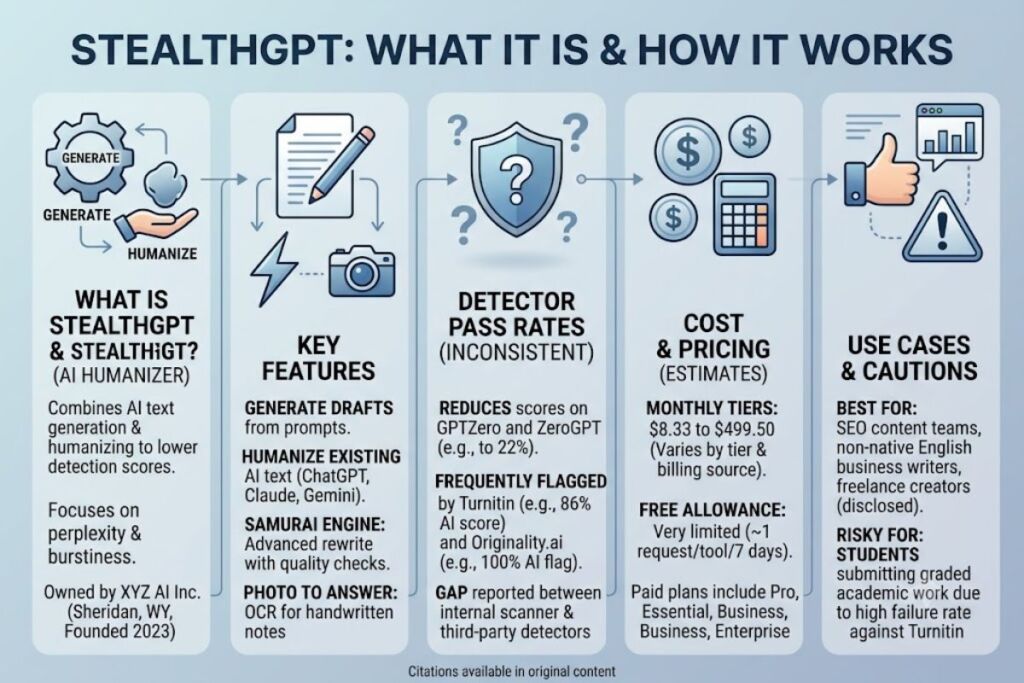
StealthGPT is an AI humanizer and text generator that rewrites AI-generated content to lower its AI-detection score. Independent tests across six detectors show inconsistent results: it reduces scores on GPTZero and ZeroGPT but frequently still gets flagged by Turnitin and Originality.ai.
- 01What Is StealthGPT?
- 02What Are StealthGPT’s Key Features?
- 03How Much Does StealthGPT Cost?
- 04What Are the Pros and Cons of StealthGPT?
- 05Pros
- 06Cons
- 07How Does StealthGPT Compare to Undetectable AI?
- 08How Accurate Are Turnitin and GPTZero, the Detectors StealthGPT Is Built to Beat?
- 09Who Should Use StealthGPT?
- 10What Are the Best Alternatives to StealthGPT?
- 11Frequently Asked Questions
What Is StealthGPT?
StealthGPT is a web-based AI writing platform that bundles a text generator and an AI humanizer, built to rewrite AI-generated content so it reads as human-authored to detection tools like Turnitin, GPTZero, and Originality.ai. The platform is owned by XYZ AI Inc., a company founded in 2023 and headquartered in Sheridan, Wyoming.<cite index=”31-1″>Crunchbase lists StealthGPT’s U.S. server location as Sheridan, Wyoming, with a pre-seed funding round announced in 2024</cite>. The tool runs two core modes: Generate, which drafts new content from a topic prompt, and Humanize, which rewrites text pasted in from ChatGPT, Claude, or Gemini.<cite index=”4-1″>The humanizer targets perplexity, burstiness, vocabulary distribution, and the stereotyped phrasal patterns that AI detectors key on</cite>.
| Attribute | Value |
|---|---|
| Parent Company | XYZ AI Inc. |
| Founded | 2023 |
| Headquarters | Sheridan, Wyoming, US |
| Platforms | Web app, browser extension, API, iOS app |
| Entry Pricing | $8.33–$25/month (varies by tier and billing source) |
| Top Pricing Tier | $100.50–$499.50/month (Business/Enterprise) |
| Key Feature | Combined AI generator + humanizer in one subscription |
| Claimed Detector Coverage | Turnitin, GPTZero, Originality.ai, ZeroGPT, Copyleaks |
What Are StealthGPT’s Key Features?
StealthGPT ships four core features that separate it from single-purpose paraphrasers. Each feature targets a specific stage of the AI-detection-evasion workflow.
- Generate original drafts from a topic prompt, with StealthGPT’s rewriting layer applied automatically during output rather than as a second pass.
- Humanize existing AI text pasted from ChatGPT, Claude, or Gemini, rewriting sentence structure and word choice to alter perplexity and burstiness scores.
- Run the Samurai engine, a premium rewrite mode that adds extra quality checks and an em-dash remover on top of the standard Ghost engine.<cite index=”1-1″>Samurai is described as an advanced undetectable model with extra quality checks, an em-dash remover, and 10 additional humanizer requests per day</cite>.
- Convert uploaded PDFs or photos of handwritten notes into text responses through the Photo to Answer feature.
- Integrate the tool into existing workflows through a developer API and Google Docs/Gmail browser extensions on higher-tier plans.
None of these features guarantees a passing score. <cite index=”1-1″>StealthGPT’s own pricing page adds a disclaimer that no tool guarantees a 100% bypass and that detector models update regularly</cite> — a caveat worth weighing against the marketing claims on the same page.
How Much Does StealthGPT Cost?
StealthGPT runs $8.33 to $499.50 per month across four tiers, with independent pricing trackers reporting different numbers for the same tier names because the company has changed its plan structure multiple times in 2026. <cite index=”2-1″>Capterra lists a Pro plan starting at $30/month with 100 requests per day, 1,500 words per request, and access for 3 seats, alongside Essential at $34.50, Business at $100.50, and Enterprise at $499.50</cite>. A separate pricing tracker lists three flat tiers instead: <cite index=”8-1″>Essential at $8.33/month, Pro at $16.66/month, and Exclusive at $24.99/month, with no free plan offered</cite>. A third source dated June 2026 puts the entry Essential tier closer to $25/month and Pro near $35/month.<cite index=”9-1″>That reviewer notes the older “Hacker” tier name referenced across the web no longer exists and recommends confirming exact figures directly at stealthgpt.ai before paying</cite>, since the site restricts automated scraping and different trackers disagree.
The free tier is narrow regardless of which pricing table is accurate. <cite index=”9-1″>Independent reporting puts StealthGPT’s free allowance at roughly one request per tool every seven days</cite> — enough to preview the interface, not enough to test the tool across multiple drafts before committing to a subscription.
What Are the Pros and Cons of StealthGPT?
Pros
- Bundles generation and humanization in one subscription, unlike single-purpose competitors that require pasting output between two separate tools.
- Reduces detection scores on GPTZero and ZeroGPT in multiple independent tests, even when it does not fully eliminate the AI flag.
- Supports over 100 languages on Pro and Business tiers, plus browser extensions for in-document rewriting in Google Docs and Gmail.
- Responds quickly to support tickets, according to Trustpilot reviews cited by independent testers, even when product performance disappoints.
Cons
- Fails against Originality.ai in repeated independent tests. <cite index=”29-1″>One controlled test found Originality.ai flagged both the raw ChatGPT draft and the StealthGPT-rewritten version at 100% confidence as AI-generated</cite>.
- Fails against Turnitin in a separate test. <cite index=”27-1″>A different reviewer ran StealthGPT output through Turnitin and recorded an 86% AI-written score after cleaning up grammar errors first</cite>.
- Shows a gap between its own AI checker and third-party detectors. <cite index=”34-1″>One tester found StealthGPT’s internal scanner rated output at 88% human while GPTZero flagged the same text as 100% AI</cite>.
- Still triggers academic review thresholds even on a “win.” <cite index=”34-1″>A separate independent test recorded StealthGPT dropping a GPTZero-style AI score from roughly 98% to 22% — still above the 10–15% threshold that triggers manual review at most universities</cite>.
- No trial period on paid tiers, per multiple 2026 reviews, meaning users commit a minimum charge before confirming bypass performance on their own writing sample.
How Does StealthGPT Compare to Undetectable AI?
Undetectable AI outperforms StealthGPT on independent detector pass-rate testing and offers a larger free tier, while StealthGPT’s advantage is its built-in text generator, which Undetectable AI does not include.
| Feature | StealthGPT | Undetectable AI |
|---|---|---|
| Built-in text generator | Yes | No (humanizer only) |
| Free tier | ~1 request per tool / 7 days | Multiple free runs, no signup required |
| Turnitin bypass (independent test) | 86% AI flagged | Lower flag rate in the same test series |
| Own AI checker vs. third-party detectors | Gap reported (88% human vs. 100% AI on GPTZero) | Closer internal/external score alignment reported |
| API access | Yes | Yes |
For a full feature-by-feature breakdown, see our dedicated StealthGPT vs. Undetectable AI comparison.
How Accurate Are Turnitin and GPTZero, the Detectors StealthGPT Is Built to Beat?
Both detectors publish accuracy claims above 98%, but independent, real-world testing consistently lands 10 to 25 percentage points lower, with false-positive rates that disproportionately affect non-native English writers.
Turnitin states a false positive rate near 1% on documents scoring above its 20% AI-writing threshold.<cite index=”25-1″>Scores between 1% and 19% display only as an asterisk rather than a specific number, because Turnitin considers false positives more likely in that low range</cite>. Independent research tells a different story at scale. <cite index=”20-1″>A Stanford study found detectors flagged 61% of non-native English student essays as AI-written, a pattern that subsequent 2024 and 2025 peer-reviewed work has largely confirmed</cite>, and <cite index=”20-1″>unedited GPT-4 and Claude output in academic register scores in the 90–95% detection range on Turnitin — below the company’s 98% claim but still high</cite>. <cite index=”26-1″>Turnitin’s own Chief Product Officer told BestColleges the company intentionally trades detection coverage for a lower false-positive rate, putting real-world detection closer to 85%, not 98%</cite>.
GPTZero shows a similar gap between lab and field results. <cite index=”12-1″>GPTZero scored 99.5% accuracy with a 0.05% false positive rate on the University of Chicago Booth School of Business’s February 2026 benchmark, the highest of any detector tested against GPT-4.1, Claude Opus 4, Claude Sonnet 4, and Gemini 2.0 Flash</cite>. <cite index=”12-1″>That same month, independent testing across 2,400 mixed samples put real-world accuracy at 87% with a 10% false positive rate</cite>. On humanized or bypassed text specifically, <cite index=”11-1″>GPTZero’s own 2026 benchmark claims 93.5% recall — meaning it still catches the large majority of AI text that has already been run through a humanizer</cite>.
Who Should Use StealthGPT?
StealthGPT fits professional and marketing use cases better than high-stakes academic submissions, given its inconsistent performance against the two detectors most universities actually use.
- SEO content teams and marketers producing high-volume blog or product copy where an occasional AI flag carries no formal penalty.
- Non-native English business writers drafting internal emails and reports who want faster, more natural-sounding output without academic-integrity exposure.
- Freelance content creators who already disclose AI assistance to clients and need a generator-plus-humanizer combo in one login.
- Students submitting graded academic work are the group with the most exposure: independent Turnitin and Originality.ai tests above show the tool failing outright in multiple runs, and a flagged submission can trigger an academic integrity investigation regardless of intent.
What Are the Best Alternatives to StealthGPT?
- Undetectable AI — a dedicated humanizer with a larger free tier and stronger independent pass rates against Turnitin in side-by-side testing; read the full Undetectable AI Review.
- QuillBot Humanizer — bundled inside QuillBot’s broader paraphrasing suite, though <cite index=”9-1″>QuillBot Humanizer’s own AI Detector re-tested its humanized output at approximately 95% AI confidence in May 2026</cite>, a result worth weighing before choosing it over standalone tools.
- Phrasly AI Humanizer — rated higher on output quality and lower on detection scores than StealthGPT in a direct head-to-head test, per <cite index=”27-1″>a review that found Phrasly produced better output quality and lower detection scores than StealthGPT in the same test set</cite>.
Frequently Asked Questions
Does StealthGPT actually bypass Turnitin?
Not reliably. Independent tests recorded an 86% AI-written score on Turnitin after StealthGPT processing, and a separate test showed a bypassed score still landing at 22% — above most universities’ manual-review threshold.
Is StealthGPT safe to use for graded academic work?
It carries real risk. Multiple independent tests show StealthGPT output still triggering flags on Turnitin and Originality.ai, and a flagged AI score can prompt an academic integrity review under most university honor codes, regardless of the tool’s marketing claims.
Does StealthGPT offer a free trial?
The free allowance is limited to roughly one request per tool every seven days, per independent reporting, with no extended free trial on paid tiers as of mid-2026.
How is StealthGPT different from ChatGPT?
ChatGPT generates original content from a prompt. StealthGPT’s Humanize mode takes existing AI-generated text — including ChatGPT output — and rewrites it to alter the perplexity and burstiness signals that detectors measure.