
⏱ 8 Reading Time
- 01What Are Cartesia and MiniMax Speech?
- 02How Do Cartesia and MiniMax Speech Compare on Latency?
- 03How Do Cartesia and MiniMax Speech Compare on Pricing?
- 04How Do Cartesia and MiniMax Speech Compare on Voice Quality Benchmarks?
- 05How Do Cartesia and MiniMax Speech Compare on Languages and Voice Cloning?
- 06Should You Choose Cartesia or MiniMax Speech?
- 07What Is the Final Verdict on Cartesia vs MiniMax Speech?
- 08Frequently Asked Questions
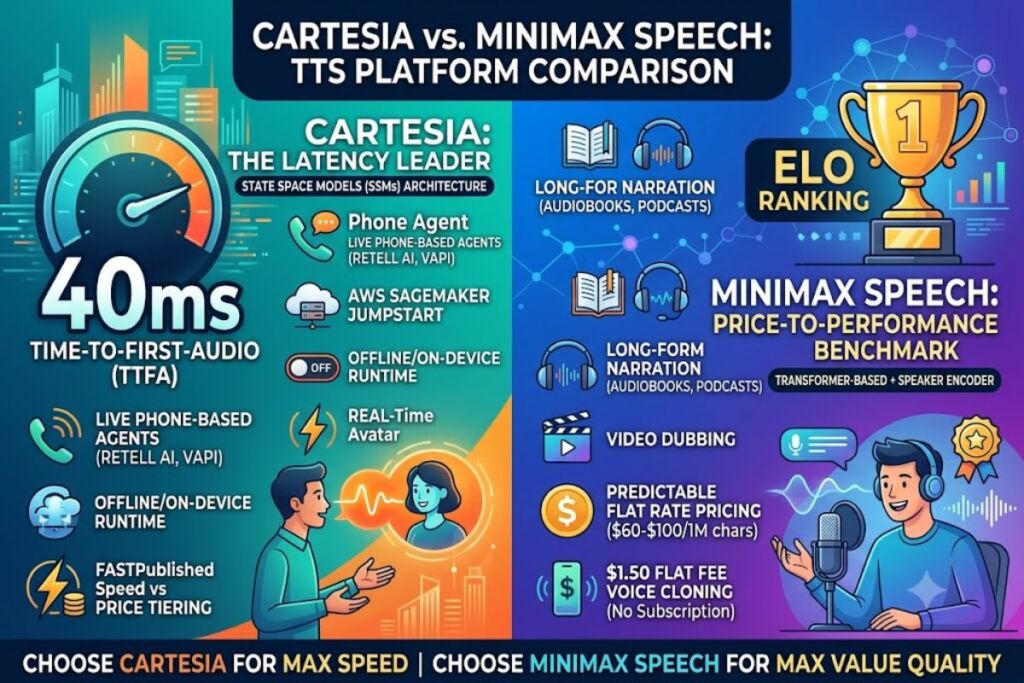
Cartesia wins on raw latency; MiniMax Speech wins on price-to-performance. Cartesia’s Sonic Turbo model generates audio at 40ms time-to-first-audio (TTFA), the fastest published figure in the commercial TTS market. MiniMax Speech ranked #1 on the Artificial Analysis Speech Arena and Hugging Face TTS Arena at launch while pricing its API at roughly half of ElevenLabs’ rate, making it the value benchmark rather than the speed benchmark.
What Are Cartesia and MiniMax Speech?
Cartesia is a State Space Model (SSM) voice AI company built for latency-critical voice agents; MiniMax Speech is a Transformer-based TTS model line built for benchmark-leading audio quality at a lower cost than ElevenLabs. Both ship streaming APIs, but each optimizes for a different variable.
Cartesia AI launched in September 2023, founded by Karan Goel, Albert Gu, Arjun Desai, Brandon Yang, and Stanford AI Lab advisor Christopher Ré after the group left the Stanford AI Lab. The company builds on State Space Models (SSMs), an architecture that replaces the Transformer’s attention mechanism with a sequential state update, cutting inference latency and holding memory usage constant regardless of audio length. Cartesia shipped its first Sonic model on May 31, 2024, and released Sonic-3 in October 2025 with 90ms model latency and 190ms end-to-end latency across 42 languages. On June 16, 2026, Cartesia released Sonic-3.5 alongside Ink 2, a speech-to-text model, and CEO Karan Goel stated Sonic-3.5 reached the #1 position on the Artificial Analysis leaderboard.
MiniMax is a Shanghai-based AI company founded in December 2021. MiniMax Speech (originally Speech-02, now succeeded by Speech-2.8-HD and Speech-2.8-Turbo) uses an autoregressive Transformer architecture combined with a learnable speaker encoder, which extracts a speaker’s timbre from a reference clip without requiring a transcript. Speech-02-HD reached an ELO score of 1,161 on the Artificial Analysis Speech Arena at launch in 2025, ranking ahead of both OpenAI’s TTS model and ElevenLabs on that leaderboard.
| Attribute | Cartesia | MiniMax Speech |
|---|---|---|
| Parent Company | Cartesia AI (Daly City, CA) | MiniMax (Shanghai, China) |
| Founded | September 2023 | December 2021 |
| Core Architecture | State Space Models (SSMs) | Autoregressive Transformer + speaker encoder |
| Flagship Model | Sonic-3.5 / Sonic Turbo | Speech-2.8-HD / Speech-2.8-Turbo |
| Fastest Published TTFA | 40ms (Sonic Turbo) | Sub-200ms TTFB (Turbo) |
| Entry Pricing | Free tier: 20,000 credits/month | Free tier: 10,000 credits/month |
| Paid Pricing Range | ~$5–$37 per million characters | $60–$100 per million characters |
| Languages | 42 | 30+ (32 tested by Knowara) |
| Independent Benchmark Rank | #10 on Artificial Analysis (per TextToLab tracking) | #1 on Artificial Analysis Speech Arena + Hugging Face TTS Arena at launch |
| Voice Cloning | Instant cloning from a 3-second sample | Instant cloning from a 10-second sample, $1.50/voice flat fee |
How Do Cartesia and MiniMax Speech Compare on Latency?
Cartesia’s Sonic Turbo delivers 40ms time-to-first-audio; MiniMax Speech Turbo delivers time-to-first-byte under 200ms. Cartesia’s SSM architecture processes audio sequentially with constant memory usage, while MiniMax’s Transformer pipeline trades a latency premium for higher perceived voice quality.
Cartesia publishes its 90th-percentile latency benchmarks across 100 measurements per model. Sonic-3 posts 90ms TTFA and 190ms end-to-end latency, and Sonic Turbo compresses that further to approximately 40ms. Fortune reported that Cartesia’s Sonic model cut latency from 90ms to 45ms between its 2024 and 2025 releases, and Google Cloud’s own case study on Cartesia cites sub-90ms latency in production at 99.99% uptime across more than 50,000 customers. MiniMax positions Speech-2.8-Turbo for real-time voice agents with time-to-first-byte under 200ms, streaming raw 24kHz PCM directly into WebRTC pipelines such as LiveKit and Pipecat. That figure trails Cartesia’s Turbo tier by a factor of five, which matters for phone-based voice agents where every 100ms of added latency increases the odds a caller perceives the system as non-human.
How Do Cartesia and MiniMax Speech Compare on Pricing?
MiniMax Speech charges $60 per million characters on Turbo and $100 per million characters on HD; Cartesia’s credit system prices out to roughly $5–$37 per million characters but adds overage tiers as usage scales. MiniMax’s flat per-character rate stays predictable; Cartesia’s credit model rewards light usage and penalizes heavy usage.
Cartesia bills through a credit system where 1 credit equals 1 character of TTS output. The Free tier includes 20,000 credits per month. The Pro plan costs $4 per month on annual billing (or $5 per month billed monthly), and the Scale plan runs $299 per month for 8 million credits. Voice cloning on Cartesia’s Pro tier bills at 1.5 credits per character, cutting the effective credit budget by a third versus standard TTS. Independent pricing trackers including Smallest.ai warn that Cartesia’s advertised rate does not reflect full production cost once audio seconds, concurrent connections, and gated features are added at scale.
MiniMax’s Free plan provides 10,000 credits per month, equal to roughly 12 minutes of HD audio and 3 voice slots, with no credit card required. Paid usage runs $60 per million characters on the Turbo tier and $100 per million characters on the HD tier, a rate MiniMax and third-party trackers cite as roughly half of ElevenLabs’ comparable per-character cost. Voice cloning on MiniMax costs a flat $1.50 per voice with no recurring subscription fee. The synchronous API caps requests at 10,000 characters, while the asynchronous long-text endpoint accepts up to 1 million characters per request.
How Do Cartesia and MiniMax Speech Compare on Voice Quality Benchmarks?
MiniMax Speech ranked #1 on the Artificial Analysis Speech Arena and Hugging Face TTS Arena at launch; Cartesia’s Sonic-3 won 62% of blind preference tests against ElevenLabs but trails MiniMax on the same third-party arena rankings. Benchmark placement, not marketing copy, separates the two on perceived audio quality.
MiniMax Speech-02-HD posted an ELO score of 1,161 on the Artificial Analysis Speech Arena, an ELO-style leaderboard built from crowdsourced blind comparisons of generated audio samples, placing it ahead of OpenAI’s and ElevenLabs’ TTS models at the time of ranking. The Hugging Face TTS Arena, a separate blind-test leaderboard, independently confirmed the same ordering. Cartesia’s Sonic-3 won 62% of blind preference votes against ElevenLabs in company-reported testing and later claimed the #1 position on the Artificial Analysis leaderboard following the Sonic-3.5 release in June 2026, per CEO Karan Goel’s launch-day statement. Independent tracking from TextToLab placed Cartesia at #10 on the same Artificial Analysis leaderboard prior to the Sonic-3.5 update, indicating the ranking shifts frequently as both vendors release new checkpoints.
How Do Cartesia and MiniMax Speech Compare on Languages and Voice Cloning?
Cartesia supports 42 languages with Sonic-3; MiniMax Speech supports 30+ languages with native-accent handling, and both offer instant voice cloning from short reference clips. Language breadth favors Cartesia by a small margin; cloning speed favors MiniMax by a wider one.
Cartesia’s Sonic-3 covers 42 languages, confirmed independently through Amazon Web Services’ SageMaker JumpStart listing, which cites “high naturalness, accurate transcript following, and industry-leading latency” alongside the 42-language count. Cartesia’s Voice Changer feature clones a voice from a 3-second audio sample at 90ms latency. MiniMax Speech supports 30+ languages with native-accent pronunciation, confirmed at 32 languages during Knowara’s own testing across audiobook, IVR, and dubbing use cases documented in the MiniMax Speech Review 2026: HD vs Turbo Pricing. MiniMax clones a voice from a 10-second reference sample for a flat $1.50 fee, with no subscription requirement, and preserves speaker identity across long-form output without manual re-stitching.
Should You Choose Cartesia or MiniMax Speech?
Choose Cartesia for phone-based voice agents where every millisecond of latency changes the caller’s experience; choose MiniMax Speech for narration-heavy or dubbing projects where audio quality per dollar matters more than sub-100ms response time.
Choose Cartesia if:
- Deploy a live phone-based voice agent that cannot tolerate more than 200ms of end-to-end latency.
- Build on Amazon SageMaker JumpStart, Together AI, Retell AI, or Vapi, all of which integrate Sonic-3 as a native model option.
- Require an on-device or offline TTS deployment, since Sonic runs locally without an internet connection.
- Prioritize the industry’s fastest published TTFA over the lowest per-character list price.
Choose MiniMax Speech if:
- Produce long-form audiobook, podcast, or dubbing content where perceived voice naturalness ranks above raw response speed.
- Need voice cloning without a recurring subscription, since MiniMax charges a flat $1.50 per cloned voice.
- Run high-character-volume jobs where a flat $60–$100 per million characters is more predictable than a credit system with overage tiers.
- Want a model that independently ranked #1 on two separate speech-quality arenas rather than relying on vendor-reported comparisons.
What Is the Final Verdict on Cartesia vs MiniMax Speech?
Cartesia is the latency leader in the TTS market, publishing the fastest TTFA at 40ms; MiniMax Speech is the price-to-performance leader, ranking #1 on two independent speech-quality arenas at roughly half of ElevenLabs’ per-character rate. Teams building latency-sensitive voice agents deploy Cartesia. Teams producing high-volume narration, dubbing, or cloning work at scale deploy MiniMax Speech.
Frequently Asked Questions
Is Cartesia faster than MiniMax Speech?
Cartesia’s Sonic Turbo model posts a published 40ms time-to-first-audio, faster than MiniMax Speech-2.8-Turbo’s sub-200ms time-to-first-byte figure.
Is MiniMax Speech cheaper than Cartesia?
No. MiniMax Speech’s published rate of $60–$100 per million characters runs higher than Cartesia’s effective $5–$37 per million characters, though Cartesia’s credit system adds overage costs at scale that MiniMax’s flat per-character rate avoids.
Does MiniMax Speech beat ElevenLabs on quality?
MiniMax Speech-02-HD ranked #1 on the Artificial Analysis Speech Arena and Hugging Face TTS Arena at launch, ahead of ElevenLabs’ listed models on the same leaderboards, according to MiniMax’s official benchmark announcement.
Can Cartesia run offline?
Yes. Cartesia’s Sonic model runs locally on-device without an internet connection, a capability MiniMax Speech does not publish for its cloud-only API.
Cartesia’s 40ms TTFA remains the fastest published figure in the commercial TTS market as of July 2026, and MiniMax Speech’s #1 arena ranking at half of ElevenLabs’ price stands as the strongest price-to-performance claim among the platforms reviewed on Knowara.