
⏱ 10 Reading Time
- 01What Is Voice.ai?
- 02What Are Voice.ai’s Key Features?
- 03How Much Does Voice.ai Cost?
- 04What Are the Pros and Cons of Voice.ai?
- 05Is Voice.ai’s User-Generated Voice Library Legal to Use?
- 06How Does Voice.ai Compare to Kits.AI?
- 07Who Should Use Voice.ai?
- 08What Are the Best Alternatives to Voice.ai?
- 09Frequently Asked Questions
- 10Final Verdict
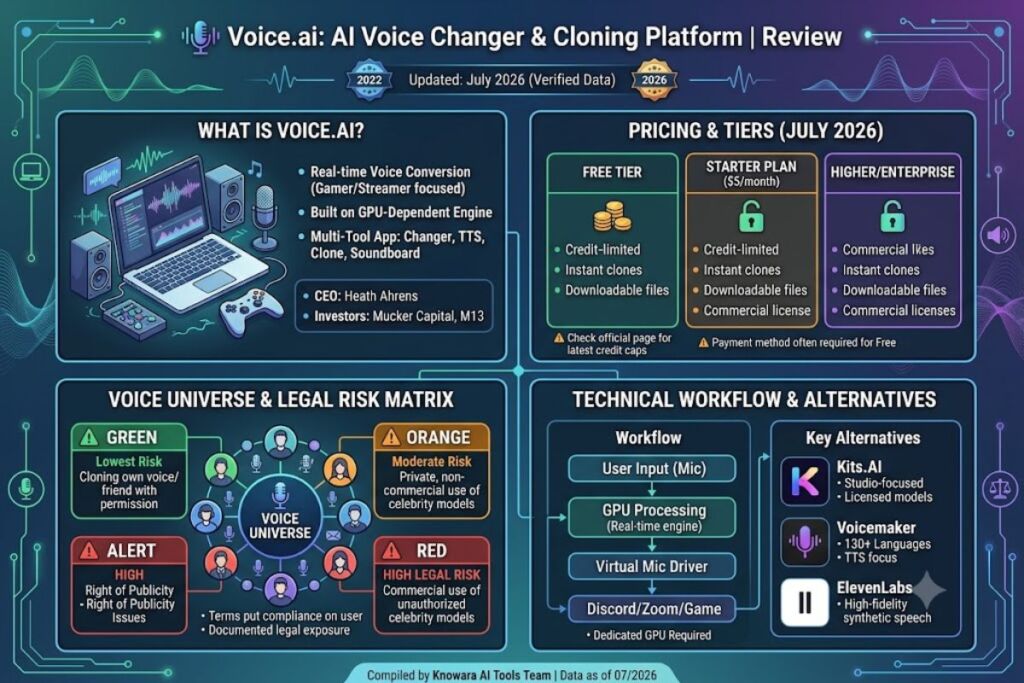
Voice.ai is a real-time AI voice changer and voice-cloning platform built for gamers, streamers, and Discord users. It runs on a GPU-dependent conversion engine and a user-generated voice library called Voice Universe, which carries documented legal exposure.
This review was compiled by the Knowara AI Tools team from Voice.ai’s official product pages, its published pricing structure, third-party pricing audits, app-store review data, and legal analysis of voice-cloning right-of-publicity cases. Every figure below is dated and sourced; where a number could not be independently confirmed against Voice.ai’s live pricing page at the time of writing, it is flagged explicitly rather than estimated.
What Is Voice.ai?
Voice.ai is a real-time voice conversion application that changes a user’s live voice into another voice during calls, streams, or games. It launched in November 2022 and combines a voice changer, an instant voice-cloning tool, a text-to-speech engine, and a soundboard in a single desktop app.
The company was founded by CEO Heath Ahrens, who previously built a cloud-based text-to-speech engine used by Amazon and Google. Voice.ai reached break-even revenue early and secured funding from Mucker Capital and M13. Its core differentiator is Voice Universe, a community library where users upload and share voice models trained on real audio samples — a feature that also produces its main legal liability, covered later in this review.
| Attribute | Value |
|---|---|
| Company | Voice.ai Inc. |
| CEO | Heath Ahrens |
| Release Year | 2022 (November) |
| Platforms | Windows, macOS (desktop app); browser-based tools for TTS and audio cleanup |
| Key Feature | Real-time voice conversion + user-generated voice library (Voice Universe) |
| Investors | Mucker Capital, M13 |
| Free Tier | Available, credit-limited (see Pricing section) |
| Entry Paid Plan | Starter, $5/month |
Company and product data verified as of July 2026 from Voice.ai’s official hub pages and public funding disclosures.
What Are Voice.ai’s Key Features?
- Convert live microphone audio into a different voice in real time, for use inside Discord, Zoom, and most games that read a system audio input.
- Clone a voice from a short audio sample using the Instant Voice Clone tool, available starting on the Starter plan at 5 clones per month.
- Browse Voice Universe, a library Voice.ai has marketed as containing tens of thousands of user-uploaded voice models, ranging from original character voices to unauthorized celebrity-style imitations.
- Generate speech from typed text using the built-in TTS Studio, with downloadable audio files on paid plans.
- Remove vocals, echo, and reverb from existing audio tracks using the platform’s audio-cleanup tools, separate from the voice-changing pipeline.
- Split a track into isolated stems (vocals, instruments) for remixing or editing.
- Route converted audio into third-party apps through a virtual microphone driver, which is what lets the changed voice appear inside Discord or a game voice chat.
A GPU is required for smooth real-time conversion. On systems below Voice.ai’s minimum hardware threshold, third-party pricing audits report choppy, delayed output — a hardware dependency that isn’t disclosed prominently on the marketing pages.
How Much Does Voice.ai Cost?
Voice.ai runs on a freemium credit model, with paid plans starting at $5 per month for the Starter tier. Free-tier access requires an account and, per multiple user reports, a payment method on file even before any paid feature is used.
| Plan | Price | What It Unlocks |
|---|---|---|
| Free | $0/month | Limited TTS minutes and limited audio-tool runs per month; no commercial license; no downloadable clone files |
| Starter | $5/month | Instant Voice Clones (5/month), downloadable TTS files, commercial license, TTS Studio access |
| Higher tiers | Variable, usage-based | Additional credits, more clone slots, Voice Agent minutes; exact ceiling not published in a flat table on the public pricing page |
| Enterprise | Custom pricing | Custom clone limits, negotiated terms |
Pricing verified as of July 2026, cross-referenced against a third-party pricing audit (CloudTalk, updated May 2026). Voice.ai’s own pricing page was not directly fetchable at the time of writing; readers should confirm exact current tier limits on Voice.ai’s official pricing page before purchasing, since credit allotments and free-tier caps on AI voice tools change frequently.
Independent reporting also flags two recurring billing complaints: users signing up for the free tier are asked for card details before touching a paid feature, and multiple reviewers report being charged on auto-renewal without an advance notification email, with support cancelling the subscription but declining a refund on the disputed charge. Unable to verify exact free-tier minute caps against Voice.ai’s live page — check the official pricing page for current numbers before budgeting.
What Are the Pros and Cons of Voice.ai?
Pros:
- Combines a real-time voice changer, TTS engine, and audio-cleanup suite in one app, removing the need for separate software for each task.
- Voice Universe gives access to a large, community-sourced voice catalog rather than a fixed set of studio-recorded voices.
- Instant Voice Clone requires no technical audio editing skill — a short sample is enough to generate a usable model.
- Virtual microphone routing works across most Discord, Zoom, and game clients without manual audio configuration.
Cons:
- Real-time conversion requires a dedicated GPU. Workaround: users on integrated graphics can still use the non-real-time TTS Studio and file-based voice cloning, which don’t depend on live GPU throughput.
- Voice quality across the community model library is inconsistent, with some user-uploaded voices reported as robotic or distorted. Workaround: Voice.ai’s own Instant Voice Clone (trained on the user’s own sample) is reported as more reliable than pulling a random community model from Voice Universe.
- Free-tier signup reportedly requires payment details up front, and auto-renewal billing has generated refund complaints. Workaround: cancel before the renewal date rather than after, and screenshot the plan terms at signup.
- The user-generated voice library includes unauthorized celebrity-style voices, which creates legal exposure for anyone who publishes content made with them (detailed below). Workaround: stick to self-cloned voices or clearly original/fictional characters for any content intended for public or commercial use.
Is Voice.ai’s User-Generated Voice Library Legal to Use?
Voice.ai’s Voice Universe library sits in a legal gray area because it lets users upload and share voice models, including unauthorized clones of celebrities and public figures, without the platform verifying consent from the person whose voice was cloned.
Cloning a real person’s voice without their permission violates that person’s right of publicity in most US states, a legal protection separate from copyright that lets an individual control commercial use of their own voice and likeness. California’s right-of-publicity statute is one of the most commonly cited state protections in voice-cloning disputes. Voice.ai itself acknowledges this exposure on its own legal-information page, stating that entertainment companies and copyright holders can pursue legal action over unauthorized celebrity-style AI voices.
Recent case law adds nuance rather than removing the risk. A 2025 New York federal court ruling in a voice-cloning dispute against AI company Lovo dismissed a Lanham Act false-advertising claim and found that using a voice clone alone doesn’t automatically satisfy false-association standards — but the court’s reasoning applied to a specific commercial-use fact pattern and did not create blanket legal cover for cloning someone’s voice without consent. Separately, in a widely reported 2026 music-industry dispute, producers who used an AI tool to mimic singer Jorja Smith’s voice in a viral track faced takedown notices and royalty demands after the track scaled on TikTok — an example of the commercial risk that follows unauthorized voice cloning even when the tool itself is legal to use.
The practical risk breakdown for Voice.ai users:
- Cloning your own voice: Legal. No third-party consent issue exists.
- Cloning a friend or colleague’s voice with their permission: Legal, provided consent is documented.
- Downloading a celebrity-style voice from Voice Universe for private, non-commercial use: Lower risk, but still contested territory depending on state law.
- Publishing or monetizing content made with an unauthorized celebrity clone from Voice Universe: High legal risk, exposing the publisher — not just Voice.ai — to right-of-publicity claims, and in extreme cases, defamation or fraud claims if the voice is used to make false statements.
Voice.ai’s terms of service place the compliance burden on the end user, not the platform, which is consistent with how most voice-cloning apps structure their legal liability.
How Does Voice.ai Compare to Kits.AI?
Voice.ai and Kits.AI both offer voice cloning and audio-cleanup tools, but they target different use cases: Voice.ai is built around real-time, live voice conversion for streaming and gaming, while Kits.AI is built around studio-quality voice training for music production.
| Feature | Voice.ai | Kits.AI |
|---|---|---|
| Real-time voice changing | Yes, GPU-dependent | Limited; focused on post-production |
| Voice library source | User-generated (Voice Universe) | Platform-trained and licensed voice models |
| Entry paid price | $5/month (Starter) | $9.99/month |
| Primary use case | Gaming, streaming, Discord | Music production, vocal remixing |
| Free tier | Credit-limited, requires payment method | Includes 1 voice slot and 15 conversion minutes |
Kits.AI’s free tier discloses its exact conversion-minute limit publicly; Voice.ai’s does not display an equivalent fixed number on its public marketing pages as of this writing, which makes Kits.AI easier to budget against for light users.
Who Should Use Voice.ai?
Voice.ai fits users who need a live, in-call voice changer more than a studio-grade voice-cloning pipeline. Specific fits include:
- Gamers who want to change their in-game or Discord voice for privacy, roleplay, or anonymity during multiplayer sessions.
- Streamers running voice-based bits or character segments on Twitch who need low-latency conversion during a live broadcast.
- Solo content creators who need a combined TTS and voice-changer tool without licensing separate software for each function.
- Users with access to a dedicated GPU, since real-time performance depends on it.
Voice.ai is a weaker fit for teams building customer-facing AI voice agents at scale, since its Voice Agent functionality is a secondary feature layered onto an audio-creation product rather than a purpose-built calling infrastructure with native CRM integrations.
What Are the Best Alternatives to Voice.ai?
- Kits.AI — a studio-focused voice cloning and vocal-remover platform aimed at music producers, with a transparent free-tier minute cap and licensed rather than user-uploaded voice models.
- Voicemaker — a text-to-speech and voice-cloning platform supporting 130+ languages, better suited to audiobook and multilingual narration production than live conversion.
- ElevenLabs — a text-to-speech and voice-cloning provider known for high-fidelity synthetic speech, positioned closer to professional narration and dubbing than live, in-call voice changing.
Frequently Asked Questions
Is Voice.ai free to use?
Voice.ai offers a free tier with limited monthly TTS and audio-tool usage. Full features — including downloadable voice clones and a commercial license — require the $5/month Starter plan or higher.
Does Voice.ai require a subscription to clone a voice?
Instant Voice Cloning is a paid-tier feature starting on the Starter plan, which includes 5 clones per month. The free tier does not include downloadable, commercially licensed clones.
Is it legal to use a celebrity’s voice from Voice.ai’s library?
Using an unauthorized celebrity-style voice for private, non-commercial purposes carries lower risk than publishing or monetizing content made with it. Publishing content with an unauthorized celebrity clone exposes the publisher to right-of-publicity claims in most US states.
Does Voice.ai work without a GPU?
Real-time voice conversion needs a dedicated GPU for smooth output. Non-real-time features — TTS Studio and file-based voice cloning — function without one, though at reduced convenience for live use cases like streaming.
Final Verdict
Voice.ai’s $5/month entry price undercuts most dedicated voice-cloning competitors, but the platform’s core differentiator — a user-generated voice library with unverified celebrity clones — is also its biggest liability, shifting legal risk onto whoever publishes content made with an unauthorized voice.