
⏱ 8 Reading Time
- 01What Is ElevenLabs?
- 02What Is Inworld AI?
- 03How Do ElevenLabs and Inworld AI Compare on Core Features?
- 04How Does Latency Compare for Real-Time Voice Agents?
- 05How Much Do ElevenLabs and Inworld AI Cost?
- 06ElevenLabs Pricing (Monthly, Billed Annually)
- 07Inworld AI Pricing (Per 1M Characters, Usage-Based)
- 08What Are the Pros and Cons of ElevenLabs vs Inworld AI?
- 09Should You Choose ElevenLabs or Inworld AI?
- 10Who Should Use ElevenLabs vs Inworld AI?
- 11What Are the Best Alternatives to ElevenLabs and Inworld AI?
- 12Frequently Asked Questions
- 13The Bottom Line
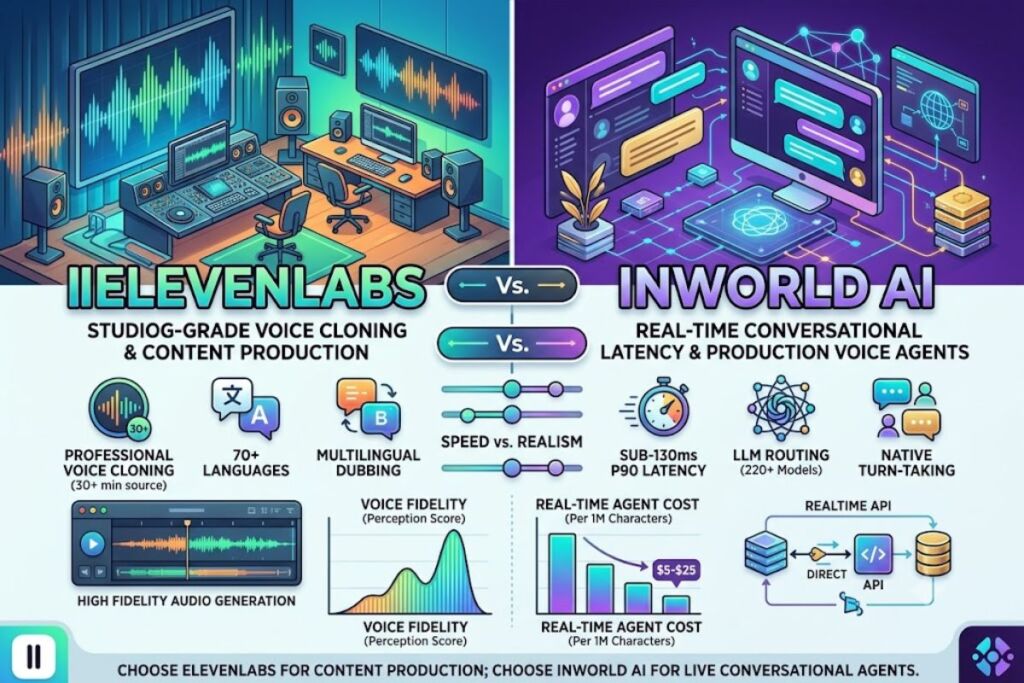
ElevenLabs wins on voice cloning quality and content-creation workflows; Inworld AI wins on real-time conversational latency for production voice agents. ElevenLabs charges $5–$990 per month across six tiers. Inworld AI charges $5–$25 per million characters, dropping to $10 at scale.
What Is ElevenLabs?
ElevenLabs is a London-based AI audio platform that converts text to speech, clones voices from short audio samples, and dubs video content across 70+ languages. Mati Staniszewski and Piotr Dąbkowski founded the company in April 2022. ElevenLabs raised a $500 million Series D in February 2026 at an $11 billion valuation.
| Attribute | Value |
|---|---|
| Company | ElevenLabs Inc. |
| Founded | 2022 |
| Headquarters | London, UK |
| Pricing | $0–$990/month (6 tiers) + custom Enterprise |
| Platforms | Web app, REST API, SDKs (Python, Node.js, Swift) |
| Key Feature | Professional voice cloning from 30+ minutes of source audio |
| Flagship Models | Multilingual v3, Flash v2.5, Turbo v2.5 |
| Languages | 70+ |
ElevenLabs built its reputation on studio-grade voice cloning for podcasters, audiobook narrators, and dubbing studios. The platform later added Conversational AI Agents, but the core architecture optimizes for output fidelity over turn-taking speed.
What Is Inworld AI?
Inworld AI is a Mountain View-based real-time voice infrastructure company that builds low-latency text-to-speech, speech-to-text, and an LLM router for production voice agents. Ilya Gelfenbeyn, Kylan Gibbs, and Michael Ermolenko founded Inworld in 2021. The founding team previously built Dialogflow, the conversational AI platform Google acquired.
| Attribute | Value |
|---|---|
| Company | Inworld AI, Inc. |
| Founded | 2021 |
| Headquarters | Mountain View, California |
| Pricing | $5–$25 per 1M characters (usage-based, drops to $10 at scale) |
| Platforms | REST API, WebSocket streaming, WebRTC, on-premise deployment |
| Key Feature | Sub-200ms time-to-first-audio via the Realtime API |
| Flagship Models | Realtime TTS-2 (Research Preview), TTS 1.5 Mini, TTS 1.5 Max |
| Languages | 15 GA languages, 90+ in TTS-2 preview |
Inworld sells infrastructure, not a consumer app. Development teams call the Realtime API to combine TTS, speech-to-text, and an LLM Router spanning 220+ models inside a single WebSocket connection.
How Do ElevenLabs and Inworld AI Compare on Core Features?
ElevenLabs prioritizes voice fidelity and a 70-language library; Inworld AI prioritizes sub-200ms latency and multi-LLM orchestration for live agents. Both platforms support instant voice cloning, but they optimize for opposite ends of the speed-versus-realism tradeoff.
| Feature | ElevenLabs | Inworld AI |
|---|---|---|
| Voice cloning | Instant (Starter+) and Professional (Creator+, 30+ min source audio) | Instant, from 5–15 seconds of audio |
| Streaming latency | ~75ms (Flash v2.5) to ~250ms+ (Multilingual v3) | <130ms P90 (TTS 1.5 Mini) to <250ms P90 (TTS 1.5 Max) |
| Language coverage | 70+ languages (GA) | 15 languages (GA), 90+ (TTS-2 preview) |
| LLM routing | Not native; requires third-party orchestration | Built-in Router across 220+ LLMs |
| Turn-taking / interruption handling | Available via Conversational AI Agents | Native intelligent turn-taking with adjustable eagerness |
| Function/tool calling | Available on Agent Platform | Native mid-session function registration |
| On-premise deployment | Enterprise tier only | Available on paid tiers |
| Benchmark ranking | Multilingual v3 leads on realism per Artificial Analysis TTS Arena listening tests | Realtime TTS-2 ranks #1 on the Artificial Analysis Realtime TTS Arena at ~1,208 ELO |
How Does Latency Compare for Real-Time Voice Agents?
Inworld AI’s Realtime TTS 1.5 Mini delivers sub-130ms P90 time-to-first-audio; ElevenLabs’ fastest production model, Flash v2.5, streams at roughly 75ms but runs on infrastructure built for content generation, not multi-turn conversation. Latency alone does not decide agent quality — turn-taking logic and interruption handling matter equally in live calls.
ElevenLabs’ Conversational AI Agent product layers a voice pipeline on top of its TTS models and handles telephony through Twilio-style integrations. Inworld AI’s Realtime API instead unifies TTS, speech-to-text, and LLM routing inside one WebSocket connection, cutting the network hops between components that typically add latency in assembled voice-agent stacks. This architectural difference explains why Inworld AI markets itself specifically for “realtime voice AI” while ElevenLabs markets itself as an “AI audio platform.”
Enterprise teams building customer-support bots or sales-call agents measure round-trip latency, not just TTFA. Inworld AI’s SOC 2 Type II compliance, zero-retention mode, and on-premise deployment option target this exact enterprise voice-agent segment.
How Much Do ElevenLabs and Inworld AI Cost?
ElevenLabs uses flat monthly subscription tiers from $0 to $990; Inworld AI uses per-character usage pricing from $25 down to $10 per million characters at scale. Source: ElevenLabs’ official pricing page and Inworld AI’s official TTS API pricing page.
ElevenLabs Pricing (Monthly, Billed Annually)
| Tier | Price | Credits/Month | Key Unlock |
|---|---|---|---|
| Free | $0 | 10,000 (~10 min audio) | No commercial rights |
| Starter | $5 | 30,000 (~30 min) | Commercial rights, instant voice cloning |
| Creator | $22 | 100,000 (~100 min) | Professional voice cloning, 192kbps output |
| Pro | $99 | 500,000 | Higher concurrency, priority processing |
| Scale | $299 | 2,000,000 | Team seats, higher voice-clone limits |
| Business | $990 | — | 10 professional voice clones, multi-agent deployment |
| Enterprise | Custom | Custom | SLA, dedicated support |
Inworld AI Pricing (Per 1M Characters, Usage-Based)
| Model | Standard Rate | Growth Tier | Enterprise Scale |
|---|---|---|---|
| Realtime TTS 1.5 Mini | $25/1M | $12.50/1M | $5/1M |
| Realtime TTS 1.5 Max | $35/1M | — | $10/1M |
| Realtime TTS-2 (Research Preview) | $25/1M | $12.50/1M | $10/1M |
Inworld AI bills TTS, speech-to-text, and LLM routing under one combined spend commit, so total cost depends on call volume rather than a flat seat price. ElevenLabs bills per character-credit inside a fixed monthly allotment, and overage rates fall from $0.06 to $0.02 per generation as usage scales into higher tiers.
What Are the Pros and Cons of ElevenLabs vs Inworld AI?
ElevenLabs delivers the widest voice library and highest cloning fidelity; its tradeoff is higher per-character cost and a pipeline not purpose-built for live agent turn-taking. Inworld AI delivers lower latency and lower per-character cost at scale; its tradeoff is narrower GA language coverage.
ElevenLabs pros:
- Clones professional-grade voices from 30+ minutes of source audio
- Covers 70+ languages in general availability
- Supports AI dubbing that preserves original voice characteristics
- Maintains a public voice marketplace with community-created voices
ElevenLabs cons:
- Charges up to $206 per million characters on Multilingual v3
- Restricts commercial rights to paid tiers only
- Runs conversational agents on infrastructure not originally engineered for sub-200ms turn-taking
Inworld AI pros:
- Achieves <130ms P90 time-to-first-audio on TTS 1.5 Mini
- Ranks #1 on the Artificial Analysis Realtime TTS Arena with Realtime TTS-2
- Routes calls across 220+ LLMs through one unified API
- Drops to $5–$10 per million characters at enterprise scale
Inworld AI cons:
- Covers only 15 languages in general availability
- Ships Realtime TTS-2 as a research preview, not a stable GA release
- Requires developer integration; offers no no-code consumer app comparable to ElevenLabs Studio
Should You Choose ElevenLabs or Inworld AI?
Choose ElevenLabs for voice cloning, dubbing, and content-creation workflows; choose Inworld AI for live, multi-turn voice agents where response speed determines user experience.
Choose ElevenLabs if:
- Produce audiobooks, podcasts, or dubbed video content
- Need professional voice cloning from long-form source audio
- Require 70+ language coverage in one platform
- Want a no-code studio interface without writing API integration code
Choose Inworld AI if:
- Build phone-based or web-based conversational voice agents
- Require sub-200ms latency for natural turn-taking
- Need to route requests across multiple LLM providers in one call
- Operate at high call volume where per-character cost at scale matters more than a flat subscription
Who Should Use ElevenLabs vs Inworld AI?
Content creators, dubbing studios, and audiobook publishers fit ElevenLabs; engineering teams building customer-support bots, sales-call agents, or AI companions fit Inworld AI. Solo podcasters generating narration weekly fit ElevenLabs’ Creator tier at $22/month. Enterprise contact centers running thousands of concurrent calls fit Inworld AI’s enterprise-scale character pricing.
Game studios building interactive NPCs increasingly use Inworld AI’s Realtime API for dialogue that reacts to player input without perceptible delay. Marketing agencies producing multilingual ad voiceovers use ElevenLabs for its broader GA language library and instant voice cloning.
What Are the Best Alternatives to ElevenLabs and Inworld AI?
Cartesia, Deepgram Aura-2, and PlayHT rank as the top three alternatives for teams evaluating options beyond ElevenLabs and Inworld AI.
- Cartesia delivers Sonic 3.5 at 40ms time-to-first-audio, the fastest TTFA figure among major providers, built on a State Space Model architecture.
- Deepgram Aura-2 achieves sub-90ms latency and prices its Voice Agent API at roughly $4.50 per hour for end-to-end voice bots, competing directly with Inworld AI on real-time use cases.
- PlayHT offers a subscription pricing model comparable to ElevenLabs, targeting creators who need voice cloning without usage-based billing.
For a full breakdown of category leaders, see our Best AI Voice Cloning Tools in 2026 guide.
Frequently Asked Questions
Is ElevenLabs or Inworld AI better for AI voice agents?
Inworld AI performs better for real-time voice agents. Its Realtime TTS 1.5 Mini delivers sub-130ms P90 latency and a native LLM Router, both purpose-built for live, multi-turn conversation.
Does Inworld AI support voice cloning like ElevenLabs?
Yes. Inworld AI clones voices from 5–15 seconds of source audio. ElevenLabs requires 30+ minutes of source audio for its highest-fidelity Professional Voice Cloning tier but supports shorter Instant Voice Cloning on paid tiers too.
Which platform costs less at high volume?
Inworld AI costs less at high volume. Its enterprise-scale rate drops to $5–$10 per million characters, compared to ElevenLabs’ Flash v2.5 rate near $103 per million characters and Multilingual v3 near $206 per million characters.
Can I use both ElevenLabs and Inworld AI in the same product?
Yes. Development teams commonly use ElevenLabs for pre-produced content, such as narration or dubbing, and Inworld AI for live conversational features, such as an in-app voice assistant, within the same application.
The Bottom Line
ElevenLabs and Inworld AI solve different problems inside the same voice-AI category. ElevenLabs’ $22/month Creator tier delivers the highest voice-cloning fidelity per dollar for content production. Inworld AI’s $10-per-million-character enterprise rate and sub-130ms latency deliver the lowest cost and fastest response time for live voice agents at scale. Teams building narration and dubbing pick ElevenLabs; teams building real-time conversational agents pick Inworld AI.