
⏱ 7 Reading Time
- 01What Is ElevenLabs?
- 02What Is Hume AI?
- 03How Do ElevenLabs and Hume AI Pricing Plans Compare?
- 04How Do ElevenLabs and Hume AI Differ in Voice Cloning?
- 05How Do ElevenLabs and Hume AI Differ in Emotional Expressiveness?
- 06What Are the Pros and Cons of ElevenLabs?
- 07What Are the Pros and Cons of Hume AI?
- 08Which Tool Should You Choose: ElevenLabs or Hume AI?
- 09What Are the Best Alternatives to ElevenLabs and Hume AI?
- 10Frequently Asked Questions
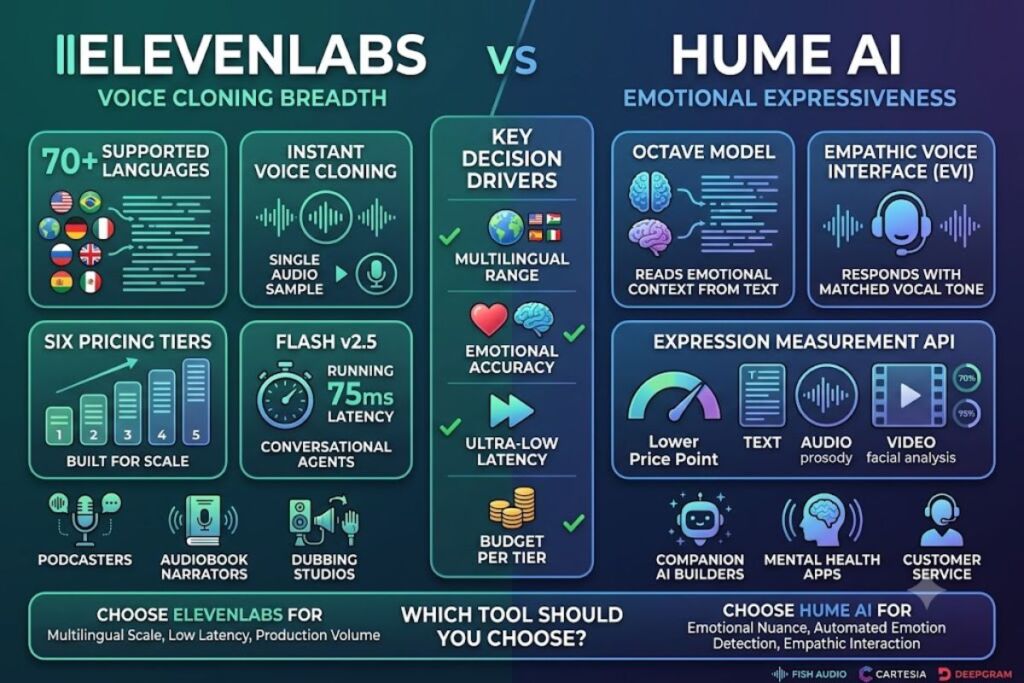
ElevenLabs wins on voice cloning breadth: 70+ supported languages, instant cloning from a single audio sample, and six pricing tiers built for scale. Hume AI wins on emotional expressiveness: its Octave model reads emotional context directly from text and its Empathic Voice Interface (EVI) responds with matched vocal tone.
What Is ElevenLabs?
ElevenLabs is an AI voice synthesis platform that converts text into natural-sounding speech and clones human voices from short audio samples. The company operates six pricing tiers, an API split from its standard UI plans, and a credit system tied to character counts.
Founded in 2022, ElevenLabs built its reputation on the Multilingual v2 and Eleven v3 text-to-speech models. <cite index=”17-1″>Eleven v3 covers more than 70 languages with expressive audio tags, and the Flash v2.5 model hits roughly 75 milliseconds of latency for conversational voice agents.</cite> ElevenLabs targets podcasters, audiobook narrators, dubbing studios, and developers building voice agents through its API.
| Attribute | Value |
|---|---|
| Company | ElevenLabs Inc. |
| Release Year | 2022 |
| Pricing | $0–$1,320/month (self-serve), custom Enterprise above |
| Platforms | Web app, API, mobile SDKs |
| Key Feature | Instant voice cloning + 70+ language TTS |
What Is Hume AI?
Hume AI is an emotional AI platform that generates speech aware of emotional context and measures emotional expression in text, audio, and video. The platform runs on two products: Octave, a speech-language model, and the Empathic Voice Interface (EVI), a real-time conversational voice engine.
Hume AI separates its offering into generative audio and expression measurement. <cite index=”12-1″>Octave understands both language and meaning, and it grasps context, emotion, and instructions when generating speech, while EVI captures detailed conversation histories that let developers analyze past interactions.</cite> Hume AI targets companion AI builders, mental health app developers, and customer service teams that need emotionally calibrated voice output.
| Attribute | Value |
|---|---|
| Company | Hume AI, Inc. |
| Release Year | 2021 |
| Pricing | $0–$500/month (self-serve), custom Enterprise above |
| Platforms | Web app, API |
| Key Feature | Emotion-aware TTS (Octave) + Expression Measurement API |
How Do ElevenLabs and Hume AI Pricing Plans Compare?
ElevenLabs costs more at every comparable tier: its Business plan runs $1,320/month against Hume AI’s $500/month Business plan. Both platforms use credit-based or character-based billing with overage rates that drop at higher tiers.
<cite index=”9-1″>ElevenLabs Free delivers approximately 10 minutes of audio monthly. Starter at $5/month provides approximately 30 minutes, Creator at $22/month provides approximately 100 minutes plus voice cloning, Pro at $99/month provides approximately 500 minutes, and Scale at $330/month targets high-volume production, with real cost per minute ranging from $0.10 on Scale to $0.50 on Starter.</cite>
<cite index=”12-1″>Hume AI’s Starter plan at $3/month includes 30 to 60 minutes of text-to-speech generation, 15 requests per minute, and 40 minutes of EVI use, restricted to voice creation only. The Creator plan at $14/month includes 140 to 280 minutes of TTS duration, 75 requests per minute, 1,000 projects, and 200 minutes of EVI use. The Pro plan at $70/month includes 1,000 to 2,000 minutes of TTS duration and 5,000 minutes of EVI use. The Scale plan at $200/month includes 3,300 to 6,600 minutes of TTS time and 10,000 projects.</cite>
| Tier | ElevenLabs | Hume AI |
|---|---|---|
| Free | $0 — 10 credits/10 min | $0 — 10,000 characters, 5 EVI min |
| Entry paid | $5 (Starter) — 30 min | $3 (Starter) — 30–60 min |
| Mid tier | $22 (Creator) — 100 min + cloning | $14 (Creator) — 140–280 min, unlimited cloning |
| Business use | $99 (Pro) — 500 min | $70 (Pro) — 1,000–2,000 min |
| High volume | $330 (Scale) | $200 (Scale) |
| Top self-serve | $1,320 (Business) | $500 (Business) |
| Enterprise | Custom | Custom |
How Do ElevenLabs and Hume AI Differ in Voice Cloning?
ElevenLabs supports broader cloning infrastructure: Professional Voice Cloning (PVC) at 192 kbps output, instant cloning from a single sample, and cloned voices deployable across 70+ languages. Hume AI restricts unlimited voice cloning to paid tiers but does not publish comparable multi-language cloning coverage.
<cite index=”4-1″>ElevenLabs’ Creator plan includes Professional Voice Cloning for higher-quality custom voices and 192 kbps audio output, targeting podcasters, audiobook narrators, and content creators who need premium voice quality.</cite> Hume AI’s Free plan, by contrast, <cite index=”10-1″>already permits unlimited voice cloning at zero cost, a feature most competing tools lock behind paid tiers, though the Free plan carries no commercial license and stops output entirely once the character cap is reached.</cite>
ElevenLabs’ cloning breadth extends into dubbing and multilingual deployment; Hume AI’s cloning depth stays tied to its emotional-generation pipeline rather than raw language coverage.
How Do ElevenLabs and Hume AI Differ in Emotional Expressiveness?
Hume AI reads and generates emotional context natively through Octave and EVI, while ElevenLabs adds emotion through manually inserted audio tags rather than automatic emotional inference. Hume AI additionally ships a dedicated Expression Measurement API that ElevenLabs does not offer.
<cite index=”16-1″>Hume’s Expression Measurement API prices video-with-audio analysis at $0.0828 per minute, audio-only prosody and vocal-burst analysis at $0.0639 per minute, video-only facial analysis at $0.045 per minute, image facial analysis at $0.00204 per image, and text-only emotional-language analysis at $0.00024 per word.</cite> No equivalent measurement product exists in ElevenLabs’ catalog; ElevenLabs users control emotional tone through inline tags for laughter, whispers, and sighs rather than automated detection.
What Are the Pros and Cons of ElevenLabs?
ElevenLabs delivers the most natural-sounding voice output on the market alongside the widest language coverage, but its per-minute costs run higher than Hume AI at every matching tier.
- Generates speech across 70+ languages using Eleven v3
- Clones a voice from a single short audio sample
- Reaches approximately 75 millisecond latency on Flash v2.5 for real-time agents
- Charges up to $1,320/month for the Business self-serve tier, 2.6x Hume AI’s equivalent tier
- Splits UI and API plans separately, adding billing complexity
- Omits a dedicated emotion-measurement product
What Are the Pros and Cons of Hume AI?
Hume AI generates emotionally calibrated speech and measures emotion across text, audio, video, and images, but its language coverage and cloning documentation stay narrower than ElevenLabs’.
- Detects emotion through Octave during speech generation, not through manual tags
- Offers unlimited voice cloning starting on the Free plan
- Provides a standalone Expression Measurement API across five input types
- Prices its Business tier at $500/month, below ElevenLabs’ Business tier
- Publishes narrower language-coverage documentation than ElevenLabs’ 70+ language claim
- Restricts commercial usage until a paid plan begins
Which Tool Should You Choose: ElevenLabs or Hume AI?
Choose ElevenLabs when multilingual cloning breadth and low-latency voice agents matter more than automated emotional inference. Choose Hume AI when emotional accuracy and built-in emotion measurement matter more than raw language count.
Choose ElevenLabs if:
- Deploy voice content across 70+ languages from one cloned voice
- Build real-time voice agents that need approximately 75ms latency
- Produce audiobooks, dubbing, or podcast narration at high monthly volume
- Require enterprise compliance packages like HIPAA/BAA on custom contracts
Choose Hume AI if:
- Build companion AI, mental health apps, or empathic customer service tools
- Need automated emotion detection in generated speech, not manual tags
- Analyze user emotion from text, audio, video, or images via API
- Operate on a lower monthly budget across comparable usage tiers
What Are the Best Alternatives to ElevenLabs and Hume AI?
Three platforms compete directly with ElevenLabs and Hume AI on voice generation and conversational AI: Fish Audio, Cartesia, and Deepgram.
- Fish Audio delivers comparable voice quality to ElevenLabs at a lower price point, targeting high-volume users who do not need emotion-specific features.
- Cartesia runs the Sonic-3.5 TTS and Ink-2 STT model pair for real-time voice agents, with Line minutes billed starting at $0.06 per minute.
- Deepgram operates a speech AI API platform covering speech-to-text, text-to-speech, and audio intelligence on usage-based pricing with a starting credit allocation.
Frequently Asked Questions
Is ElevenLabs or Hume AI cheaper?
Hume AI costs less at every matching tier. Its Business plan runs $500/month against ElevenLabs’ $1,320/month Business plan.
Does Hume AI clone voices as well as ElevenLabs?
Hume AI offers unlimited voice cloning starting on its Free plan, but ElevenLabs documents broader multi-language cloning deployment across 70+ languages.
Which tool detects emotion automatically?
Hume AI detects emotion automatically through its Octave model and Expression Measurement API. ElevenLabs requires manually inserted audio tags to signal emotional tone.
Can I use either tool for real-time voice agents?
Yes. ElevenLabs’ Flash v2.5 model targets approximately 75ms latency for real-time agents, and Hume AI’s EVI handles real-time conversational speech-to-speech interaction.
ElevenLabs charges more per tier and covers more languages; Hume AI charges less per tier and detects emotion natively — the choice comes down to whether the deployment needs multilingual cloning scale or built-in emotional accuracy.