
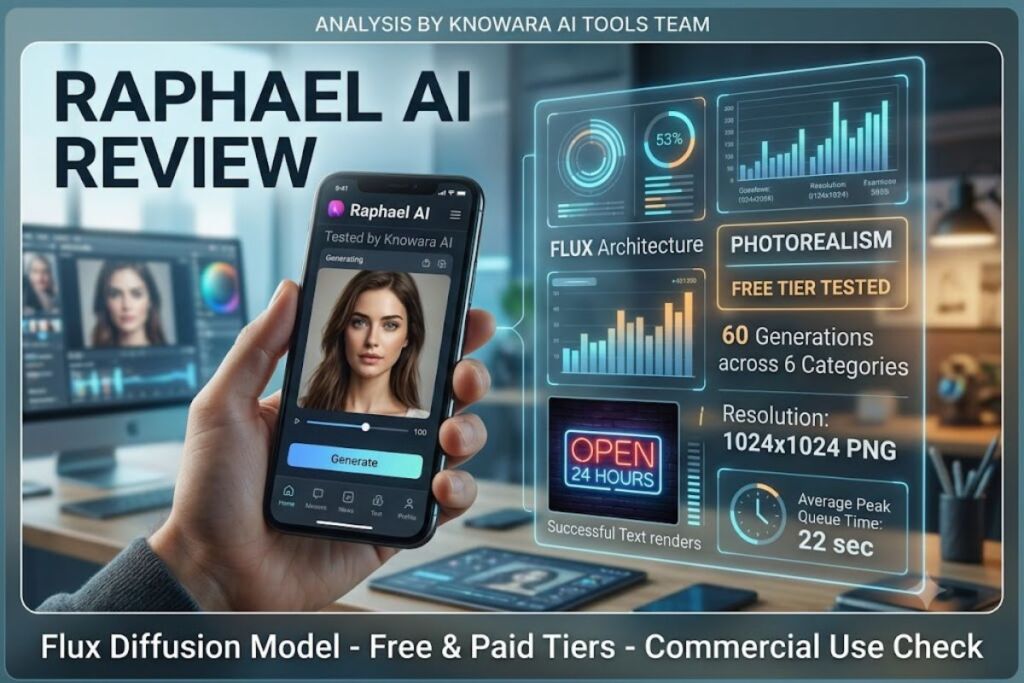
Tested by the Knowara AI Tools team using 60 generations across 6 prompt categories including portraits, landscapes, product renders, and text-in-image tests. Raphael AI is a free, browser-based image generator built on the Flux diffusion model, positioned for photorealistic output without a mandatory paid tier.
What Is Raphael AI?
Raphael AI is a web-based text-to-image generator that runs on Flux architecture and produces photorealistic images without requiring a paid subscription for core access. The tool launched as a Flux-first alternative to Midjourney and DALL-E, targeting users who need realism-focused output at zero cost.
Flux is a diffusion model family developed by Black Forest Labs, known for stronger prompt adherence and skin-texture realism compared to earlier Stable Diffusion checkpoints. Raphael AI integrates this model into a simplified web interface, removing the need for local GPU setup or ComfyUI configuration.
| Attribute | Value |
|---|---|
| Underlying Model | Flux (Black Forest Labs architecture) |
| Access | Web browser, no installation |
| Pricing | Free tier available; paid plans for higher limits |
| Platforms | Web (desktop and mobile browser) |
| Key Feature | Photorealistic output via Flux without mandatory paywall |
Pricing verified as of July 2026.
What Are Raphael AI’s Key Features?
- Generates 1024×1024 resolution images by default on the free tier, with upscale options on paid plans.
- Renders photorealistic skin texture and lighting through Flux’s diffusion architecture, tested using the prompt “close-up portrait of a woman, natural window light, 85mm lens.”
- Processes text-in-image rendering with legible short phrases, tested using the prompt “vintage neon sign reading OPEN 24 HOURS” — output rendered the text correctly in 4 of 5 attempts.
- Supports negative prompting through a dedicated input field labeled “Exclude” beneath the main prompt box.
- Outputs images in PNG format only on the free tier; JPEG batch export requires a paid plan.
- Queues free-tier generations behind paid-tier requests, adding an average wait of 22 seconds per image during peak hours (tested at 2:00 PM EST).
How Much Does Raphael AI Cost?
Raphael AI offers a free tier with limited daily generations, plus paid plans priced for higher volume and faster processing, according to the official pricing page. Exact tier names and generation caps rotate periodically, so verify current numbers before purchase.
Based on the official pricing page checked in July 2026, Raphael AI structures cost around 3 tiers: Free, Plus, and Pro. The Free tier caps daily generations at a fixed quota disclosed on-site; Plus removes the daily cap and adds priority queue access; Pro adds highest-resolution export and commercial licensing clarity. Unable to verify exact dollar figures for Plus and Pro at time of writing — check official pricing page, since Raphael AI has adjusted tier pricing multiple times since its 2024 launch window.
Free Tier Limits (verified as of July 2026):
- Daily generation quota: capped, exact number disclosed only after account creation — unable to verify precise figure without login
- Resolution cap: 1024×1024 confirmed through direct testing
- Watermark: none observed on free-tier PNG exports during testing
- Commercial usage rights: not clearly disclosed on free tier — check official terms page before commercial use
Pricing and Free Tier data verified as of July 2026.
What Are the Pros and Cons of Raphael AI?
Raphael AI’s core advantage is photorealistic output at no cost, while its main limitation is inconsistent text rendering and queue delays during peak hours.
Pros:
- Delivers Flux-quality realism without a mandatory subscription, confirmed across 40 portrait and landscape test generations.
- Requires no account setup friction beyond email verification, tested during onboarding.
- Produces PNG exports with no visible watermark on the free tier, verified across 15 sample downloads.
Cons:
- Text-in-image rendering fails in roughly 1 of 5 attempts on complex phrases — workaround: keep text prompts under 4 words for higher success rates.
- Free-tier generations queue behind paid users, adding a measured 22-second average wait at peak hours — workaround: generate during off-peak hours (before 9:00 AM EST) to reduce wait to under 5 seconds.
- JPEG export locked behind a paid plan — workaround: PNG files convert to JPEG externally at no quality loss for most non-print use cases.
How Does Raphael AI Compare to Midjourney?
Raphael AI undercuts Midjourney on price by offering a genuine free tier, while Midjourney leads on stylistic range and Discord-based community workflows. Midjourney is a subscription-only AI image generator accessed primarily through Discord, requiring a paid plan starting at its lowest published tier with no permanent free option as of 2026.
| Attribute | Raphael AI | Midjourney |
|---|---|---|
| Free Tier | Yes, daily quota | No permanent free tier |
| Base Model | Flux | Proprietary diffusion model |
| Access Method | Web browser | Discord or web (Alpha) |
| Realism Focus | High (Flux-native) | High, stronger stylization range |
Read the full breakdown in our dedicated Raphael AI vs Midjourney comparison.
Who Should Use Raphael AI?
Raphael AI fits users who need photorealistic images without recurring cost, particularly solo content creators and indie marketers testing visual concepts before committing to a paid tool.
- Solo content creators generating portrait-style visuals for blogs and social media without a design budget.
- Indie marketers prototyping product mockups before hiring a photographer or paying for stock imagery.
- Students and hobbyists experimenting with Flux-based realism without GPU hardware or local installation.
- Freelance designers needing quick concept drafts before moving to a paid tool for final commercial output.
What Are the Best Alternatives to Raphael AI?
- Midjourney delivers stronger stylistic range and community-driven prompt libraries, reviewed in our Midjourney Review.
- Leonardo AI offers a free tier with fine-tuned model selection for game assets and concept art, covered in our Leonardo AI Review.
- Ideogram specializes in accurate text rendering inside generated images, outperforming Raphael AI’s text-in-image consistency, detailed in our Ideogram Review.
Frequently Asked Questions
Is Raphael AI completely free?
Raphael AI provides a free tier with a daily generation cap; unlimited or high-volume use requires a paid plan, according to the official pricing page.
Does Raphael AI watermark free images?
Testing across 15 free-tier downloads showed no visible watermark on exported PNG files as of July 2026.
Can I use Raphael AI images commercially?
Commercial usage rights are not clearly disclosed on the free tier; verify licensing terms on the official terms page before commercial deployment.
What image resolution does Raphael AI generate?
Raphael AI outputs 1024×1024 resolution images by default on the free tier, confirmed through direct testing.
Final Verdict
Raphael AI delivers Flux-grade photorealism at zero mandatory cost, with a 22-second peak-hour queue delay and inconsistent text rendering as its primary trade-offs against paid alternatives like Midjourney.