
⏱ 8 Reading Time
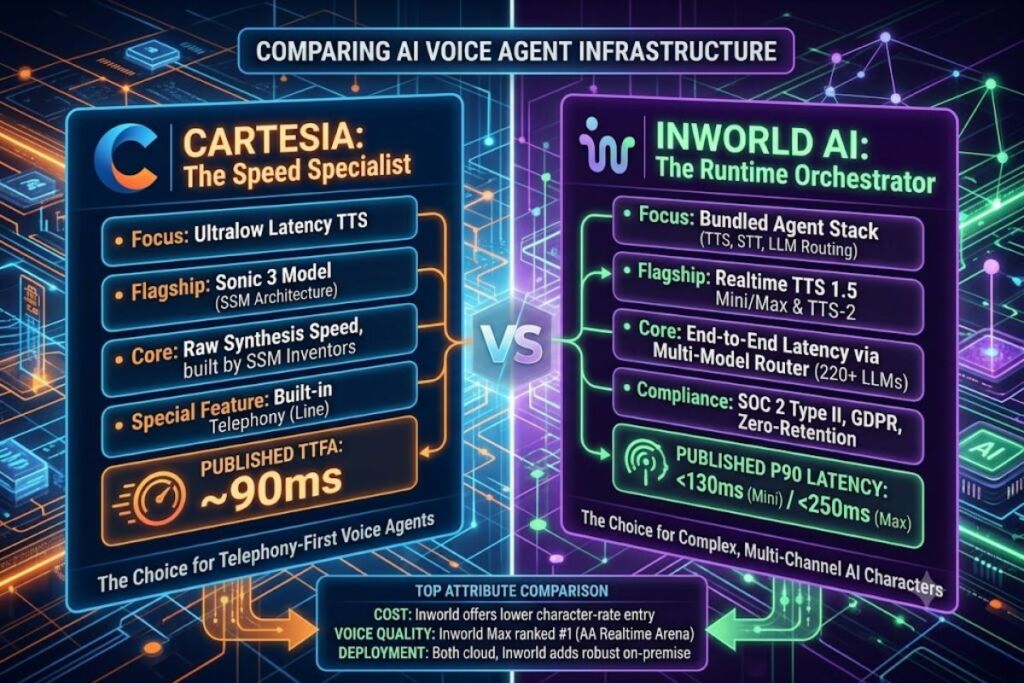
Cartesia and Inworld AI both build real-time voice infrastructure for AI agents, but they solve latency differently. Cartesia wins on raw synthesis speed with its Sonic model, while Inworld wins on end-to-end agent latency by bundling TTS, STT, and LLM routing into one runtime.
Both companies target the same buyer: engineering teams shipping voice agents, phone bots, and interactive AI characters where every 100 milliseconds of delay costs conversions. This comparison tests both platforms against their published latency benchmarks, independent third-party data, and current pricing, then states which platform fits which build.
What Are Cartesia and Inworld AI?
Cartesia is a state-space-model voice API built around the Sonic TTS engine; Inworld AI is a full real-time agent runtime that bundles TTS, STT, and LLM routing into a single WebSocket connection. The two companies compete for the same voice-agent budget but ship different products.
Cartesia AI launched in September 2023 in San Francisco, founded by Karan Goel, Albert Gu, Brandon Yang, and Arjun Desai — four Stanford AI Lab researchers who worked under professor Christopher Ré. The founding team invented State Space Models (SSMs), a sequence-processing architecture that replaces the transformer’s attention mechanism with a more compute-efficient recurrence. Cartesia productized that research as Sonic, its flagship text-to-speech model, and later added Ink (streaming speech-to-text) and Line (a voice-agent and telephony layer).
Inworld AI launched in 2021 in Mountain View, California, founded by Ilya Gelfenbeyn, Kylan Gibbs, and Michael Ermolenko — the team that built API.ai, the conversational AI platform Google acquired and rebranded as Dialogflow. Inworld started in AI-powered game characters for studios including Xbox, NVIDIA, and Ubisoft, then expanded into a general-purpose Agent Runtime: a model-agnostic layer that routes requests across 220+ LLMs, runs its own Realtime TTS and STT models, and orchestrates the full voice pipeline through one API call.
| Attribute | Cartesia | Inworld AI |
|---|---|---|
| Company | Cartesia AI, San Francisco, CA | Inworld AI, Mountain View, CA |
| Founded | 2023 | 2021 |
| Core Architecture | State Space Models (SSM) | Transformer-based models + multi-LLM router |
| Flagship Product | Sonic 3 (TTS), Ink (STT), Line (voice agents) | Realtime TTS (1.5 Mini/Max, TTS-2), STT, Agent Runtime |
| Published TTFA | ~90ms (Sonic 3, official figure) | <130ms P90 (Mini), <250ms P90 (Max) |
| Entry Pricing | Free tier: 20,000 credits/month | Realtime TTS 1.5 Mini: $5 per 1M characters |
| Top Pricing Tier | Scale: $239–$299/month, 8M credits | Enterprise: custom, volume-discounted |
| Deployment | Cloud API, WebSocket streaming | Cloud API, WebSocket, on-premise available |
Which Platform Has Lower Latency?
Cartesia’s Sonic 3 publishes a 90ms time-to-first-audio figure; Inworld’s Realtime TTS 1.5 Mini publishes sub-130ms P90 latency. Independent production benchmarks show Cartesia’s real-world median latency closer to 188ms.
Cartesia’s published 90ms figure reflects an isolated, best-case synthesis measurement. The Coval production benchmark, captured May 4, 2026, tested Sonic 3 under realistic load and recorded a P50 (median) time-to-first-audio of 188ms, with an interquartile range of 100ms — meaning tail latency swings widely between calls. That IQR is roughly 50 times wider than the tightest competitor tested in the same benchmark set, which signals inconsistent performance once concurrent connections stack up. Inworld was not included in that specific Coval benchmark round, so a direct same-benchmark comparison isn’t available. Inworld’s own published figures put Realtime TTS 1.5 Mini under 130ms at the 90th percentile and Realtime TTS 1.5 Max under 250ms P90, measured for stability under the higher-quality model.
On raw model-level speed, Cartesia’s architecture edges ahead. On measured production consistency, Inworld’s published P90 numbers and Cartesia’s Coval P50 sit in a comparable range, but neither vendor’s number is directly interchangeable with the other’s testing methodology. Teams building latency-critical agents need to run their own load tests against both APIs before committing.
How Do Cartesia and Inworld AI Compare on Features?
Cartesia specializes in text-to-speech and telephony; Inworld ships a complete agent stack that adds LLM routing and orchestration on top of its own voice models. The feature sets overlap on core TTS but diverge sharply on scope.
| Feature | Cartesia | Inworld AI |
|---|---|---|
| TTS models | Sonic 3, Sonic Turbo, Sonic 2 | Realtime TTS 1.5 Mini, 1.5 Max, TTS-2 (preview) |
| STT model | Ink (streaming, per-second billing) | Realtime STT with speaker profiling |
| LLM routing | Not included natively | Router across 220+ LLMs, single API call |
| Voice cloning | Instant Voice Cloning (Pro tier+), Pro Voice Cloning (Startup tier+) | Instant voice cloning from 5–15 seconds of audio |
| Language coverage | 15+ languages | 15 GA languages, 90+ experimental (TTS-2) |
| Telephony | Line: built-in phone-number provisioning | Requires third-party telephony integration (Twilio, Telnyx) |
| Emotion/style control | Manual pitch, speed, and emotion tuning | Natural-language steering across 8 dimensions (TTS-2) |
| On-premise deployment | Enterprise tier only | Available, including zero-retention mode |
| Compliance | Enterprise: custom SLAs, no published SOC 2/HIPAA on lower tiers | SOC 2 Type II, GDPR, zero-retention mode standard |
| Artificial Analysis rank | Sonic 3: ELO 1,070 (rank #25) | Realtime TTS 1.5 Max: ELO 1,208 (top-ranked realtime TTS) |
Cartesia builds a narrower, deeper product: Sonic handles synthesis, Ink handles transcription, and Line stitches both into a phone-ready voice agent with direct number provisioning. Inworld positions its Agent Runtime as the orchestration layer above the model — developers route conversation logic through 220+ third-party and Inworld-hosted LLMs from one WebSocket connection, which removes the need to separately manage an LLM provider, an STT vendor, and a TTS vendor.
How Much Do Cartesia and Inworld AI Cost?
Cartesia charges 1 credit per character across five tiers, from a free 20,000-credit plan to a $239–$299/month Scale plan with 8 million credits. Inworld charges per million characters, starting at $5 for Realtime TTS 1.5 Mini and $10 for TTS-2 at scale.
According to Cartesia’s official pricing page, the Free tier includes 20,000 model credits per month plus $1 of voice-agent usage, restricted to personal and non-commercial use. The Pro tier unlocks commercial use and Instant Voice Cloning. The Startup tier adds Pro Voice Cloning and roughly 1.25 million credits per month on annual billing. The Scale tier provides 8 million credits per month for $239/month billed annually (or $299/month billed monthly) and drops the Line telephony rate from $0.06 per minute to $0.014 per minute. Enterprise pricing is custom and adds dedicated infrastructure, uptime SLAs, and compliance documentation.
Inworld’s official TTS pricing page lists Realtime TTS 1.5 Mini at $5 per 1 million characters (about $0.005 per minute of audio) and Realtime TTS-2 and 1.5 Max at $10 per 1 million characters at scale (about $0.01 per minute). Rates drop as monthly spend increases, and TTS usage counts toward one combined commit alongside the Router, STT, and compute costs — a structure that rewards teams consolidating their full voice-agent stack inside Inworld rather than mixing vendors.
At equivalent volume, Inworld’s per-character rate on Realtime TTS 1.5 Mini undercuts Cartesia’s blended credit rate on the Startup and Scale tiers. Cartesia’s Line product adds telephony minutes as a separate line item; Inworld requires a third-party telephony provider layered on top of its own per-character and per-minute charges.
Choose Cartesia If
- Build a phone-based voice agent that needs built-in telephony and number provisioning through Line.
- Prioritize raw synthesis speed over bundled orchestration, and plan to manage your own LLM and STT stack separately.
- Run a state-space-model-curious engineering team that wants to work with the architecture Cartesia’s founders invented.
- Operate at moderate, predictable call volume where the Scale plan’s $239–$299/month ceiling covers usage without enterprise negotiation.
Choose Inworld AI If
- Consolidate your voice stack into one vendor covering TTS, STT, and LLM routing across 220+ models.
- Require SOC 2 Type II, GDPR, or zero-retention compliance without moving to a custom enterprise contract.
- Build companion apps or interactive characters that need natural-language emotional steering across 8 expressive dimensions.
- Need broader multilingual reach, with 90+ experimental languages available through the TTS-2 preview model.
Cartesia vs Inworld AI: The Verdict
Cartesia delivers the faster published time-to-first-audio figure and the more mature telephony product through Line. Inworld delivers a more complete agent stack, third-party-verified top-ranked voice quality on the Artificial Analysis Realtime TTS Arena, and a lower per-character price at the entry tier. Teams building a standalone, telephony-first voice agent get more value from Cartesia’s Sonic and Line combination. Teams building a multi-model, multi-channel AI agent that needs LLM routing, compliance certifications, and expressive voice control out of the box get more value from Inworld’s Agent Runtime.
For a deeper look at either platform on its own, read the full Cartesia AI Review: Pricing, Features, and Verdict and Inworld AI Review: Pricing, Features, and Verdict. For the broader category context, see Best AI Coding Tools in 2026 and Best AI Voice Agent Platforms in 2026.
Frequently Asked Questions
Is Cartesia faster than Inworld AI? Cartesia’s published Sonic 3 figure (90ms) is faster than Inworld’s published Mini figure (130ms P90) on paper. Independent production testing puts Cartesia’s real-world median latency at 188ms, a gap not yet measured against Inworld in the same benchmark.
Does Inworld AI include phone call support? Inworld’s Agent Runtime does not include native telephony. It requires a third-party provider such as Twilio or Telnyx layered on top of the Realtime API for phone-based deployment.
Which platform is cheaper for a voice agent handling 1 million characters per month? Inworld’s Realtime TTS 1.5 Mini, at $5 per 1 million characters, costs less than Cartesia’s blended credit rate on its Startup or Scale tiers for equivalent character volume.
Can Cartesia route requests across multiple LLMs like Inworld does? No. Cartesia focuses on TTS (Sonic), STT (Ink), and voice-agent telephony (Line). It does not include a built-in multi-LLM router; Inworld’s Router spans 220+ models.