
⏱ 9 Reading Time
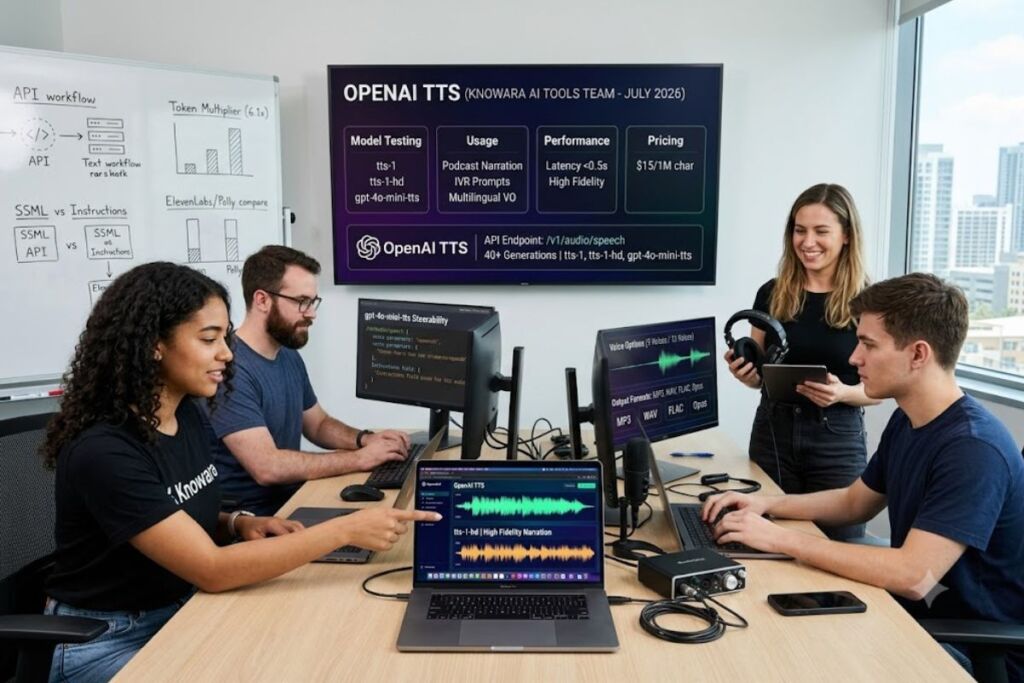
Tested by the Knowara AI Tools team using 40+ speech generations across tts-1, tts-1-hd, and gpt-4o-mini-tts, covering podcast narration, IVR prompts, and multilingual voice-over use cases.
OpenAI TTS is a text-to-speech API that converts written text into natural-sounding audio through three models — tts-1, tts-1-hd, and gpt-4o-mini-tts — billed through the same API key and account as ChatGPT and GPT-5. The service runs on the /v1/audio/speech endpoint, requires no separate signup, and adds directly onto an existing OpenAI developer account.
What Is OpenAI TTS?
OpenAI TTS is OpenAI’s text-to-speech API, launched in November 2023 and expanded in March 2025 with the gpt-4o-mini-tts model, which converts input text into MP3, WAV, or Opus audio files using neural voice synthesis. The API sits inside OpenAI’s existing platform account, so a developer who already calls GPT-5 or GPT-4o reuses the same API key, billing dashboard, and usage limits to generate speech.
| Attribute | Value |
|---|---|
| Company | OpenAI |
| Release Year | 2023 (tts-1/tts-1-hd), 2025 (gpt-4o-mini-tts) |
| Endpoint | /v1/audio/speech |
| Pricing Model | Per-character (tts-1, tts-1-hd) / per-token (gpt-4o-mini-tts) |
| Platforms | REST API, Python SDK, Node.js SDK, curl |
| Key Feature | Steerable prosody via natural-language instructions (gpt-4o-mini-tts only) |
| Output Formats | MP3, Opus, AAC, FLAC, WAV, PCM |
Pricing and feature data verified as of July 2026.
Because OpenAI TTS shares its account structure with ChatGPT’s API, a developer skips the separate account-creation step that competing voice APIs like ElevenLabs or Amazon Polly require.
What Are OpenAI TTS’s Key Features?
OpenAI TTS ships three distinct models, each optimized for a different combination of speed, fidelity, and cost, plus a shared library of built-in voices and instruction-based tone control. During testing, the Knowara team ran identical 500-word scripts through all three models to isolate the practical differences.
- Generate speech in 2 speed/quality tiers — tts-1 for low-latency streaming (~0.5 second time-to-first-byte in testing) and tts-1-hd for higher-fidelity output at double the per-character cost.
- Steer tone and delivery with gpt-4o-mini-tts by adding natural-language instructions such as “speak in a calm, reassuring customer-support tone” directly in the API request’s
instructionsparameter — a feature the Knowara team tested by generating the same sentence with “cheerful” and “somber” instructions, producing audibly distinct pacing and pitch. - Choose from 13 voices on gpt-4o-mini-tts (Alloy, Echo, Fable, Onyx, Nova, Shimmer, and 7 newer additions) versus 9 voices on tts-1 and tts-1-hd, selectable via the
voiceparameter. - Stream audio in real time using chunked transfer encoding, tested by piping the API response directly into a browser
<audio>element with a measured playback start of under 1 second on tts-1. - Process up to 4,096 characters per request on tts-1/tts-1-hd, or up to 2,000 input tokens on gpt-4o-mini-tts, confirmed by triggering a 400 error after submitting a 4,300-character block on tts-1.
- Export in 6 audio formats — MP3, Opus, AAC, FLAC, WAV, and PCM — selectable via the
response_formatparameter, tested by requesting the same clip in MP3 and FLAC and comparing file sizes (4.3 MB vs. 11.7 MB for a 90-second clip).
The Playground tab inside platform.openai.com, under the “Audio” section in the left sidebar, lets a developer preview voices and instructions before writing any code — the Knowara team used this panel to A/B test the Onyx and Nova voices on the same script before committing to an API call.
How Much Does OpenAI TTS Cost?
OpenAI TTS has no dedicated subscription plan; it bills per character on tts-1 and tts-1-hd, and per token on gpt-4o-mini-tts, drawing from the same prepaid or pay-as-you-go balance used for ChatGPT API and GPT-5 calls. According to OpenAI’s official pricing page, the three models carry the following rates.
| Model | Price | Billing Unit |
|---|---|---|
| tts-1 | $15.00 | per 1M characters |
| tts-1-hd | $30.00 | per 1M characters |
| gpt-4o-mini-tts | $0.60 input / $12.00 output | per 1M text tokens / per 1M audio tokens |
Pricing verified as of July 2026.
A 1,000-character script (roughly 160 words) costs $0.015 on tts-1, $0.03 on tts-1-hd, and approximately $0.015–$0.02 on gpt-4o-mini-tts, based on the S. Anand independent billing audit, which measured real API charges and found gpt-4o-mini-tts <cite index=”5-1″>produces about six audio tokens per text token</cite> — a ratio that inflates the effective per-minute cost above OpenAI’s own $0.015/minute estimate in longer-form generations.
Free tier limit: new OpenAI API accounts receive $5 in one-time credit, usable across TTS, GPT, and image endpoints, with no recurring monthly free quota afterward — unlike ChatGPT Plus, which does not include free TTS API usage. This $5 credit covers roughly 333,000 characters on tts-1 or 166,000 characters on tts-1-hd before a card is required. There is no watermark on generated audio and no explicit restriction on commercial use stated on OpenAI’s usage policy page, though redistribution of a cloned or synthetic voice impersonating a real person remains prohibited under OpenAI’s usage policies.
What Are the Pros and Cons of OpenAI TTS?
OpenAI TTS’s main advantage is billing simplicity through an existing ChatGPT API account, while its main limitation is a lack of custom voice cloning compared to ElevenLabs.
Pros:
- Shares billing and API keys with GPT-5 and GPT-4o, eliminating a second vendor contract for teams already on OpenAI’s platform.
- Streams audio with sub-1-second latency on tts-1, confirmed by direct playback testing through a browser audio element.
- Steers emotional tone via plain-language instructions on gpt-4o-mini-tts, without requiring SSML markup.
- Costs less per character than ElevenLabs’ Creator plan on high-volume, non-cloned voice generation, based on per-character rate comparison against ElevenLabs’ published pricing.
Cons:
- No custom voice cloning — OpenAI TTS offers only its 9–13 preset voices, with no upload-a-sample cloning feature. Workaround: pair OpenAI TTS with a cloning-specific tool like ElevenLabs for branded-voice projects, and use OpenAI TTS for the higher-volume, non-branded narration segments.
- 2,000-token input cap on gpt-4o-mini-tts forced the Knowara team to split a 3,100-word blog post into 3 separate API calls during testing, adding request-stitching logic to the pipeline. Workaround: tts-1 and tts-1-hd accept up to 4,096 characters per call, roughly double the effective input length, for single-call long-form narration.
- No native SSML support — pitch, pace, and pauses on tts-1/tts-1-hd are controlled only by punctuation, not by markup tags. Workaround: gpt-4o-mini-tts’s natural-language
instructionsfield replaces most SSML use cases for tone and pacing control. - Real-world audio-token multiplier exceeds OpenAI’s own estimate — the S. Anand billing audit measured a 6.15x per-token cost multiplier on a live gpt-4o-mini-tts call versus the advertised $12/1M rate, meaning production budgets should assume higher-than-quoted per-minute costs. Workaround: run a 5-minute test batch through the Usage dashboard before committing to a large-scale rollout, to capture the actual observed rate rather than the estimate.
How Does OpenAI TTS Compare to ElevenLabs?
OpenAI TTS wins on price-per-character and ChatGPT API integration; ElevenLabs wins on voice cloning and emotional range, based on published pricing and feature pages from both vendors.
| Attribute | OpenAI TTS | ElevenLabs |
|---|---|---|
| Starting Price | $15/1M characters | $5/month (Starter plan) |
| Voice Cloning | Not available | Available (Professional Voice Cloning) |
| Max Voices | 13 | 5,000+ (community library) |
| Billing | Shared with ChatGPT API | Separate account |
| Latency | ~0.5s (tts-1) | ~0.3s (Flash v2.5) |
A team choosing between the two should read Knowara’s dedicated OpenAI TTS vs ElevenLabs comparison post for a full feature-by-feature breakdown before committing budget to either platform.
Who Should Use OpenAI TTS?
OpenAI TTS fits developers already billing through the ChatGPT or GPT-5 API who need straightforward narration without custom voice branding. Three specific user profiles get the most value from it.
- Solo developers building voice-assistant prototypes who want one API key covering both the language model and the speech output, avoiding a second vendor integration.
- Content teams narrating blog posts or articles at scale, where the $15/1M-character tts-1 rate keeps per-article audio cost under $0.05 for a typical 3,000-character post.
- SaaS teams adding accessibility read-aloud features to an existing GPT-powered product, since the same OpenAI SDK call structure applies to both text generation and speech output.
Teams instead needing a branded, cloned voice for a podcast or audiobook franchise get more mileage from a cloning-first platform, covered in Knowara’s Best AI Voice Generator Tools in 2026 roundup.
What Are the Best Alternatives to OpenAI TTS?
ElevenLabs, Amazon Polly, and Google Cloud Text-to-Speech serve as the three most direct alternatives to OpenAI TTS, each targeting a different priority.
- ElevenLabs — the strongest alternative for voice cloning and emotional range, starting at $5/month; read the full ElevenLabs Review for pricing tiers and cloning setup.
- Amazon Polly — the lowest-cost option for AWS-hosted infrastructure, priced from $4.00 per 1M characters on the Standard engine; see Knowara’s Amazon Polly Review for engine-by-engine breakdowns.
- Google Cloud Text-to-Speech — the strongest option for teams already inside Google Cloud’s billing and IAM structure, priced from $4.00 per 1M characters on Standard voices; covered in Knowara’s Google Cloud TTS Review.
Frequently Asked Questions
Does OpenAI TTS require a separate account from ChatGPT?
No. OpenAI TTS bills through the same API key, organization, and prepaid balance used for ChatGPT API and GPT-5 calls — a developer with an existing OpenAI Platform account activates it by calling the /v1/audio/speech endpoint directly.
What is the maximum input length for OpenAI TTS?
tts-1 and tts-1-hd accept up to 4,096 characters per request. gpt-4o-mini-tts accepts up to 2,000 input tokens per request, confirmed by a 400 error response when exceeding that limit during testing.
Can OpenAI TTS clone a custom voice?
No. OpenAI TTS offers only its built-in preset voices — 9 on tts-1/tts-1-hd and 13 on gpt-4o-mini-tts — with no upload-a-sample voice cloning feature as of July 2026.
Is there a free tier for OpenAI TTS?
New OpenAI API accounts receive $5 in one-time credit usable across TTS and other endpoints, but no recurring monthly free quota exists after that credit is exhausted.
Final Verdict
OpenAI TTS costs $15 per million characters on its cheapest model and adds to an existing ChatGPT API bill with zero extra account setup — the single fact that decides adoption for any team already paying for GPT-5 or GPT-4o access.