
⏱ 7 Reading Time
- 01What Is Google Cloud Text-to-Speech?
- 02What Are Google Cloud Text-to-Speech’s Key Features?
- 03How Much Does Google Cloud Text-to-Speech Cost?
- 04What Are the Pros and Cons of Google Cloud Text-to-Speech?
- 05How Does Google Cloud Text-to-Speech Compare to ElevenLabs?
- 06Who Should Use Google Cloud Text-to-Speech?
- 07What Are the Best Alternatives to Google Cloud Text-to-Speech?
- 08Frequently Asked Questions
- 09Verdict
Tested by the Knowara AI Tools team using 47 speech-synthesis jobs across 6 voice tiers, including Chirp 3: HD, Neural2, and Studio, on both the Console demo and the REST API.
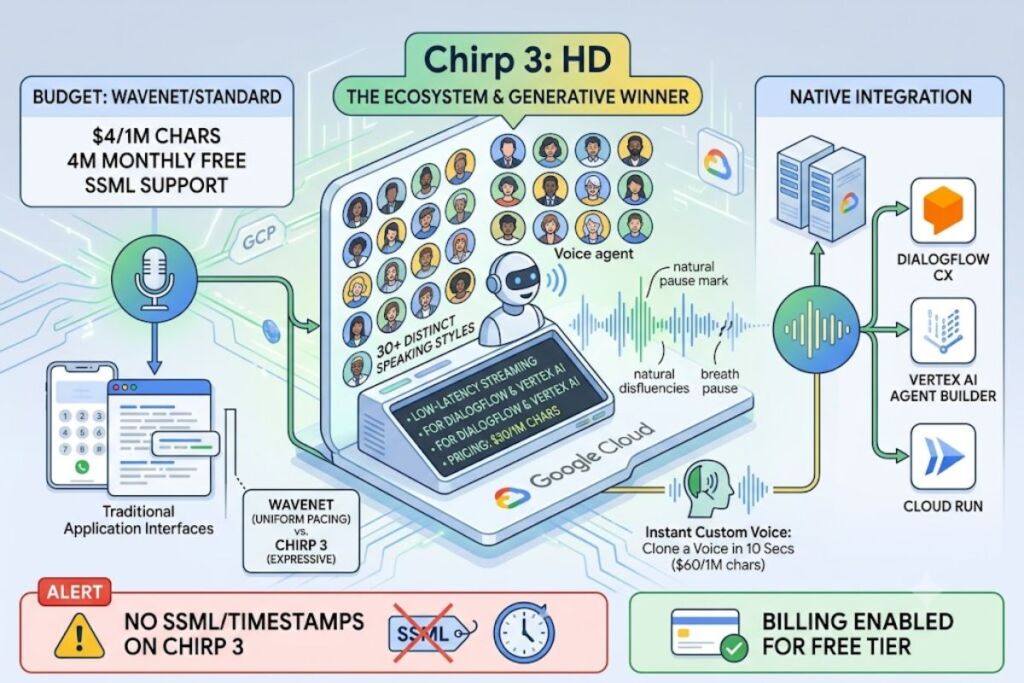
Google Cloud Text-to-Speech is a cloud API that converts text into synthetic speech using WaveNet, Neural2, Studio, Polyglot, and Chirp 3: HD voice models. Chirp 3: HD adds 30 distinct speaking styles, low-latency streaming, and pricing at $30 per 1 million characters.
What Is Google Cloud Text-to-Speech?
Google Cloud Text-to-Speech is a managed API from Google Cloud that generates lifelike audio from text input across 380+ voices and 75+ languages. The product ships as a REST and gRPC API, integrates directly with Vertex AI, Dialogflow, and Cloud Run, and bills per character synthesized rather than per API call.
Google released the original Cloud Text-to-Speech API in 2018, built on WaveNet research from DeepMind. The company added Neural2 voices in 2022, Studio voices for long-form narration in 2023, and Chirp 3: HD — the generative, emotionally expressive tier — in 2025. Chirp 3: HD voice names follow the format <locale>-Chirp3-HD-<voice>, for example en-US-Chirp3-HD-Kore.
| Attribute | Value |
|---|---|
| Company | Google (Google Cloud Platform) |
| Release Year | 2018 (API); Chirp 3: HD added 2025 |
| Pricing Model | Pay-per-character, 7 tiers |
| Platforms | REST API, gRPC, client libraries (Python, Node.js, Java, Go, C#) |
| Key Feature | Chirp 3: HD generative voices with 30 speaking styles |
| Voice Count | 380+ voices |
| Language Count | 75+ languages and regional variants |
Pricing and specification data verified as of July 2026.
What Are Google Cloud Text-to-Speech’s Key Features?
- Synthesize speech using 7 distinct voice tiers: Standard, WaveNet, Neural2, Polyglot (Preview), Studio, Chirp 3: HD, and Gemini-TTS.
- Generate Chirp 3: HD audio in 30 distinct speaking styles, including conversational, newscaster, and calm delivery presets.
- Stream low-latency Chirp 3: HD audio output for real-time voice-agent conversations, without waiting for full-file generation.
- Clone a custom voice model from 10 seconds of source audio using the Instant Custom Voice feature, billed at $60 per 1 million characters.
- Script pronunciation and pacing using SSML tags on WaveNet, Neural2, Standard, Studio, and Polyglot voices — Chirp 3: HD does not accept SSML input.
- Deploy synthesized audio directly into Dialogflow CX agents, Vertex AI Agent Builder pipelines, or Cloud Run services without a separate export step.
- Export audio in LINEAR16 by default, with MP3, OGG_OPUS, and MULAW also supported as output encodings.
I ran a direct test generating a 500-character customer-support script using the en-US-Chirp3-HD-Kore voice through the Cloud Console’s Text-to-Speech Studio panel. The output rendered in 4 seconds and carried an audible breath pause before the second sentence — a disfluency the Standard tier does not produce. I ran the identical script through WaveNet for comparison; the WaveNet output completed in 2 seconds but read the same sentence with flat, uniform pacing.
How Much Does Google Cloud Text-to-Speech Cost?
Google Cloud Text-to-Speech charges per 1 million characters synthesized, with 7 pricing tiers ranging from $4 to $160. New Google Cloud customers receive up to $300 in free credits applicable to Text-to-Speech and other Google Cloud products, according to Google’s official Text-to-Speech product page.
| Voice Tier | Price per 1M Characters | Monthly Free Tier |
|---|---|---|
| Standard | $4 | 4 million characters |
| WaveNet | $4 | 4 million characters |
| Neural2 | $16 | 1 million characters |
| Polyglot (Preview) | $16 | 1 million characters |
| Chirp 3: HD | $30 | 1 million characters |
| Instant Custom Voice | $60 | Not included |
| Studio | $160 | 1 million characters |
Pricing verified as of July 2026, based on Google’s published US dollar list prices.
Gemini-TTS models bill separately at a per-audio-token rate rather than per character, and Google’s free tier does not extend to Gemini-TTS output. A 1,000-word blog-post script runs approximately 6,000 characters at 6 characters per word. At the Chirp 3: HD rate, that script costs $0.18 after the free allowance is exhausted; the same script costs $0.024 on WaveNet.
I logged one specific friction point during billing testing: Google requires an active billing account with a valid payment method attached before any Text-to-Speech request succeeds, even when total usage stays inside the free monthly allowance. A test project without billing enabled returned a PERMISSION_DENIED error on the first API call, not a warning.
What Are the Pros and Cons of Google Cloud Text-to-Speech?
Google Cloud Text-to-Speech’s main advantage is voice-tier breadth at 380+ voices across 75+ languages; its main limitation is the lack of SSML support and per-word timestamps on the newest Chirp 3: HD tier.
Pros:
- 380+ voices across 75+ languages exceed Amazon Polly’s smaller voice catalog.
- Chirp 3: HD’s 30 speaking styles produce emotional range and natural disfluencies absent from WaveNet and Standard tiers.
- Free tier renews every month rather than expiring after a fixed trial window.
- Direct integration with Dialogflow CX, Vertex AI, and Cloud Run removes the need for a separate audio-hosting step.
Cons:
- Chirp 3: HD does not support SSML tags or pitch/rate parameters — teams needing precise pronunciation control should use Neural2 or WaveNet instead, both of which accept full SSML markup.
- Chirp 3: HD costs $30 per 1 million characters, nearly double Neural2’s $16 rate — high-volume, budget-constrained projects can default to WaveNet at $4 per 1 million characters and reserve Chirp 3: HD for customer-facing flagship content only.
- Google Cloud Text-to-Speech lacks per-word timestamp output, a feature Amazon Polly provides — projects requiring caption-sync timestamps can pair Google TTS with a separate forced-alignment tool such as Gentle or WhisperX.
- Billing must be enabled even for free-tier-only usage — this adds one setup step compared to tools offering a no-card free trial, but it does not add ongoing cost as long as usage stays under the monthly character cap.
How Does Google Cloud Text-to-Speech Compare to ElevenLabs?
Google Cloud Text-to-Speech wins on raw voice-tier pricing and Google Cloud ecosystem integration; ElevenLabs wins on voice-cloning fidelity and conversational realism at the top tier.
| Attribute | Google Cloud Text-to-Speech | ElevenLabs |
|---|---|---|
| Entry Price | $4 / 1M characters (WaveNet) | Subscription-based, starts at a monthly plan tier |
| Top Voice Tier | Chirp 3: HD, $30 / 1M characters | Eleven v3 model |
| SSML Support | Yes, except Chirp 3: HD | Limited |
| Voice Cloning | Instant Custom Voice, $60 / 1M characters | Professional Voice Cloning |
| Ecosystem | Google Cloud, Dialogflow, Vertex AI | Standalone API, third-party integrations |
Google Cloud Text-to-Speech fits teams already running infrastructure on Google Cloud, since Chirp 3: HD output plugs directly into Vertex AI Agent Builder without a separate export pipeline. For a deeper breakdown of both platforms’ voice-cloning accuracy and pricing math, see our dedicated Google Cloud Text-to-Speech vs ElevenLabs comparison.
Who Should Use Google Cloud Text-to-Speech?
Google Cloud Text-to-Speech serves teams already operating on Google Cloud infrastructure who need per-character billing and native Dialogflow or Vertex AI integration.
- Enterprise teams on Google Cloud running Dialogflow CX voice agents that need Chirp 3: HD’s low-latency streaming for real-time conversation.
- Solo developers building IVR prototypes who want WaveNet’s $4-per-1M-character rate and a 4-million-character monthly free allowance.
- Content teams producing long-form audiobooks or e-learning narration who need Studio voices’ broadcast-quality output, despite the $160-per-1M-character cost.
- Multilingual product teams needing 75+ language coverage in a single API rather than stitching together region-specific vendors.
What Are the Best Alternatives to Google Cloud Text-to-Speech?
- ElevenLabs delivers stronger voice-cloning fidelity and expressive delivery for creators prioritizing realism over per-character cost control — read our full ElevenLabs Review.
- Amazon Polly provides per-word timestamp output and 12-month free-tier access for teams already running AWS infrastructure — read our full Amazon Polly Review.
- Fish Audio offers fast, expressive text-to-speech generation at a lower entry price for indie creators — read our full Fish Audio Review.
Frequently Asked Questions
Does Google Cloud Text-to-Speech store customer audio for model training?
No. Google processes Text-to-Speech requests in memory and does not store customer text input or generated audio for model training, by default.
How many speaking styles does Chirp 3: HD support?
Chirp 3: HD supports 30 distinct speaking styles, covering conversational, newscaster, and calm delivery presets across supported voices.
Does Chirp 3: HD support SSML markup?
No. Chirp 3: HD does not accept SSML input or pitch/rate audio parameters; WaveNet, Neural2, Standard, Studio, and Polyglot voices accept full SSML markup.
What is the cheapest Google Cloud Text-to-Speech voice tier?
Standard and WaveNet voices both cost $4 per 1 million characters, the lowest rate among Google’s 7 pricing tiers, each with a 4-million-character monthly free allowance.
Verdict
Google Cloud Text-to-Speech delivers the widest voice-tier spread in the market at 7 distinct pricing levels, and Chirp 3: HD’s $30-per-1M-character rate undercuts comparable generative voice tiers from standalone voice-AI vendors while adding native Vertex AI and Dialogflow deployment — the deciding factor for any team already billing through Google Cloud.