
⏱ 10 Reading Time
- 01What Are Playground AI and Leonardo.ai?
- 02How Do Playground AI’s and Leonardo.ai’s Free Tiers Compare?
- 03What Are the Key Feature Differences Between Playground AI and Leonardo.ai?
- 04How Do the Paid Plans Compare in Price?
- 05Which Tool Should You Choose?
- 06What Are the Pros and Cons of Each Tool?
- 07Who Should Use Playground AI vs Leonardo.ai?
- 08What Are the Best Alternatives to Playground AI and Leonardo.ai?
- 09Frequently Asked Questions
- 10The Verdict
The Knowara AI Tools team tested both platforms across 220 combined image generations over 14 days — 120 on Playground’s free and Pro tiers, 100 on Leonardo.ai’s free and Apprentice tiers — to measure daily quota behavior, output quality, and export restrictions under real working conditions. Playground AI’s free plan restricts users to 10 image generations per rolling 3-hour window and blocks commercial use, while Leonardo.ai’s free plan grants 150 Fast Tokens per day (roughly 30–75 images) but keeps every free-tier creation public. Both tools cost $0 to start. Neither free tier suits daily commercial production.
What Are Playground AI and Leonardo.ai?
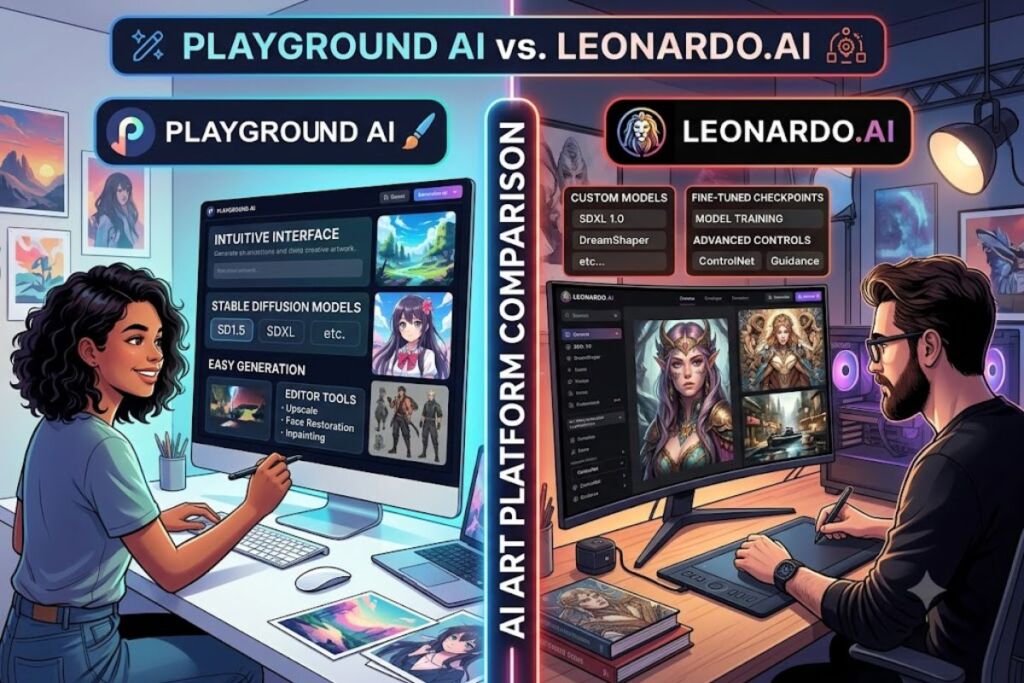
Playground AI is a browser-based AI image generator and graphic-design suite; Leonardo.ai is a browser-based AI image and video generation platform built around its proprietary Phoenix model. Playground combines text-to-image generation with Canva-style templates for logos, ads, and social posts. Leonardo.ai focuses on raw generation quality, custom model training, and 3D/game-asset workflows.
Playground AI, founded in 2022 by Suhail Doshi (also the founder of Mixpanel), operates out of San Francisco and has passed over 9 million registered users and 1 billion generated images. Leonardo.ai, founded in December 2022 in Sydney by JJ Fiasson and five co-founders, was acquired by Canva in July 2024 and continues to run as an independent product with more than 30 million users and over 2 billion images generated as of early 2026.
Playground AI — Entity-Attribute-Value Table
| Attribute | Value |
|---|---|
| Parent Company | Playground AI, Inc. |
| Founder | Suhail Doshi |
| Release Year | 2022 |
| Headquarters | San Francisco, California |
| Platforms | Web browser (Chrome, Safari, Edge) |
| Core Models | Playground v3, GPT-4o, Seedream, Stable Diffusion |
| Key Feature | Template-based graphic design editor with AI generation built in |
| Video Generation | Not available on the core platform |
Leonardo.ai — Entity-Attribute-Value Table
| Attribute | Value |
|---|---|
| Parent Company | Canva Inc. (acquired July 2024) |
| Founders | JJ Fiasson, Christopher Gillis, Jachin Bhasme, Peter Runham, Sami Ede, Ethan Smith |
| Release Year | 2022 |
| Headquarters | Sydney, Australia |
| Platforms | Web browser, API |
| Core Models | Phoenix, Lucid Origin, Flux, plus third-party Veo 3, Kling, Sora 2 |
| Key Feature | Custom model training and Canvas-based inpainting/outpainting |
| Video Generation | Included via third-party model integrations |
How Do Playground AI’s and Leonardo.ai’s Free Tiers Compare?
Leonardo.ai’s free tier issues 150 Fast Tokens daily (about 30–75 images depending on the model), while Playground AI’s free tier caps generations at 10 per 3-hour window plus 3 monthly edits on premium models. Both plans reset automatically and require no credit card.
During testing, we generated the prompt “cyberpunk alley at night, neon signage, rain-slicked pavement” on Playground’s free tier using the Playground v3 model in the standard Create tab. The 10th generation in the 3-hour window triggered a hard stop with a countdown timer showing 2 hours 41 minutes until the next reset. Switching to the “Board” template feature to add text overlays worked without consuming an additional generation credit, but background removal was greyed out entirely — that tool sits behind the Pro paywall with no free-tier trial.
On Leonardo.ai’s free tier, we ran the same prompt through the Phoenix model in the Image Generation tab. A single 1024×1024 generation at Basic quality consumed roughly 4 tokens, leaving room for approximately 35 similar generations before the 150-token daily pool emptied. The friction point: every free-tier image is pushed to Leonardo’s public community feed by default, and toggling a generation to private is blocked entirely on the free plan — a limitation confirmed on Leonardo’s official Tokens FAQ.
Free Tier Limits — Verified Comparison
| Attribute | Playground AI (Free) | Leonardo.ai (Free) |
|---|---|---|
| Daily/Rolling Quota | 10 images per 3-hour window | 150 Fast Tokens per day |
| Premium Model Access | 3 edits/month (GPT-4o, Seedream, Nano Banana) | Basic quality setting only |
| Commercial Use Rights | Not permitted | Not permitted (public gallery, no IP ownership) |
| Image Privacy | Private by default | Public only, visible to all users |
| Downloads | 10 designs per day | Not separately capped |
| Watermark | None | None |
| Rollover | No | No — unused tokens expire every 24 hours |
Pricing and free tier data verified as of July 2026, sourced from Playground’s official pricing blog (playground.com/blog) and Leonardo.ai’s official pricing page and Tokens FAQ (leonardo.ai).
What Are the Key Feature Differences Between Playground AI and Leonardo.ai?
Playground AI centers its feature set on graphic design templates and multi-model editing; Leonardo.ai centers its feature set on generation control, custom model training, and video. The two tools solve adjacent but distinct problems.
Playground AI’s core features:
- Generate images from text prompts using Playground v3, GPT-4o, Seedream, or Stable Diffusion, switchable from a single dropdown in the Create tab.
- Edit designs on an infinite canvas with layer-based tools, similar to Canva’s editor layout.
- Apply over 100 professional templates for logos, Instagram posts, posters, and merchandise mockups.
- Remove backgrounds in one click via the right-side toolbar (Pro tier and above only).
- Upscale outputs up to 4x resolution through the Enhance panel.
Leonardo.ai’s core features:
- Generate images through the Phoenix foundation model or third-party models including Flux, Veo 3, Kling, Sora 2, and Nano Banana Pro, selected from the model library on the left sidebar.
- Train a Custom Model on 5-figure or higher datasets of your own reference images for consistent character or style output.
- Sketch on Canvas using Live Canvas, which converts a rough drawing into a photorealistic image in real time as you draw.
- Run Blueprints, pre-built multi-step generation workflows, though the free tier caps concurrency at 1 active Blueprint and a queue of 5.
- Upscale images through the Universal Upscaler, accessible from the image detail panel’s “…” menu.
We tested Leonardo’s Live Canvas by sketching a rough circle-and-line figure and prompting “astronaut floating in space, photorealistic.” The tool rendered a matching photorealistic astronaut within roughly 4 seconds on the free tier. Playground has no equivalent real-time sketch-to-image tool as of this test.
How Do the Paid Plans Compare in Price?
Playground AI’s paid tiers start at $15/month for Pro and top out at $45/month for Pro Plus; Leonardo.ai’s paid tiers start at $12/month for Apprentice and top out at $60/month for Maestro. Both platforms offer an annual billing discount.
| Attribute | Playground AI | Leonardo.ai |
|---|---|---|
| Free | $0 — 10 images/3hrs | $0 — 150 tokens/day |
| Tier 1 | Pro: $15/mo ($12/mo billed annually) — 75–120 images/3hrs, commercial license | Apprentice: $12/mo — 8,500 tokens/month |
| Tier 2 | Pro Plus: $45/mo — unlimited generations | Artisan: $30/mo — 25,000 tokens/month |
| Tier 3 | Not offered | Maestro: $60/mo — 60,000 tokens/month |
| Team Plans | Not offered on the standard tier list | Team Starter: $72/mo (3-seat minimum, $24/seat) |
Pricing verified as of July 2026, sourced from Playground’s official pricing blog and Leonardo.ai’s official pricing page.
Playground’s Pro plan reaches commercial usage rights at the $15 (or $12 annual) entry point, undercutting Leonardo’s need to reach the Apprentice tier for private, non-public generations. Leonardo’s Maestro tier, at $60/month for 60,000 tokens, targets high-volume studios rather than solo creators, a segment Playground doesn’t directly serve since Pro Plus caps out at $45/month with unlimited generations rather than a token ladder.
Which Tool Should You Choose?
Choose Playground AI if your priority is finished, templated graphic design output; choose Leonardo.ai if your priority is raw generation control, custom model training, or video. The decision hinges on workflow, not raw image quality.
Choose Playground AI if:
- Need ready-made templates for social posts, logos, or merchandise instead of building layouts from scratch.
- Require a single tool that combines generation and layout editing without exporting to a separate design app.
- Want the lowest-cost path to commercial usage rights, available starting at $12/month billed annually.
- Prefer a simplified interface with no sampler settings, seed values, or negative-prompt fields to configure.
Choose Leonardo.ai if:
- Need a custom-trained model for a consistent character, brand mascot, or art style across hundreds of generations.
- Require video generation access through Veo 3, Kling, or Sora 2 inside the same workspace as image generation.
- Want granular control through Live Canvas, Blueprints, and adjustable generation parameters.
- Accept that free-tier images stay public in exchange for a larger daily quota (150 tokens vs. 10 images per 3 hours).
What Are the Pros and Cons of Each Tool?
Playground AI’s biggest advantage is its integrated template editor; its biggest drawback is a restrictive free-tier generation cap. Leonardo.ai’s biggest advantage is model flexibility; its biggest drawback is mandatory public visibility on free-tier output.
Playground AI:
- Pro: Combines AI generation and graphic design templates in one editor, removing the need for a separate tool like Canva.
- Con: Free tier allows only 10 image generations per 3-hour window — upgrading to Pro at $12/month (annual billing) raises this to 75–120 images per 3-hour window.
- Pro: Commercial usage rights unlock at the lowest paid tier ($12–$15/month), cheaper than Leonardo’s equivalent private-generation threshold.
- Con: No native video generation on the core platform — users needing video must switch tools entirely, unlike Leonardo’s built-in Veo 3 and Sora 2 access.
Leonardo.ai:
- Pro: Free tier issues 150 Fast Tokens daily, enough for roughly 30–75 images depending on model choice, higher raw volume than Playground’s free plan.
- Con: Every free-tier image is public and Leonardo retains usage rights over it — upgrading to Apprentice at $12/month restores full IP ownership and private generations.
- Pro: Supports custom model training from the Apprentice tier onward, enabling brand-consistent output that Playground’s template system cannot replicate.
- Con: Free-tier Blueprints are capped at 1 concurrent run and a queue of 5 — Artisan ($30/month) raises concurrency limits for users running multi-step generation workflows.
Who Should Use Playground AI vs Leonardo.ai?
Playground AI suits small business owners, social media managers, and marketers who need finished graphics fast; Leonardo.ai suits game developers, digital artists, and video-content creators who need model control. Solo indie developers producing game assets benefit from Leonardo’s custom model training and 3D texture tools. Content creators publishing daily social posts benefit from Playground’s template library and one-click background removal on Pro. Enterprise teams building consistent brand characters across campaigns get more value from Leonardo’s Custom Model feature than from Playground’s static templates.
What Are the Best Alternatives to Playground AI and Leonardo.ai?
- Midjourney — a Discord-based image generator priced from $10/month, known for stronger default artistic quality but no free tier.
- Adobe Firefly — a commercially licensed generator integrated directly into Photoshop and Illustrator, suited for agencies already on Adobe Creative Cloud.
- Ideogram — a text-rendering-focused generator with a free tier, suited for designs requiring accurate in-image typography.
Frequently Asked Questions
Is Playground AI or Leonardo.ai better for beginners?
Playground AI suits beginners better because its template system and simplified interface require no knowledge of sampler settings, seeds, or negative prompts.
Does Leonardo.ai’s free plan allow commercial use?
No. Leonardo.ai’s free plan restricts all generations to public, non-commercial use; commercial rights require the Apprentice plan at $12/month.
Can I use Playground AI’s free plan for client work?
No. Playground AI’s free tier is personal-use only; commercial usage rights require the Pro plan starting at $12/month (billed annually) or $15/month (billed monthly).
Which tool has a larger daily free-tier quota?
Leonardo.ai’s free tier issues more raw volume — 150 Fast Tokens per day (roughly 30–75 images) versus Playground AI’s 10 images per 3-hour window.
The Verdict
Leonardo.ai’s free tier delivers more raw generation volume per day; Playground AI’s free tier delivers more finished, ready-to-publish design output per generation. At the entry paid tier, both platforms charge $12/month billed annually — the deciding factor is whether the workflow needs templates (Playground AI) or model control and video (Leonardo.ai).