
⏱ 10 Reading Time
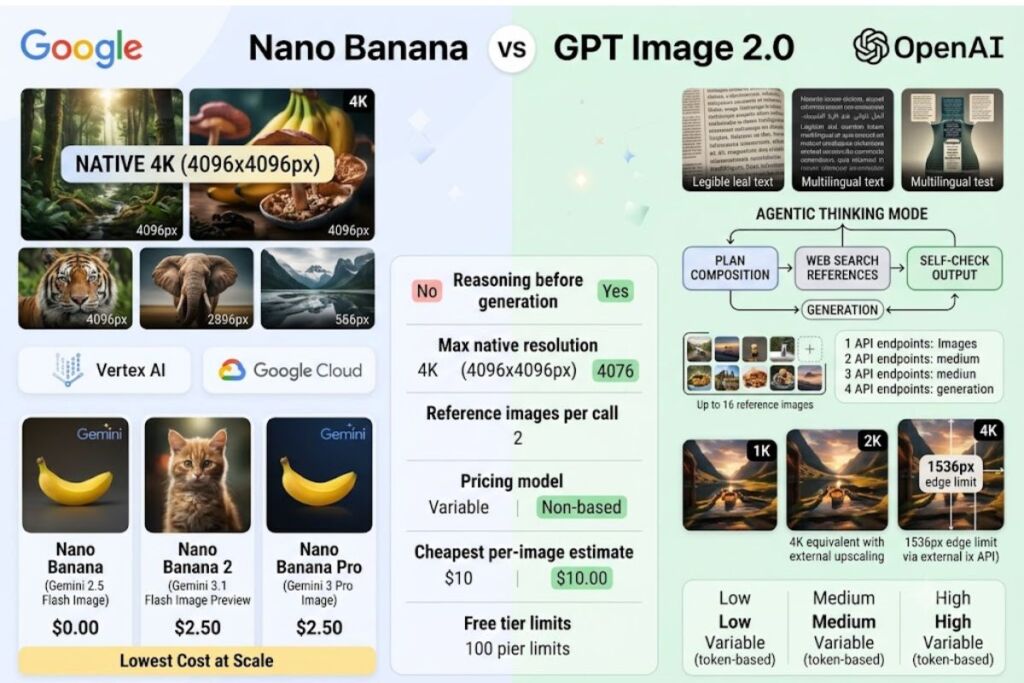
Nano Banana is Google’s Gemini-native image generation family. GPT Image 2.0 is OpenAI’s flagship image model with built-in reasoning. GPT Image 2.0 wins on text rendering and agentic prompt planning; Nano Banana Pro wins on native 4K resolution and per-image cost at scale.
This comparison draws on OpenAI’s and Google’s official API pricing documentation, published model pages, and cross-checked third-party benchmark sources, verified in July 2026.
What Is Nano Banana?
Nano Banana is Google’s brand name for Gemini’s native image generation models, built directly into the Gemini 2.5 and Gemini 3 model families rather than shipped as a separate image tool.
The name covers three distinct models with three different price points, which is the single biggest source of buyer confusion in Google’s 2026 image lineup. The original Nano Banana runs on Gemini 2.5 Flash Image and <cite index=”4-1″>launched in September 2025 at $0.039 per image</cite>. Nano Banana 2 runs on Gemini 3.1 Flash Image Preview, <cite index=”4-1″>launched February 26, 2026, and combines Pro-level quality with Flash-level generation speed</cite>. Nano Banana Pro runs on Gemini 3 Pro Image and is the highest-quality tier of the three, <cite index=”4-1″>priced at $0.134 per image and built for photorealistic output with native 4K support</cite>.
| Attribute | Value |
|---|---|
| Company | Google (Gemini team) |
| Release Year | 2025 (original), 2026 (Pro, 2) |
| Model IDs | Gemini 2.5 Flash Image · Gemini 3 Pro Image · Gemini 3.1 Flash Image Preview |
| Pricing (API) | $0.039/image (original) · $0.134–$0.24 per image (Pro, 2K–4K) · $0.067–$0.101 per image (Nano Banana 2, 1K–2K) |
| Platforms | Gemini app, Google AI Studio, Vertex AI / Gemini API |
| Key Feature | Native 4K generation up to 4096×4096 pixels (Pro) |
Pricing verified as of July 2026.
What Are Nano Banana’s Key Features?
Nano Banana’s three tiers cover resolution, speed, and cost differently, and picking the wrong one inflates spend without adding quality.
- Generate native 4K output at up to 4096×4096 pixels on Nano Banana Pro.
- Render text inside images with reported accuracy above 94% on Nano Banana Pro, <cite index=”6-1″>generating full 4K images in under 12 seconds</cite>.
- Produce high-throughput batches on Nano Banana 2 Lite, <cite index=”3-1″>priced for large-scale commercial workflows with a four-second generation time per image</cite>.
- Scale cost-efficiently on Nano Banana 2, which <cite index=”1-1″>costs roughly 3x less per image than Nano Banana Pro at equivalent 1K output</cite>.
- Access the Batch API for non-real-time jobs, which <cite index=”6-1″>cuts standard per-image rates in half in exchange for a 24-hour processing window</cite>.
How Much Does Nano Banana Cost?
Nano Banana pricing splits into a free consumer tier, four Gemini subscription plans, and per-image API billing, and the cheapest option depends entirely on volume.
On the subscription side, <cite index=”6-1″>Google offers a free plan limited to roughly 2–3 images per day, AI Plus at $7.99/month, AI Pro at $19.99/month with approximately 100 image generations per day at up to 2K resolution, and AI Ultra at $249.99/month</cite> for priority access. On the developer side, <cite index=”5-1″>Google AI Studio bills standard API access at $0.134 per 2K image and $0.24 per 4K image, with the Batch API cutting those rates to $0.067 and $0.12 respectively</cite>. Nano Banana 2 uses resolution-based pricing instead: <cite index=”4-1″>$0.067 per image at 1K resolution, rising to $0.101 at 2K</cite>. Free-tier access through Google AI Studio is reported at up to 50 requests per day for developers testing the API, though Google does not publish this figure on an official rate-limit page, so treat it as unverified until confirmed on Google’s own documentation.
Pricing verified as of July 2026. Source: Google AI Studio and Gemini subscription pages, cross-checked against third-party pricing trackers.
What Is GPT Image 2.0?
GPT Image 2.0 (model ID gpt-image-2) is OpenAI’s third-generation flagship image model, following gpt-image-1 (April 2025) and gpt-image-1.5 (December 2025).
OpenAI <cite index=”7-1″>officially released gpt-image-2 as “ChatGPT Images 2.0″ on April 21, 2026, giving ChatGPT and Codex users access starting April 22 and opening API access to developers in early May 2026</cite>. The defining change from earlier GPT Image models is reasoning: <cite index=”7-1″>before generating an image, gpt-image-2 researches, plans, and reasons about image structure, which OpenAI positions as the industry’s first agentic image generation model</cite>. <cite index=”9-1”>OpenAI calls this “Thinking Mode” — the model plans layout, can search the web for reference material, and self-checks its output before finalizing an image</cite>.
| Attribute | Value |
|---|---|
| Company | OpenAI |
| Release Year | 2026 (April 21) |
| Model ID | gpt-image-2 (snapshot gpt-image-2-2026-04-21) |
| Pricing (API) | $8/M image input tokens, $2/M cached, $30/M image output tokens |
| Platforms | ChatGPT, Codex, OpenAI API (/v1/images/generations, /v1/images/edits, /v1/responses, /v1/chat/completions) |
| Key Feature | Agentic “Thinking Mode” with pre-generation planning and web search |
Pricing verified as of July 2026.
What Are GPT Image 2.0’s Key Features?
GPT Image 2.0 replaces the old “low/medium/high quality” control with a simpler resolution-based system and adds reasoning ahead of generation.
- Plan image composition automatically through Thinking Mode before rendering any pixels.
- Accept up to 16 reference images per call, each up to 100MB, for <cite index=”13-1″>reference-guided generation across three resolution variants: 1K, 2K, and 4K</cite>.
- Render dense, multilingual text inside images with sharper legibility than gpt-image-1.
- Output at three fixed resolutions — <cite index=”9-1″>1024×1024, 1024×1536, and 1536×1024 — across Low, Medium, and High quality tiers</cite>.
- Call the model through four separate endpoints, including
/v1/responsesand/v1/chat/completions, for direct integration into agentic workflows.
How Much Does GPT Image 2.0 Cost?
GPT Image 2.0 bills per token, not per image, which makes cost estimation less predictable than Nano Banana’s flat per-image rates.
<cite index=”9-1″>OpenAI’s official API pricing lists image input at $8.00 per million tokens, cached image input at $2.00 per million tokens, image output at $30.00 per million tokens, text input at $5.00 per million tokens, and text output at $10.00 per million tokens</cite>. Translated into per-image estimates at 1024×1024 resolution, <cite index=”9-1″>a Low-quality image runs approximately $0.006, Medium approximately $0.053, and High approximately $0.211</cite>. Editing workflows cost more: <cite index=”11-1″>gpt-image-2 always processes uploaded reference images at high fidelity, which adds image input tokens to every edit request and can push edit-heavy workflows to 2–3x the text-to-image baseline cost</cite>. On the consumer side, <cite index=”15-1″>ChatGPT Plus costs $20/month and ChatGPT Pro costs $200/month, with Pro reserved for heavy users who need priority generation and the highest individual-tier limits</cite>. API rate limits scale with spend: <cite index=”9-1″>Tier 1 accounts cap at 5 images per minute, Tier 2 at 20, Tier 3 at 50, and Tier 5 at 250 — reaching Tier 5 requires $1,000 in cumulative spend and a 30-day-old account</cite>.
Pricing verified as of July 2026. Source: OpenAI API pricing documentation and OpenAI rate-limits guide.
How Do Nano Banana and GPT Image 2.0 Compare on Features?
| Feature | Nano Banana (Pro / 2) | GPT Image 2.0 |
|---|---|---|
| Release date | Sept 2025 (original), Feb 2026 (Nano Banana 2) | April 21, 2026 |
| Reasoning before generation | No | Yes — Thinking Mode plans layout and can search the web |
| Max native resolution | 4096×4096 (Pro) | 1536×1536 equivalent at 4K via third-party hosting; native API caps at 1536px edge |
| Reference images per call | Not specified on official docs | Up to 16, 100MB each |
| Pricing model | Flat per-image | Token-based (image input/output tokens) |
| Cheapest per-image estimate | $0.034 per image at scale (Nano Banana 2 Lite) | $0.006 per image (Low quality, 1024×1024) |
| Free tier | 2–3 images/day (Gemini app) | No published cap; access limited on the free ChatGPT tier |
Both platforms are moving in the same direction — cheaper high-volume tiers alongside pricier flagship quality — but they solve for different priorities: Google optimizes for resolution ceiling and cost-per-image at scale; OpenAI optimizes for reasoning accuracy and text legibility.
What Are the Pros and Cons of Nano Banana?
Pros:
- Native 4K output on Nano Banana Pro at up to 4096×4096 pixels, ahead of GPT Image 2.0’s officially documented resolution ceiling.
- Lowest per-image cost at scale through Nano Banana 2 Lite, priced for high-throughput commercial pipelines.
- Direct integration with Vertex AI for teams already running Google Cloud infrastructure.
Cons:
- Three separately branded models (Nano Banana, Nano Banana 2, Nano Banana Pro) create pricing confusion — the workaround is to default to Nano Banana 2 for general use and reserve Pro specifically for jobs that require native 4K or maximum text accuracy.
- The Gemini app free tier caps at roughly 2–3 images per day, too low for daily content production — the workaround is the Google AI Studio developer console, where free-tier request allowances are reported to be substantially higher for API testing.
What Are the Pros and Cons of GPT Image 2.0?
Pros:
- Agentic Thinking Mode plans composition and can pull reference material from the web before generating, reducing failed first-pass prompts.
- Accepts up to 16 reference images per call for complex, reference-guided edits.
- Four separate API endpoints support direct integration into existing agentic and chat-based workflows.
Cons:
- Token-based billing makes per-image cost unpredictable across prompt complexity and resolution — the workaround is running a one-week pilot at target quality and size, then using OpenAI’s official cost calculator to project monthly spend before committing to a workflow.
- Reference images are always processed at high fidelity on edit requests, inflating cost 2–3x over plain text-to-image generation — the workaround is limiting calls to 3–5 well-chosen reference images instead of the maximum of 16, since additional references compete for influence without proportional quality gain.
- The free ChatGPT tier publishes no fixed generation cap, which interrupts consistent professional workflows — the workaround is ChatGPT Plus at $20/month, which removes most rate friction for individual creators.
Choose Nano Banana If
- You need native 4K output above 3840×2160 pixels without third-party upscaling.
- You are generating at high volume and need the lowest possible cost per image.
- You already run infrastructure on Google Cloud or Vertex AI.
Choose GPT Image 2.0 If
- You need the model to plan composition and reference real-world visual context before generating.
- Your use case depends on dense, accurate, multilingual text rendered inside the image.
- You need reference-guided edits with support for multiple input images in a single call.
Frequently Asked Questions
Is Nano Banana the same as Gemini?
No. Nano Banana is Google’s brand name for the native image generation capability built into specific Gemini models — Gemini 2.5 Flash Image, Gemini 3 Pro Image, and Gemini 3.1 Flash Image Preview — not a standalone product separate from Gemini.
Is GPT Image 2.0 the same as DALL-E 3?
No. <cite index=”14-1″>GPT Image 2 is OpenAI’s next-generation image model released after DALL-E 3, with improved prompt adherence, better in-image text rendering, and built-in image-editing support that DALL-E 3 does not have</cite>. DALL-E 2 and DALL-E 3 were removed from OpenAI’s API entirely in May 2026.
Which model is cheaper for high-volume use?
Nano Banana 2 and Nano Banana 2 Lite undercut GPT Image 2.0 at equivalent resolutions for pure text-to-image generation. GPT Image 2.0 becomes more expensive specifically on edit and reference-image workflows, since every reference image is billed at high-fidelity input token rates.
Does either model have a genuinely free tier for commercial use?
Both free tiers are consumer-oriented and rate-limited, not built for commercial production. Nano Banana’s Gemini app free tier caps around 2–3 images per day; GPT Image 2.0’s free ChatGPT access has no published cap but is explicitly rate-limited by OpenAI for consistent professional use. Commercial pipelines on either platform require a paid subscription or direct API billing.
Verdict
GPT Image 2.0 costs less per image at the low-quality tier ($0.006) than any Nano Banana model, but Nano Banana Pro is the only one of the two with officially documented native 4K generation at 4096×4096 pixels — for photorealistic large-format output, that resolution ceiling decides the choice before pricing does.