
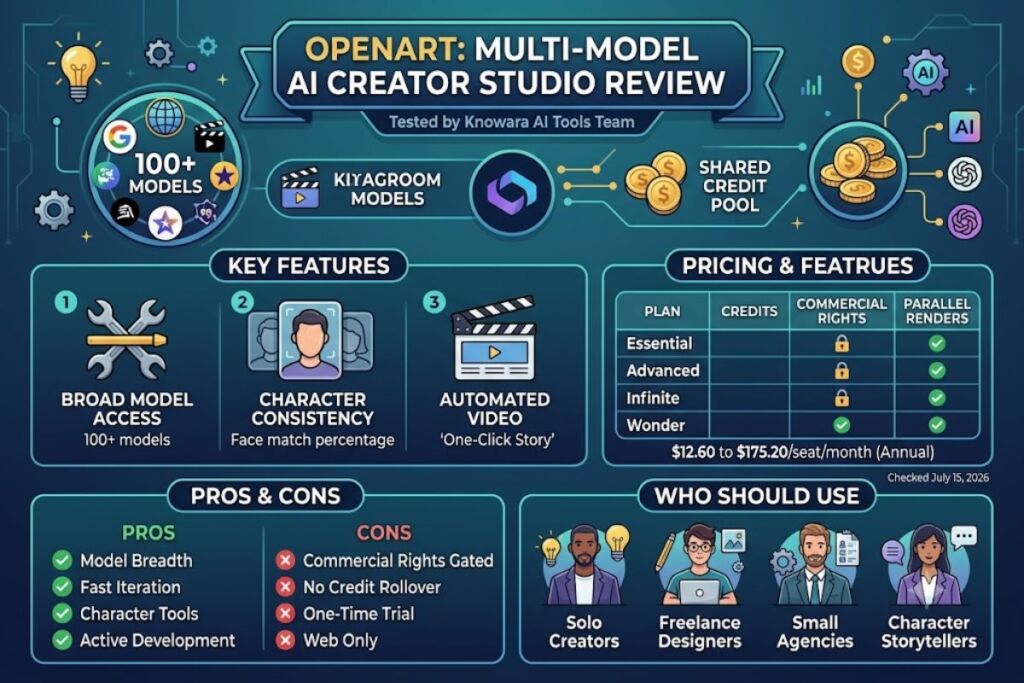
Tested by the Knowara AI Tools team. This review is built from OpenArt’s official pricing page (checked July 15, 2026), the company’s help-center documentation, and on-record statements from OpenArt co-founder and CEO Coco Mao to TechCrunch. Every price, credit figure, and feature limit below is cited to its source — figures we could not verify against a primary source are explicitly flagged rather than estimated.
OpenArt is a browser-based AI creator studio that gives one subscription access to 100+ image, video, and audio generation models — including Google Veo, Kling, Nano Banana Pro, Seedance, and Stable Diffusion — through a single shared credit balance. It targets creators who want model variety without stacking five separate tool subscriptions.
What Is OpenArt?
OpenArt is a multi-model AI content platform that consolidates image generation, video generation, character consistency tools, and model training into one credit-based subscription. Founded in 2022 by former Google employees Coco Mao and John Qiao, OpenArt is headquartered in San Francisco and has raised more than $30 million across two funding rounds, including a Series A led by Canaan Partners.
Instead of building one proprietary generation model, OpenArt licenses access to over 100 third-party models and routes user prompts to whichever model the task calls for — text-to-image, image-to-video, lip-sync, upscaling, or style-consistent character rendering. A single credit pool, not separate per-model subscriptions, pays for all of it.
| Attribute | Value |
|---|---|
| Company | OpenArt, Inc. — San Francisco, CA |
| Founded | 2022 (co-founders: Coco Mao, John Qiao) |
| Funding | $30M+ raised, Series A led by Canaan Partners |
| Platforms | Web browser only — no desktop or mobile app as of this review |
| Key Feature | 100+ integrated image, video, and audio models on one credit system |
| Pricing | Free trial credits, then $12.60–$175.20/seat/month (annual billing) across four paid tiers |
Pricing and feature figures verified against OpenArt’s official pricing page on July 15, 2026. AI tool pricing changes frequently — confirm current figures at openart.ai/pricing before purchasing.
What Are OpenArt’s Key Features?
OpenArt’s feature set centers on three areas: model breadth, character consistency, and automated video production.
- Access 100+ premium models spanning image, video, and audio generation from a single account, per OpenArt’s official pricing page — no separate logins for image versus video tools.
- Generate up to 106,000 images per month on the Wonder tier, scaling down to 4,000/month on Essential, based on the official credit allocations per plan.
- Run parallel generations from 8 concurrent renders on Essential up to 32 concurrent renders on Infinite and Wonder, cutting iteration time when testing prompt variations.
- Train personalized models for consistent characters or styles — Essential unlocks roughly 13 trainable models, Wonder scales to roughly 353, per the official pricing breakdown.
- Build consistent characters across multiple images and video scenes, addressing what CEO Coco Mao described to TechCrunch in August 2025 as a core weakness in generative video: characters losing visual consistency between frames.
- Automate One-Click Story production, converting a single sentence, script, or uploaded song into a complete short-form video using one of three templates — Character Vlog, Music Video, or Explainer — per TechCrunch’s August 2025 reporting.
- Direct longer-form narratives through “Director,” a conversation-driven visual storytelling tool OpenArt launched in June 2026, per Business Wire coverage cited by Tracxn.
- Connect via OpenArt MCP (Model Context Protocol) for workflow automation, included starting on the Essential tier.
- Edit images through a built-in suite covering inpainting, outpainting, and upscaling, available on every paid tier per the official pricing page.
How Much Does OpenArt Cost?
OpenArt runs four paid tiers on annual billing — Essential at $12.60/seat/month, Advanced at $23.20/seat/month, Infinite at $43.70/seat/month, and Wonder at $175.20/seat/month — plus a limited free trial. Monthly billing costs more per tier: $14, $29, $56, and $240 respectively.
| Plan | Monthly Price | Annual Price (per seat/mo) | Credits/Month | Parallel Generations | Commercial Rights |
|---|---|---|---|---|---|
| Free | $0 | $0 | One-time trial credits (non-renewing) | 4 | No |
| Essential | $14 | $12.60 | 4,000 | 8 | No |
| Advanced | $29 | $23.20 | 12,000 | 16 | Yes |
| Infinite | $56 | $43.70 | 24,000 | 32 | Yes |
| Wonder | $240 | $175.20 | 106,000 | 32 | Yes |
Source: OpenArt official pricing page, verified as of July 2026.
Two pricing details matter more than the headline numbers. First, commercial usage rights only activate on the Advanced plan and above — the Free and Essential tiers are for non-commercial use only, per the official pricing page. Second, monthly plan credits do not roll over, according to OpenArt’s help-center FAQ structure, though separately purchased add-on credit packs ($15/month per 5,000 credits) do carry forward to the next billing cycle.
The free tier’s exact starting allocation is not published on OpenArt’s live pricing page in a way we could independently confirm at time of writing. Multiple third-party pricing trackers consistently report 40 one-time trial credits, plus up to 50 additional credits for joining OpenArt’s Discord community — verify this figure directly on openart.ai before publishing budget-dependent content around it.
What Are the Pros and Cons of OpenArt?
OpenArt’s strength is model consolidation — 100+ generation models under one credit system — while its main limitation is a higher price floor for commercial rights compared to single-model competitors.
Pros:
- Model breadth. 100+ integrated image, video, and audio models replace what would otherwise require separate subscriptions to multiple single-purpose tools, per the official pricing page.
- Fast iteration at scale. Parallel generation scales from 8 renders (Essential) to 32 renders (Infinite/Wonder), reducing wait time when testing prompt variations across a session.
- Character consistency tooling. Dedicated character-training and One-Click Story features target a documented pain point in AI video — character drift across frames — per Coco Mao’s statements to TechCrunch.
- Funded, active development. $30M+ in institutional backing and a June 2026 feature launch (“Director”) indicate ongoing investment rather than a stagnant tool, per Tracxn’s company tracking.
Cons:
- Commercial rights gated behind $23.20/seat/month. Free and Essential tier output is non-commercial use only, per the official pricing page. Workaround: budget for Advanced ($23.20/seat/month annual) before generating anything intended for paid client or commercial use — Essential remains usable for concept drafts and personal exploration.
- Credits don’t roll over on base subscriptions. Unused monthly allocation resets to zero at the next billing cycle, per OpenArt’s help-center structure. Workaround: purchase add-on credit packs ($15/5,000 credits) instead of upgrading tiers outright — add-on credits do carry forward, unlike base subscription credits.
- Free trial is one-time, not recurring. Third-party trackers consistently report a fixed 40-credit trial that does not refill monthly. Workaround: treat the free tier strictly as an evaluation window, not an ongoing free workflow, and confirm current trial terms on OpenArt’s pricing page before relying on it.
- No desktop or offline application. OpenArt runs entirely in-browser, per the platform’s own help documentation. Workaround: this trade-off removes local GPU/setup requirements entirely, which benefits users without dedicated hardware — but it means no access during connectivity outages, unlike locally hosted tools such as Automatic1111.
How Does OpenArt Compare to Midjourney?
OpenArt undercuts Midjourney on entry price and model variety, but Midjourney includes commercial rights on every paid tier while OpenArt withholds them until $23.20/month.
| Attribute | OpenArt | Midjourney |
|---|---|---|
| Entry price (annual) | $12.60/month (Essential) | $10/month (Basic) |
| Model access | 100+ third-party models (image, video, audio) | Single proprietary image model |
| Commercial rights | From Advanced ($23.20/month) | Included from $10/month |
| Interface | Browser dashboard | Discord + limited web app |
| Native video generation | Yes (Veo, Kling, Seedance) | No |
OpenArt’s pitch is tool consolidation across image, video, and audio in one subscription. Midjourney’s pitch is a single, artistically distinctive image model with commercial rights available from its cheapest tier. For a full breakdown of both platforms’ credit systems and output quality, see Knowara’s dedicated OpenArt vs Midjourney comparison.
Who Should Use OpenArt?
OpenArt fits users who need model variety more than they need one polished proprietary aesthetic:
- Solo content creators and social media managers producing a steady mix of images and short-form video without hiring separate tools for each format.
- Freelance designers serving paying clients, provided they budget for the Advanced tier ($23.20/seat/month annual) to unlock commercial usage rights.
- Small agencies and production teams that need parallel generation at volume — the Infinite tier’s 32 concurrent renders suit iterative client work.
- Character-driven storytellers — YouTubers, indie game developers, and narrative video creators — who need a subject to stay visually consistent across many generations.
OpenArt fits less well for users who want one signature aesthetic and don’t need video, or high-volume technical users willing to self-host for zero per-generation cost.
What Are the Best Alternatives to OpenArt?
- Midjourney — the closest competitor on image quality and artistic distinctiveness, with commercial rights included from its $10/month Basic tier; read Knowara’s full Midjourney Review.
- Leonardo AI — the nearest like-for-like credit-based competitor, including commercial rights on all paid plans starting at $12/month, versus OpenArt’s $23.20/month floor; read Knowara’s full Leonardo AI Review.
- Stable Diffusion (self-hosted) — the zero-subscription alternative for high-volume users with their own GPU hardware, eliminating per-generation cost entirely at the expense of setup complexity; read Knowara’s guide to the Best Free AI Image Generation Tools.
Frequently Asked Questions
Is OpenArt free to use?
OpenArt offers a one-time free trial rather than an ongoing free plan. Third-party pricing trackers report 40 non-renewing trial credits, with up to 50 additional credits available for joining OpenArt’s Discord community — confirm current terms on OpenArt’s official pricing page.
Does OpenArt include commercial usage rights?
No, not on every tier. Commercial rights activate starting on the Advanced plan at $23.20/seat/month (annual billing), per OpenArt’s official pricing page. Free and Essential tier output is restricted to non-commercial use.
How many models does OpenArt support?
OpenArt provides access to 100+ image, video, and audio generation models, including Stable Diffusion, Flux, DALL-E 3, Google Veo, Kling, Nano Banana Pro, and Seedance, per the official pricing page and OpenArt’s product documentation.
Do OpenArt credits roll over each month?
Base subscription credits do not roll over between billing cycles, per OpenArt’s help-center structure. Separately purchased add-on credit packs ($15/month per 5,000 credits) do carry forward if unused.
The Bottom Line
OpenArt’s Advanced plan, at $23.20/seat/month billed annually, is the minimum tier that combines commercial usage rights with meaningful credit volume (12,000/month) and 16 parallel generations — positioning it as a single-subscription replacement for separately paying for an image generator, a video generator, and an upscaling tool.