
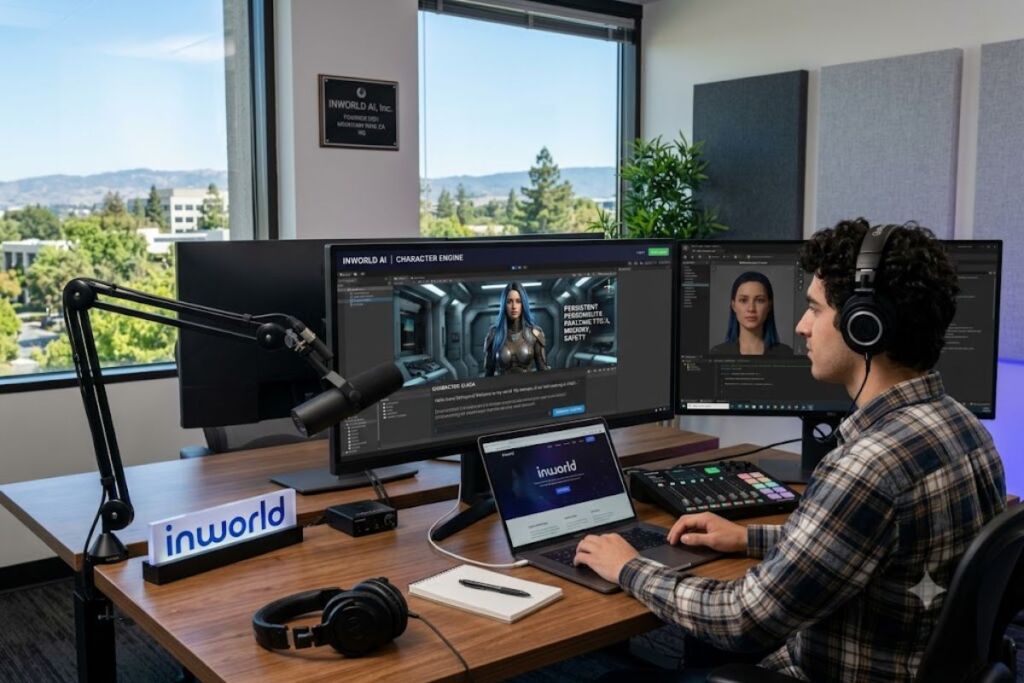
Inworld AI is a character-engine and voice-AI platform for building AI-driven non-player characters, voice agents, and conversational apps. Founded in 2021, Inworld provides text-to-speech, speech-to-text, an LLM router, and a Runtime SDK for game studios and developers.
What Is Inworld AI?
Inworld AI is a developer platform for building AI characters and voice agents, combining text-to-speech, speech-to-text, LLM routing, memory, and safety tools into one API-driven system. Inworld’s core product, the Character Engine, gives NPCs and voice agents persistent personalities, memory, and behavioral logic that carry across sessions.
Inworld AI was founded in 2021 in Mountain View, California, by Ilya Gelfenbeyn, Kylan Gibbs, and Michael Ermolenko — a team that previously built API.AI, the conversational-AI platform Google acquired and renamed Dialogflow. The company has raised $117 million across four funding rounds from Lightspeed Venture Partners, Kleiner Perkins, CRV, Intel Capital, Microsoft’s M12 fund, and Eric Schmidt’s First Spark Ventures, reaching a valuation above $500 million.
| Attribute | Value |
|---|---|
| Company | Inworld AI, Inc. |
| Founded | 2021 |
| Headquarters | Mountain View, California |
| Pricing model | Usage-based (credits + pay-per-character) |
| Platforms | REST API, Unreal Engine, Unity, web SDK |
| Key feature | Character Engine with persistent memory and Realtime TTS-2 |
| Total funding | $117 million |
| Employees | 88 (as of May 2026) |
Game studios integrate Inworld’s Runtime SDK directly into Unreal Engine and Unity projects. NetEase Games, Niantic, ILM Immersive, and LG UPlus run production NPCs on Inworld’s infrastructure.
What Are Inworld AI’s Key Features?
Inworld AI packages voice, character logic, and safety tooling into five core products. Each feature targets a specific stage of building an AI character or voice agent, from raw audio generation to long-term memory retention.
- Generate speech through Realtime TTS-2, ranked #1 on the Artificial Analysis Speech Arena for quality-to-price ratio, priced from $10 per 1 million characters.
- Transcribe audio with Inworld’s Speech-to-Text API, built for low-latency conversational agents under 90 milliseconds of round-trip latency.
- Route requests across OpenAI, Anthropic, and Google models through the LLM Router, which auto-selects the model for a given character response.
- Build agents with the Inworld Runtime, a free-to-use framework for client-side logic and local model inference — developers pay only for connected LLM provider consumption.
- Persist memory across sessions using Inworld Memory, which stores character history, relationships, and prior conversation context at no added cost.
- Enforce safety with Inworld Safety, a moderation layer that filters unsafe outputs before they reach the end user, included free on every plan.
- Deploy characters into Unreal Engine’s MetaHuman framework or Unity through native SDK integrations, avoiding custom animation-rigging work.
How Much Does Inworld AI Cost?
Inworld AI uses pure usage-based pricing with no flat subscription requirement — developers buy credits and pay per character or per API call, starting at $5 per 1 million characters on Founder-tier text-to-speech. Pricing is confirmed on Inworld’s official pricing page.
Inworld cut prices more than 50% across TTS, STT, and LLM routing in June 2026, moving standard Realtime TTS-2 rates down to roughly $10 per 1 million characters on the Growth plan, with enterprise commitments stepping down toward $5 per 1 million characters at the largest volume tiers, according to Inworld’s own pricing announcement. Four paid tiers exist: Creator, Developer, Growth, and Enterprise.
- Creator unlocks audio downloads and custom voice access for individual creators and small projects.
- Developer adds workspace creation, team sharing, higher API and concurrency limits, and priority email support for production applications.
- Growth raises API limits further, unlocks 1,000 custom voices, and adds compliance add-ons for high-volume production use cases.
- Enterprise is fully custom-priced through direct sales contact, covering on-premise deployment.
Unused credits on Creator-tier plans and above roll over for up to three months with an active subscription, per Inworld’s billing documentation. Inworld Safety, Memory, and Knowledge features carry no separate charge on any tier. Provider LLM usage through the Router bills separately at each provider’s own rate.
What Are the Pros and Cons of Inworld AI?
Inworld AI delivers measurable cost savings and top-ranked voice quality, but its usage-based pricing model creates unpredictable monthly bills for high-traffic consumer apps. Both strengths and limitations trace back to the same architectural choice: pay-per-character billing instead of flat seats.
Pros:
- Realtime TTS-2 ranks #1 overall for quality-to-price ratio among tested voice models, according to BuildMVPFast’s June 2026 TTS pricing comparison.
- Inworld’s Realtime TTS-2 costs roughly $10 per 1 million characters, compared to ElevenLabs’ Multilingual v3 at $206 per 1 million characters — a documented 95% cost reduction for comparable output.
- Wishroll, a five-person team behind the social app Status, cut AI infrastructure costs by 95% after switching to Inworld, according to Inworld’s own case study.
- Inworld Safety, Memory, and Knowledge modules ship free on every paid plan, removing separate line items competitors charge for.
- Native Unreal Engine MetaHuman and Unity integrations cut custom animation-rigging work for game studios.
Cons:
- Usage-based billing makes monthly cost forecasting harder for apps with unpredictable traffic spikes compared to flat-rate competitors.
- Founder-tier pricing locked in before May 7, 2026, is no longer available to new accounts, which now start on higher on-demand base rates of $25 per 1 million characters for Mini-tier TTS.
- LLM provider costs bill separately from Inworld’s own credits, adding a second invoice source to track.
- Inworld’s consumer-app tooling remains newer than its gaming-focused Character Engine, with fewer public case studies outside NPC and voice-agent use cases.
How Does Inworld AI Compare to ElevenLabs?
Inworld AI undercuts ElevenLabs on price by roughly 90% at comparable quality tiers while adding character memory and personality logic ElevenLabs does not offer. ElevenLabs focuses on voice generation alone; Inworld bundles voice into a full character-and-agent system.
| Attribute | Inworld AI | ElevenLabs |
|---|---|---|
| TTS price (per 1M characters) | ~$10 (Realtime TTS-2, Growth plan) | ~$103–$206 (Flash/Multilingual v3) |
| Character memory | Included free | Not offered |
| Safety moderation | Included free | Add-on |
| Pricing model | Usage-based credits | Subscription tiers |
| Primary use case | Game NPCs, voice agents, character apps | Voice generation, dubbing, audiobooks |
Developers who need voice generation only, without character personality or memory, find ElevenLabs simpler to integrate for that narrower use case. Read the full breakdown in our dedicated Inworld AI vs ElevenLabs comparison.
Who Should Use Inworld AI?
Game studios building NPCs for Unreal Engine or Unity gain the most from Inworld AI’s native MetaHuman integration and persistent character memory. Consumer AI app developers running high-volume voice sessions also benefit directly from Inworld’s June 2026 price cuts.
- Indie and mid-size game studios integrating conversational NPCs into Unreal Engine or Unity without building custom dialogue-and-memory systems from scratch.
- Consumer AI app founders running companion apps, social AI products, or language-learning tools where session length and character consistency drive retention.
- VR/AR experience designers building interactive characters for immersive environments that require low-latency voice and real-time adaptability.
- Enterprise teams deploying branded AI characters at scale who need on-premise deployment and custom compliance terms.
Solo developers testing a single voice-only feature, with no character logic or memory requirement, get simpler onboarding from a dedicated TTS-only platform instead.
What Are the Best Alternatives to Inworld AI?
Three platforms compete directly with Inworld AI across voice generation, character AI, and consumer conversational apps.
- ElevenLabs specializes in premium voice generation and dubbing without character-memory or NPC-logic tooling — read our ElevenLabs Review.
- Character.AI focuses on direct-to-consumer character chat rather than developer infrastructure, targeting end users instead of studios — read our Character.AI Review.
- Fish Audio offers a lower-cost, TTS-only alternative for developers who need voice generation without Inworld’s full character-engine stack.
Frequently Asked Questions
Is Inworld AI free to use?
Inworld’s Runtime SDK is free to use; developers pay only for connected LLM provider consumption and for TTS/STT usage beyond any included credits.
What companies use Inworld AI?
NetEase Games, Niantic, ILM Immersive, LG UPlus, and Alpine Electronics have deployed AI characters built on Inworld’s platform, according to Inworld’s public case studies.
Does Inworld AI support Unreal Engine and Unity?
Inworld AI integrates natively with Unreal Engine’s MetaHuman framework and Unity through dedicated SDKs, letting studios link generated characters to existing rigging systems.
How does Inworld AI’s pricing compare to ElevenLabs?
Inworld’s Realtime TTS-2 costs approximately $10 per 1 million characters versus ElevenLabs’ Multilingual v3 at approximately $206 per 1 million characters — roughly a 95% price difference at comparable quality tiers, per BuildMVPFast’s June 2026 pricing comparison.
Inworld AI’s June 2026 price cuts, combined with free Memory and Safety modules, make it the lower-cost option for any team building character-driven voice apps rather than voice generation alone — the deciding factor is whether a project needs character logic, not just audio output.