
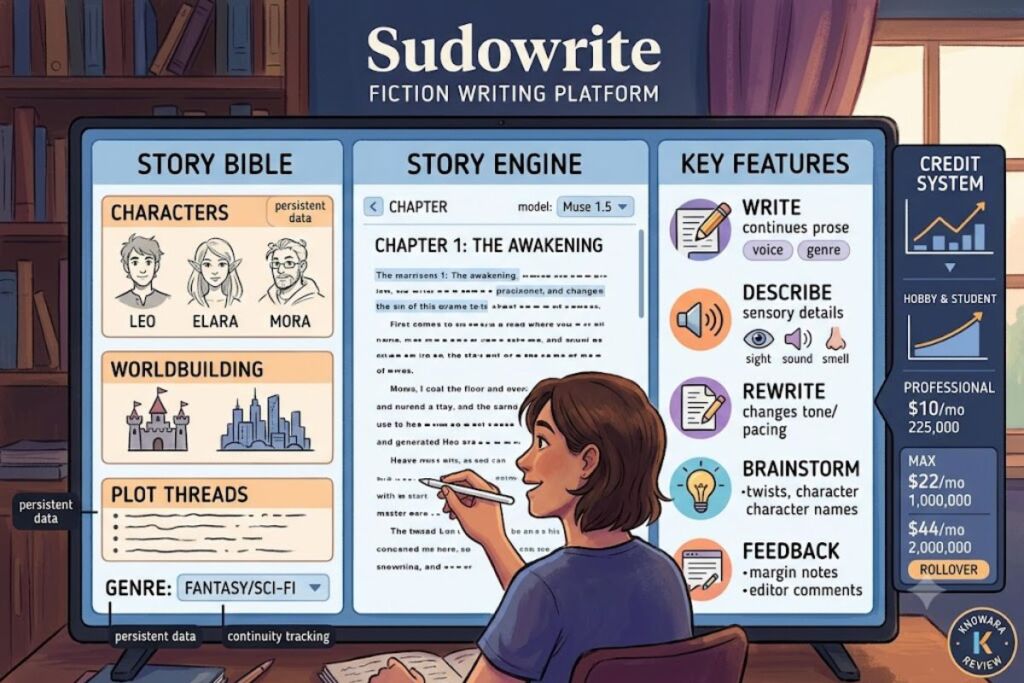
Sudowrite is a fiction-specific AI writing platform built for novelists and screenwriters, combining a proprietary narrative model (Muse) with tools like Story Bible, Story Engine, and Canvas to draft, expand, and revise manuscripts. Pricing starts at $10/month (annual billing) for 225,000 credits, with no permanent free plan — only a 10,000-credit trial.
What Is Sudowrite?
Sudowrite is an AI writing assistant purpose-built for fiction, not general content marketing or blogging. Amit Gupta and James Yu founded the company in 2020 in San Francisco, and it now runs on a mix of proprietary and third-party language models.
Sudowrite differs from general-purpose tools like ChatGPT or Jasper because its interface was designed specifically for storytellers — novelists, short fiction writers, screenwriters, and game designers — rather than repackaging a general chatbot. The platform organizes fiction work into modular tools rather than a single chat window: Story Bible for continuity tracking, Canvas for outlining, and a chapter-level generation engine. Sudowrite runs on its proprietary Muse 1.5 model, plus optional prose modes powered by Claude and GPT-family models. ScribeCountAMRYTT
| Attribute | Value |
|---|---|
| Founding Company | Sudowrite LLC |
| Founders | Amit Gupta, James Yu |
| Release Year | 2020 |
| Headquarters | San Francisco, CA |
| Pricing (annual billing) | $10–$44/month |
| Pricing (monthly billing) | $19–$59/month |
| Platforms | Web app (browser-based), mobile-responsive |
| Key Feature | Story Bible — persistent character, world, and plot continuity engine |
| Proprietary Model | Muse (fiction-specialized) |
| Free Trial | ~10,000 credits, no credit card required |
What Are Sudowrite’s Key Features?
Sudowrite’s core feature set covers the full fiction drafting cycle — from blank page to revised chapter — through six primary tools.
- Generate chapter-length prose from the Story Engine using an outline, synopsis, and character sheet stored in Story Bible.
- Track continuity automatically across a manuscript through Story Bible, which stores characters, worldbuilding rules, and plot threads as persistent reference data.
- Expand existing scenes with the Write feature, which continues prose in the user’s established voice and genre.
- Rewrite selected passages in a different tone, pacing, or style without regenerating the entire scene.
- Describe sensory details — sight, sound, smell, touch, taste — from a single sentence prompt to enrich flat prose.
- Brainstorm plot twists, character names, and story beats through the Twist and Brainstorm tools when a writer hits a block.
- Review drafts through the Feedback tool, which returns editor-style margin notes referencing Story Bible context for pacing and consistency issues.
- Match an author’s existing voice using the style-matching function built into Write and Rewrite.
A typical high-value workflow runs: check Story Bible for character goals and setting constraints, expand a key beat for tension, run a Describe pass for sensory grounding, rewrite dialogue for sharper intent, then run a Feedback pass to catch pacing drag. This sequence mirrors how novelists revise manually, which is the structural difference between Sudowrite and a single-window chatbot. AMRYTT
How Much Does Sudowrite Cost?
Sudowrite runs on three consumer subscription tiers priced from $10 to $44 per month on annual billing, or $19 to $59 on monthly billing, based entirely on a credit-consumption model. According to Sudowrite’s official documentation, Hobby & Student includes 225,000 credits at $10/month paid annually or $19/month paid monthly; Professional includes 1,000,000 credits at $22/month annually or $29/month monthly; Max includes 2,000,000 rollover credits at $44/month annually or $59/month monthly. Sudowrite
All three tiers unlock the identical feature set. The only difference between plans is the number of credits included each month and whether unused credits expire. Credits do not map to a fixed word count. Visualize is the single feature with a fixed cost at 2,500 credits per image; every other feature (Write, Expand, Rewrite, Describe, Brainstorm, Feedback) consumes a variable credit amount that scales with output length, requested variation count, and the AI model selected. Selecting a premium model like Claude or GPT-4o for generation drains credits faster than Sudowrite’s in-house Muse model on identical output. Sudowrite
Sudowrite offers no permanent free tier. New users get a one-time trial of roughly 10,000 credits with no credit card required, then must select a paid plan to continue using AI generation features. Enterprise pricing for publishing houses and writing programs requires a custom sales quote.
What Are the Pros and Cons of Sudowrite?
Sudowrite’s strength is fiction-specific continuity tooling; its weakness is a credit system with no permanent free tier and no manuscript export beyond plain formats.
Pros:
- Story Bible maintains character, plot, and world continuity across a full-length manuscript, a function absent from general-purpose AI writers.
- Muse model is trained specifically on fiction rather than marketing or SEO copy, producing narrative-appropriate prose by default.
- Feedback tool returns editor-style margin notes referencing stored Story Bible context rather than generic grammar checks.
- Max tier credits roll over for 12 months, giving high-output authors banking flexibility other tiers lack.
Cons:
- No permanent free plan; the trial caps out at approximately 10,000 credits.
- Credit costs vary non-linearly by model and output length, making monthly spend hard to predict in advance.
- No built-in export to formatted ebook or print-ready files, no cover design, and no audiobook generation.
- Individual-seat pricing structure; teams need a custom Enterprise quote rather than a published multi-seat tier.
How Does Sudowrite Compare to NovelAI?
Sudowrite focuses on structured, continuity-driven long-form fiction production; NovelAI focuses on freeform, lorebook-driven interactive storytelling and image generation.
| Attribute | Sudowrite | NovelAI |
|---|---|---|
| Starting price (annual) | $10/month | $10/month |
| Continuity system | Story Bible | Lorebook |
| Proprietary model | Muse | Kayra |
| Chapter-length generation | Yes (Story Engine) | Limited, context-window dependent |
| Image generation | No | Yes (Anlas-based) |
| Editor-style feedback tool | Yes | No |
Writers drafting a full novel with recurring characters across dozens of chapters get more structural support from Sudowrite’s Story Bible and Feedback tool. Writers who want open-ended, interactive fiction generation alongside AI illustration find NovelAI’s lorebook system and image model better suited to that workflow. Full breakdown available in Knowara’s Sudowrite vs NovelAI: Which AI Fiction Writer Wins?
Who Should Use Sudowrite?
Sudowrite fits working fiction writers managing long manuscripts with recurring characters, not marketers or non-fiction content teams.
- Novelists drafting full-length manuscripts who need persistent character and plot tracking across 80,000+ words.
- Screenwriters developing scene-level dialogue and beat structure who use Rewrite and Describe for tone control.
- Indie authors self-publishing multiple titles per year who benefit from the Max tier’s credit rollover.
- Writing students on the discounted Hobby & Student tier drafting shorter works or testing AI-assisted workflows.
Sudowrite is a poor fit for marketing teams producing blog content, SEO copy, or ad variations — its feature set has no keyword, SERP, or brand-voice tooling built for that use case.
What Are the Best Alternatives to Sudowrite?
Three named alternatives cover the gaps Sudowrite leaves open: freeform interactive fiction, full-book export automation, and general-purpose long-form drafting.
- NovelAI — better fit for interactive, lorebook-driven storytelling with integrated AI image generation. See Knowara’s full NovelAI Review.
- Novelcrafter — better fit for writers who want to bring their own AI model (via API key) into a dedicated novel-writing workspace. See Knowara’s full Novelcrafter Review.
- Squibler — better fit for scriptwriters and outline-first drafters who need built-in formatting templates for screenplays and novels. See Knowara’s full Squibler Review.
Frequently Asked Questions
Does Sudowrite have a free plan?
No. Sudowrite offers a one-time trial of approximately 10,000 credits with no credit card required, then requires a paid subscription starting at $10/month on annual billing.
What AI models power Sudowrite?
Sudowrite uses dozens of AI models, including the latest Claude models from Anthropic, multiple open-source models, in-house fiction models like Muse, and several OpenAI models, paired with proprietary narrative pre- and post-processing. Framer
Does Sudowrite train on user manuscripts?
No. Sudowrite states it does not use user writing to train its own models or OpenAI’s models. Framer
Can Sudowrite export a finished manuscript to a formatted ebook?
No. Sudowrite handles drafting and revision inside its editor but does not include cover design, audiobook creation, or formatted ebook export — writers need a separate tool for final publishing formatting.
Sudowrite’s $10-per-month entry tier delivers the most continuity-focused fiction drafting toolkit on the market, but the absence of a permanent free plan and the variable credit-cost model make actual monthly spend the deciding factor for any writer choosing it over a flat-rate alternative.