
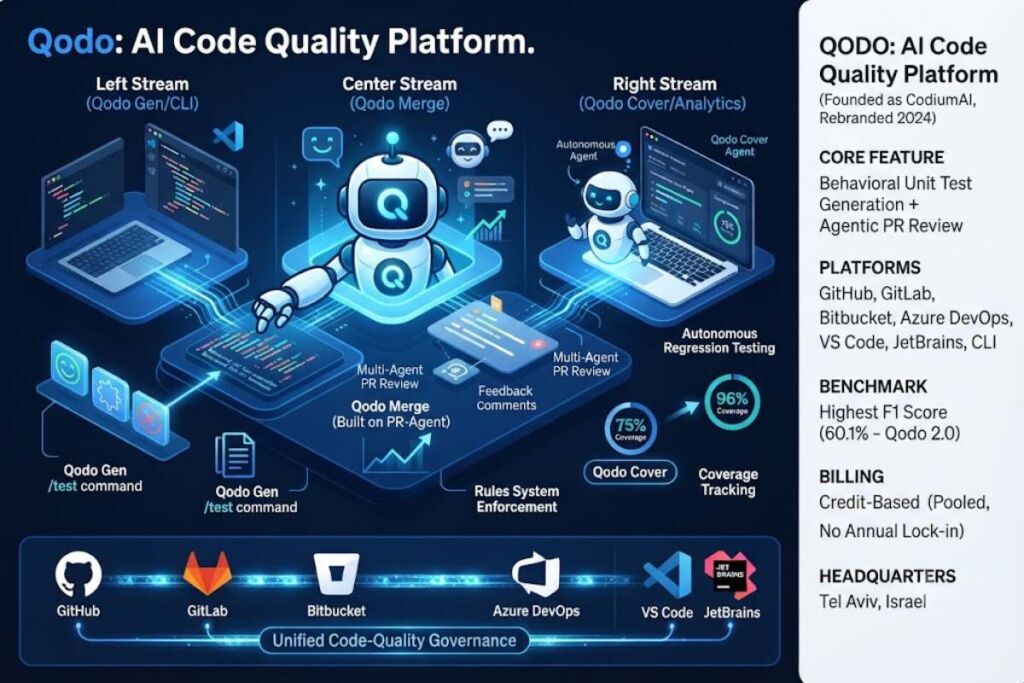
Qodo is an AI code quality platform that generates behavioral unit tests and runs agentic pull request reviews across GitHub, GitLab, Bitbucket, and Azure DevOps. Founded in 2022 as CodiumAI and rebranded in 2024, Qodo pairs test generation with PR review in a single credit-based platform.
- 01What Is Qodo?
- 02What Are Qodo’s Key Features?
- 03How Much Does Qodo Cost?
- 04What Are the Pros and Cons of Qodo?
- 05Pros
- 06Cons
- 07How Does Qodo Compare to CodeRabbit?
- 08Who Should Use Qodo?
- 09What Are the Best Alternatives to Qodo?
- 10Frequently Asked Questions
- 11Does Qodo have a permanent free tier?
- 12Does Qodo train AI models on my code?
- 13What is Qodo Merge built on?
- 14Was Qodo previously called CodiumAI?
What Is Qodo?
Qodo is an AI code quality platform, founded in 2022 as CodiumAI and rebranded to Qodo in September 2024, that generates behavioral unit tests and runs agentic pull request reviews across four Git platforms and two IDE families.
Qodo Ltd. builds three connected products around one goal: verifying that code behaves as intended, not just generating it fast. Qodo Gen is the IDE and CLI assistant for VS Code and JetBrains that handles code completion, chat, and test generation through its /test command. Qodo Merge is the hosted PR review service, built on the open-source PR-Agent project, that posts agentic review comments, summaries, and test suggestions on every pull request. Qodo Cover is an autonomous regression-testing agent that generates and validates test suites to raise measurable coverage. The company is headquartered in Tel Aviv, Israel, and started as CodiumAI before rebranding to Qodo on September 30, 2024 to reflect its expansion beyond test generation into full code-quality governance.
Qodo raised a $40 million Series A in 2024 and employs roughly 100 people across Israel, the United States, and Europe. Gartner named Qodo a Visionary in its 2025 Magic Quadrant for AI Code Assistants. Qodo 2.0, released in February 2026, replaced the platform’s single-pass review with a multi-agent architecture; independent benchmark testing reported by DEV Community measured a 60.1% F1 score, the highest among seven AI code review tools tested. Qodo customers include Intel, HiBob, NVIDIA, Macmillan, monday.com, Sansan, Walmart, and Intuit.
| Company | Qodo Ltd. (formerly CodiumAI) |
| Founded | 2022 (rebranded to Qodo, Sept. 30, 2024) |
| Headquarters | Tel Aviv, Israel |
| Pricing | 14-day free trial, then credit-based Pro Team plan or custom Enterprise |
| Platforms | GitHub, GitLab, Bitbucket, Azure DevOps, VS Code, JetBrains, CLI |
| Key Feature | Behavioral unit test generation (Qodo Gen, Qodo Cover) combined with agentic PR review (Qodo Merge) |
| Total Funding | $40 million Series A (2024) |
What Are Qodo’s Key Features?
Qodo generates behavioral unit tests via a /test command, runs multi-agent PR reviews through Qodo Merge, tracks coverage with Qodo Cover, and enforces team standards with an unlimited Rules system across four Git platforms.
- Generates behavioral unit tests through the /test command in Qodo Gen, covering happy paths, edge cases, and error conditions instead of trivial assertions.
- Runs agentic pull request reviews through Qodo Merge, built on the open-source PR-Agent engine, across GitHub, GitLab, Bitbucket, and Azure DevOps.
- Tracks test coverage autonomously through Qodo Cover, an agent that generates and validates regression test suites over time.
- Enforces team-specific conventions through an uncapped Rules system available on every paid Pro Team plan.
- Analyzes cross-file context through the Context Engine, which powers multi-repo awareness on Enterprise plans.
- Supports VS Code and JetBrains IDEs, including IntelliJ, WebStorm, PyCharm, and CLion, plus a standalone CLI for CI/CD workflows.
- Achieved a 60.1% F1 score in third-party benchmark testing of Qodo 2.0’s multi-agent review architecture, released in February 2026.
- Connects to Anthropic Claude, OpenAI, and other model backends, with bring-your-own-key support on Enterprise.
- Meters usage through a shared credit pool at $0.012 per credit, with no per-seat rate limits on the Pro Team plan.
- Self-hosts for free through the open-source PR-Agent project on GitHub for teams that supply their own LLM API keys.
According to Qodo’s official pricing page, the Pro Team plan carries no annual commitment and no rate limits, with credit packs switchable at any time from the dashboard.
How Much Does Qodo Cost?
Qodo offers a 14-day free trial with unlimited reviews and credits, then a credit-based Pro Team plan billed at $0.012 per credit pooled across the team, plus custom Enterprise pricing for organizations with 30 or more users.
| Plan | Price | Includes |
| Free Trial | $0 for 14 days, no credit card | Unlimited reviews, unlimited credits, full Pro Team feature access |
| Pro Team | $0.012/credit, pooled across the team | Agentic PR code review, unlimited Rules system, Git + IDE integrations, pre-PR review skills, dashboard & analytics |
| Enterprise | Custom (30+ users) | Everything in Pro Team, plus SSO/SAML, audit logs, governance analytics, BYOK, single-tenant SaaS or on-prem, dedicated CSM |
Qodo runs a credit-metered model rather than a flat per-seat fee: a team burning roughly 2,500 credits a month completes about 36 PR reviews, while a 20,000-credit allocation supports roughly 144 reviews a month. Credits pool across the entire team and can be reallocated between packs at any time with no annual lock-in on Pro Team. Qualified open-source projects receive free access through the Qodo for Open Source program, and the underlying PR-Agent engine remains free and self-hostable on GitHub for teams supplying their own LLM API keys. Qodo does not currently publish a permanent free tier for private repositories. Pricing figures are sourced from Qodo’s official pricing page as of July 2026.
What Are the Pros and Cons of Qodo?
Qodo’s strengths are combining test generation with PR review in one platform and its open-source PR-Agent foundation; its weaknesses are the absence of a permanent free tier and a credit system that adds billing complexity.
Pros
- Combines behavioral test generation and agentic PR review in a single platform, a pairing no direct competitor offers at the same depth.
- Scored the highest F1 rate (60.1%) among seven benchmarked AI code review tools following the February 2026 Qodo 2.0 release.
- Self-hosts for free through the open-source PR-Agent engine, giving teams a zero-cost fallback with their own LLM keys.
- Supports all four major Git platforms plus native VS Code and JetBrains IDE plugins and a CLI for CI/CD pipelines.
Cons
- Offers no permanent free tier; the trial runs 14 days before a paid Pro Team or Enterprise plan is required.
- Meters usage by credit rather than a flat seat price, so premium models like Claude Opus consume 4-5 credits per request against a $0.012 base rate.
- Reserves cross-repo context, BYOK, and SSO for the custom Enterprise tier, unavailable on Pro Team.
How Does Qodo Compare to CodeRabbit?
Qodo generates behavioral unit tests alongside PR review and meters usage by credit; CodeRabbit skips test generation, prices Pro at a flat $24 per developer per month, and supports one more Git platform with Azure DevOps parity on both tools.
| Attribute | Qodo | CodeRabbit |
| Test generation | Yes — Qodo Gen /test command + Qodo Cover | No — review-only, no test generation |
| Git platforms | GitHub, GitLab, Bitbucket, Azure DevOps | GitHub, GitLab, Azure DevOps, Bitbucket |
| Entry price | 14-day trial, then $0.012/credit pooled | Free tier, then $24/mo/user (Pro, annual) |
| Open-source engine | PR-Agent (free, self-hostable) | Not open source |
| Billing model | Shared credit pool | Per active PR author |
Qodo’s advantage is generating and maintaining tests alongside review, a workflow CodeRabbit does not cover. Teams that need only automated PR review without test generation, and prefer a predictable flat per-seat price with a permanent free tier, fit CodeRabbit’s model more closely — see our CodeRabbit Review: AI Pull Request Reviewer for the full breakdown. For a platform-by-platform comparison across the category, see our Best AI Coding Tools in 2026 pillar guide.
Who Should Use Qodo?
Qodo fits engineering teams that need automated test coverage alongside PR review, teams already running the open-source PR-Agent engine, and organizations enforcing codified review standards through the Rules system.
- Quality-focused engineering teams that need both PR review and behavioral test generation in one connected workflow instead of two separate tools.
- Teams migrating from open-source PR-Agent who want the same review engine with hosted infrastructure, credit-based scaling, and a dashboard.
- Organizations enforcing coding standards across multiple repositories through Qodo’s uncapped Rules system and, on Enterprise, cross-repo governance analytics.
- Enterprises requiring on-prem or single-tenant deployment with SSO, audit logs, and bring-your-own-key model access.
What Are the Best Alternatives to Qodo?
The strongest alternatives to Qodo are CodeRabbit, GitHub Copilot Code Review, and Sourcery, each trading Qodo’s test-generation depth for a narrower, cheaper, or more bundled focus.
- CodeRabbit reviews pull requests across four Git platforms at a flat $24/mo/user with a permanent free tier, covered in our CodeRabbit Review: AI Pull Request Reviewer, best for teams that don’t need test generation.
- GitHub Copilot Code Review bundles AI review into the existing Copilot subscription at $19 per seat, best for teams fully standardized on GitHub.
- Sourcery focuses on Python-specific refactoring and review, covered in our Sourcery AI Code Review Tool Review, best for single-language Python teams.
Frequently Asked Questions
Does Qodo have a permanent free tier?
No. Qodo offers a 14-day free trial with unlimited reviews and credits, but requires a paid Pro Team or Enterprise plan afterward. Qualified open-source projects can apply for free access through the Qodo for Open Source program.
Does Qodo train AI models on my code?
No. Qodo’s official pricing page states that code is used only to generate reviews for the team and is not used to train models.
What is Qodo Merge built on?
Qodo Merge is built on PR-Agent, Qodo’s open-source review engine available on GitHub, which teams can self-host for free using their own LLM API keys.
Was Qodo previously called CodiumAI?
Yes. The company launched in 2022 as CodiumAI and rebranded to Qodo on September 30, 2024 to reflect its expansion from test generation into full code-quality governance.
Verdict: Qodo is the only AI code review platform combining behavioral test generation with agentic PR review in one credit-metered product, making it the stronger choice over CodeRabbit specifically for teams that need automated test coverage, not just review comments, as of July 2026.