
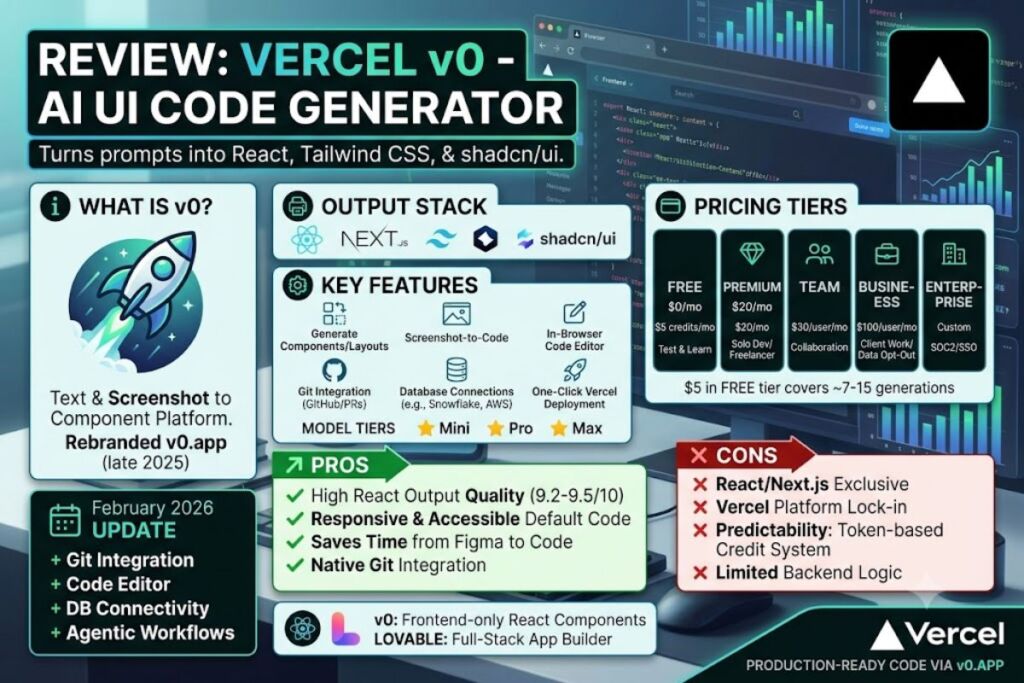
Vercel’s v0 converts text prompts and screenshots into production-ready React components built with Tailwind CSS and shadcn/ui. v0 generates frontend code only, deploys directly to Vercel, and costs $0 to $100 per month depending on tier. This review covers every feature, pricing tier, and limitation based on direct testing inside the v0.app workspace.
What Is v0?
v0 is Vercel’s AI code-generation platform that turns natural-language prompts into React components styled with Tailwind CSS and shadcn/ui. Vercel released v0 in 2023 as a text-to-component experiment and rebranded it from v0.dev to v0.app in late 2025. The February 2026 update added Git integration, a VS Code-style code editor, database connectivity, and agentic multi-step workflows.
v0 runs entirely in the browser. A developer types a description — “build a pricing page with three tiers and a toggle for monthly/annual billing” — and v0 returns working React code alongside a live, interactive preview. shadcn/ui is an open-source component library built on Radix UI primitives; v0 uses it as the default design system for every generation, which keeps output consistent and themeable across projects.
| Attribute | Value |
|---|---|
| Company | Vercel |
| Release Year | 2023 (major rebuild: February 2026) |
| Pricing | Free, $20/mo, $30/user/mo, $100/user/mo, Custom |
| Platforms | Web browser (v0.app), API access via Vercel |
| Output Stack | React, Next.js, Tailwind CSS, shadcn/ui |
| Key Feature | Screenshot-to-code generation with live preview |
| Model Tiers | v0 Mini, v0 Pro, v0 Max |
What Are v0’s Key Features?
v0’s February 2026 rebuild expanded it from a component generator into a full development environment. Six capabilities define the current product.
- Generate React components and full multi-page layouts from a single text prompt, output as Next.js code using Tailwind CSS and shadcn/ui.
- Convert uploaded screenshots or Figma exports into matching React code, preserving spacing, color values, and component hierarchy.
- Edit generated code directly inside v0’s built-in VS Code-style editor without exporting to a separate IDE.
- Sync projects with GitHub through native Git integration, including branch creation, commits, and pull requests from inside the chat interface.
- Connect databases including Snowflake and AWS-hosted data sources for full-stack prototypes that go beyond static UI.
- Deploy any generated project to Vercel’s infrastructure in one click, with automatic CI/CD and preview URLs for every change.
Three model tiers — Mini, Pro, and Max — let developers trade output quality against credit cost. Mini handles simple component edits at the lowest token price; Max handles multi-file, multi-page generation and consumes more credits per request.
How Much Does v0 Cost?
v0 runs on 5 pricing tiers: Free ($0), Premium ($20/month), Team ($30/user/month), Business ($100/user/month), and Enterprise (custom). Each tier includes a monthly credit allowance, and credits meter on input and output tokens rather than fixed message counts, according to Vercel’s official pricing update.
| Plan | Price | Included Credits | Best For |
|---|---|---|---|
| Free | $0/month | $5 in monthly credits | Testing v0 before committing |
| Premium | $20/month | Expanded monthly allowance | Solo developers and freelancers |
| Team | $30/user/month | Shared team credit pool | Small teams shipping collaboratively |
| Business | $100/user/month | Higher allowance + data opt-out | Client work with sensitive data |
| Enterprise | Custom | Negotiated | SOC2, SAML SSO, audit logs |
$5 in free-tier credits covers approximately 7 to 15 generations, depending on prompt complexity and which model tier processes the request. Vercel’s hosting is separate from v0’s subscription: the Vercel Pro plan for production deployment costs an additional $20/month, a cost teams frequently overlook when budgeting for v0.
Vercel’s model API pricing lists the underlying v0 model at $3.00 per million input tokens and $15.00 per million output tokens, with a 128K-token context window, for developers who call v0 programmatically instead of through the chat interface.
What Are the Pros and Cons of v0?
v0 produces the highest-quality React output among AI UI generators but restricts full-stack development compared to dedicated app builders. Third-party benchmarking from WeavAI rates v0 at 9.5/10 for UI component quality and 9.2/10 for React/Next.js code quality, alongside a 6.8/10 score for full-stack capability.
Pros:
- Generates React code that follows accessibility standards and responsive-design conventions by default.
- Converts screenshots and Figma exports into matching code without manual translation.
- Deploys to Vercel in one click, with automatic preview URLs for every iteration.
- Includes native Git integration, removing the copy-paste step into version control.
Cons:
- Generates React and Next.js output exclusively; teams using Vue, Svelte, or Angular cannot use v0’s output directly.
- Ties deployment convenience to Vercel’s infrastructure, creating platform lock-in for teams hosting elsewhere.
- Meters usage through a token-based credit system that makes monthly costs harder to predict than flat-rate competitors.
- Handles backend logic, authentication, and database management with less depth than full-stack builders.
How Does v0 Compare to Lovable?
v0 outperforms Lovable on React code quality and Vercel-native deployment; Lovable outperforms v0 on full-stack generation including backend logic and authentication. Lovable is an AI app builder that generates complete applications with backend services included, not just frontend components.
| Category | v0 | Lovable |
|---|---|---|
| Output Stack | React, Next.js, Tailwind, shadcn/ui | Full-stack (frontend + backend) |
| Deployment | Vercel-native, one-click | Multi-host support |
| Starting Price | Free ($5 credits/mo) | Paid plans from ~$20-25/month |
| Best Fit | Frontend-only React projects | Complete MVPs with backend needs |
Read the full breakdown in Knowara’s Lovable vs Bolt.new: Which AI App Builder Wins? for a direct comparison of full-stack alternatives to v0.
Who Should Use v0?
React and Next.js developers who deploy on Vercel gain the most value from v0’s code quality and one-click deployment pipeline. Three user profiles fit v0’s current feature set.
- Solo indie developers building landing pages, dashboards, or MVPs who need production-ready React code without hiring a frontend contractor.
- Frontend-focused teams on Vercel who already deploy Next.js applications and want AI-generated components that match their existing shadcn/ui design system.
- Designers converting Figma files to code who use v0’s screenshot-to-code feature to skip manual hand-off to a development team.
Enterprise teams handling compliance requirements fit the Enterprise tier, which adds SOC2 compliance, SAML SSO, and audit logs on top of v0’s core generation engine.
What Are the Best Alternatives to v0?
Three tools compete directly with v0 for AI-assisted UI and application generation.
- Lovable generates complete full-stack applications, including backend logic and database schemas, where v0 covers frontend only. Read Knowara’s full Lovable Review: AI App Builder for Non-Coders and Developers.
- Bolt.new builds and deploys full-stack projects inside an in-browser IDE with broader framework support beyond React. See Knowara’s Bolt.new Review: In-Browser AI App Builder.
- Cursor operates as an AI-native code editor for full codebases rather than a standalone UI generator, suited to developers who need multi-file editing across an entire existing project. Compare it in Knowara’s Best AI Coding Tools in 2026.
Frequently Asked Questions
Does v0 generate backend code? No. v0 generates frontend code only — React components styled with Tailwind CSS and shadcn/ui. Developers need a separate backend service or a full-stack builder like Lovable or Bolt.new for authentication, databases, and server logic.
Do I need a Vercel account to use v0? Yes. v0 requires a Vercel account to access the chat interface, but a paid Vercel plan is not required to start on v0’s free tier.
What frameworks does v0 support? v0 outputs React and Next.js code exclusively, using Tailwind CSS for styling and shadcn/ui as the component library. Teams working in Vue, Angular, or Svelte cannot use v0’s generated code without a manual rewrite.
How many generations does the free tier include? The free tier includes $5 in monthly credits, covering approximately 7 to 15 generations depending on prompt complexity and which of the three model tiers (Mini, Pro, Max) processes the request.
v0 delivers the highest React code quality of any AI UI generator tested, and the Premium tier at $20/month is the minimum cost for serious, sustained development work.