
⏱ 8 Reading Time
- 01Quick Summary
- 02Why Apple Is Splitting the iPhone 18 Launch
- 03iPhone 18 Pro Release Date
- 04iPhone 18 Pro Price: What It Might Cost
- 05iPhone 18 Pro Specs and Features
- 06Design and Colors
- 07Display
- 08Camera
- 09Chip and Performance
- 10Modem and Connectivity
- 11Battery
- 12iPhone 18 Pro vs iPhone 17 Pro: What’s Actually Changing
- 13Frequently Asked Questions
Apple’s next flagship lineup is edging closer, and the rumor mill has been unusually active this year. Unlike previous cycles, the iPhone 18 series is expected to arrive in two separate waves rather than one big September reveal a shift that changes how, when, and what you should expect to buy. Below is a complete breakdown of everything currently known (and rumored) about the iPhone 18 Pro, iPhone 18 Pro Max, and Apple’s first foldable device, drawing on recent reporting from MacRumors, Forbes, and PCMag.
Quick Summary
- Expected announcement: Early-to-mid September 2026, possibly September 9
- What’s launching: iPhone 18 Pro, iPhone 18 Pro Max, and Apple’s first foldable iPhone (rumored name: iPhone Ultra)
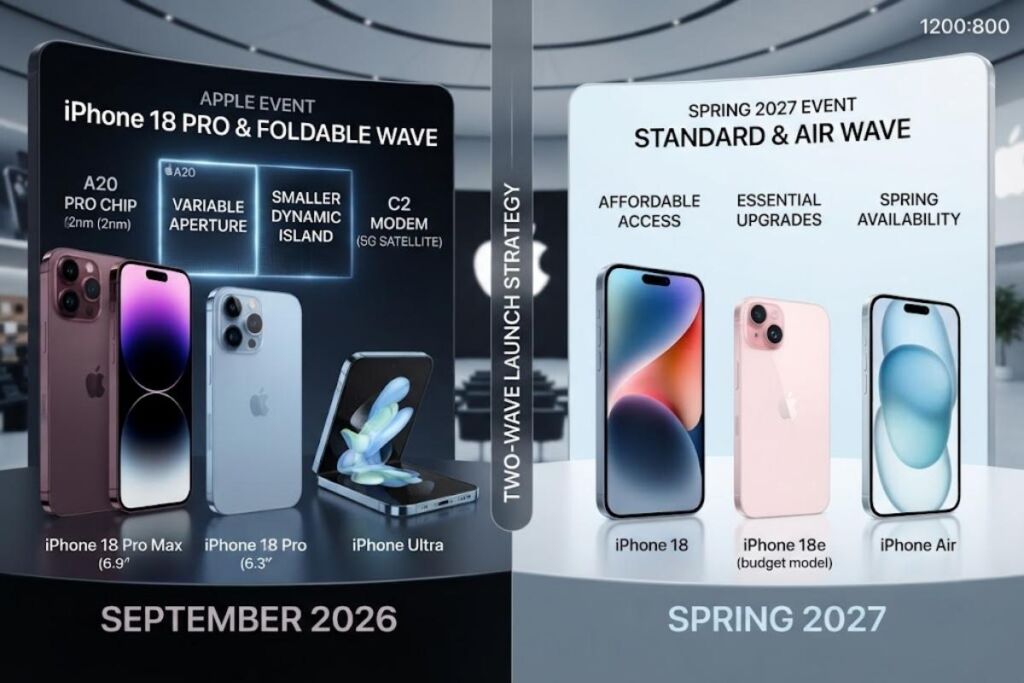
- What’s not launching this fall: The standard iPhone 18, iPhone 18e, and second-generation iPhone Air — these are expected in spring 2027 instead
- Starting price estimate: Around $1,299 for the Pro, possibly $1,399 for the Pro Max
- Biggest upgrades: A20 Pro chip on a 2nm process, a smaller Dynamic Island, variable-aperture main camera, and a new C2 modem with 5G satellite support
Why Apple Is Splitting the iPhone 18 Launch
For years, Apple released its entire iPhone lineup in one September event. That pattern is expected to change this cycle. Instead of unveiling four or more phones simultaneously, Apple is reportedly organizing its 2026-2027 lineup into two separate launch windows, according to Forbes.
The September 2026 event is expected to focus on premium hardware only: the iPhone 18 Pro, iPhone 18 Pro Max, and the company’s first-ever foldable phone. The standard iPhone 18, the budget-friendly iPhone 18e, and a second-generation iPhone Air would then follow around March 2027.
There appear to be a few practical reasons behind this restructuring. With a foldable device joining the lineup, Apple would otherwise be introducing as many as six new iPhones in a single year an unusually crowded slate that risks diluting attention away from the foldable, which is meant to be the headline product. Spacing the releases out also gives the foldable room to be the centerpiece of the fall keynote rather than competing for coverage with several other new models.
There’s a consumer-facing benefit too. Under the old system, anyone whose carrier contract ended early in the year, or who received an iPhone as a holiday gift, had to wait around nine months for the next new model. A spring release means a fresh set of options becomes available much sooner. Pushing the standard and budget models to 2027 may also give Apple more breathing room on component costs, which have been rising industry-wide.
iPhone 18 Pro Release Date
Apple hasn’t confirmed a date, but based on historical launch patterns and recent reporting, the fall 2026 keynote is widely expected in the first half of September with September 9 circulating as the most-cited estimate, since Labor Day falls on September 7 this year. Pre-orders would typically open a few days after the announcement, with retail availability following about a week later, consistent with Apple’s usual September rollout cadence.
iPhone 18 Pro Price: What It Might Cost
Apple hasn’t raised iPhone prices in recent cycles, even as it increased prices on several other product lines earlier this year. However, industry analysts have pointed to rising RAM and storage costs as a pressure point that could finally push iPhone Pro pricing upward.
Based on component-cost analysis reported by PCMag, estimates suggest the iPhone 18 Pro could start around $1,299, up from the iPhone 17 Pro’s $1,099 starting price. Following Apple’s usual $100 price gap between Pro and Pro Max models, the iPhone 18 Pro Max could start closer to $1,399, compared to the iPhone 17 Pro Max’s current $1,199 starting price. These figures remain unofficial and should be treated as informed estimates rather than confirmed pricing.
iPhone 18 Pro Specs and Features
Most of the hardware details below come from a recent MacRumors round-up of 12 rumored features, cross-checked against separate leaks compiled by PCMag.
Design and Colors
Don’t expect a dramatic redesign. The iPhone 17 Pro already introduced a significant overhaul including the raised camera “plateau” and a two-tone finish so the iPhone 18 Pro is expected to largely carry that design forward.
Color options are where things could get more interesting. Multiple leakers point to a new Dark Cherry (a deep red) shade and a Light Blue option joining the lineup, while the current Cosmic Orange and Deep Blue finishes are expected to be retired. The rear Ceramic Shield panel around the MagSafe area is also rumored to get a more frosted, seamless look compared to the current two-tone rear.
On the Pro Max specifically, some reports suggest a slightly thicker and heavier build roughly a quarter-millimeter thicker and about 7 grams heavier — likely tied to a larger battery.
Display
Screen sizes are expected to hold steady at 6.3 inches for the Pro and 6.9 inches for the Pro Max. The more notable change is under the hood: Apple is reportedly moving to LTPO+ display technology, which should improve power efficiency and, by extension, battery life.
The front-facing change generating the most buzz is a smaller Dynamic Island. Reports suggest Apple could shrink the cutout by roughly a third by relocating the Face ID flood illuminator beneath the display panel itself, rather than housing it within the cutout.
Camera
The main 48-megapixel Fusion camera is rumored to gain a variable aperture a first for the iPhone. This would let the camera physically adjust how much light reaches the sensor, offering more control over exposure in bright conditions and better low-light performance without relying solely on software processing. Reports indicate this hardware has already entered production.
Apple is also expected to simplify the Camera Control button introduced on the iPhone 16 and 17 lines, dropping touch sensitivity and haptic feedback in favor of a simpler, pressure-only mechanism.
Chip and Performance
The headline upgrade is the A20 Pro chip, Apple’s first built on TSMC’s second-generation 2-nanometer process (moving up from the 3nm process used in the A19 Pro). The smaller process node should allow for more transistors and better power efficiency, though it’s also expected to raise Apple’s per-chip manufacturing costs significantly.
Some reports suggest the A20 may also use a new wafer-level packaging approach that integrates memory more closely with the processor, potentially improving speed and efficiency further. There’s also chatter that Apple could equip the entire iPhone 18 Pro lineup with the same high-end chip variant, rather than reserving small differences between models.
Alongside the A20 Pro, a new N2 chip is expected to handle Wi-Fi 7, Bluetooth 6, and Thread connectivity, following on from the N1 chip introduced in the iPhone 17 generation.
Modem and Connectivity
The iPhone 17 Pro used a third-party modem, but the iPhone 18 Pro is expected to switch to Apple’s own third-generation C2 modem, continuing the shift toward in-house cellular hardware that began with the C1 modem. The C2 is rumored to bring 5G connectivity via satellite, enabling basic web browsing even without Wi-Fi or traditional cellular signal a meaningful upgrade for users in areas with limited coverage.
Battery
Exact battery capacities are never confirmed by Apple ahead of launch, but leaked regulatory filings suggest the iPhone 18 Pro Max could see close to a 10% capacity increase over the iPhone 17 Pro Max, landing somewhere around 5,200mAh. The standard iPhone 18 Pro is expected to see a much smaller bump, moving only marginally higher than its predecessor. Combined with a more efficient chip, modem, and display, real-world battery life could improve more than the raw capacity numbers suggest.
iPhone 18 Pro vs iPhone 17 Pro: What’s Actually Changing
| Feature | iPhone 17 Pro (Current) | iPhone 18 Pro (Rumored) |
|---|---|---|
| Chip | A19 Pro (3nm) | A20 Pro (2nm) |
| Modem | Third-party | Apple C2, with 5G satellite |
| Dynamic Island | Standard size | Up to ~35% smaller |
| Display tech | Standard LTPO | LTPO+ |
| Main camera aperture | Fixed | Variable |
| Camera Control | Touch + haptic | Pressure-only |
| Colors | Cosmic Orange, Deep Blue, etc. | Dark Cherry, Light Blue (rumored) |
| Starting price | $1,099 | ~$1,299 (estimated) |
Frequently Asked Questions
Is the iPhone 18 launching this year?
No — only the iPhone 18 Pro, iPhone 18 Pro Max, and Apple’s first foldable are expected in September 2026. The standard iPhone 18, iPhone 18e, and second-generation iPhone Air are rumored to arrive around spring 2027 instead.
When will the iPhone 18 Pro be announced?
No official date has been confirmed, but current estimates point to the first half of September 2026, with September 9 frequently mentioned as the likely date.
Will the iPhone 18 Pro get more expensive?
Possibly. Estimates based on rising component costs suggest a starting price around $1,299 for the Pro and $1,399 for the Pro Max, though Apple has not confirmed any pricing.
What is the biggest camera upgrade on the iPhone 18 Pro?
The most talked-about change is a variable aperture on the main camera, which would let the lens physically adjust how much light it lets in a first for any iPhone.
Should I wait for the iPhone 18 Pro or buy an iPhone 17 Pro now?
If your priority is the newest chip, a smaller Dynamic Island, and satellite connectivity, waiting until September makes sense. If you need a phone immediately and don’t need the latest camera or chip improvements, the iPhone 17 Pro remains a strong option, especially if prices rise with the new generation.