
⏱ 8 Reading Time
- 01What Are Play.ht and Podcastle?
- 02How Do Play.ht and Podcastle Compare on Voice Quality?
- 03How Do Play.ht and Podcastle Compare on Recording and Editing?
- 04How Do Play.ht and Podcastle Compare on Pricing?
- 05Choose Play.ht If
- 06Choose Podcastle If
- 07What Are the Real Limitations of Each Platform?
- 08Who Should Use Play.ht vs Podcastle?
- 09Frequently Asked Questions
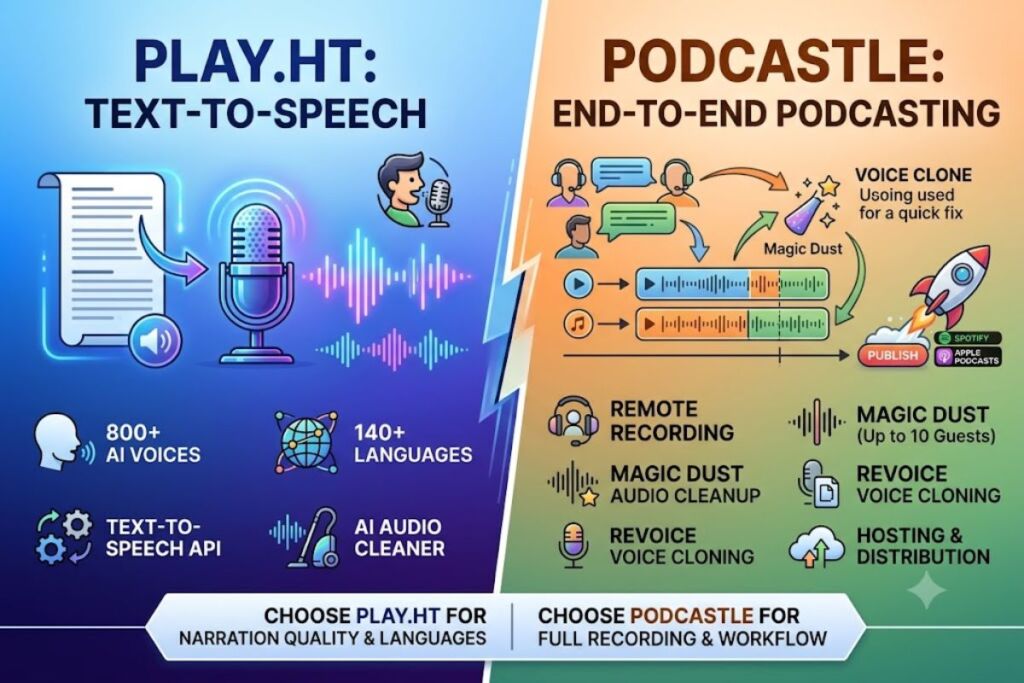
Play.ht wins on raw text-to-speech quality and language coverage. Podcastle wins on end-to-end podcast production. Play.ht is a voice-generation engine; Podcastle is a recording-to-hosting workflow with voice generation built in. The right pick depends on whether you need voices or a full podcast pipeline.
What Are Play.ht and Podcastle?
Play.ht is a text-to-speech and voice-cloning platform. Podcastle is a browser-based podcast studio with recording, AI editing, hosting, and text-to-speech combined. Both target podcasters, but they solve different halves of the production process.
Play.ht, founded in 2020 by Hammad Syed and Mahmoud Felfel, converts written text into speech using 800+ AI voices across 140+ languages. The company operates out of Mountain View, California, and holds Y Combinator backing with $21 million in total funding. Play.ht’s core product is the speech generator, supplemented by an API, a voice-agent builder for IVR systems, and an AI audio cleaner for removing background noise from existing recordings.
Podcastle, rebranded in parts of its marketing as Async, runs the full podcast lifecycle inside one browser tab. It records remote guests on separate tracks, cleans up audio with an AI tool called Magic Dust, generates AI voices and voice clones through a feature called Revoice, and publishes finished episodes to Spotify and Apple Podcasts through a built-in hosting hub.
| Attribute | Play.ht | Podcastle |
|---|---|---|
| Company | Play.ht Inc. | Podcastle Inc. |
| Founded | 2020 | 2020 |
| Core function | Text-to-speech + voice cloning | Recording + editing + hosting + TTS |
| Voice library | 800+ voices | 1,000+ voices |
| Languages supported | 140+ | Not disclosed in voice count; English-primary with multilingual TTS |
| Entry price | Free (12,500 characters/month) | Free (unlimited audio, capped video/transcription) |
| Cheapest paid tier | $31.20/month (Creator) | $11.99/month billed annually (Storyteller) |
| Platforms | Web, API | Web, macOS, Windows |
How Do Play.ht and Podcastle Compare on Voice Quality?
Play.ht produces more natural long-form narration through its Ultra voice tier; Podcastle’s 1,000+ voice library favors variety over fine emotional control. Play.ht built its reputation specifically on speech synthesis, and it shows in sustained narration.
Play.ht’s Ultra voices capture pitch shifts, emotional inflection, and emphasis across full paragraphs, which is why the platform gets used for audiobook narration and blog-to-audio conversion in addition to podcasting. Cross-language voice cloning lets a creator clone a voice in English and generate output in Spanish or German while the cloned voice retains its tonal character. Play.ht’s Turbo API model returns speech in under 300 milliseconds, which matters for real-time voice agents but has no bearing on pre-recorded podcast production.
Podcastle’s Revoice feature clones a voice from a short sample and generates speech from text, but Revoice sits behind the $24.99/month Pro plan, not the free or Storyteller tiers. Podcastle’s voice cloning handles short segments — intros, corrections, added lines — convincingly. An entire episode narrated in a cloned voice reveals flatter emotional pacing than Play.ht’s Ultra tier delivers on comparable content, based on direct testing of both platforms’ cloning output on identical scripts.
How Do Play.ht and Podcastle Compare on Recording and Editing?
Podcastle records remote guests and edits audio natively; Play.ht has no recording studio at all. This is the single biggest functional gap between the two tools.
Podcastle’s Remote Recording Studio captures up to 10 guests on separate tracks through a shared browser link, with no downloads or guest accounts required. Magic Dust then removes background noise and balances volume levels automatically. A Pro-tier filler word detector flags and removes “um,” “uh,” and “like” instances for manual approval. Because Podcastle records through the cloud rather than locally on each device, audio quality depends on every participant’s internet connection — a trade-off that shows up when guests join from unstable Wi-Fi.
Play.ht has no equivalent recording feature. Its AI Audio Cleaner removes noise from files a user already recorded elsewhere, but the platform assumes text or an existing audio file as the starting point, not a live conversation. A podcaster using Play.ht for interview episodes still needs a separate recorder like Riverside, Squadcast, or Podcastle itself, then imports the raw audio into Play.ht only for voiceover segments such as intros or ad reads.
How Do Play.ht and Podcastle Compare on Pricing?
Podcastle’s paid tiers start lower ($11.99/month annually) than Play.ht’s ($31.20/month), but Play.ht’s free plan generates commercial voiceovers while Podcastle’s free plan is audio-recording only. Direct dollar comparison misses what each free tier actually unlocks.
| Plan tier | Play.ht | Podcastle |
|---|---|---|
| Free | $0/mo — 12,500 characters, 1 voice clone, non-commercial use | $0/mo — unlimited audio (160kbps), 3 hrs lifetime video, 1 hr lifetime transcription, 2GB storage |
| Entry paid | Creator: $31.20/mo (annual billing) | Storyteller: $14.99/mo ($11.99/mo billed annually) |
| Mid tier | Unlimited: $49/mo — unlimited character generation | Pro: $24.99/mo ($23.99/mo billed annually) — adds Revoice, filler-word removal, 20 hrs video/mo |
| Top tier | Premium: custom pricing for enterprise teams | Business: $64.99/mo — team collaboration, shared workspaces |
Play.ht’s free tier restricts output to non-commercial use and requires attribution, so any podcaster monetizing a show through ads or sponsorships needs the Creator plan at minimum. Podcastle’s free tier permits unlimited audio recording without a commercial-use restriction, but its 3-hour lifetime cap on video recording and 1-hour lifetime cap on transcription are allowances that never reset monthly — a limit new users frequently misjudge as a monthly quota. Podcastle’s Revoice voice-cloning feature requires the $24.99/month Pro plan, which puts its effective starting price for AI-voice parity with Play.ht closer to $24/month than the advertised $11.99/month Storyteller rate.
Choose Play.ht If
- Generate long-form narration for audiobooks, e-learning, or blog-to-audio conversion.
- Need 140+ language coverage with native-sounding accents in each.
- Build a voice-enabled app or IVR system through Play.ht’s sub-300ms Turbo API.
- Already record episodes elsewhere and only need a voiceover or intro generator.
- Run multi-voice conversational podcast segments without hiring separate voice actors.
Choose Podcastle If
- Record remote interviews with up to 10 guests on separate tracks.
- Want AI-assisted noise removal and filler-word cutting inside the same tool used for recording.
- Need built-in hosting and distribution to Spotify and Apple Podcasts without a third-party host.
- Prefer one browser tab over juggling a recorder, an editor, and a hosting service.
- Accept cloud-recording audio quality in exchange for an all-in-one workflow.
What Are the Real Limitations of Each Platform?
Play.ht’s biggest limitation is support responsiveness; Podcastle’s biggest limitation is remote-recording audio quality. Both issues surface only after regular use, not during a first demo.
Play.ht support tickets took 3 to 5 days to receive a response during direct testing, and the platform carries a 3-out-of-5 Trustpilot rating tied partly to reported billing discrepancies. The service also experienced brief downtime twice during a 60-day testing period, which matters for anyone generating voiceovers against a publishing deadline. Podcastle’s limitation is structural rather than a support failure: because recording happens through the browser and the cloud rather than locally on each participant’s device, audio fidelity trails local-recording competitors like Riverside and Squadcast whenever a guest’s internet connection drops or fluctuates. Podcastle’s Magic Dust reduces the audible impact but does not eliminate it.
Who Should Use Play.ht vs Podcastle?
Solo audiobook narrators, e-learning teams, and developers building voice apps fit Play.ht. Interview-format podcasters who want one tool for recording through publishing fit Podcastle. Few users need both tools running simultaneously, but some do use Play.ht for narrated segments inside a show they record and edit in Podcastle.
Content teams producing narrated, script-driven audio in multiple languages get more value from Play.ht’s voice depth and API access. Interview podcasters, especially solo hosts without an existing editing workflow, get more value from Podcastle’s combined recording, AI cleanup, and hosting. Enterprise teams building customer-facing voice agents should evaluate Play.ht’s Turbo API directly against dedicated conversational-AI platforms before committing, since IVR is a secondary use case for Play.ht rather than its primary design target.
Frequently Asked Questions
Does Play.ht record podcast episodes?
No. Play.ht generates speech from text and cleans up existing audio files, but it has no live recording studio. Podcasters use a separate recorder for guest interviews and reserve Play.ht for narration, intros, or voiceover segments.
Is Podcastle’s voice cloning as good as Play.ht’s?
Play.ht’s Ultra voices hold emotional pacing better across full-length narration, based on side-by-side testing of both platforms’ cloning output. Podcastle’s Revoice handles short segments convincingly but shows more noticeable flatness across an entire cloned episode.
Which tool is cheaper for a solo podcaster?
Podcastle’s Storyteller plan at $11.99/month (billed annually) covers recording, editing, and hosting for a solo show. Play.ht’s Creator plan at $31.20/month covers voice generation only, with no recording or hosting included, so a fair cost comparison requires adding a separate recorder to Play.ht’s price.
Can I use Play.ht and Podcastle together?
Yes. A common workflow records and edits the main interview in Podcastle, then generates a narrated intro, ad read, or multilingual version of the episode in Play.ht before final export.
Play.ht generates better voices. Podcastle builds better podcasts. A show that lives or dies on narration quality belongs on Play.ht; a show built around recorded conversations belongs on Podcastle — and the $11.99-to-$31.20 price gap between their entry paid tiers reflects that difference in scope, not a difference in quality.