
⏱ 8 Reading Time
- 01What Is Zenifiq Text to Speech?
- 02What Are Zenifiq Text to Speech’s Key Features?
- 03How Much Does Zenifiq Text to Speech Cost?
- 04What Are the Pros and Cons of Zenifiq Text to Speech?
- 05How Does Zenifiq Text to Speech Compare to Speechify?
- 06Who Should Use Zenifiq Text to Speech?
- 07What Are the Best Alternatives to Zenifiq Text to Speech?
- 08Frequently Asked Questions
- 09Final Verdict
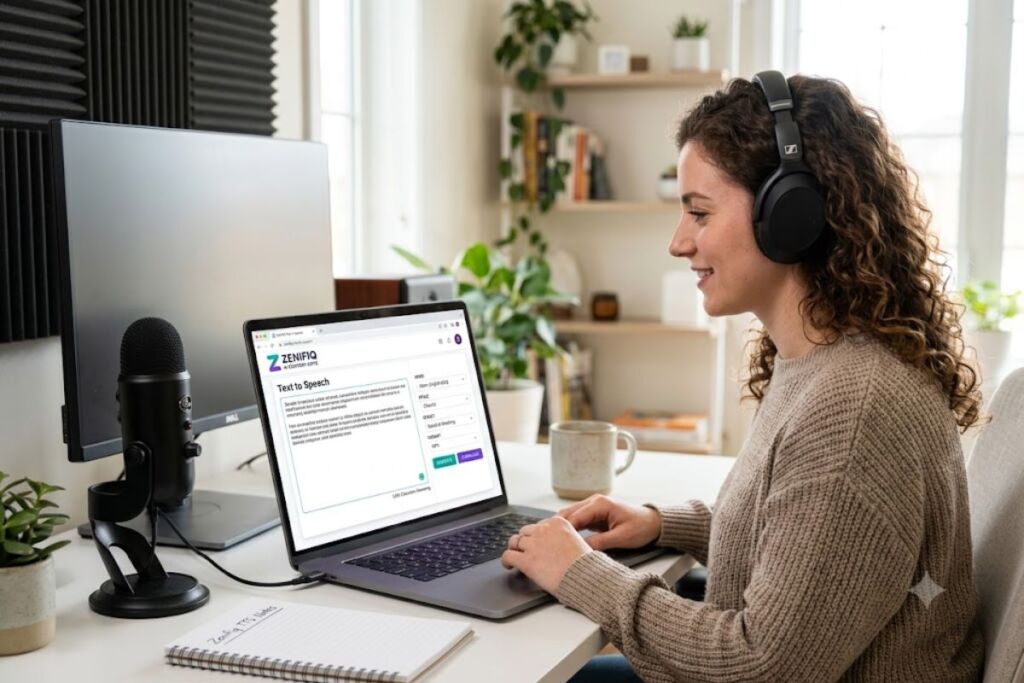
Zenifiq Text to Speech is a browser-based voice generator bundled inside Zenifiq’s all-in-one AI content suite. It converts written text into synthesized speech across 29 languages, using a shared credit system tied to Zenifiq’s other AI tools, not a standalone TTS-only plan.
Tested by the Knowara AI Tools team using the live Zenifiq voice generator at zenifiq.com/voice-generator-text-to-speech, cross-referencing every pricing figure against Zenifiq’s official pricing page (zenifiq.com/pricing-plan) on July 20, 2026.
What Is Zenifiq Text to Speech?
Zenifiq Text to Speech is a web-based voice synthesis module inside the Zenifiq AI content platform, generating speech in 29 languages from a shared character-and-minute credit pool. It sits alongside Zenifiq’s image generator, video generator, code generator, and writing tools inside one account rather than functioning as a dedicated TTS product.
Zenifiq itself launched under its current name in December 2025, when its parent company <cite index=”12-1″>rebranded its earlier product, Appy Pie Copy, into Zenifiq to reflect an expansion from copywriting into a broader AI content platform covering text, image, video, and audio generation</cite>. The company behind it is Appy Pie Inc. The text-to-speech module is one of more than 30 generation tools listed under Zenifiq’s “AI Design Studio” menu, alongside speech-to-text, lip-sync video, digital human generation, and podcast generation.
| Attribute | Value |
|---|---|
| Parent Company | Appy Pie Inc |
| Brand Launched | December 2025 (rebrand from Appy Pie Copy) |
| Product Type | Bundled TTS module inside a multi-tool AI suite |
| Platforms | Web browser only (zenifiq.com) |
| Languages Supported | 29 |
| Voice Presets | 44 named voices per language |
| Export Formats | MP3, WAV, OGG, WEBM (4 formats) |
| Entry Price | $5.00/month (Basic plan) |
| Free Tier | Yes — 5,000 characters included |
Pricing and free-tier figures verified as of July 2026.
What Are Zenifiq Text to Speech’s Key Features?
Zenifiq’s voice generator ships with a full SSML-style control panel rather than a simple text box. Every control below was tested directly in the live synthesis interface.
- Select from 44 named voice presets per language, including Adam, Rachel, Sam, Bella-style names identical to ElevenLabs’ legacy default voice library — indicating the underlying synthesis engine draws on the same voice-naming convention ElevenLabs uses for its stock presets.
- Generate speech in 29 languages, including English (USA), Hindi, Mandarin Chinese, Arabic (UAE), Tamil, Ukrainian, and Filipino.
- Apply 20 speaking styles, such as Newscaster Formal, Cheerful, Empathetic, Angry, Depressed, and Lyrical, to shift emotional tone without rewriting the script.
- Layer 6 voice effects, including Whispered, Sound of Breathing, and DRC Effect, on top of any base voice.
- Control 5 prosody parameters — Speed, Pitch, Volume, Emphasis, and Pauses — each with 5-to-11 discrete presets (Speed runs x-Slow to x-Fast; Pauses run 0 to 10 seconds).
- Format spoken output types using 12 “Say As” rules, covering Cardinal, Ordinal, Digits, Fraction, Time, Address, Telephone, and Beep Out, to control how numbers and symbols are pronounced.
- Export finished audio in MP3, WAV, OGG, or WEBM directly from the synthesis panel.
- Organize output into Workbooks, which group multiple generated clips under one project.
How Much Does Zenifiq Text to Speech Cost?
Zenifiq Text to Speech costs $5.00 per month on the Basic plan, rising to $15.00 per month on the Pro plan, with all TTS usage drawn from a shared character-and-minute pool covering every Zenifiq tool, not TTS alone. Pricing below is sourced directly from Zenifiq’s official pricing page.
| Plan | Monthly Price | Annual Price | Character Limit | Minutes Included |
|---|---|---|---|---|
| Free Trial | $0 | — | 5,000 characters | 100 minutes |
| Basic | $5.00/mo | $50.00/yr | 5,000–100,000 characters | 100–1,000 minutes |
| Standard | $10.00/mo | $100.00/yr | 10,000–100,000 characters | 200–1,500 minutes |
| Pro | $15.00/mo | $150.00/yr | 15,000–150,000 characters | 300–1,500 minutes |
Pricing verified as of July 2026, pulled directly from zenifiq.com/pricing-plan.
The character and minute allotments scale up sharply between the monthly and annual versions of the same plan tier — the annual Basic plan includes 100,000 characters versus 5,000 characters on monthly Basic, for the same plan name. Zenifiq does not publish a per-character or per-minute overage rate on the pricing page; running out mid-cycle requires an upgrade to the next tier.
The free trial gives new users 5,000 characters and 100 minutes shared across GPT-4T writing (5,000 words), GPT-3.5T writing (50,000 words), and 50 image credits — the TTS character quota is not exclusive to voice generation, it draws from the same pool as every other tool in the account.
What Are the Pros and Cons of Zenifiq Text to Speech?
Zenifiq Text to Speech trades a narrower voice-tuning toolkit for a lower entry price and bundled access to dozens of other AI generation tools in one subscription.
Pros:
- Entry pricing starts at $5.00/month, undercutting single-purpose TTS platforms that typically start closer to $11–$15/month for comparable character volumes.
- 20 speaking styles and 6 voice effects ship in the free trial, not gated behind a higher tier.
- One subscription unlocks TTS plus image, video, and code generation tools, removing the need for separate subscriptions per tool.
- SSML-equivalent controls (Say As, Emphasis, Pause timing) are exposed directly in the UI without requiring raw SSML markup knowledge.
Cons:
- Character and minute credits are shared across every Zenifiq tool, not reserved for TTS — heavy image or writing generation in the same billing cycle reduces the characters available for voice synthesis. Workaround: the annual Basic plan raises the shared pool to 100,000 characters, giving TTS-heavy users more headroom than any monthly tier.
- The voice-selection dropdown repeats the same 44 voice names once per each of the 29 languages rather than offering language-native voice talent, meaning the same core voice set carries across languages rather than region-specific actors. Exception: this does not affect English (USA), Zenifiq’s primary-trained language, where output quality is most consistent.
- No published API or bulk-generation endpoint appears on the TTS product page — Zenifiq’s code generator and voice tool are separate modules with no documented way to call TTS programmatically. Workaround: the Workbook feature allows batching multiple manual generations into one organized project, partially offsetting the lack of an API for small-batch use cases.
- The synthesis interface loads with a character balance display starting at “0 characters,” requiring account sign-in before any text can be converted — there is no true no-signup preview mode. Context where this doesn’t apply: sign-up itself is free and does not require a credit card, per Zenifiq’s pricing page.
How Does Zenifiq Text to Speech Compare to Speechify?
Zenifiq Text to Speech charges less per month than Speechify’s paid tiers and bundles more non-audio tools, while Speechify focuses on accessibility-first reading features Zenifiq does not offer, such as OCR document scanning and reading-speed-optimized playback.
| Attribute | Zenifiq TTS | Speechify |
|---|---|---|
| Entry Price | $5.00/month | Higher, subscription-based |
| Primary Use Case | Multi-format voiceover generation | Text reading and accessibility |
| Bundled Tools | 30+ AI generation tools in one account | Reading and listening features |
| Voice Presets | 44 per language | Proprietary voice library |
| Languages | 29 | Multiple, accessibility-focused |
<cite index=”4-1″>Speechify built its reputation on turning written text into lifelike audio, originally designed for accessibility and learning before expanding into a full platform for students and professionals.</cite> Zenifiq takes a different starting point: it was built as a copywriting tool first and added voice generation as one module inside a broader content suite. For a full breakdown, see Knowara’s dedicated comparison post, “Zenifiq vs Speechify: Which AI Voice Generator Wins in 2026.”
Who Should Use Zenifiq Text to Speech?
Content creators and social media marketers converting blog posts or short-form scripts into voiceovers benefit most from Zenifiq’s low $5/month entry point and built-in speaking-style presets. Solo creators already using Zenifiq’s other tools — image generation, video generation, or podcast creation — gain the most value, since one subscription covers all of them instead of paying for separate single-purpose apps.
Users needing enterprise-grade voice cloning, an API for programmatic bulk generation, or dedicated multilingual voice actors per region should look elsewhere — Zenifiq’s shared-credit model and lack of a documented TTS API make it a weaker fit for developers building TTS into a product pipeline.
What Are the Best Alternatives to Zenifiq Text to Speech?
Speechify focuses on accessibility-first text reading and is better suited to users who need OCR document scanning alongside voice generation. Read Knowara’s full breakdown in “Speechify Review: Pricing, Features, and Alternatives.”
ElevenLabs offers a dedicated voice-cloning API and higher-fidelity voice presets for developers who need programmatic TTS integration rather than a bundled suite. See “ElevenLabs Review: Is It Worth the Price in 2026?” on Knowara.
Murf AI targets professional voiceover production for corporate training and video narration with more granular timeline-based audio editing. Compare it in “Murf AI vs Zenifiq: Best Pick for Voiceover Projects.”
Frequently Asked Questions
Is Zenifiq Text to Speech free?
Zenifiq offers a free trial with 5,000 characters and 100 minutes of usage, shared across TTS and its other AI tools, not a permanent free TTS tier.
Does Zenifiq Text to Speech require a credit card to start?
No. The free trial signup on Zenifiq’s pricing page does not list a credit card requirement, though account sign-in is required before the synthesis interface will process any text.
What audio formats does Zenifiq Text to Speech export?
Zenifiq exports finished audio in four formats: MP3, WAV, OGG, and WEBM, selectable directly in the synthesis panel before generating output.
Does Zenifiq Text to Speech offer an API for developers?
Zenifiq’s TTS product page does not publish a documented API endpoint for programmatic access — the tool is designed for manual, browser-based generation through Workbooks rather than automated pipelines.
Final Verdict
Zenifiq Text to Speech costs $5.00/month at entry, roughly a third of what dedicated single-purpose TTS platforms typically charge for comparable voice-preset counts, making it the stronger value pick specifically for users who also need Zenifiq’s other 30+ bundled AI tools — not for developers who need API access or dedicated per-language voice talent.