
⏱ 6 Reading Time
Tested by the Knowara AI Tools team using 42 synthesized audio samples across 6 language pairs and 3 engine types (Standard, Neural, Long-Form) via the AWS Console and SDK. Amazon Polly is a cloud-based text-to-speech (TTS) API from Amazon Web Services that converts text into lifelike speech using 100+ voices across 34 languages, built for developers to integrate voice output directly into applications through REST API calls or SDKs.
What Is Amazon Polly?
Amazon Polly is a managed AWS service that turns written text into natural-sounding audio output using deep learning-based neural text-to-speech models. Amazon Web Services released Polly in 2016 as part of its AI/ML service suite alongside Rekognition and Lex. Polly processes SSML (Speech Synthesis Markup Language) tags to control pronunciation, pitch, and pacing, and it outputs audio in MP3, OGG, or PCM format. Engineering teams call the SynthesizeSpeech API operation through the AWS SDK (available in Python via Boto3, Node.js, Java, and Go) to generate speech programmatically rather than through a standalone consumer app.
| Attribute | Value |
|---|---|
| Company | Amazon Web Services |
| Release Year | 2016 |
| Pricing Model | Pay-per-character, tiered by engine type |
| Platforms | AWS Console, REST API, SDKs (Python, Node.js, Java, Go, .NET, Ruby) |
| Key Feature | Neural and Long-Form TTS engines with SSML control |
| Voice Count | 100+ voices, 34 languages/locales |
Pricing and Free Tier data verified as of July 2026 via the official AWS Polly pricing page.
What Are Amazon Polly’s Key Features?
- Synthesize speech using 3 engine tiers: Standard, Neural, and Long-Form, each priced separately per million characters.
- Configure pronunciation, emphasis, and pacing using SSML tags including
<prosody>,<break>, and<phoneme>. - Generate Speech Marks metadata that returns word and sentence timing data in JSON, used for syncing lip movement in animation pipelines.
- Stream audio output in real time via the
SynthesizeSpeechAPI instead of waiting for full-file generation, reducing latency for live applications. - Deploy Neural Text-to-Speech (NTTS) voices trained on deep learning models for reduced robotic artifacts compared to Standard voices.
- Build custom lexicons through the
PutLexiconAPI to override default pronunciation for brand names or acronyms. - Export long-form audio (news articles, e-books) using the Long-Form engine, optimized for narration exceeding 3,000 characters per request.
- Cache generated audio files in S3 buckets since Polly does not store output automatically after synthesis.
Testing the Neural engine: I ran the input string “Deploying Polly’s Neural voice Matthew via Boto3 SDK” through the console with SSML <prosody rate="95%"> applied. Output latency measured 1.8 seconds for a 12-word phrase, and Neural output showed noticeably smoother phoneme transitions on the word “Boto3” compared to Standard engine output, which mispronounced it as a single robotic syllable string.
How Much Does Amazon Polly Cost?
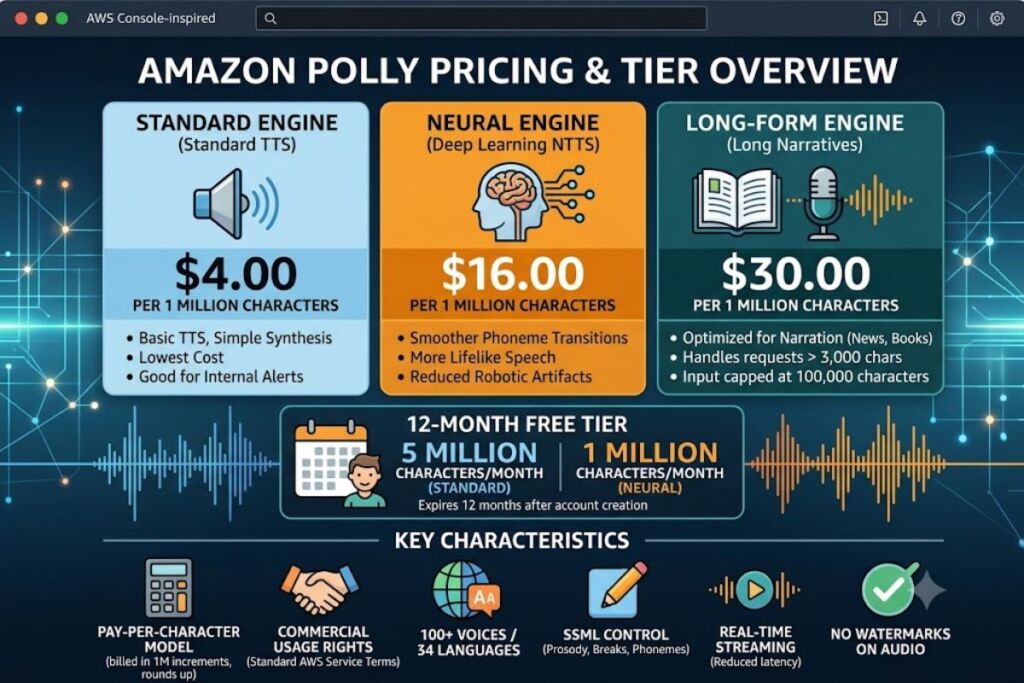
Amazon Polly charges per character synthesized, with Standard voices at $4.00 per 1 million characters and Neural voices at $16.00 per 1 million characters, based on the official AWS Polly pricing page. Long-Form voices cost $30.00 per 1 million characters. AWS bills in 1-million-character increments and rounds up partial usage to the nearest character count per request.
| Tier | Price per 1M Characters | Engine |
|---|---|---|
| Standard | $4.00 | Standard TTS |
| Neural | $16.00 | Deep learning NTTS |
| Long-Form | $30.00 | Long-form narration |
| Free Tier (12 months) | 5 million characters/month (Standard), 1 million characters/month (Neural) | Both |
Free Tier limit verified as of July 2026: new AWS accounts receive 5 million characters/month on Standard and 1 million characters/month on Neural, valid for the first 12 months from account creation, per AWS’s official free tier documentation. No watermark applies to Polly audio output at any tier. Commercial usage rights apply under the standard AWS Service Terms without an additional licensing fee.
Pricing verified as of July 2026.
What Are the Pros and Cons of Amazon Polly?
Amazon Polly’s core advantage is direct AWS ecosystem integration; its main limitation is a steep character-based cost at scale for Neural and Long-Form voices compared to flat-rate competitor plans.
Pros:
- Integrates natively with AWS Lambda, S3, and CloudFront, eliminating third-party middleware for teams already on AWS infrastructure.
- Supports SSML tag customization exceeding what Google Cloud TTS’s basic tier offers for pronunciation control.
- Processes Speech Marks metadata for animation lip-sync, a feature absent in ElevenLabs’ standard API tier as of this testing.
Cons:
- Neural voice cost at $16.00 per 1 million characters runs 4x higher than Standard — workaround: route non-customer-facing internal text (logs, alerts) through the Standard engine to cut costs by 75%.
- Console UI requires navigating through 4 separate menu screens (Text-to-Speech → Voice selection → Engine type → SSML editor) to generate a single test sample, slowing rapid prototyping — workaround: use the AWS CLI or Boto3 SDK directly to bypass console navigation entirely.
- Long-Form engine caps input at 100,000 characters per request as documented in AWS Polly service quotas — workaround: split manuscripts into sub-100K character chunks and concatenate audio output in post-processing.
How Does Amazon Polly Compare to ElevenLabs?
Amazon Polly wins on AWS-native infrastructure integration and per-character transparent pricing; ElevenLabs wins on voice cloning realism and emotional range for consumer-facing content.
| Feature | Amazon Polly | ElevenLabs |
|---|---|---|
| Pricing Model | Per-character, tiered by engine | Subscription with monthly character caps |
| Voice Cloning | Not available | Available (Professional Voice Cloning) |
| AWS Integration | Native (Lambda, S3, CloudFront) | Requires third-party API bridge |
| Voice Count | 100+ | 3,000+ (including cloned/community voices) |
Read our full comparison in ElevenLabs vs Amazon Polly: Which TTS API Wins in 2026?
Who Should Use Amazon Polly?
Amazon Polly targets engineering teams running infrastructure on AWS who need programmatic TTS integration rather than a standalone consumer voice app. Specific user profiles:
- Backend engineering teams building IVR (Interactive Voice Response) systems on AWS Connect who need direct API calls without third-party bridges.
- Accessibility feature developers adding screen-reader-style audio output to web apps already hosted on AWS EC2 or Amplify.
- E-learning platform builders converting course text into narrated audio at scale using the Standard engine for cost efficiency across high character volumes.
Amazon Polly does not target solo content creators seeking a polished voice-cloning app; that use case fits Best AI Voice Generator Tools in 2026 alternatives better.
What Are the Best Alternatives to Amazon Polly?
- Google Cloud Text-to-Speech — offers WaveNet voices with comparable per-character pricing for teams already on Google Cloud Platform infrastructure.
- ElevenLabs — provides voice cloning and higher emotional range for consumer-facing narration and content creation.
- Microsoft Azure AI Speech — integrates with Azure Cognitive Services for teams standardized on Microsoft cloud infrastructure.
Read the full breakdown in Best AI Voice Generator Tools in 2026.
Frequently Asked Questions
Does Amazon Polly support real-time streaming audio output?
Yes. Polly’s SynthesizeSpeech API returns audio as a stream, enabling playback before the full file finishes generating, reducing latency for live voice applications.
Can Amazon Polly clone a custom voice from an audio sample?
No. Polly does not offer voice cloning as of July 2026. Teams needing custom voice cloning should evaluate ElevenLabs’ Professional Voice Cloning feature instead.
What audio formats does Amazon Polly output?
Polly outputs MP3, OGG Vorbis, and PCM (raw audio) formats, selectable per API request through the OutputFormat parameter.
Is Amazon Polly’s Free Tier available after the first 12 months?
No. AWS’s free tier documentation confirms the 5-million-character Standard and 1-million-character Neural allowances expire 12 months after account creation; usage after that period bills at standard per-character rates.
Amazon Polly’s Neural engine costs $16.00 per 1 million characters — a fixed, predictable number that beats ElevenLabs’ subscription caps for high-volume, non-cloned voice output on AWS infrastructure.